
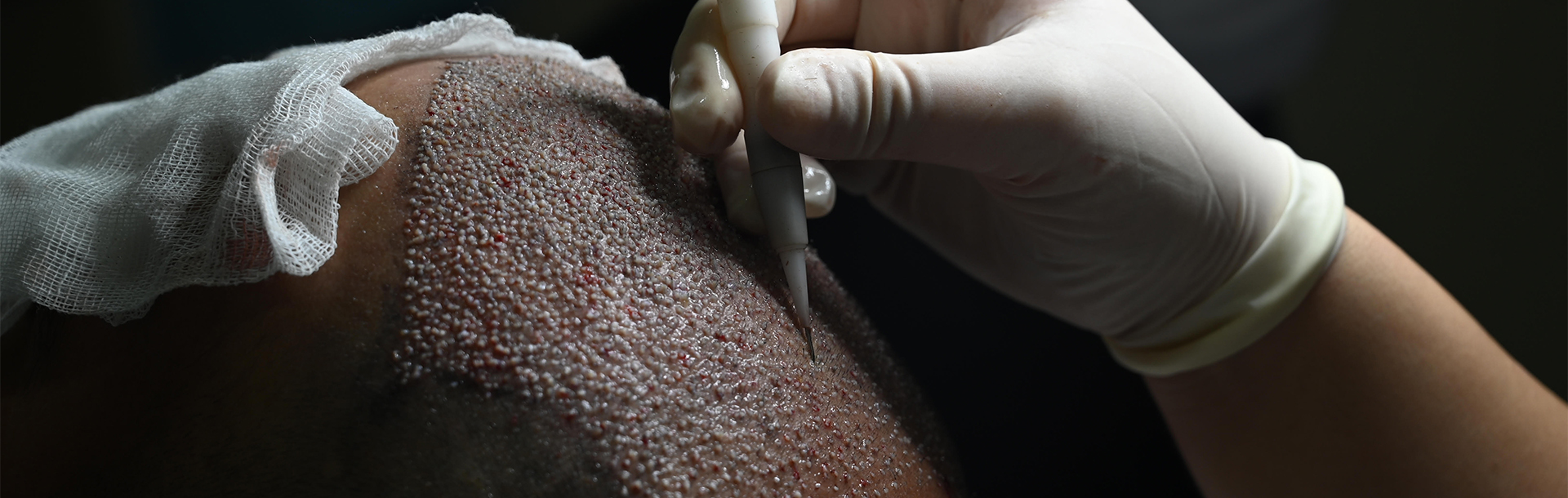
Somewhere in most families there is a photograph that explains the fear. An uncle, a neighbour, a newsreader from the eighties — hair sitting on the scalp in visible tufts, spaced out like seedlings in a tray, pale skin showing in the gaps between them. Nobody ever had to explain what had happened to that man. You could read it from across a room.
That picture is still doing an enormous amount of work forty years later. It is why people type why do hair transplants look gross into a search bar at two in the morning, and it is why a lot of men who would do well with surgery never book the consultation. The uncomfortable part of the answer is that the image in your head is accurate. It just belongs to an operation that has almost nothing in common with what happens in a modern theatre.
The short answer: Hair plugs were round grafts cut out with a 3 to 4 mm punch, each one carrying roughly 15 to 30 hairs, then set into spaced rows. They looked artificial because human scalp hair does not grow in clumps that size. A modern hair transplant moves follicular units of 1 to 4 hairs — the grouping your hair already grows in — at matched angles and in a deliberately irregular pattern. Done carefully, the result is undetectable at conversational distance. Done carelessly, it can still look wrong, which is why the clinic matters more than the technique name.
What follows is the actual history, because understanding why the old results looked the way they did is the fastest way to judge whether a result you are being shown today is any good.
What a Hair Plug Actually Was
The technique dates to the late 1950s and stayed more or less standard for three decades. A surgeon used a circular punch, usually somewhere between 3 and 4.5 millimetres across, to core out a cylinder of skin from the back of the head. That cylinder came away as a single piece: skin, fat, and the fifteen to thirty hairs growing out of it. A matching punch made a hole in the bald area at the front, and the cylinder was dropped in.
It worked, in the narrow sense. The hairs were taken from the permanent zone at the back and sides, so they kept growing after the move. The biology was sound and it is the same biology we rely on now. The problem was never survival. The problem was scale.
Because each plug was a discrete disc of tissue, it had to sit some distance from the next one, or the skin between them would lose its blood supply and break down. So the plugs went in with gaps, in rows, and the surgeon planned to come back later and fill the gaps with more plugs. Patients often stopped after the first or second session — sometimes because of cost, sometimes because they hated how it looked and could not face more. What was left was the half-finished version, which is the version everyone remembers.
Why Did Old Hair Transplants Look So Gross?
Four things stacked up, and any one of them alone would have been noticeable.
The first was clump size. Scalp hair emerges from the skin in natural groupings of one, two, three or occasionally four hairs, each group with its own tiny opening. When twenty hairs come out of one 4 mm circle of skin, the eye reads it instantly as a bristle rather than as hair. This is the effect people described as doll’s hair or a toothbrush head, and no amount of styling hid it.
The second was spacing. Rows of tufts with visible scalp between them create a pattern, and human vision is ruthlessly good at spotting pattern where nature is supposed to be random. Even at a distance, before you could see individual hairs, you saw regularity.
The third was the hairline itself. Old work put a hard, straight front edge on the head, often too low and often running in a flat line from temple to temple. Real hairlines are not lines. They are soft, uneven zones that fade in.
The fourth was the donor area. Plug harvesting left a field of round white scars across the back of the head, and later strip surgery left a long linear one. Short haircuts were off the table permanently. For a lot of men from that era, the back of the head told the story as loudly as the front did.
The Shift From Plugs to Follicular Units
The change did not arrive as a single invention. It came out of a slow argument through the late 1980s and 1990s about how small a graft could usefully be, and it was settled by the microscope.
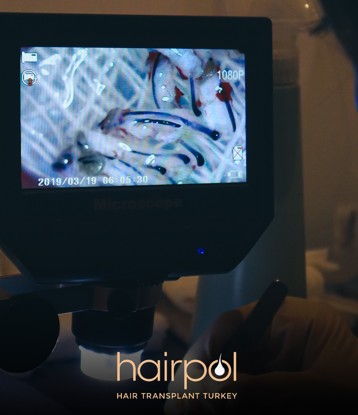
Once surgeons started dissecting donor tissue under magnification rather than by eye, they could separate that tissue into its natural units instead of cutting it into arbitrary squares. Each unit came away intact — the follicles, their sebaceous glands, the small muscle attached to them, and the sheath of tissue around the group. Placed into a matching slit rather than a punched hole, it healed almost invisibly, because the skin was no longer losing a circle of itself.
Two consequences followed, and both mattered more than the surgery textbooks predicted at the time. Grafts could be placed far closer together, because the wounds were small enough that the skin between them survived comfortably. And the front of the hairline could be built from single hairs alone, which is the only way an edge ever looks soft.
By the early 2000s the follicular unit was the standard everywhere serious work was being done. Everything since — the move from strip harvesting to individual extraction, finer punches, implanter pens, sapphire-tipped blades for making recipient sites — has been refinement inside that framework rather than a change of framework.
Where Naturalness Actually Comes From
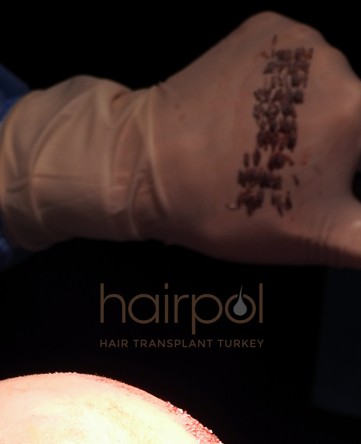
Patients tend to assume naturalness is a property of the technique, and clinics encourage the assumption because techniques are easy to advertise. It is not true. Naturalness comes from three decisions, and a surgeon can get all three wrong using the most current equipment on the market.
The first is unit size and how it is distributed. Single-hair units belong at the very front, in a zone perhaps one to two centimetres deep. Two-hair units sit behind them. Three and four-hair units go further back where density is doing the visual work and nobody is looking at individual openings. Get this gradient backwards and the hairline looks abrupt no matter how good the growth is.
The second is angle and direction, which is the subject of its own section below because it is the failure people find hardest to describe and hardest to fix.
The third is irregularity. A natural hairline is not a curve; it is a scatter. There are small peaks and recessions, isolated hairs sitting a few millimetres ahead of the main edge, tiny clusters that break up the line. A surgeon has to design that scatter deliberately, and it takes longer than drawing a smooth arc. At Hairpol, the design is drawn and agreed with you while you are sitting upright with your hair dry, because a hairline sketched on a reclined patient under bright theatre light tends to end up lower and flatter than it should be.
Why a Believable Hairline Is Slightly Untidy
Look closely at the front hairline of somebody who has never had surgery. It is a mess, in the best possible way. There is no clean boundary between hair and forehead — there is a transition zone a centimetre or so deep where fine, wispy, often lighter hairs sit at irregular intervals, some of them alone, some in twos, none of them lined up.
That zone is what surgeons call the transition or sentinel zone, and building it convincingly is the single hardest cosmetic task in the operation. It uses the finest single hairs available from the donor area, placed with visible randomness in both position and depth of the edge. A hairline built with all the same graft type at a uniform distance produces what people online call a pluggy look even when every graft is a proper follicular unit — the graft is right, the arrangement is wrong.
There is a second element people rarely notice consciously: real hairlines have small asymmetries. The two temple recessions are almost never identical. Frontal peaks sit slightly off-centre. Copying the symmetry of a computer-generated mock-up produces a face that reads as slightly artificial even when the observer cannot say why. If you want to see how this plays out in normal light and normal photographs, our piece on whether a hair transplant looks natural in real life rather than in clinic photos goes through it in detail.
Angle and Direction: The Detail You Notice Only When It Is Wrong
Hair does not come out of the scalp vertically. At the hairline it exits at a sharp forward angle, often fifteen to twenty-five degrees from the skin surface, lying almost flat and pointing forward and slightly down. Behind that it steepens gradually. At the crown it spirals. Every region of the scalp has its own grain, and that grain is why hair falls into place when you comb it.
Recipient sites have to be made at that same angle, one incision at a time, with the surgeon tracking the direction of any existing native hairs so the new growth runs with them rather than across them. Get this wrong by twenty degrees and the transplanted hair stands up. It will not lie down, it will not part, and it catches light differently from the hair around it. Patients describe it as their hair looking like it has been glued on, and they are essentially right — the hairs are healthy and growing, they are simply pointing the wrong way.
Angle errors are also the least forgiving mistake in the whole operation. Density can be added later. A low hairline can sometimes be softened. But an angle is set at the moment the site is made, and correcting it means removing the grafts and starting again in that area. This is one of the reasons careful clinics make sites slowly and why an operation that finishes suspiciously fast is worth asking about.
What People Mean by “Pluggy” in 2026
Genuine plugs are rare now. Almost nobody is punching out 4 mm cylinders and dropping them into holes. Yet people still come to consultations with recent work that reads as pluggy, and the word is doing something slightly different than it used to.
Today it usually describes one of four things. Grafts placed too far apart across too wide an area, so the scalp shows through under overhead light and the pattern of individual units becomes visible. A hairline built with multi-hair units at the front edge, which produces small tufts even though each tuft is a real follicular unit. A straight, low, symmetrical hairline that no man of that age would naturally have. Or an isolated island of transplanted hair sitting in front of a bald zone, because the plan chased the hairline without accounting for what would happen behind it in ten years.
All four are planning failures rather than technical ones. The extraction was fine, the grafts survived, the surgeon owned modern equipment. What went missing was somebody thinking about the head as a whole, at the patient’s age, over the next two decades. That is why clinic selection has become a more important variable than the choice between one technique and another, and why our page on hair transplant surgery in Turkey describes how a session is staffed and planned rather than which device is used.
Can a Modern Hair Transplant Still Look Bad?
Yes, and pretending otherwise is how patients get talked into things. The failure modes have changed rather than disappeared.
Over-large sessions are the most common problem in high-volume settings. When a clinic promises five thousand grafts in a single day, something has to give: either the grafts sit out of the body too long and graft survival drops, or the placement is rushed and the angles wander, or both. Grafts are living tissue with a limited tolerance for time outside the scalp, and that clock does not care how busy the schedule is.
The second failure is technician-led surgery. In some clinics the doctor draws the hairline, greets the patient, and leaves the extraction and placement entirely to assistants whose training you cannot verify. The result is not automatically bad — experienced technicians exist — but you are buying an outcome without knowing whose hands produce it.
The third is operating on unstable loss without a plan. A twenty-four-year-old with active thinning who receives a dense hairline and no medical treatment will look good for two years and then be left with a strip of transplanted hair in front of a bald patch. The surgery did not fail. The forecast did.
If you are looking at old work — your own, or someone else’s that you are afraid of ending up with — and you cannot tell whether the problem is the grafts or the plan, photographs settle it far faster than a phone call. You can send front, top and side shots taken in daylight through the Hairpol assessment form and get a written opinion back rather than a sales pitch.
How to Read a Result Photograph Without Being Fooled
Most of what you see in clinic marketing is technically true and practically useless. Learning to read the images is the cheapest protection available to you.
Check the lighting first. Transplant results look best under front lighting and worst under overhead light, which is exactly why so many before-and-after sets flip the direction between the two shots. A clinic confident in its work will show you the same angle, the same light and the same haircut in both frames.
Then look for wet hair. Water separates hair into strands and shows the scalp underneath, which is why a wet result photo is worth ten dry ones. Ask for it specifically. Ask for video, too — hair moving reveals the direction it grows in, and a still image cannot.
Finally, check the timeline. A result photographed at month six is showing you roughly sixty to seventy per cent of what will eventually be there, and hair at that stage is still fine and immature. A photograph labelled twelve to eighteen months is a real result. One labelled four months is a promise. Our before and after gallery is organised around this, with the month noted, because a case at eight months and a case at eighteen months are not the same evidence.
The Questions That Separate a Careful Clinic From a Fast One
You do not need surgical knowledge to run this test. You need four questions and the willingness to notice how they are answered.
- Who makes the recipient sites, and who places the grafts? A precise answer naming the surgeon and describing their role is what you want; a vague one about the team is a real answer too, just not the one you were hoping for.
- How many grafts do you think I need, and what are you leaving in reserve for later? A clinic that quotes the maximum your donor can give, with nothing held back, is not planning for your fifties.
- What does my hairline look like in fifteen years if I lose more? If nobody has raised this, the design is being drawn for today’s face only.
- What happens if the result is thin in one area at twelve months? The answer tells you whether there is a revision policy or only a payment plan.
The tone of the answers matters as much as the content. A consultation that keeps steering back to a price valid until Friday is telling you where the clinic’s attention actually sits; a clinic that is straightforward about what a hair transplant costs and what the price includes has no need for a deadline.
If You Are Already Carrying Old Plug Work
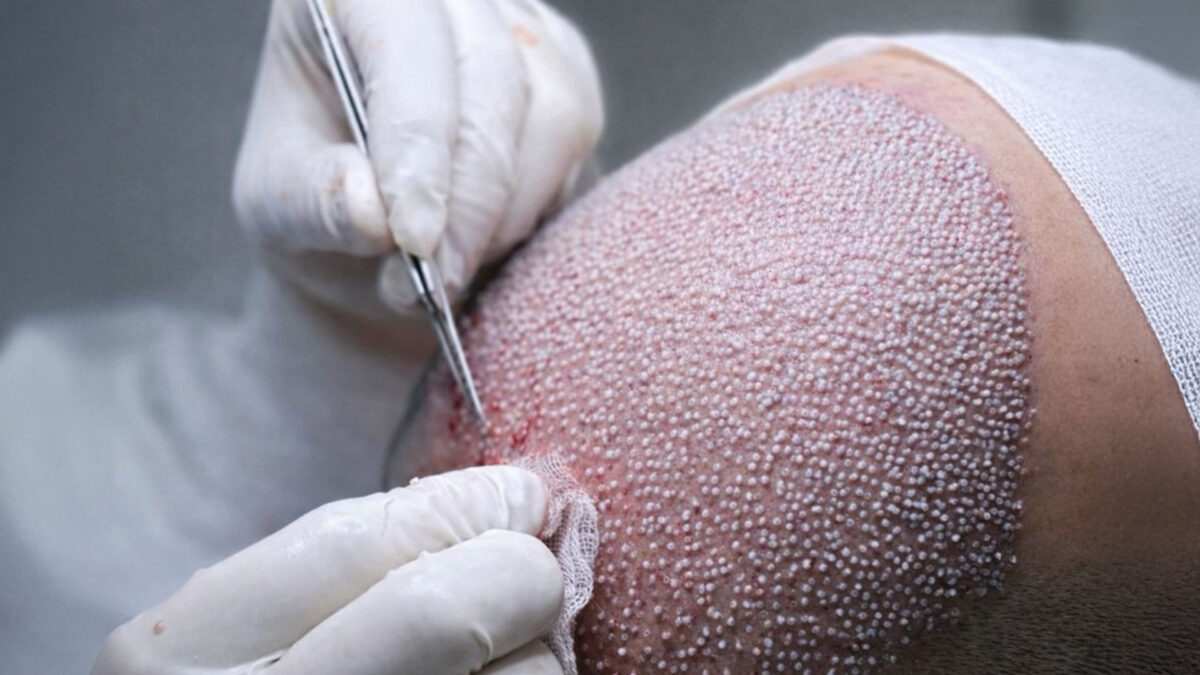
Men who had plugs in the eighties and nineties are now in their sixties and seventies, and a surprising number have spent decades combing hair forward and avoiding wind. The position is genuinely better than most of them assume, though it is rarely a single-operation fix.
Broadly, three tools exist. Large old grafts can be removed with a fine punch and the hairs within them recycled as individual units, which turns a liability into donor supply. Single-hair grafts can be planted in front of and between the old tufts to break up the pattern and soften the edge — often the change that does the most visible good for the least surgery. And where donor supply is exhausted, scalp micropigmentation can reduce the contrast between hair and skin so the remaining tufts stop announcing themselves.
Repair work is slower, more staged and more dependent on the individual head than primary surgery, and it deserves its own discussion rather than a paragraph here. We wrote that up separately in repairing an old, pluggy hair transplant and what modern revision can actually fix, including what is realistically achievable and what is not.
Chasing a Hairline You No Longer Have
There is a specific conversation that happens in consultations with men in their thirties and forties, and it is usually the most important one of the appointment. The patient brings a photograph of himself at nineteen and asks for that hairline back.
It is an understandable request and almost always the wrong one. A hairline that suited a nineteen-year-old face sits too low and too flat on a forty-year-old one, and rebuilding it consumes donor hair that will be needed further back later. It also creates the exact contrast that makes work look artificial: a dense, juvenile front edge on a head that is thinning behind it.
The design that ages well is slightly higher, with the temple recessions left open rather than filled, and with the frontal peaks kept soft. It looks more conservative on the day and looks better every year after. This is not a cost-saving exercise on the clinic’s part — it is the difference between a result that survives your fifties and one that has to be rescued in your forties. Where the front zone is being built with implanter pens in a DHI session, the same principle governs the work; our piece on why the Choi pen suits the front zone covers how that placement control is used in the transition area.
What a Modern Result Honestly Looks Like at Twelve Months
Set the expectation properly and the outcome is usually satisfying. Set it against a photograph of your teenage self and almost nothing will be.
A well-planned transplant at twelve months gives you a hairline that frames your face again, hair you can push back or part without checking a mirror first, and a front zone that survives daylight and a barber’s inspection. It does not give you the density you had before the loss started, because roughly forty to fifty grafts per square centimetre is a realistic placement figure and native hair sits at closer to eighty follicular units. The result reads as full because coverage, angle and contrast are working together, not because the count was matched.
Growth follows a predictable shape. Shedding of the transplanted hairs in the first month, a quiet stretch through months two and three that unsettles nearly everyone, first growth around months four and five, meaningful change at six, and steady thickening from eight to twelve. The crown lags the hairline by a few months. Judgement before month twelve is premature, and any clinic offering to revise at month six should be asked why.
At Hairpol, that conversation happens before anyone quotes a graft number — we would rather tell you that your donor area supports a good result at a slightly higher hairline than sell you the hairline you walked in asking for. If you want to know what is realistic for your own pattern and age, our hair transplantation department page explains how the assessment works, and a set of clear photographs is enough for our surgeons to give you a straight answer before you commit to anything.
Find this helpful? Add Hairpol as a preferred source on Google.
Get a Free Consultation
Answer a few questions and the medical team will review your situation.
