
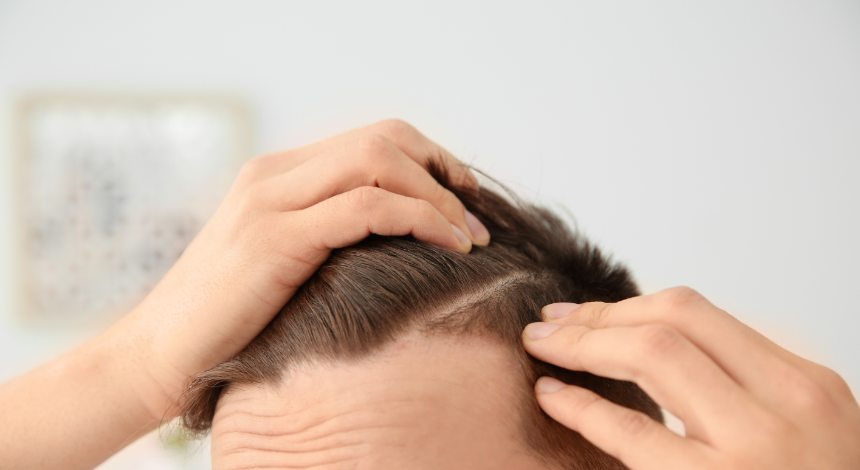
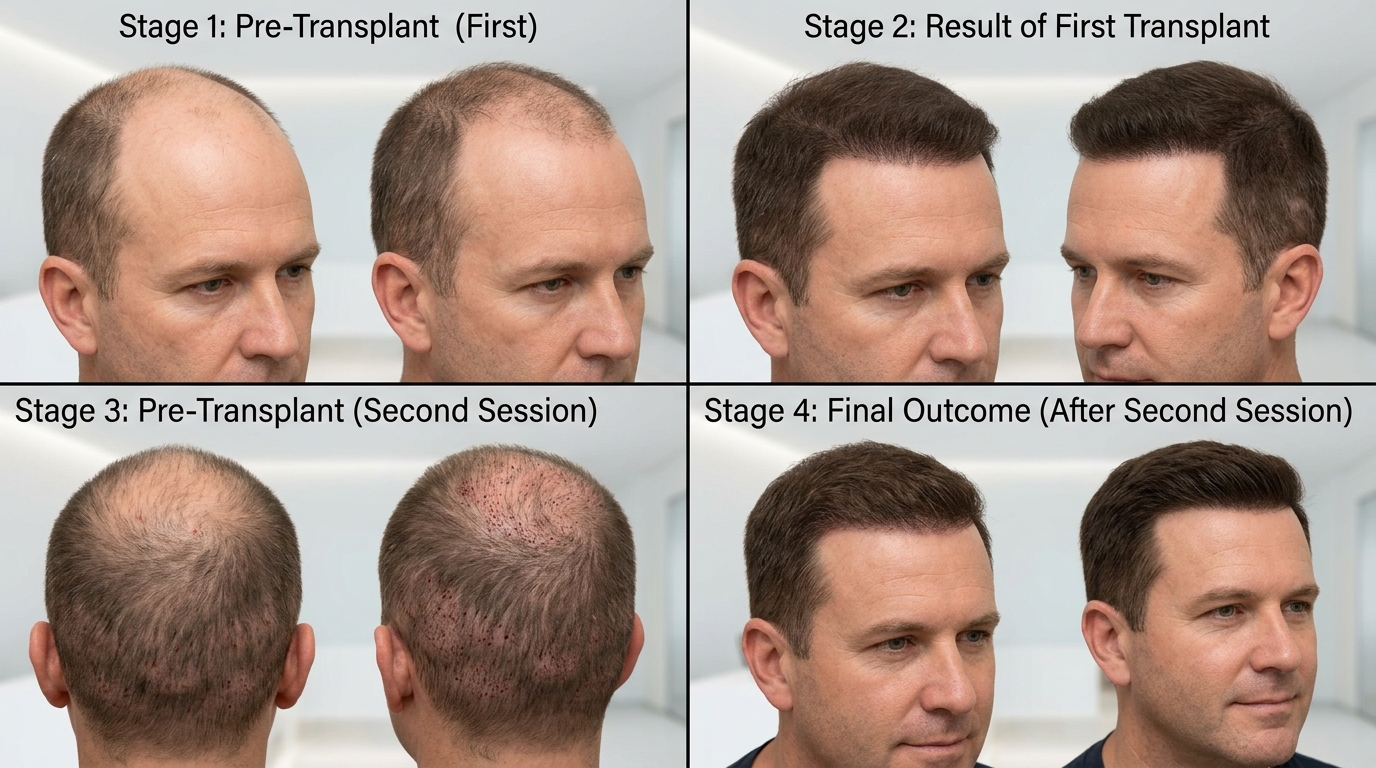
The message usually arrives somewhere around month fourteen. The photographs attached to it are good ones — the hairline sits where it was drawn, the shedding phase is a distant memory, the front no longer flashes scalp under the bathroom light. Then comes the sentence the pictures did not prepare us for: I am happy with it, but I want it fuller.
That is not a complaint, and it is not a rescue request. Nothing failed. The first operation did what it was planned to do, and now that the result has settled into ordinary life — into work photos, into wind, into the overhead lighting of restaurants and lifts — the eye has quietly recalibrated and started asking for the next increment. At Hairpol this is one of the most common reasons people come back to us, and it is also the request that most needs honest arithmetic before anyone books a date.
The short answer: A second hair transplant for density is usually worth discussing from 12 to 18 months after the first, once the result has finished maturing. A density pass typically adds another 15 to 25 FU/cm² to a zone already carrying 30 to 45, which usually means 800 to 2,000 grafts and a visible but noticeably smaller improvement than the first surgery delivered. The limiting factor is rarely the surgery itself. It is your lifetime donor supply, and the point at which extra grafts stop changing what the mirror shows.
What follows is the density-specific version of this decision. If you are still asking the broader question — whether a second procedure is warranted at all, and when going back to theatre is the wrong instinct — that ground is covered in second hair transplant: when it is needed and when it is a mistake. Everything below assumes your first result is sound and your only remaining question is how much more fullness can be bought, at what price, and whether it is worth spending donor hair you can never get back.
Two Very Different Reasons People Book a Second Session
Surgeons see two patients who use almost identical words and need completely different conversations.
The first has a problem. Growth was patchy, an area failed, a hairline was drawn badly, the donor was over-harvested, or loss carried on around a transplanted island and left it stranded. This patient needs a correction, and the planning question is what went wrong and whether it can be undone. Risk tolerance here is different, because the current state is not acceptable and doing nothing has its own cost.
For a closer look at what a second session can realistically add, read our second hair transplant guide.
The second patient has no problem at all. The surgery worked. The result is natural, the angles are right, nobody who meets them knows. They simply want more hair per square centimetre in a zone that already has hair. This is an elective upgrade, not a repair, and it deserves a much harder look at the numbers — because the baseline you are risking is a good result rather than a bad one.
The distinction matters more than patients expect. A correction can justify aggressive use of remaining donor supply. A density top-up has to earn it. If your first result is genuinely good and you are considering a second pass purely for fullness, the honest starting position is that you may be about to spend a quarter of your lifetime donor budget on a change that photographs will register only faintly.
When Does It Make Sense to Add Density?
Twelve months is the earliest sensible conversation. Fifteen to eighteen is better, and if the zone in question is the crown, eighteen is closer to honest.
The reason is not caution for its own sake. A transplanted hair does not arrive at its final appearance when it emerges. The first hairs to break through are thin, often lighter in colour, and they thicken over subsequent growth cycles. Calibre keeps improving well into the second year, and calibre is a large part of what your eye reads as density — a scalp with 40 FU/cm² of coarse hair looks fuller than one with 50 FU/cm² of fine hair. We wrote about that specific effect in why your second-year result can look better than your first, and it is the single most common reason a planned density session turns out to be unnecessary.
There is a surgical reason to wait as well. The donor area needs time to recover. Extraction sites heal quickly on the surface, but donor density and scalp laxity take longer to return to a state where a surgeon can safely take another few thousand follicular units without leaving visible thinning. Most teams want at least eight to twelve months before harvesting the same donor field again, and the crown or occipital scalp of a patient who has already been through one large session will look different under a trichoscope than it did before.
Patients who push for a second session at month seven are almost always reacting to a result that is halfway through arriving. At Hairpol we ask those patients for a fresh set of photographs at month twelve before booking anything, and a meaningful share of them cancel.
What a Density Pass Can Realistically Add
Numbers make this concrete, so here are the ones that matter.
A full head of native hair on an untouched scalp usually carries somewhere around 80 to 100 follicular units per square centimetre, though this varies with ethnicity, hair calibre and individual biology. A first transplant pass does not attempt to match that. Typical placement densities in a single session run from around 30 to 45 FU/cm² in the frontal zone, sometimes a little higher at the leading edge of a hairline, and often lower at the crown where blood supply is thinner and the whorl makes placement harder.
A second pass into that same area cannot start from zero. The space between existing grafts is already occupied, and the surgeon is now working around follicles they must not damage. Realistically, a density session adds another 15 to 25 FU/cm². That takes a well-executed frontal zone from roughly 40 to something in the region of 55 to 65 — approaching two-thirds of native density, which is generally where a transplanted scalp stops looking transplanted under any lighting.
Translate that into grafts. A frontal zone of about 50 cm² — a fairly typical Norwood III to IV frontal area — needs around 750 to 1,250 grafts to gain 15 to 25 FU/cm². Add the mid-scalp and you are into 1,500 to 2,000. That is why density sessions are usually smaller than first sessions, and why a quote for 4,000 grafts on a second pass should prompt a question about exactly which surface area is being covered.
The Diminishing Returns Curve Nobody Draws for You
This is the part of the conversation that gets skipped, and it is the part that decides whether you will be happy.
The relationship between density and perceived fullness is not a straight line. Going from a bald scalp to 25 FU/cm² is a transformation — the difference between skin and hair. Going from 25 to 40 is still clearly visible in photographs and is where most first sessions land. Going from 40 to 55 is a real improvement that you will notice in specific conditions: wet hair, harsh overhead light, a phone camera flash from above. Going from 55 to 70 is, for most people, something only they can see.
The rough rule that clinicians work with is that a scalp carrying around half its original density reads as full to a casual observer. Above that threshold, each additional graft is buying insurance against difficult lighting rather than buying visible hair. That is not an argument against a density pass — plenty of people care about how they look in exactly those difficult conditions — but it changes what you should expect. The second session will not feel like the first one felt.
There is also a ceiling imposed by biology. Beyond roughly 55 to 60 FU/cm², incisions placed close together start competing for the same local blood supply, and survival in the field can drop. A surgeon who agrees to pack a previously transplanted area to native density is trading graft survival for a number on a quotation. The trade-off between spreading grafts thin over a wide area and concentrating them in a small one is the same one you faced the first time; we set it out fully in density vs coverage: the trade-off nobody explains at consultation.
Your Donor Area Is a Lifetime Budget, Not a Refill
Every graft you use is permanently gone from the back and sides of your head. This is the sentence patients nod through at their first consultation and only truly absorb at their second.
The safe donor zone — the band of DHT-resistant hair across the occipital and lateral scalp — holds a finite number of follicular units. In a good donor, lifetime extractable capacity across all sessions is often described as somewhere in the region of 5,000 to 8,000 grafts. Plenty of patients have less. Very few have more. If your first surgery took 3,500, you are not starting your second from a full account.
Per-session limits matter too. Harvesting more than roughly a quarter to a third of the follicular units from a given area starts to show, and it shows in a way that is difficult to reverse: a donor region that looks moth-eaten with a number two clipper, or a visible density gradient between the harvested band and the hair below it. A surgeon planning your second session is protecting that appearance as much as they are protecting your recipient result.
Then there is the reserve you owe your future self. If you are 34, your loss pattern is not finished. The hair that is native today around your transplanted zone may not be there at 50, and if you have spent your entire donor budget buying density at 34, there is nothing left to defend the coverage you will need at 55. Good planning holds something back on purpose. It is one of the least popular things a surgeon can say in a consultation, and one of the most important.
Touch-Up or Full Second Session: What Actually Differs
These two words get used interchangeably in marketing and they describe genuinely different operations.
A touch-up is small and targeted — typically 500 to 1,500 grafts. It refines a hairline edge with single-hair follicular units, fills a slightly thin patch behind the transition zone, sharpens temple points, or corrects a small area where growth underperformed. It is usually a half-day or short single-day procedure, swelling is milder, and most people are back to normal appearance faster than they were after their first surgery. The donor cost is modest.
A full second session is a planned density build across a whole zone — 2,000 to 3,500 grafts, a full operating day, the same recovery timetable as the first surgery and a meaningful bite out of the donor budget. It is the right choice when the area genuinely needs more hair everywhere rather than in one spot, and the wrong choice when what is bothering you is a single patch you can point to with one finger.
Pricing behaves differently too. Many clinics run a minimum session fee, which means a 700-graft touch-up rarely costs a fifth of a 3,500-graft session; theatre time, staff and anaesthesia have fixed costs regardless of graft count — the same fixed costs that shape an all-inclusive hair transplant package in Turkey. If you are weighing this up financially, our breakdown of what a hair transplant actually costs and what is included explains where those fixed costs sit and which quoted extras are genuinely optional.
If you cannot tell from your own photographs whether you need 800 grafts or 2,500 — and that is a normal thing not to be able to tell — a standardised photo set is usually enough for a surgeon to give you a real graft range and an honest donor assessment. You can send yours through the Hairpol assessment form and get a written answer rather than a phone call from a salesperson.
Does Adding Density Risk the Hair You Already Have?
There is a real risk, it is small in experienced hands, and you should hear it named rather than dismissed.
When a surgeon opens new channels in a zone that already contains transplanted and native follicles, each incision passes close to hair that is already growing. Follicles can be transected. Existing grafts can be disturbed. And any surgical trauma to a scalp can provoke shock loss — a temporary shedding of miniaturised or stressed native hairs in the operated field, which usually recovers over three to six months but is genuinely alarming while it is happening.
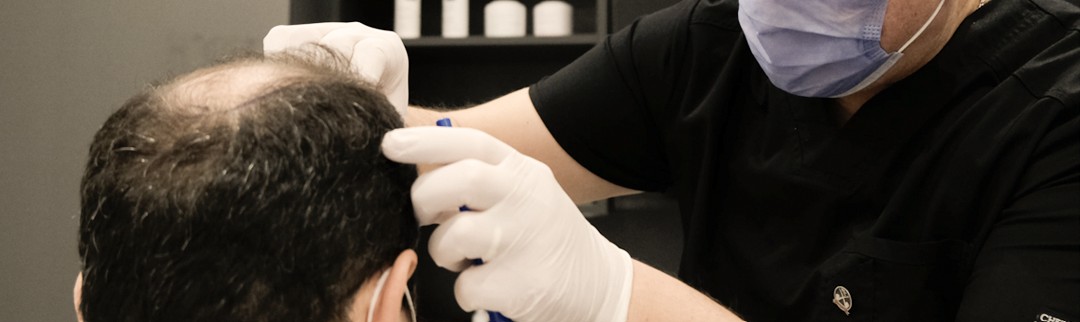
The mitigations are unglamorous and they work: high magnification, conservative incision density, matching the existing exit angles precisely, and a surgeon who is willing to place fewer grafts than the quotation allowed for if the field turns out to be more crowded than the photographs suggested. Working between established hairs is slower than working into bare scalp, and a team that treats a density pass as a faster, easier version of the first surgery is the wrong team for it.
What this means practically is that the risk calculus differs from your first operation. Then, the downside of a poor outcome was staying as you were. Now, the downside includes disturbing something that already looks good.
How Surgeons Decide Where the New Grafts Go
Not evenly. That is the first thing to understand.
The eye does not scan a scalp uniformly. It lands on the frontal third, on the part line, and on whatever catches direct overhead light. A density pass concentrates its grafts where perception is highest — the transition zone and the first few centimetres behind the hairline, then the part line, then the mid-scalp. The crown comes last in almost every plan, not because it does not matter but because it consumes grafts at a punishing rate for the visual return, and because a crown that is left slightly thinner rarely reads as strange.
Within the frontal zone, the finishing detail is irregularity. A hairline that gains density but keeps a machine-straight edge looks more artificial than one left slightly thinner with a broken, uneven leading margin. Single-hair units go at the front, two- and three-hair units behind them, and the transition should never be abrupt; where an implanter pen is used, as in DHI placement, that gradient is set as each graft goes in.
The other constraint is direction. Every new graft has to leave the scalp at the same angle as its neighbours, and in a previously transplanted field those angles were set by someone else. Reading and matching them is a large part of what makes second-pass work slower — and it is why photographs of your original result, and ideally your original operative notes, are worth bringing to the consultation.
When a Second Pass for Density Is a Bad Idea
Some patients should be talked out of this, and a clinic that never does so is telling you something about itself.
- Weak or depleted donor. If donor density has already dropped near the visible threshold, or if a trichoscope shows miniaturisation in the safe zone, further harvesting trades a discreet recipient gain for a visible donor loss.
- Diffuse unpatterned alopecia. Where thinning affects the donor zone as well as the top, transplanted hair is not permanent hair, and adding density now means watching it disappear later.
- Unstabilised loss. If native hair around the transplanted area is still receding and no medical treatment is in place, a density pass will be undone by the same process that created the gap.
- Less than twelve months since surgery. The result is not finished and the donor has not recovered.
- Expectations pinned to a photograph of someone else. If the target is a specific image of a different head of hair, more grafts will not close that gap.
There is one more category, and it deserves care rather than bluntness. A small number of patients return repeatedly over a good result, describing a flaw that other people cannot see, spending hours checking it under particular lights, and finding that each procedure relieves the distress only briefly. That pattern is recognised in medicine, it is treatable, and surgery is not the treatment — repeated operations tend to make it worse. A surgeon who raises this with you gently is not dismissing your concern. They are declining to sell you something that will not help, and it is one of the harder conversations in this field to have well.
When the Problem Is Contrast, Not Density
Before you spend grafts, it is worth checking whether density is even the variable that is bothering you.
Perceived fullness is driven by three things: how many hairs there are, how thick each one is, and how much the hair colour differs from the scalp beneath it. That last factor is doing more work than most people realise. Dark hair on pale skin is the highest-contrast combination there is, and a scalp at 45 FU/cm² can look thin in that pairing while the identical density on someone with light brown hair and a similar skin tone looks perfectly full.
Which opens options that cost no donor hair at all. Scalp micropigmentation reduces the contrast directly and can make an existing transplant look considerably denser without a single new graft. Growing the hair slightly longer creates overlap and shadow. A matte styling product prevents the shine that reveals scalp. Medical therapy that thickens surviving native hairs raises calibre, which raises perceived density across the whole field. At Hairpol we routinely suggest a patient try the non-surgical route for six months before committing donor supply, because if it works, the grafts stay in the bank.
How Do You Know You Actually Need More Density?
Your bathroom mirror is a poor instrument and your phone at arm’s length is worse. Both of them lie in different directions depending on the hour.
The useful method is dull and it works. Take photographs in the same place, at the same time of day, with the same lighting, from four angles — front, both sides and directly down onto the crown — with the hair dry and styled normally. Then take a second set with the hair wet and combed back, which strips out every styling advantage and shows the underlying density honestly. Do this at month twelve and again at month fifteen, and compare them side by side rather than from memory. Our before and after gallery is labelled by month for the same reason.
Then ask the specific question. Not “does it look thin?” — under enough overhead light, most hair does. Ask instead which photograph actually bothers you, and how often you are in that situation. A patient whose only complaint appears in a downward-angled flash photo they take deliberately at midnight is in a different position from one whose office lighting shows scalp through the part line every working day.
One more filter. Wait six weeks, look at the same photographs again, and see whether you feel the same way. Density decisions made in the week after an unflattering photo have a habit of looking different a month later.
Working out a graft count is easier with a number in front of you. Our hair graft calculator turns your loss stage and the area you want covered into a typical graft range, so the figures above have something concrete to sit against before a surgeon looks at your case.
What to Do in the Twelve Months Before You Decide
If you have concluded that you probably want a density pass, the year before it is not dead time. What you do with it changes both whether you need the surgery and how well it turns out.
Protect the hair you still have. Medical therapy — minoxidil, finasteride and the alternatives your physician may consider — is what keeps the native hair around your transplant from thinning further, and any use, dose or change must be discussed with a doctor who knows your history, since these medications carry side effects and are not appropriate for everyone. Nothing undermines a second session faster than adding grafts to a field that is still losing native hairs on the other side of the ledger. Supportive treatments such as PRP or mesotherapy can help maintain existing hair for some patients, though they add nothing that is not already there and are not a substitute for grafts.
Keep the donor in good condition. Avoid very short clipper lengths that expose extraction sites, protect the scalp from sun, and be honest with yourself about smoking — nicotine constricts the vessels that both your existing grafts and any future ones depend on. Take your photographs every three months so that when you sit down with a surgeon you have a record rather than an impression.
And go into the consultation with the right question. Not “how many grafts can you give me”, which any clinic will answer generously, but “how many grafts do I have left in total, and what is the best use of them across the next twenty years”. The answer to that second question is the one that separates a plan from a sale.
At Hairpol, second-session planning starts with the donor assessment rather than the recipient wish list, and we would rather tell you that your result is already at the point of diminishing returns than take grafts you will need later. If you want a realistic view of what a density pass would add in your case — and whether it is worth doing at all — you can review our approach to hair transplantation at Hairpol and send your photographs for an assessment before you commit to anything.
Find this helpful? Add Hairpol as a preferred source on Google.
Get a Free Consultation
Answer a few questions and the medical team will review your situation.
