
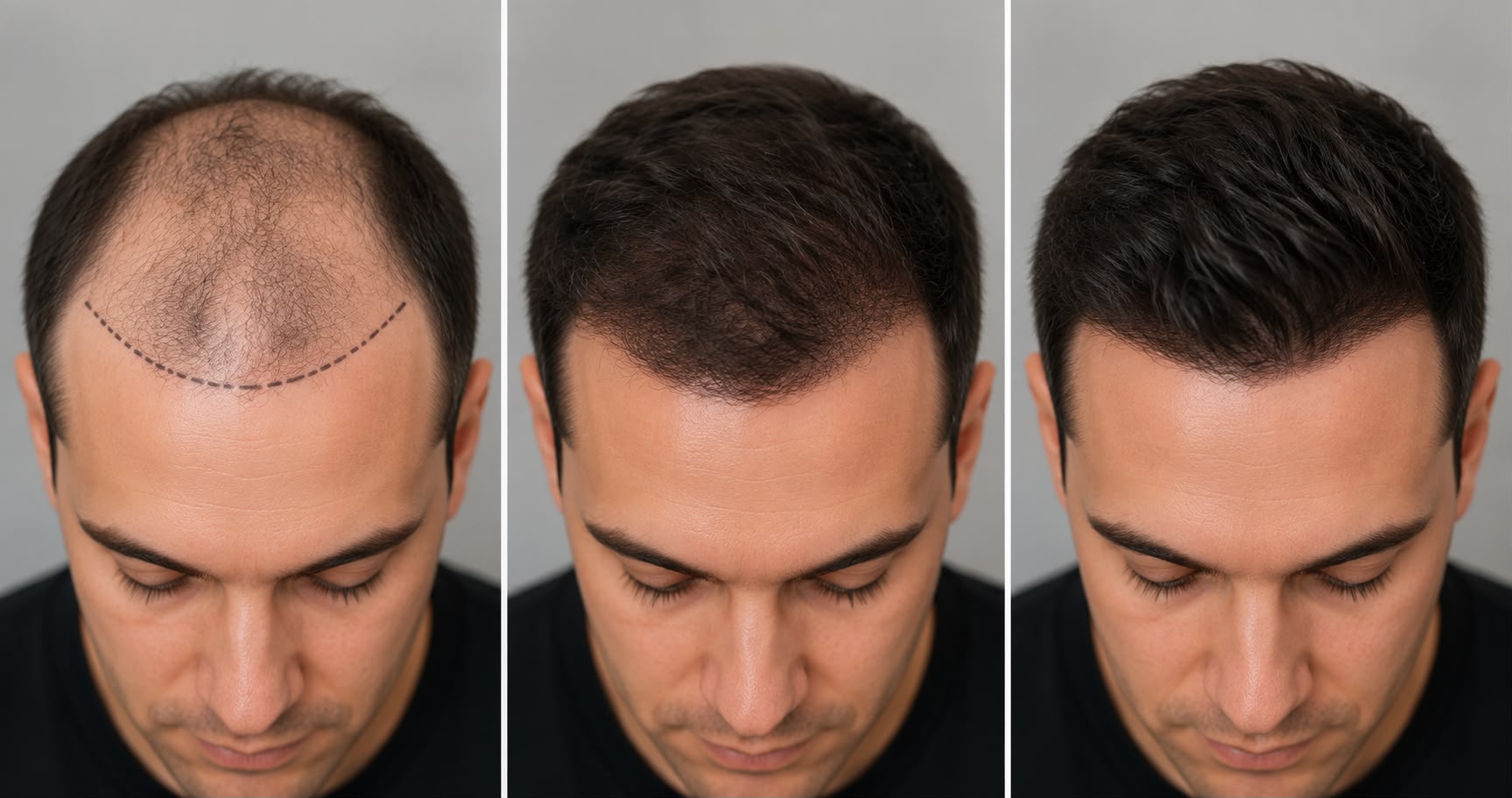
Twelve months after surgery, most people take the photo, compare it to the one from the morning of the procedure, and quietly decide that whatever they are looking at is what they are going to live with. The industry has trained you to think that way. Almost every clinic brochure, consent form and consultation script repeats the same line: final results at twelve months. It is a tidy number. It fits inside a marketing cycle. It is also, in a lot of cases, wrong by about a year.
Not wrong in a dishonest way. Twelve months genuinely is when the majority of the visible work has been done. But there is a difference between “most of the growth has happened” and “nothing will change from here.” At Hairpol, we photograph patients at twelve months and again at eighteen and twenty-four, and the gap between those two sets of images is frequently large enough that patients ask whether something extra was done. Nothing extra was done. The hair simply kept maturing.
Where the “Twelve Months Is Final” Idea Came From
There is a practical reason the twelve-month mark became the industry standard, and it is not entirely cynical. Follicles transplanted into a recipient site go through a predictable sequence: a dormant phase, shedding of the original shaft, a rest period, then re-entry into active growth. Stagger that across thousands of grafts and you get a growth curve that rises steeply between months four and eight, keeps climbing through month ten, then flattens noticeably. By month twelve the curve looks nearly horizontal on a chart. If you are measuring graft yield — how many transplanted follicles produced a hair — twelve months is a fair audit point.
The problem is that graft yield and cosmetic result are two different measurements, and people confuse them constantly. Yield asks how many hairs are present. Cosmetic result asks how those hairs look: how thick each shaft is, how it sits against the scalp, how much light it blocks, how it behaves when you comb it, whether the edge between transplanted and native hair still reads as an edge. Those qualities keep evolving well past the point where the follicle count has stabilised. That is the whole reason a second-year photo can beat a first-year photo without a single new graft being placed.
We covered the month-by-month arc of that first year in detail in our guide to what really happens from day one to twelve months. This piece picks up where that one stops.
What Is Still Happening in Months Thirteen Through Twenty-Four
Think of the transplanted follicle as a factory that was dismantled, moved and rebuilt. In the first year it restarts production. In the second year it optimises. Several separate processes run in parallel, and each one contributes a small amount of visible improvement that compounds with the others.
The follicle itself is still recalibrating its blood supply. A graft placed into a recipient site depends on new capillary growth to feed it, and that vascular network continues densifying long after the first hair emerges. Better perfusion tends to mean a thicker shaft and a longer growth phase. Meanwhile the surrounding tissue is remodelling collagen laid down during healing, which changes how the hair exits the skin. And the follicles that were slowest to wake up are still, quietly, waking up.
None of this is dramatic on any given week. That is precisely why patients miss it. You do not notice your own hair thickening by a few micrometres per month any more than you notice yourself ageing in the mirror. You notice it when you put two photographs side by side and the difference is undeniable.
Calibre Maturation: The Hairs Get Thicker, Not Just Longer
This is the single biggest contributor to second-year improvement, and it is the one almost nobody explains at consultation. When a transplanted follicle produces its first hair, that hair is usually thinner than the hair the same follicle grew in the donor area. It often emerges fine, sometimes wispy, occasionally almost colourless at the tip. Over subsequent growth cycles, the shaft diameter increases toward the follicle’s genetic baseline.
Shaft diameter matters far more than most people assume, because the light-blocking ability of a hair scales with its cross-sectional area rather than its width. A hair that goes from 60 micrometres to 80 micrometres is not one third more effective at covering scalp — it is closer to twice as effective. Multiply that across three or four thousand grafts and you have a visible density change produced by zero additional surgery.
This is why patients who felt slightly underwhelmed at month nine often feel genuinely satisfied at month twenty. The count did not change. The hair calibre did. At Hairpol, when a patient at ten or eleven months tells us the coverage looks thin under bright light, calibre maturation is usually the honest answer rather than a consolation prize — and we say so with the caveat that it is an improvement measured in degrees, not a rescue for an under-grafted plan.
Texture and Curl: Transplanted Hair Stops Behaving Strangely
A lot of patients report that in the first year their new hair felt different. Frizzy. Kinky. Prone to sticking out at odd angles instead of lying flat. Some describe it as looking like pubic hair, which is blunt but accurate for a certain phase.
That texture change is real and it is temporary. Trauma to the follicle during extraction and placement can distort the shape of the follicular bulb and the channel the hair grows through, and a distorted channel produces a distorted shaft. As the follicle recovers and the surrounding tissue settles, the shaft geometry normalises. Wavy hair that came in as tight coils relaxes. Straight hair that came in with an odd kink straightens.
The practical consequence is that hair which refused to lie down at month eight will often behave itself at month eighteen. This matters enormously for perceived naturalness, because unruly hair standing at the wrong angle catches light in a way that broadcasts “something was done here,” even when the density and design are excellent. Once the texture normalises, the transplanted zone stops announcing itself.
Patients with naturally curly or coily hair see a version of this too, though for them the arc runs the other way — the transplanted hair often comes in straighter than their native pattern and gradually reclaims its curl. Since curl is a major part of how their coverage reads, the second year can transform the result. We go into that in more depth on our page for afro-textured hair transplantation, where curl pattern drives the whole surgical plan.
Late Bloomers: Grafts That Show Up After Month Twelve
Not every follicle restarts on the same schedule. A subset of transplanted grafts stay dormant for an unusually long time — twelve, fourteen, occasionally eighteen months — before producing their first hair. In the literature these are sometimes called delayed-onset or late-blooming grafts, and their existence is one of the clearest arguments against declaring anything final at the one-year mark.
The proportion varies. In most cases it is modest, perhaps five to fifteen percent of placed grafts. But that percentage is not distributed evenly across the scalp, which is where it becomes clinically interesting.
Why the Crown Is the Classic Late Zone
The crown is slower than the front. This is consistent enough that experienced surgeons plan for it. Recipient tissue at the vertex tends to have a different vascular profile, the whorl pattern means grafts sit at more varied angles, and the area is frequently operated at the edge of an actively thinning zone rather than a stable one. All of that pushes the growth timeline right.
If you had crown work, judging your result at twelve months is genuinely premature. A vertex that looks patchy and disappointing at month eleven can fill meaningfully by month eighteen, and the change is often more noticeable there than anywhere else on the scalp because the whorl geometry means small increases in density produce large changes in how much scalp shows through. We laid out realistic crown milestones in our article on crown results at six, eight and twelve months, and the honest summary is that the crown is the one region where we routinely ask patients to hold their judgement until month eighteen.
At Hairpol, if a crown case comes back at twelve months looking incomplete, our first question is not whether to book a second session. It is whether we are looking at a finished result or an unfinished one — and often the only way to know is to wait two more review cycles.
Scar Tissue Softens and the Hair Starts Lying Down
Every recipient site is a small wound. Thousands of them heal simultaneously, and the tissue they leave behind is not identical to the tissue that was there before. In the first year that healed tissue is slightly firmer, sometimes minimally raised, and it holds the emerging hair at whatever angle the incision dictated with very little give.
Over the following twelve to eighteen months, collagen remodelling softens that tissue. The scalp regains pliability. Hair that was locked into a stiff exit angle gains a small amount of freedom to fall the way it wants to. You will not see the scar tissue itself — at this scale it is invisible to the naked eye — but you will notice that your hair suddenly styles more easily and sits flatter without product.
The same softening happens in the donor area. Extraction sites that looked faintly stippled under a short clipper cut at month eight often blend seamlessly by month twenty, which matters for anyone who wants to keep wearing very short back and sides.
Length Changes Everything About Perceived Density
Here is a purely optical effect that has nothing to do with biology. At twelve months, your transplanted hair may only be a few centimetres long. Short hair stands more upright, covers less horizontal area, and lets more light reach the scalp. Longer hair lies over its neighbours, overlaps, and blocks light from a much wider footprint.
Because your transplanted hair started growing from zero at a specific point in the timeline, month twenty-four is simply the first time you can style it at a genuinely medium length. Many patients discover that a result they described as adequate at one year looks strong at two, purely because they finally have enough length to work with. This is one of the most underrated variables in the whole process, and we unpacked it separately in our article on why results change as hair grows longer.
The flip side is worth stating honestly: length is a styling advantage, not added density. If you shave down to a number two, you will see roughly what you saw at twelve months. Length flatters the result. It does not create one.
Native Hair Recovers From Shock Loss on Its Own Schedule
Surgical trauma can push nearby native follicles into premature shedding — shock loss — and while the bulk of that recovers within the first year, the recovery is not always complete at month twelve. Miniaturised native hairs that were shocked can take several additional cycles to return to their previous calibre. Some never fully do, particularly if they were already in decline before surgery.
For patients who had significant shock loss around the transplanted area, the second year often delivers a quiet improvement that has nothing to do with the grafts themselves. The native hair that thinned in month two finishes rebuilding, and the transition zone between transplanted and existing hair stops looking like a border.
This is also why we push so hard on medical maintenance. Grafted hair is largely resistant to DHT. Native hair around it is not. Whatever second-year gain you get from recovered native hair can be handed straight back if the underlying loss keeps progressing unchecked.
Who Sees the Biggest Second-Year Difference
The improvement is not evenly distributed across patients. Some see a modest refinement. Others see a genuine transformation. A few patterns come up repeatedly.
- Crown and vertex cases. The slowest zone, the most late-blooming grafts, and the geometry that rewards small density gains the most.
- Curly, wavy and afro-textured hair. Curl returning in the second year adds coverage that straight hair simply cannot replicate at the same density.
- High contrast between hair and skin. Dark hair on light skin, or light hair on dark skin, is unforgiving — every gap reads. Calibre maturation and texture normalisation disproportionately help these patients.
- Fine-haired patients. When your baseline shaft diameter is low, every micrometre of calibre gain counts for more, proportionally.
- Large sessions in diffuse thinning. When grafts are placed between existing miniaturised hairs, the combined recovery of native and transplanted hair takes longer to resolve into a single coherent look.
If you are in none of these groups — a stable hairline case with medium-calibre straight hair and low contrast — expect refinement rather than revelation. That is still worth waiting for, but calibrate the expectation.
Your Month-Twelve Photograph Is Probably Lying to You
Before you conclude anything from a comparison, look at how the two photographs were taken. Overhead lighting is the single most brutal condition for a transplanted scalp, because it drives light straight down through the hair to the skin. Direct flash does something similar. Wet hair, freshly washed and not yet styled, exposes scalp that dry hair hides. The angle of the camera relative to the whorl can make the same crown look full or bare.
At Hairpol we standardise review photography for exactly this reason — same distance, same angles, same lighting, dry hair, no product — because otherwise you end up comparing two different conditions and calling it progress or failure. If your own month-twelve photo was taken under a bathroom downlight after a shower and your month-six photo was taken outdoors in soft daylight, you have learned nothing about your result.
Before you spend a year worrying, retake the photo properly. A surprising number of “my result got worse” messages resolve into “my lighting changed.”
When Waiting Is Wisdom and When It Is Denial
Everything above can be misused. “Give it another year” is also the sentence bad clinics use to run out the clock on a complaint, and you deserve a clear line between patience and avoidance.
Waiting is reasonable when the growth pattern is even but immature — hair present across the whole treated zone, just fine or short; when the crown is the concern and you are inside eighteen months; when your dissatisfaction is about texture, styling or how it photographs rather than about visible bare scalp; and when your surgeon can point to specific areas where new hairs have appeared between reviews.
Waiting is not reasonable when there are clearly demarcated bare patches inside the treated area with no emerging hairs at all by month twelve; when the density is uniformly far below what the graft count should have delivered; when the hairline design, angle or direction is wrong, since design errors do not improve with time; when grafts were placed as visible clusters or plugs; or when there are signs of a healing problem such as persistent inflammation or scarring in the recipient zone.
The distinction is between a result that is immature and a result that is structurally flawed. Immaturity resolves. Structure does not. If you suspect the second, our article on what really lasts over five years is a useful reality check on what time can and cannot fix.
What to Actually Do During Year Two
The second year is not passive. There are a few things that measurably change how it ends.
Keep taking standardised photographs every three months in identical conditions. This is the only reliable way to see change that is too gradual to notice in the mirror. Stay on whatever medical therapy your surgeon recommended, because the biggest threat to a good two-year result is not graft failure but ongoing loss of the native hair around the grafts. Consider supportive scalp treatments if your surgeon thinks they are appropriate for your case — Hairpol offers medical scalp treatments including PRP and mesotherapy that can support the surrounding native hair, though they are an adjunct rather than a substitute for surgical planning.
Grow the hair out at least once before you judge the result, so you know what it can do at length. And book a proper eighteen-month review rather than defaulting to a second procedure at twelve. If a second session is genuinely needed, the information you gather by waiting makes that session better planned, not worse.
How Hairpol Handles the Second Year
We schedule reviews at three, six, nine and twelve months, then again at eighteen and twenty-four. That last pair is not a formality. It is where we decide whether a case is finished, whether a small refinement session would add meaningful value, and whether the donor area has recovered enough to make that session sensible.
It also keeps us honest. A clinic that only reviews at twelve months never has to confront how its work ages. Looking at the same patient at two years tells you things about your own hairline design, angle control and graft handling that no one-year photograph will.
If you are sitting at eleven or twelve months and quietly disappointed, the most useful thing you can do is get a proper assessment before drawing conclusions. Sometimes the answer is that your result is still arriving. Sometimes it is that something needs correcting, and you should know that sooner rather than later. Either way, guessing on your own in front of a bathroom mirror is the worst version of this. To talk through where your result actually stands, or to plan a procedure with realistic timelines from the start, you can review our approach to hair transplantation at Hairpol and arrange a consultation with our team in Ataşehir, Istanbul.
Frequently Asked Questions (FAQ)
Is twelve months really the final result of a hair transplant?
Twelve months is the point where most transplanted grafts have produced a hair, but it is not the end of visible change. Shaft thickness, texture, how the hair lies against the scalp and the last late-blooming grafts continue to develop through months thirteen to twenty-four. Twelve months is a fair audit of graft yield and an early snapshot of cosmetic result.
How much can a hair transplant improve between year one and year two?
It varies by case. Most patients see a refinement rather than a transformation: slightly thicker shafts, better-behaved texture and a more natural fall. Patients with crown work, curly hair, fine hair or high hair-to-skin contrast often see a larger change, sometimes enough that a two-year photo looks noticeably fuller than a twelve-month photo.
Why is my transplanted hair thinner than my donor hair?
The first hairs a relocated follicle produces are usually finer than what that follicle grew before surgery. As the blood supply matures and the follicle completes more growth cycles, shaft diameter increases toward its genetic baseline. Because coverage depends on cross-sectional area, even a small gain in thickness produces a disproportionate gain in visible density.
Can grafts still start growing after twelve months?
Yes. A minority of grafts stay dormant longer than the usual schedule and produce their first hair at fourteen, sixteen or even eighteen months. These late-blooming grafts are more common in the crown than in the frontal zone, which is why crown results in particular should not be judged at the one-year mark.
Why does the crown take longer than the hairline?
The vertex has a different vascular profile, the whorl pattern means grafts sit at more varied angles, and it is often treated at the edge of an actively thinning area rather than a stable one. All three factors push the growth timeline later. Meaningful crown filling between months twelve and eighteen is common.
My transplanted hair is frizzy and sticks out. Will it settle?
In most cases yes. Trauma during extraction and placement can temporarily distort the follicle and the channel the hair grows through, which produces an oddly textured shaft. As the follicle recovers and surrounding tissue softens, the texture normalises and the hair starts lying flat. This usually improves substantially between months twelve and twenty-four.
When should I stop waiting and talk about a revision?
Waiting is reasonable when growth is even but immature, when the concern is the crown and you are inside eighteen months, or when the issue is texture and styling rather than bare scalp. It is not reasonable when there are clearly demarcated empty patches with no emerging hairs at twelve months, when density is far below what the graft count should have delivered, or when the hairline design, angle or direction is wrong. Design errors do not improve with time.
How should I photograph my result to track it properly?
Use the same distance, same angles, same lighting and dry, unstyled hair every time, and take the photos every three months. Avoid overhead lights and direct flash, which drive light straight to the scalp and exaggerate thinness. Many perceived setbacks are simply differences in lighting and hair condition rather than real changes in the result.
Find this helpful? Add Hairpol as a preferred source on Google.
Get a Free Consultation
Answer a few questions and the medical team will review your situation.
