

Three thousand. It is one of the numbers that turns up most often in hair transplant quotes, sometimes before anyone has seen the back of your head. It sounds substantial, round and reassuring, and it is easy to assume that if you hear it, you are getting a serious procedure.
Sometimes you are. 3,000 grafts is a genuinely useful amount of hair, enough to change how a face looks. But the number on its own tells you nothing about where those grafts go, how dense they will look, how much of your donor area they use, or whether 3,000 is the right figure for you at all. This guide puts the number into context.
The numbers first: a 3,000 grafts hair transplant moves roughly 6,000 to 7,000 hairs, enough to rebuild the hairline and front third at good density, or to cover front and mid-scalp more lightly. It typically suits Norwood 3 to 4 and fits in one day. At Hairpol it is quoted within our package range of typically $2,500–5,000; the exact figure follows a free hair analysis.
What does 3,000 grafts mean, and how much area does it cover?
A graft is a follicular unit: a small group of one to four hairs that grow together naturally. On average, each graft carries a little over two hairs, so 3,000 grafts usually means somewhere around 6,000 to 7,000 individual hairs, depending on your donor area.
That distinction matters when comparing quotes. Some clinics quote in hairs rather than grafts, which makes their numbers look twice as large. Always ask which unit is being used. A quote of “6,000 hairs” and a quote of “3,000 grafts” may describe exactly the same procedure.
The answer depends on the density you are aiming for. Surgeons usually plan in grafts per square centimetre. At a density of around 40 grafts per square centimetre, typical for the front of the scalp, 3,000 grafts cover roughly 75 square centimetres. At a lighter 30 per square centimetre, more common behind the hairline or in the crown, the same grafts cover around 100 square centimetres.
For context, a Norwood 3 hairline with temples and the zone just behind it is often in the range of 50 to 80 square centimetres. A crown can be 60 to 100 or more. That is why 3,000 grafts can look dense on a small front area and noticeably lighter when spread over the front and crown together.
Which Norwood stages does 3,000 grafts suit?
As a general guide, 3,000 grafts is a comfortable number for Norwood 3 and Norwood 3 vertex patterns, where the goal is a strong hairline and front with some crown work. It also fits many Norwood 4 cases, where the front and mid-scalp are treated and the crown is either left for later or given light coverage.
From Norwood 5 onwards, the bald area is usually larger than 3,000 grafts can cover at a natural density. Those cases often need 3,500 to 5,000 grafts or more, frequently split across two sessions. Where your own pattern sits is easier to judge from photos than from a description, so send yours to check whether 3,000 grafts fits your pattern; if the honest number is lower, higher or split over two visits, that is what you will be told.
Where 3,000 grafts go: front, front plus crown, or crown alone
This is where 3,000 grafts tends to look most impressive. Concentrated in the hairline, temples and the first few centimetres behind them, 3,000 grafts can create a dense, convincing front that frames the face strongly. For many Norwood 3 patients, this is the most visible change they could make.
The front third is also where design matters most. A strong hairline built with 3,000 grafts should still have fine single hairs at the edge, natural temple angles and a soft transition into the hair behind. More grafts at the front does not justify a lower or straighter line.
Things change once the crown also needs work.
When the front and crown both need work, 3,000 grafts can be divided between them, for example 1,800 to 2,000 at the front and 1,000 to 1,200 in the crown. The front gets good density; the crown gets lighter coverage that reduces the visible scalp from above.
Whether this split is wise depends on your age and how your loss is likely to progress. Spending grafts on the crown early can leave fewer for the hairline later. Our guide to how many grafts you need, from 2,000 to 7,000 explains how surgeons sequence these decisions across a lifetime.
The reverse pattern exists too.
Some patients have a strong front and a thinning or bald crown. In those cases, 3,000 grafts can give the crown solid coverage, though the crown never looks quite as dense as the front because of the whorl and the angle from which it is viewed. Crown results also take longer, often twelve to eighteen months.
Our article on what 2,000 grafts for the crown can achieve shows how crown coverage scales with graft numbers, which helps you judge whether 3,000 is more than you need.
Is 3,000 grafts a lot? Density, coverage and your donor budget
Every graft count involves a choice between density and coverage. Concentrate 3,000 grafts in a smaller area and you get high density there. Spread them over a larger area and you get more coverage at lower density, which looks full when styled but lighter under strong overhead light.
There is no universally right answer. A man who wears his hair short may prefer density at the front; a man who wears it longer may prefer broader coverage. Our article on density vs coverage explains why this is the most important conversation at consultation.
The other side of that trade-off is what the number costs your donor area.
It is a meaningful share of your donor area. An average donor zone can provide something in the region of 5,000 to 7,000 grafts over a lifetime with FUE. A 3,000-graft session therefore uses roughly half of what many people can safely give.
That is not a reason to avoid it, but it is a reason to make sure it is spent wisely. If you are young and your loss is still progressing, the plan should leave enough in reserve for future needs. Our article on donor area capacity over a lifetime explains how that reserve is estimated.
Can 3,000 grafts be done in one day, and with which technique?
Yes, for most patients. A 3,000-graft session typically takes six to eight hours: consultation and design in the morning, two to three hours of extraction, a break, then two to three hours of placement. That rhythm is why 3,000 grafts fits comfortably into a single day for most people.
Unshaven sessions are slower, and 3,000 grafts may be at or beyond the comfortable limit for an unshaven day. If you need to stay unshaven, discuss it early; the plan may change to a smaller session or a partly shaved approach.
Most 3,000-graft cases on a shaved scalp are done with channel-based FUE, often Sapphire FUE, because it is efficient for medium to large areas. DHI is often used for the hairline itself, sometimes in a combined plan with channels behind it. The technique does not change the number of follicles needed; it changes how they are placed.
The bigger variable is the team: how quickly and carefully 3,000 grafts are extracted, stored and placed. A session of this size depends on a rhythm where extraction and placement overlap, so that grafts spend as little time outside the body as possible.
How your hair changes what 3,000 grafts look like
Two people with identical graft counts can end up with very different results. Thick, coarse hair covers more scalp per graft than fine hair. Wavy and curly hair looks fuller than straight hair at the same density. Low contrast between hair and skin, such as dark hair on darker skin or light hair on fair skin, hides gaps better than dark hair on pale skin.
This is why the same 3,000 grafts can look dense on one man and moderate on another. A good assessment takes these factors into account before settling on a number.
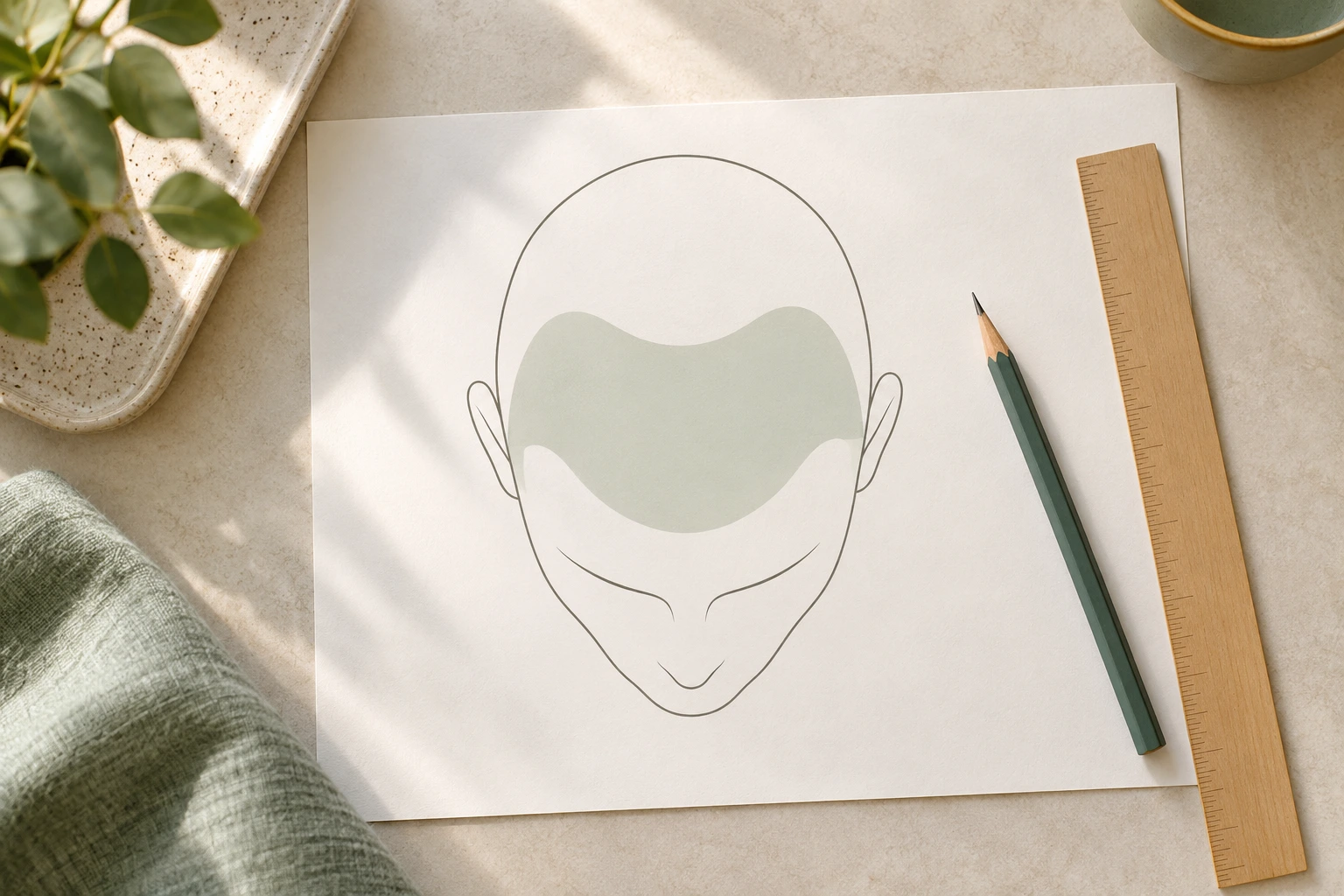
It helps to picture how the same number plays out in different heads. Imagine three men, each quoted 3,000 grafts.
The first is thirty-six, with a stable Norwood 3 pattern, thick dark wavy hair and a strong donor area. His 3,000 grafts go almost entirely into the hairline, temples and front third. At a year, his front looks dense from every angle, and he still has a healthy reserve in the donor area for the future.
The second is forty-two, Norwood 4, with fine straight hair against fair skin. His 3,000 grafts are split between the front and mid-scalp. The result is a clear improvement and looks full when his hair is styled, but under bright overhead light the mid-scalp is visibly lighter than the front. He is pleased, and he understands that a second session could add density later.
The third is twenty-five, with fast-moving loss and a family history of extensive balding. A careful clinic would not give him 3,000 grafts at all yet. It would suggest stabilising first, or a smaller hairline session with a conservative design, keeping his donor area in reserve. Same number on paper, three very different decisions.
Questions to ask about a 3,000-graft quote
- Is the figure in grafts or hairs, and how many hairs per graft do you expect from my donor area?
- Which zones will the grafts cover, and at what density per square centimetre?
- How many grafts will remain in my donor area afterwards?
- Can 3,000 be done in one day for me, or should it be split?
- What happens to the price if more grafts are recommended on the day?
Clear answers to these questions turn a round number into a plan you can actually compare.
One more request is worth making: ask for the plan drawn on your own photos, with each zone labelled by graft count. A clinic that has genuinely planned 3,000 grafts can show you where 1,800 of them go and why the remaining 1,200 sit where they do. A clinic that cannot is quoting a day’s work, not a design.
How much does a 3,000 grafts hair transplant cost?
The 3,000 grafts cost depends on the package rather than a simple multiplication. At Hairpol, hair transplant packages move mainly with graft count and technique, followed by session length and case difficulty; FUE, Sapphire FUE and DHI sit in the same package range. Your exact figure follows a free hair analysis.
Our hair transplant cost page shows the typical package range and how graft count and area influence it. When comparing quotes, make sure each one describes the same zones and the same number of grafts, not hairs.
At Hairpol, scalp packages are typically $2,500–5,000, and a 3,000-graft plan falls within that range. Where it lands depends on the technique, how the grafts are split between zones and whether the session is shaved or unshaven; the exact figure is set after a free hair analysis.
Per-graft pricing makes a quote look easy to compare, but it hides two risks. The first is that the final graft count can rise on the day, turning a quoted 3,000 into 3,600 at the same unit price. The second is that a low per-graft price can conceal a lower standard of extraction and handling, which means fewer living grafts than the count suggests.
Whatever the pricing model, ask for the graft range in writing before you travel, along with what happens if more grafts are recommended on the day. A package that answers these questions clearly is easier to trust than a low unit price.
What a 3,000-graft package should include, and why the number alone proves little
At this size, the package should state the planned graft range and the zones it covers, the technique for each zone, and who performs extraction, channel opening and placement. It should include blood tests, local anaesthesia, medication, the aftercare kit, the first wash and structured follow-up.
Our hair transplant Turkey package page explains what a package covers and which practical items, such as accommodation and transfers, vary between clinics.
Why does 3,000 come up so often? Partly because it is a comfortable day’s work and a reassuring number. If a clinic offers you 3,000 grafts before it has seen your donor area, the number came from a template rather than from your scalp. Some patients need 1,800. Others need 4,500 across two sessions.
The right figure comes from mapping the area, deciding the density and checking what your donor area can safely provide. A clinic that does this will often give you a range rather than a round number, along with an explanation.
Recovery after 3,000 grafts, and when a second session follows
Recovery after 3,000 grafts follows the usual pattern. Small scabs form around each graft and fall away between days seven and twelve with gentle washing. Swelling across the forehead is common around days two to four, and the donor area feels tight and looks pink for two to three weeks. Most people with desk jobs return to work after seven to ten days.
Because a session of this size covers a visible area, the first two weeks are the most noticeable. A loose hat helps outdoors, sleeping slightly upright reduces swelling, and avoiding heavy exercise for about two weeks protects the grafts while they anchor.
For some patients, though, the bigger question is not recovery but sequence.
For Norwood 5 and beyond, or for patients who want both a dense front and a full crown, 3,000 grafts is usually a first stage rather than the whole plan. A second session twelve to eighteen months later can add density or extend coverage, once the first result has matured.
Planning two sessions from the start is often better than forcing everything into one long day. It protects graft quality, lets the team see how your hair responds, and keeps the donor area healthy.
When will 3,000 grafts show, and how do you protect them?
Transplanted hairs usually shed between weeks two and eight. New growth starts around month three or four, builds through months six to nine and settles between twelve and eighteen months, with the crown typically last. At 3,000 grafts, the change is usually clearly visible by month six to eight.
When you judge a clinic’s results, look at 3,000-graft cases at twelve months in consistent lighting, ideally with a starting point similar to yours. Our before and after gallery is a good place to begin.
The transplanted hair is resistant to pattern loss; the native hair around it is not. If your loss is still progressing, medical treatment, always started and monitored with a doctor’s approval, can help protect the hair that frames the new grafts.
Turning a round number into your number
A round figure is the start of a conversation, not the end of one. The useful version of a 3,000-graft quote names the zones, the density per square centimetre in each, what stays in your donor area afterwards and how the plan changes if your loss moves on. When those four lines are filled in, clinics can be compared honestly; when they are blank, the number is decoration.
At Hairpol the graft count is the last thing we write down, after the map, the density and the donor check. That order sits at the centre of our hair transplantation planning, and a handful of daylight photos is enough to start it.
Find this helpful? Add Hairpol as a preferred source on Google.
Graft Range Calculator
Answer three questions to see the typical graft range for your situation — based on our published clinical guides.
This is a preliminary estimate, not a medical assessment. The exact number can only be determined by a doctor after examining your donor area and hair characteristics.
Get a Free Consultation
Answer a few questions and the medical team will review your situation.
