
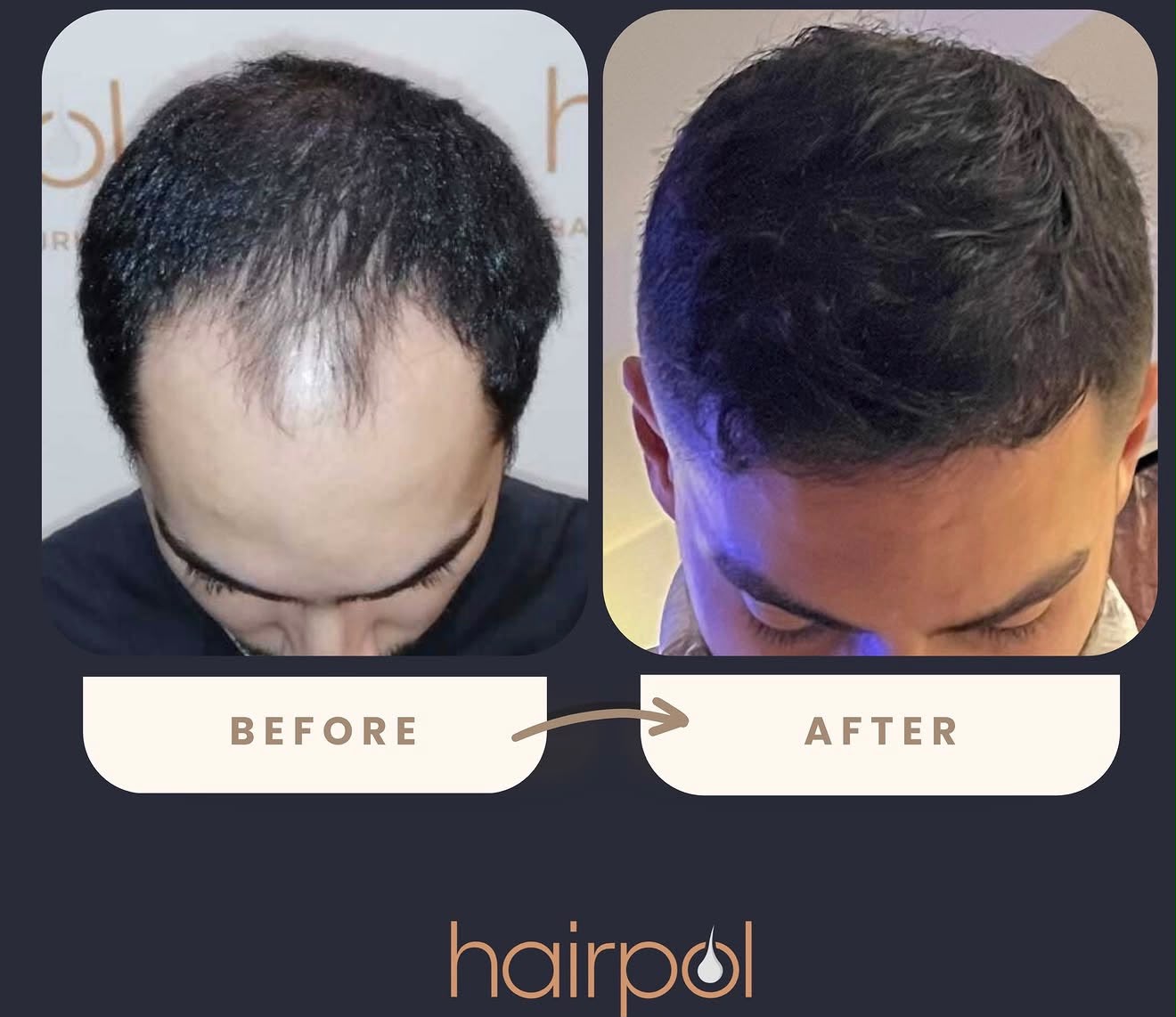
The message almost always arrives in the same form. A photo taken in a bathroom, overhead light on, hair still damp from the shower. Underneath it, a second photo from the morning of surgery. And then one line: is this it?
Month six is when that message gets sent. Not month three, when nobody expects much, and not month nine, when the picture has usually started to argue for itself. Month six is the point where the calendar feels long and the mirror feels stingy, and the two things stop agreeing with each other. At Hairpol, it is the single most common moment for a patient to quietly lose faith in a result that is developing exactly on schedule.
The short answer: at six months, most patients are looking at roughly 50 to 60 percent of their final FUE result. Nearly all the hairs that will grow are already growing, but they are thin, short and often pale. Between month six and month twelve the graft count barely moves. What changes is calibre, pigment and texture — each shaft thickens, darkens and starts lying flat against the scalp, which is why a twelve-month photo can look far denser without a single extra graft. Crown zones usually run two to four months behind the front. These ranges vary by patient.
What Month Six Actually Represents
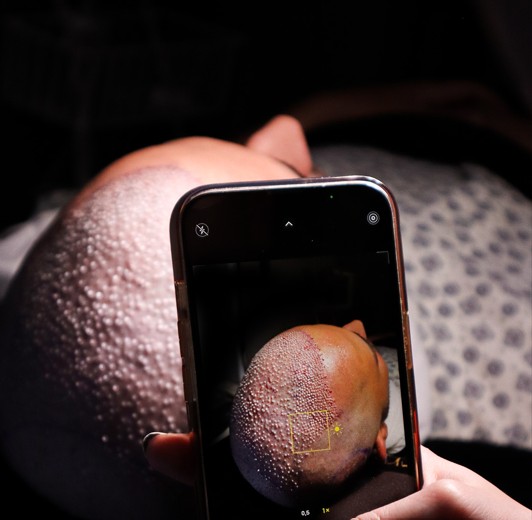
A transplanted follicle does not simply carry on growing after it is moved. It shuts down. In the first two to six weeks the original shaft sheds — the phase most patients know as shock loss — and the follicle sits dormant underneath intact skin for somewhere between six weeks and three months. Then it restarts, one follicle at a time, on its own clock.
That staggering is the reason there is no clean switch-on date. By month four, a scattered minority of grafts have pushed through. By month six, the large majority are active. If you could count follicles under a microscope at the half-year mark, the number would already be close to final. This is why surgeons describe six months as a reasonable checkpoint for graft survival.
But that count is not what you see in a mirror. Hair grows at roughly one centimetre a month, so a follicle that woke at month four has produced two centimetres of shaft by month six — and that shaft is first-generation hair, the thinnest and weakest version the follicle will ever make. You are looking at a full set of hairs in their least impressive state. The month-by-month arc of that whole first year is laid out in our recovery timeline from day one to twelve months, and it is worth reading alongside this one.
Why Does a Six-Month Result Look Thinner Than You Expected?
Because perceived density has very little to do with how many hairs you have and almost everything to do with how much light they block.
A mature terminal hair on the scalp is somewhere in the region of 60 to 90 microns across. A newly emerged transplanted hair at month six may be 30 to 50 microns — sometimes less. Halve the diameter of a cylinder and you do not halve its visual weight; you reduce it much further, because coverage scales with the cross-sectional area of the shaft, not its width. Two hundred fine hairs and two hundred thick hairs are the same count and completely different photographs.
Add to that the length problem. Short hair stands more upright, which means it shadows less scalp and lets more skin show through from above. The exact same set of follicles, grown out by another eight centimetres, will lie over each other and read as a solid mass. Nothing biological has to change for the density to appear to double. It just gets longer.
Calibre: The Biggest Single Change Between Month Six and Month Twelve
If you remember one mechanism from this article, make it this one. Between months six and twelve, transplanted follicles keep maturing, and each successive growth cycle produces a thicker shaft than the last. A follicle that pushed out a wispy 35-micron hair in month five is often producing something close to its original donor calibre by month eleven or twelve.
This matters more than any other variable because it compounds across the entire recipient area at once. Thousands of individual shafts each gaining thickness translates into a change in coverage that patients describe as sudden, even though it happened gradually. The typical report is that nothing happened for weeks and then someone at work asked whether they had changed their haircut.
It is also why the improvement does not stop dead at the twelve-month mark. Calibre maturation carries on at a slower rate well into the second year, particularly in patients who had a lot of grafts placed into a demanding zone. We wrote about that stretch separately in why your second-year result can look better than your first. For the purposes of the six-versus-twelve comparison, the point is simply that the curve is still rising at month twelve — it has not flattened, it has just slowed.
Pigment: Why the Early Hairs Look Faded
A lot of patients notice that their new hair comes in lighter than the rest of their head, sometimes almost colourless at the tip. This is normal and temporary. The pigment-producing cells inside the follicle take longer to resume full function than the cells that build the shaft itself, so the first hairs out are under-pigmented.
Under-pigmented hair is close to invisible against pale scalp. That is a large, underappreciated part of why the six-month photo disappoints: the hairs are physically present but visually absent, particularly on fair-skinned patients under direct overhead lighting. By month nine to twelve, most of that colour has caught up with the surrounding hair, and the same hairs suddenly register in photographs where they previously did not.
Grey and salt-and-pepper patients are the exception worth naming. If your native hair is largely unpigmented anyway, this particular improvement will be less dramatic for you, and the visible gain between month six and month twelve will come almost entirely from calibre and length instead.
Texture and Direction: The Awkward Phase
New transplanted hair frequently grows in with a strange texture — wiry, kinked, sometimes noticeably curlier or coarser than the hair around it. It resists combing. It stands away from the scalp at angles that look wrong. Patients with straight hair are usually the most alarmed by this, because the contrast is obvious.
It settles. The kinked texture is a feature of an immature follicle finding its rhythm again after being moved, and it typically resolves somewhere between months nine and fourteen. Direction settles on a similar schedule: the shafts gradually start following the angle of the channel they were placed into rather than sticking straight up, and once they lie down, they cover far more scalp.
The practical consequence is that styling gets easier at exactly the point most patients had given up on it. A head of hair that would not take a comb at month six is often manageable by month ten and behaving normally by month twelve.
Is It Normal for the Crown to Lag at Six Months?
Yes, and it is the most predictable delay in the whole process. If you had grafts placed in the crown, expect that zone to sit two to four months behind whatever the front is doing.
There are structural reasons. The crown grows in a whorl, a spiral pattern where hairs radiate outward from a central point, so any given area is covered by hair pointing in several directions at once — which is beautiful when it is finished and merciless when it is half-grown, because there is no dominant direction to comb over the gaps. The crown is also viewed from above, at the angle that reveals the most scalp, usually under ceiling lights. And it tends to be a larger surface than the hairline for the same graft count, so density per square centimetre is often deliberately lower.
A crown that looks patchy and unconvincing at six months is not a failed crown. It is a crown at six months. We track that zone separately in our crown recovery timeline, month by month, and the honest guidance there is the same as here: judge a crown at month twelve at the earliest, and often at month fifteen to eighteen.
The Density Illusion: Light, Length and Angle
Two photographs of the same head, taken an hour apart, can tell completely opposite stories. This is not an exaggeration, and it is not marketing trickery when a clinic’s before-and-after images look good — it is the physics of hair.
Overhead lighting is the enemy. A ceiling lamp directly above you drives light down through the hair onto the scalp, maximising contrast between shaft and skin. Wet hair clumps into strands and opens gaps that do not exist when it is dry. A phone camera held high and pointed down at the crown shows a view of your own head that nobody else in your life ever sees. Meanwhile, indirect daylight, dry hair, and a straight-on angle at eye level will make the identical result look considerably fuller.
Neither photo is lying, exactly. But if your month-six photo was taken wet under a bathroom light and your mental reference image is a dry, side-lit clinic photo, you are not comparing your result to itself. You are comparing worst case to best case. Our before-and-after gallery is shot under consistent conditions for precisely this reason.
What the Percentages Actually Mean
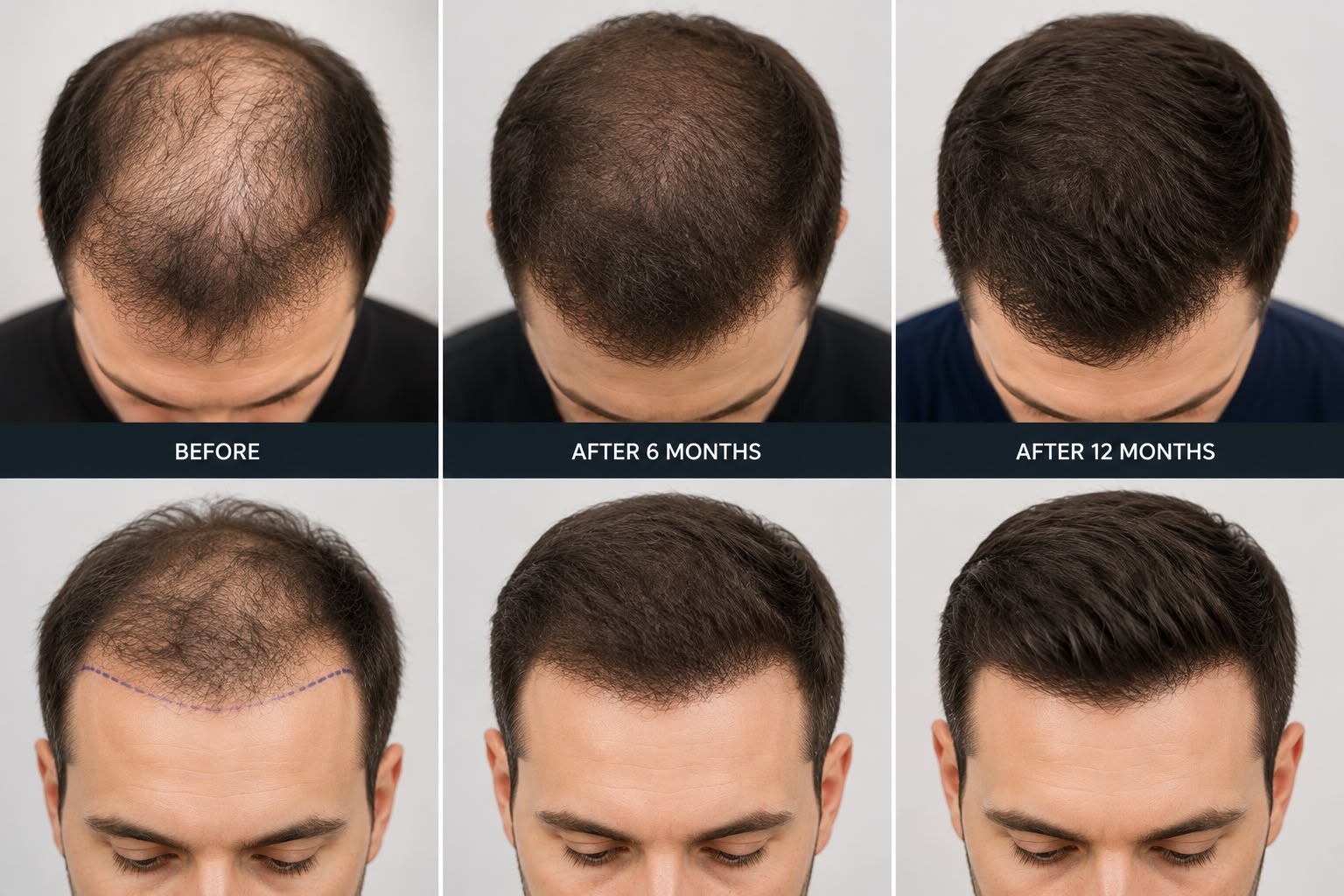
Numbers get quoted a lot in this field, and they are useful as long as everyone understands they describe a typical curve rather than a promise. Broadly, and with real variation between patients, the shape looks like this: around 10 to 20 percent of the visible result by month three, 50 to 60 percent by month six, 70 to 80 percent by month nine, and 90 percent or more by month twelve, with the remainder arriving over the following six to twelve months.
Read those figures as percentages of cosmetic appearance, not of graft survival. The grafts are largely accounted for by month six. What the percentages are tracking is how much of the final look has assembled itself out of hairs that are still thickening and darkening.
Where patients get into trouble is treating the numbers as a schedule they are entitled to. Growth is not linear and it is not synchronised. Plenty of people sit at what feels like a plateau from month six to month eight and then change noticeably in a fortnight. Others improve so evenly that they never perceive a jump at all and only see it in photographs. Both are normal. Results vary by patient, by zone, by graft count and by the state of the donor area.
The Month-Six Panic, and What It Usually Costs
Here is the pattern we see, more or less monthly. A patient reaches month six, decides the result has failed, and starts researching revision surgery. By month seven they have booked consultations elsewhere, often with clinics happy to agree that yes, this looks inadequate, and yes, a second procedure could be arranged. By month nine they have paid a deposit. By month eleven their original result has filled in and the second procedure is either unnecessary or actively harmful, because donor hair spent early is donor hair that is not available at fifty.
The donor area is a finite resource. Every graft removed from it is permanently gone from it. Spending grafts to correct a result that had not finished growing is the most avoidable mistake in this entire field, and it is driven almost entirely by the six-month photograph.
If your six-month result genuinely worries you, the correct move is not a revision booking — it is a proper assessment. At Hairpol, if you send standardised photos of the same zones under the same conditions, we can usually tell you within a day whether you are on a normal curve or whether something needs looking at. That costs you nothing and it buys back the six months you would otherwise spend anxious. You can request a photo assessment here if that is where you are.
How to Photograph Your Own Progress So the Comparison Is Fair
Most patients have no usable baseline, which makes every subsequent comparison guesswork. If you are somewhere between month six and month twelve now, start a proper photo record today — you will still be glad of it in a year.
- Same room, same time of day, same light source every time. Natural indirect daylight beats any bulb.
- Dry hair, styled the way you normally wear it. Wet-hair photos are useful once, for tracking density honestly, but keep them as a separate series.
- Four fixed angles: straight on, both profiles, and the crown from above. Same distance each time.
- No flash. No filters. No changing the phone.
- Monthly, not weekly. Week-to-week change is invisible and only feeds anxiety.
Then do the thing almost nobody does: stop comparing this month to last month. Compare month nine to month six, and month twelve to month six. Six-month intervals are where the change lives, and they are the only comparison that will tell you the truth about your own trajectory.
Which Zones Finish Early and Which Finish Late
Not all of your head is on the same clock, and knowing the order helps enormously at month six.
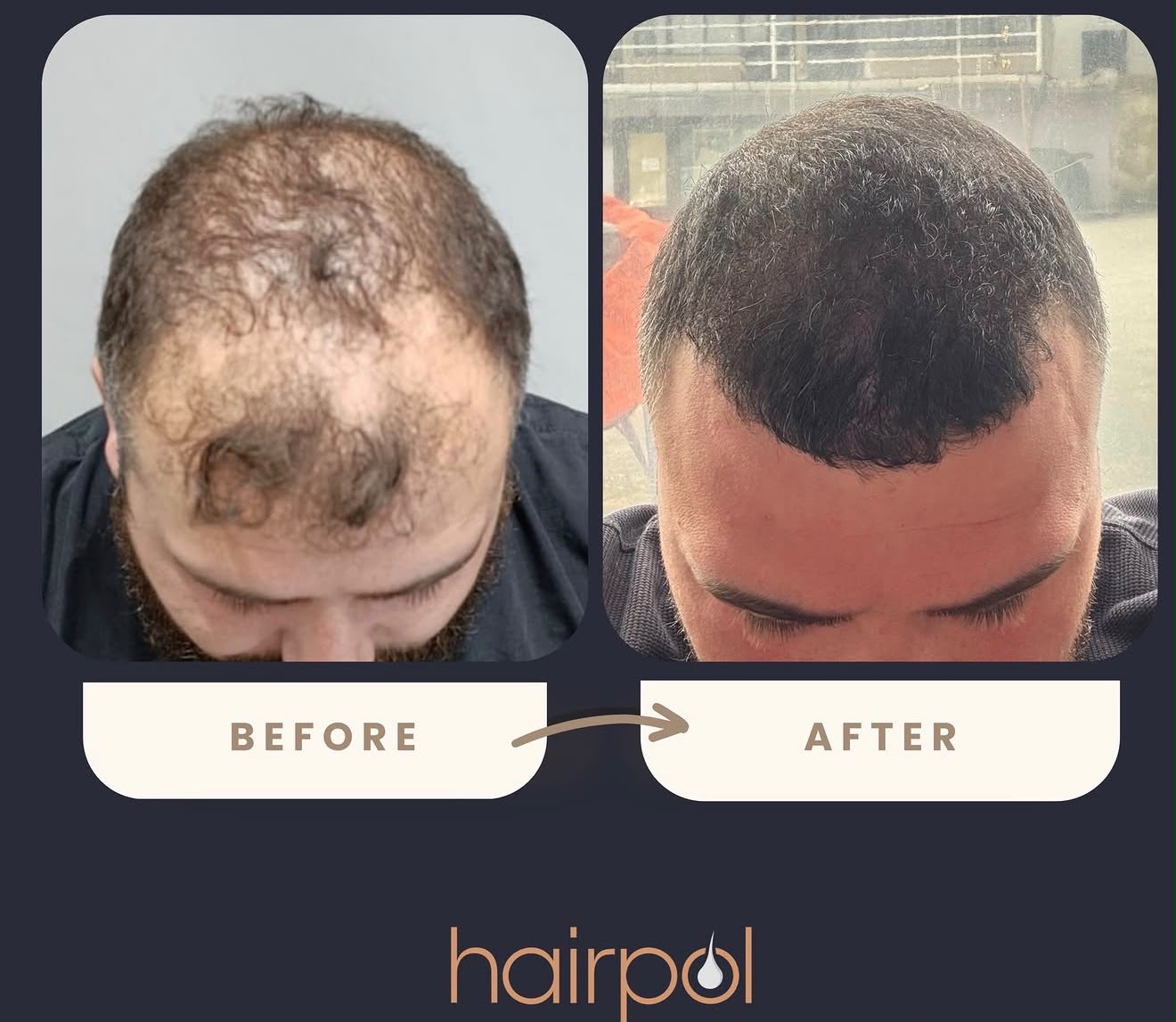
The frontal hairline is generally the fastest to become presentable, partly because of good blood supply and partly because it is the zone where even modest density reads as a dramatic improvement — a defined edge changes a face more than fill does. The mid-scalp follows, typically converting between months seven and ten. The crown is last, for the reasons already described. Temple points, which are placed with very fine single grafts, often take longer than patients expect and can look sparse until month ten or beyond.
Recipient areas with existing scar tissue — from an older strip procedure or a previous transplant — run slower again. Scarred skin has compromised circulation, and grafts placed into it wake up later and mature more gradually. If that describes your case, borrow the crown timetable rather than the hairline one, and give it eighteen months before drawing conclusions.
Does the Technique Change the Six-to-Twelve-Month Curve?
Less than most people assume. Extraction and implantation methods differ in ways that matter — how the channels are opened, how long grafts spend outside the body, how precisely angle and depth can be controlled — and those differences show up in early healing, in scabbing, and in how natural the final direction looks.
What they do not do is change the biological clock. A follicle placed with a Sapphire FUE blade and a follicle placed with the implanter pen used in DHI hair transplantation both shed, both rest, and both restart on roughly the same schedule. Anyone promising visibly faster growth from a particular instrument is selling the instrument, not describing the biology.
Graft handling does affect the outcome, but through survival rather than speed. Grafts kept out of the body too long or handled roughly yield less, and that shows up as a thinner final result — not as a slower one. Which is another reason month six tells you so little: a genuine yield problem and a normal immature phase look nearly identical at that stage, and only time separates them.
When a Weak Six-Month Result Is Genuinely Worth Investigating
Everything above argues for patience, so it is only fair to be clear about the exceptions. There are situations where waiting is the wrong call.
Complete absence of growth in an entire zone — not thin growth, none at all, while adjacent zones are visibly progressing — deserves a conversation now rather than at month twelve. So does persistent inflammation: ongoing redness, pustules or crusting at month six is not part of the normal course. Shiny, tight or scarred-looking recipient skin is worth showing to your surgeon. So is significant new thinning in the areas around the transplant, which usually points to untreated native hair loss rather than a graft problem and needs a medical plan of its own.
These are assessment triggers, not revision triggers. Even when something has genuinely gone wrong, the answer at month six is diagnosis, not more surgery. Any responsible surgeon will want to see a full twelve months before operating again, and in the crown or in scarred tissue, longer. Other timing questions patients raise at this stage are answered on our frequently asked questions page.
What to Do With the Months Between
The honest answer is: not very much, and that is uncomfortable advice for people who want to feel useful about it.
Keep taking your medication if a doctor has prescribed it. Minoxidil and finasteride are prescribed to protect native hair rather than to speed up transplanted growth, and any decision to start, stop or change a dose belongs with your physician, not with a forum. Where those and the other non-surgical options fit is set out on our hair treatments page. Eat properly, sleep, and get iron and thyroid levels checked if you were ever told they were borderline, because deficiencies do drag on hair quality. Beyond that, supplements and devices marketed as growth accelerators will mostly cost you money and prove nothing, since you will improve on schedule anyway and credit whatever you happened to be taking.
Grow it out. Longer hair is the cheapest density gain available to you, and at month six you have been keeping it short out of habit from the early recovery period. Let it reach a length where it can lie over itself.
And set your review date properly. Month twelve for the hairline and mid-scalp. Month fifteen to eighteen for the crown, for repairs, and for anything placed into scar tissue. If you reach those dates and the result still falls short of what was planned, that is the moment for a real conversation about a second session — with photographs, a donor assessment and a plan. At Hairpol, we would rather have that conversation late and correctly than early and expensively. If you are weighing up where your own result sits on this curve, our hair transplantation team will look at your photos and tell you plainly what month twelve is likely to hold.
Find this helpful? Add Hairpol as a preferred source on Google.
Get a Free Consultation
Answer a few questions and the medical team will review your situation.
