
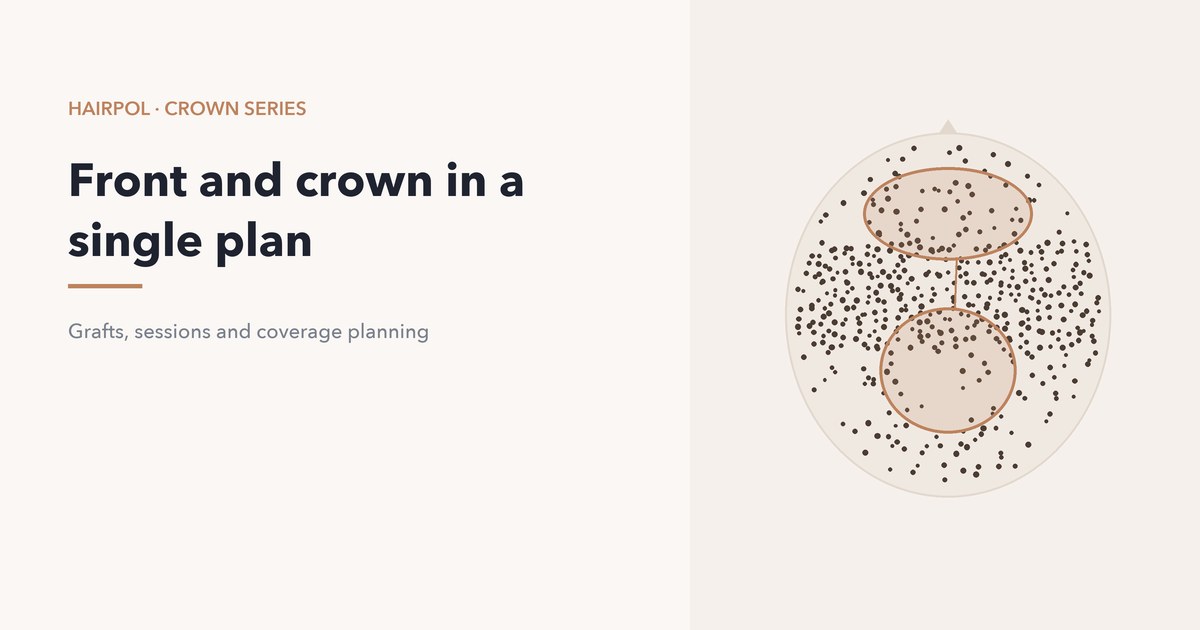
The mirror shows you one problem. The photo someone takes of you from behind shows you another. For many men, that second discovery — a thinning crown they had never actually seen — is the moment a vague plan to fix the hairline someday turns into a much bigger question: can both areas be restored properly, and can it happen in a single operation?
A hair transplant for the front and crown together is one of the most common requests we hear at Hairpol, and one of the most frequently misunderstood. It is absolutely possible, but it is not two separate procedures stapled together. It is one coverage plan drawing on one shared, finite resource: your donor area. How the grafts are divided, whether one session can honestly do the job, and when splitting the work into two stages produces a better outcome — these planning decisions shape your result far more than any technique name or clinic slogan ever will.
This guide walks through that planning process the way it unfolds in a real consultation: with numbers, with priorities, and with the limits stated out loud rather than discovered later.
Why the Front and Crown So Often Thin Together
Male pattern hair loss follows a broadly predictable map. The follicles along the hairline, temples, mid-scalp and crown are sensitive to DHT, while the hair at the back and sides is genetically resistant — which is exactly why that ring of hair survives and why it can serve as a donor zone. As the pattern advances through Norwood stages 4, 5 and 6, recession at the front and the expanding circle at the crown move toward each other, often leaving only a weakening bridge of hair between them.
That is why so many patients arrive asking about a hair transplant for the crown and hairline at the same time. It is rarely a case of two independent problems. It is one progressive process showing up in the two places where it is most visible: the frame around your face and the spiral at the top of your head.
Understanding this matters for planning. If both zones are already thinning in your early thirties, your pattern is still evolving, and any plan that treats today’s bald spots as the final picture is a plan that will look incomplete in ten years. A good surgeon designs for the pattern you are heading toward, not just the one you have now.
What “Coverage Planning” Actually Means
When only the hairline needs work, planning is relatively contained: design the line, calculate the grafts, build the density gradient. A combined front-and-crown case is a different exercise. Now the surgeon is managing a budget — a limited number of donor grafts that must be distributed across two zones with different shapes, different visibility, and different growth behavior — while keeping a reserve for the future.
Coverage planning means answering four questions in the right order. How many grafts does your donor area realistically offer over your lifetime? How many does each zone need for the coverage you would call acceptable? Which zone earns priority if the numbers do not stretch to both? And should the work happen in one session or two?
Notice what is not on that list: technique, package price, and how many grafts the clinic down the road promised you. At Hairpol, we treat those four questions as the actual consultation. Everything else is detail. When a clinic skips straight to a graft number and a date without walking you through this arithmetic, the plan is being built backwards — and combined cases punish backwards planning more than any other kind.
Can the Front and Crown Be Done in the Same Session?
Often, yes — and for the right candidate it is a genuinely good option. If the combined requirement of both zones falls within a safe single-day harvest, typically somewhere up to around 4,000 to 4,500 grafts depending on your donor density and scalp characteristics, an experienced team can treat the front and crown in the same session. One recovery period, one round of shedding and regrowth, one trip if you are travelling from abroad.
The honest caveat is that possible and optimal are not the same word. A same-session plan works when the total graft demand is moderate: a receding but not collapsed frontal zone plus an early-to-moderate crown. It becomes strained when both zones are advanced, because the arithmetic starts demanding more grafts than one session can safely deliver — and something quietly gets shortchanged, almost always the crown.
So the real question in your consultation is not whether the clinic can do both areas today. Almost any clinic will say yes. The question is: at my stage of loss, does one session genuinely cover both zones at a density I will be happy with, or is it covering one and sprinkling the other?
How the Graft Budget Gets Split Between Two Zones
In a combined plan, the split is rarely fifty-fifty. The frontal zone almost always claims the larger share, and there are solid reasons behind that. The hairline frames your face and appears in every photograph, every meeting, every mirror. Dense packing at the front produces the biggest visual return per graft. The crown, by contrast, is a whorl — hair radiates outward in a spiral, so grafts must follow curved, changing angles, and the same number of grafts covers the area less convincingly.
A representative split for a same-session case looks like 60 to 65 percent of grafts going to the front and mid-scalp, and 35 to 40 percent to the crown. In a 4,000-graft session, that might mean roughly 2,500 grafts rebuilding the hairline and frontal core, and 1,500 working through the crown’s spiral.
These are illustrations, not promises — your numbers depend on the size of each zone, the thickness of your hair shafts, and the contrast between hair and skin color. We have written a full guide to how many grafts you actually need for a natural result, and every principle in it applies twice over when two zones are competing for the same budget.
Is 3,500 Grafts Enough for the Crown and Hairline?
This exact question — is 3,500 grafts enough for the crown and hairline — is one of the most searched phrases in hair restoration, so it deserves a straight answer: sometimes yes, sometimes clearly no, and the difference is your Norwood stage.
For a Norwood 3 vertex or a moderate Norwood 4 — a receding front plus a contained crown spot — 3,500 grafts is often a genuinely workable budget: roughly 2,200 to 2,400 grafts can restore the hairline and frontal band while 1,100 to 1,300 address the crown. In that scenario, one session can produce a result that looks complete from every angle.
For a Norwood 5 and beyond, the honest math changes. Full coverage of an advanced pattern can demand 5,000 to 7,000 grafts or more across a lifetime, which no single safe session provides. At that stage, 3,500 grafts is not a full solution; it is a first stage — and it should be planned as one, with the front prioritized and the crown addressed partially or deferred to a second session. A clinic that promises complete Norwood 5 or 6 coverage from one 3,500-graft session is not describing surgery; it is describing marketing.
Donor Capacity: The Hard Ceiling on Every Combined Plan
Everything in a front-plus-crown plan ultimately answers to one number: how many grafts your donor area can give over your lifetime. For most men, the safe lifetime total sits somewhere around 6,000 to 8,000 grafts, with individual variation in both directions. Harvest beyond that ceiling and the donor zone itself starts to look visibly thin — a problem no second procedure can fix, because the resource that fixes things is exactly what got depleted.
A combined case consumes this budget faster than a single-zone case, which is why donor assessment is the first thing that should happen in your consultation, before any talk of design. Density per square centimeter, hair caliber, laxity of the scalp, the size of the stable zone — these determine whether your plan can be ambitious or must be conservative.
We have covered this in depth in our article on donor area capacity and lifetime graft supply. The short version: your donor area does not care what the plan wants. The plan has to fit the donor area, never the other way around. At Hairpol, if the lifetime math does not support full coverage of both zones, we say so in the first meeting — because you cannot make a good decision about two zones without knowing your true budget.
Megasessions: What They Promise and Where the Limits Are
Search for combined procedures and you will quickly meet the megasession: 5,000, 6,000, even 7,000 grafts promised in a single marathon day. The pitch is seductive — everything solved at once — and for a small minority of patients with exceptional donor density, larger sessions can be legitimate. But the risks scale with the numbers, and they are worth stating plainly.
Grafts are living tissue. The longer they wait outside the body, the more of them die before they ever get the chance to grow; survival rates that look excellent at 3,000 to 4,000 grafts start to erode over extended hours. Very large harvests also push the punch density in the donor zone toward visible thinning, and enormous recipient sessions stretch the team’s precision at hour ten in a way it was not stretched at hour three. Some of the graft counts quoted in aggressive marketing are also simply inflated — counted generously before extraction, never verified under the microscope.
The uncomfortable truth is that megasessions solve a scheduling problem, not a coverage problem. If your pattern genuinely needs 6,000 grafts, two well-executed sessions of 3,000 will almost always beat one heroic day — on graft survival, on donor preservation, and on the final look.
When a Two-Session Plan Is the Smarter Choice
There are combined cases where splitting the work is not a compromise — it is the better surgery. The clearest signals: an advanced pattern at Norwood 5 or beyond, where total demand exceeds a safe single session; a young patient whose loss is still progressing and whose final crown size is unknowable; borderline donor density, where conservative staged harvesting protects the zone; or diffuse thinning through the crown, where transplanting too aggressively risks shock loss to the existing hair.
A typical staged plan treats the front and mid-scalp fully in session one — the zone with the highest visual impact — and returns for the crown twelve to eighteen months later, once the first result has matured and the donor area has recovered. The second session then works with real information: how your hair actually grew, how your pattern moved, how much donor remains.
The waiting is the hard part, and we will not pretend otherwise. But a second session planned from evidence beats a first session planned from optimism. For a fuller picture of how staging decisions are made, see our guide to how many hair transplant sessions you actually need.
How Priority Is Decided When the Numbers Don’t Stretch
When the donor budget cannot fully serve both zones, something has to lead, and in the overwhelming majority of cases the front wins. The reasons are practical rather than aesthetic dogma. The hairline is visible in every social interaction; the crown mostly appears to people standing behind you. Frontal grafts produce more apparent density per unit. And a restored frame changes how your whole face reads in a way crown coverage does not.
The crown also has a strategic complication the front does not: it keeps expanding. Fill a crown early and aggressively, and continuing loss can leave a transplanted island inside a widening bald ring — demanding still more grafts from a shrinking reserve. That is why crown work is often deliberately conservative, sometimes intentionally partial, with medication holding the surrounding territory.
We have examined this dilemma from the sequencing angle in a separate article — crown vs hairline: which should you do first — which is worth reading if you can only address one zone for now. This article assumes the other path: you want a single coordinated plan for both, and the question is how to distribute, not which to abandon.
Technique Matters More When Two Zones Are Involved
A combined case asks different things of different parts of the scalp, and technique should follow anatomy. Along the hairline, the priorities are refined incisions and control of angle and direction — this is where Sapphire FUE, with its smooth sapphire blades and tight incision geometry, earns its reputation for dense, natural frontal work. In the crown, the challenge is the whorl: implantation must follow a spiral whose angles change every few millimeters, and DHI implanter pens give the surgeon direct control of angle and depth with every graft placed.
Many combined plans at Hairpol therefore use each technique where it serves best rather than forcing one method across the whole scalp. But keep the hierarchy honest: technique decides how well a plan is executed, not whether the plan itself is sound. A perfect implanter pen cannot rescue a graft budget that was split badly, and sapphire blades cannot manufacture donor capacity that is not there.
If a consultation spends more time on the brand names of the tools than on your donor math and your zone priorities, you are hearing a sales script, not a surgical plan.
What Recovery Looks Like When Both Zones Heal at Once
Practically speaking, recovering from a combined session is not dramatically harder than recovering from a single-zone procedure — the same first-week rules apply: protected sleep, careful washing, no friction, no sweat-inducing exercise. The differences are logistical. The treated territory is larger, so redness and scabbing cover more of your head and are harder to hide in the early weeks. Sleeping takes more care, because the crown itself is a treated zone, which rules out lying flat on your back against the pillow for the first nights.
Shock loss — the temporary shedding of transplanted and sometimes native hair in the weeks after surgery — can also feel more confronting in a combined case, simply because it happens across two visible regions at once. It is normal, it is temporary, and it is not evidence that anything failed.
Expect ten to fourteen days before you look socially unremarkable, a hat-friendly month, and the usual patience-testing gap between month one and month four when nothing seems to be happening. None of this differs in kind from a standard procedure. What differs is the next part: the two zones do not grow back on the same clock.
The Two-Speed Timeline: Why Your Crown Lags Your Hairline
Plan for this now and it will not worry you later: the front and the crown mature at different speeds. Frontal grafts typically show meaningful growth from month three or four, look presentable by month six, and approach their final density around month twelve. The crown routinely runs three to six months behind — believed to relate to its blood supply and the visual mechanics of the whorl — with results often still improving at month fifteen and not fairly judged before month eighteen.
This lag is the single most common source of anxiety in combined cases. At month seven, your hairline looks transformed while your crown still looks sparse under bathroom lighting, and the conclusion feels obvious: the crown failed. Almost always, it did not. It is simply on its own schedule, and photographs taken under consistent light month by month will show a slow, steady fill that memory and mirrors miss.
A clinic planning a combined case should tell you this before surgery, not explain it defensively afterwards. When you know the crown is the slow zone by design, the month-seven gap reads as expected physiology rather than a failed investment.
Protecting the Plan: Medication and Supportive Care
Here is the part of combined planning that too many patients skip: the grafts are permanent, but the native hair around them is not. Between your restored hairline and your restored crown sits mid-scalp territory that is still under genetic attack, and the crown’s borders will keep drifting outward if nothing holds them. A transplant redistributes hair; it does not switch off the underlying process.
This is why medical therapy — finasteride where appropriate, minoxidil, or both — is not an optional extra in a front-and-crown plan; it is the fence around the investment. Stabilizing the native hair shrinks the size of any future second session, keeps the bridge between your two restored zones from thinning into a gap, and preserves donor grafts for genuine needs rather than for chasing an expanding pattern.
Supportive options such as PRP and mesotherapy, offered through our hair treatments department, can further support graft recovery and native hair quality in the months after surgery. None of it replaces good planning. All of it protects good planning — which, in a two-zone case, is exactly what you paid for.
How Hairpol Plans a Front-and-Crown Case
Strip away everything above and the method is simple to state. First, measure the donor area honestly, because the lifetime budget rules everything. Second, map the full pattern you are heading toward, not just today’s thin spots. Third, split the graft budget with the front leading and the crown served realistically — fully if the numbers allow, partially or later if they do not. Fourth, choose one session or two based on arithmetic, not impatience. Fifth, hold the result with medication and follow-up, because a plan that ignores progression is not a plan.
At Hairpol in Istanbul, this is how every combined consultation runs — with your donor capacity measured before promises are made, and with the two-session conversation had openly whenever your pattern calls for it. Sometimes the honest recommendation is everything at once. Sometimes it is the front now and the crown in a year. What you will not get is a number invented to close a sale.
If your hairline and your crown are both asking for attention, start with a proper assessment. Visit our hair transplantation department to see how we approach diagnosis, planning and aftercare, and book a consultation to get numbers that actually belong to your scalp — not to an advertisement.
Frequently Asked Questions (FAQ)
Can a hair transplant cover the front and crown at the same time?
Yes, in suitable candidates both zones can be treated in a single operation. The key condition is that the combined graft requirement fits within a safe single-session harvest, usually up to around 4,000 to 4,500 grafts depending on donor capacity. In advanced hair loss, splitting the work into two sessions often gives better final coverage.
Is 3,500 grafts enough for the crown and hairline together?
For moderate patterns such as Norwood 3 vertex or Norwood 4, 3,500 grafts is often a workable budget: roughly two thirds rebuild the hairline and frontal zone while the rest covers the crown. For Norwood 5 and beyond, 3,500 grafts usually serves as a first stage rather than a complete solution, with the crown finished in a later session.
Is it risky to do the front and crown in the same session?
Not inherently, as long as the total graft count stays within safe limits and the team is experienced. Risks rise when sessions are pushed toward megasession territory: grafts spend longer outside the body, which lowers survival, and the donor area can be overharvested. A well-planned combined session keeps the numbers conservative for exactly these reasons.
How are grafts usually split between the hairline and the crown?
Most combined plans assign roughly 60 to 65 percent of the grafts to the hairline and frontal zone and 35 to 40 percent to the crown. The front gets priority because it frames the face and delivers more visible density per graft, while the crown's spiral pattern absorbs grafts less efficiently.
Why do surgeons prioritize the front over the crown?
The hairline is visible in every interaction and photograph, so it produces the largest change in appearance. The crown is mainly visible from behind and above, and it tends to keep expanding with age, which makes aggressive early crown work strategically risky. Most plans therefore secure the front first and treat the crown realistically.
What is a megasession and should I consider one?
A megasession is a very large single sitting, often 5,000 grafts or more. For a small minority of patients with exceptional donor density it can be legitimate, but graft survival tends to drop over very long procedures and the donor area faces heavier depletion. If your pattern needs that many grafts, two staged sessions usually produce a better and safer result.
How long does it take to see the full result in both zones?
The front typically shows visible growth from month three or four and approaches final density around month twelve. The crown usually runs three to six months behind, with results still improving at month fifteen and a fair final judgment around month eighteen. This lag is normal and should be built into your expectations from the start.
Do I still need medication after a combined front and crown transplant?
In most cases, yes. Transplanted grafts are permanent, but the native hair between and around the two zones remains genetically vulnerable. Medication such as finasteride or minoxidil helps stabilize that hair, keeps the crown's edges from drifting outward, and reduces the likelihood and size of any future session.
Find this helpful? Add Hairpol as a preferred source on Google.
Graft Range Calculator
Answer three questions to see the typical graft range for your situation — based on our published clinical guides.
This is a preliminary estimate, not a medical assessment. The exact number can only be determined by a doctor after examining your donor area and hair characteristics.
Get a Free Consultation
Answer a few questions and the medical team will review your situation.
