
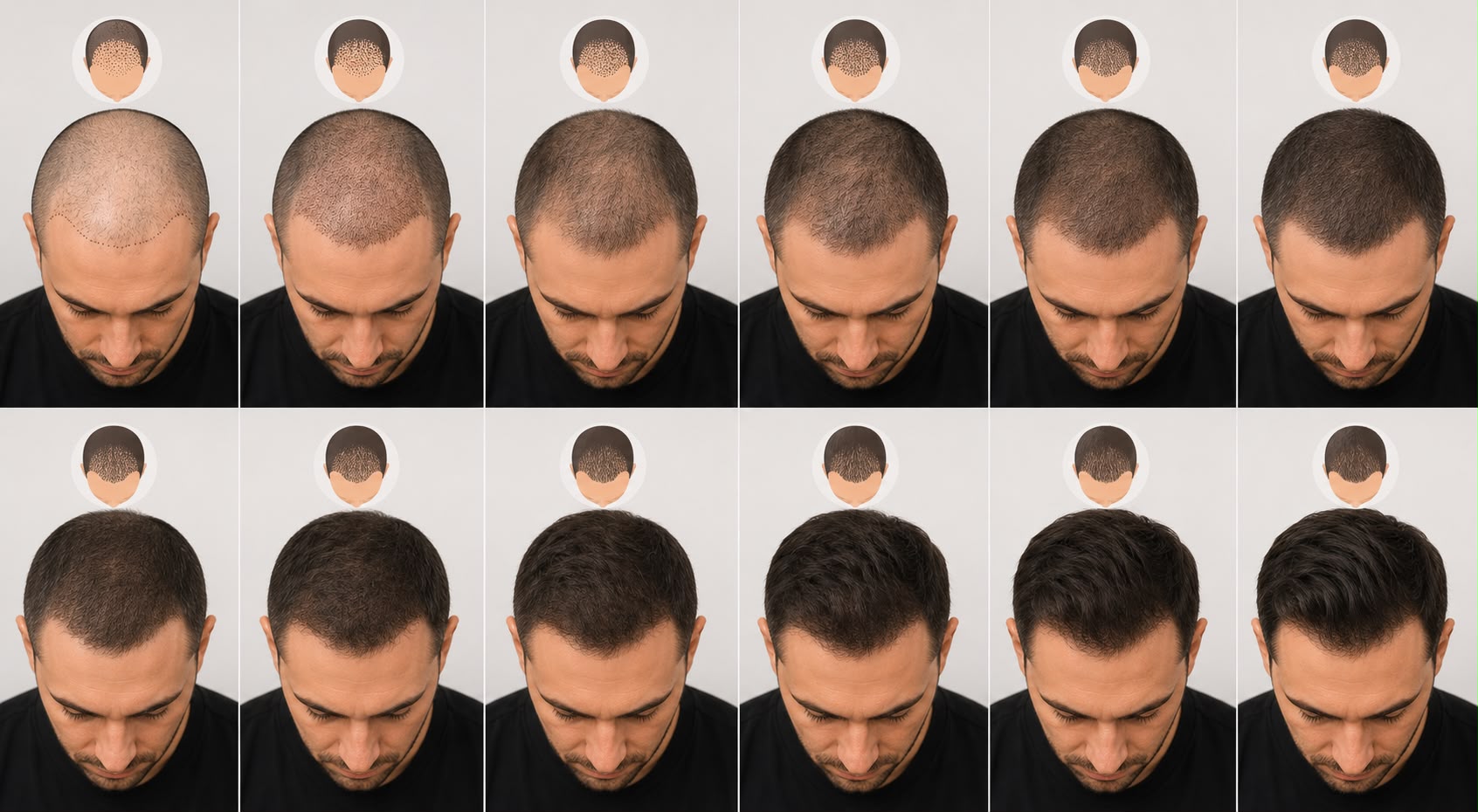
One of the most common sources of anxiety for hair transplant patients isn’t the procedure itself — it’s not knowing what’s normal during the months that follow. Patients who didn’t get a clear picture of the recovery timeline before their procedure often spend the first six months alternating between hope and worry, interpreting every shed hair and every quiet phase as a sign that something has gone wrong.
Almost none of it has. What feels like a complication is usually just a normal phase of recovery that wasn’t explained adequately. The hair transplant timeline is well-documented, biologically predictable, and follows roughly the same pattern for the vast majority of patients. Knowing that pattern in advance is one of the most useful things you can do for yourself before a procedure — because the difference between expecting a phase and being surprised by it is the difference between calm patience and unnecessary distress.
This guide walks through the entire hair transplant timeline month by month. What’s happening biologically at each stage, what you’ll see in the mirror, what’s normal and what isn’t, and how to think about each phase as you move through it. The goal is to give you the realistic mental model that makes the whole experience easier to navigate.
Day 1: The Procedure Day
The day of the procedure is long. A typical hair transplant runs six to eight hours for moderate graft counts, longer for larger procedures. The procedure itself happens under local anesthesia — you’re awake throughout, but the scalp is numbed so you don’t feel the extraction or implantation work.
What happens on the procedure day:
- Pre-procedure consultation and hairline or treatment area design confirmation.
- Donor area preparation, including shaving of the extraction zone.
- Local anesthesia administration.
- Graft extraction from the donor zone — typically the back and sides of the scalp.
- Recipient channel creation in the treatment area.
- Graft implantation into the prepared channels.
- Post-procedure cleaning, dressing where appropriate, and instructions for the first night.
By the end of the day you’re tired, your scalp feels tight and slightly tender, and your head is wrapped or partially covered for transport. You’ll need someone to take you back to your accommodation — driving immediately after the procedure isn’t appropriate.
Days 2–7: The First Week
The first week is when the visible evidence of the procedure is at its most apparent. Your scalp is healing actively, and several things are happening at once.
What you’ll see and experience:
- Small scabs forming around each implantation site as the channels close and the grafts stabilize.
- Mild to moderate swelling, often most pronounced around the forehead and eyes between days two and four. This is gravity moving fluid downward from the scalp.
- Tenderness in the donor area — the back and sides of the scalp feel sore and the skin may feel tight.
- Some redness across the recipient area.
- Tiny dots in the donor zone where individual follicles were extracted.
The most important things during this week:
- Follow the washing protocol your clinic provided exactly. The first wash is usually done at the clinic on day two or three, after which you take over.
- Sleep with your head elevated at roughly 45 degrees for the first three to five nights to minimize swelling.
- Avoid anything that puts pressure on the grafts — tight hats, sleeping directly on the recipient area, towel rubbing.
- No strenuous activity. Grafts in the first week are held in place only by a thin fibrin seal, and physical disturbance can dislodge them.
- No alcohol, no smoking. Both interfere with the healing process during the most vulnerable window.
By the end of week one, swelling has typically resolved and the scabs are beginning to loosen. The visible procedure marks are starting to settle.
Weeks 2–3: Scabs Resolve, First Signs of Shock Loss
By the start of week two, the scabs are coming away naturally during gentle washing. By the end of week three, most of the scabbing has resolved and the surface of the scalp looks much closer to normal.
This is also when many patients notice something that can be alarming if they weren’t expecting it: the transplanted hair shafts themselves beginning to shed. Hairs that came through the procedure attached to their grafts now release as those follicles enter the resting phase of the growth cycle.
This is shock loss. It’s universal, it’s expected, and it’s not the grafts being lost. The follicles are intact beneath the surface — what’s shedding is the existing hair shaft, while the follicle itself prepares to enter the next active growth phase.
Activity restrictions begin to graduate during this period:
- Light walking and normal daily activity are fine.
- Strenuous exercise, heavy lifting, and high-impact cardio should still be avoided.
- Sun exposure on the healing scalp should be managed carefully — direct sun can cause prolonged redness and pigmentation changes.
- Wearing a loose, breathable hat is acceptable if needed for sun protection.
Month 2: The Shock Loss Continues
The second month is when the result often looks its worst. Shock loss is fully underway. The transplanted hair shafts have shed, and any native hair in the treated area may also have shed in response to the procedural stress.
Patients who didn’t know what to expect during this phase frequently panic at the appearance of their scalp and worry that something has gone wrong with the procedure. Nothing has. What’s happening is the normal sequence:
- Transplanted follicles have entered the telogen phase — the resting phase of the hair growth cycle.
- The hair shafts those follicles were producing have shed.
- The follicles themselves are firmly in place beneath the surface, but they’re now in a resting state with no visible hair growing from them.
- Some native hair in the treated area may also have entered telogen and shed.
The result is that the treatment area can look genuinely sparse during month two — sometimes sparser than it did before the procedure. This is the phase where understanding the timeline matters most. Patients who know that this is what month two looks like move through it with much less distress than those who interpret it as a failure.
Activity can return to a more normal level. Most clinics permit moderate exercise from around week three onward, with full intensity training typically returning by week six. Sun protection remains important.
Months 3–4: The Quiet Phase
Months three and four are biologically the most active period of recovery and visually the most discouraging. The follicles that shed during the shock loss phase are now in telogen, preparing to re-enter the active growth phase. New hair shafts are forming below the surface, but they haven’t yet emerged.
What this means in practice:
- The treatment area looks largely unchanged from how it looked at the end of month two.
- New growth is happening, but it’s not yet visible.
- Patients often feel like nothing is improving and that progress has stalled.
Some patients begin to see the very first hairs emerging by the end of month four, particularly in the frontal zone. These early hairs are typically fine, sometimes lighter in color than the patient’s mature hair, and don’t yet contribute much to visible coverage. They’re a signal that the process is moving forward, not a representation of the final result.
This is also the phase where impatience peaks for many patients. The procedure is months in the past, the early excitement has worn off, and nothing visible seems to be happening. Holding onto the timeline framework — knowing that months three and four are quiet by biological design — makes this phase significantly easier to get through.
Months 5–6: First Real Signs of Growth
Month five is typically when the result starts to show real evidence of new growth. Hairs that have been forming beneath the surface emerge through the scalp and become visible. The treatment area begins to look less sparse than during the quiet phase.
What’s happening during this phase:
- Transplanted follicles are now in anagen — the active growth phase — and producing new hair shafts.
- Hairs emerge at varying rates across the treated area, so coverage builds unevenly at first.
- The hair that emerges is typically fine in caliber and doesn’t yet have the thickness it will reach at full maturity.
- Color may be lighter than the patient’s mature hair color initially.
By the end of month six, most patients can see meaningful improvement compared to month two. The frontal zone may be showing strong progress; the crown, if treated, often lags behind by a few weeks because of its slower growth pattern. This is when patients often begin to feel that the procedure was worth the wait — the visible payoff finally starting to materialize.
Patience is still required, though. What you’re seeing at six months is typically about half of the final result. Hair caliber hasn’t reached its mature thickness yet, late-emerging grafts haven’t all come through, and the overlapping coverage effect that will define the mature result is still building.
Months 7–9: Density Builds Visibly
Through months seven, eight, and nine, the result develops noticeably from month to month. This is the period when patients tend to take the most progress photos because the changes are genuinely visible at this interval.
What’s developing:
- Hair caliber is increasing as the new follicles mature.
- Late-emerging grafts continue to come through, adding to density.
- Hair color is darkening to its mature shade.
- The transition between transplanted and surrounding native hair is becoming less distinct.
By month nine, most patients have a result that represents the majority of what they’ll see at full maturity. The treatment area looks substantially covered, the grafts are firmly established, and the patient can begin to assess whether the procedure has produced what they hoped for.
Hair styling becomes much more practical during this period. Patients who have been keeping their hair short to manage the appearance during early recovery can start growing it out and styling normally.
Months 10–12: The Result Becomes Assessable
By months ten through twelve, the result is genuinely assessable. This is the milestone most clinics use for their primary before-and-after documentation, and it’s the point at which patients can reasonably evaluate what their procedure has produced.
At twelve months, most patients are seeing roughly 80 to 90 percent of their final result. The remaining development happens in the months that follow as the last late-emerging grafts contribute and hair caliber reaches its full thickness.
What a twelve-month result typically looks like:
- Substantially improved coverage compared to the pre-procedure starting point.
- A natural-looking integration with surrounding native hair.
- Density appropriate to the graft count placed and the area treated.
- A result that holds up under various lighting conditions and viewing angles.
- No visible signs that the patient had a procedure unless someone is specifically looking for them.
If you addressed both your hairline and your crown, you’ll notice that the frontal result has been mature for some time at this point while the crown may still be catching up. The crown typically takes two to four months longer than the frontal zone to reach full maturity.
Months 13–18: Full Maturity
The result continues to develop subtly through the second year, particularly during months thirteen through eighteen. This phase is less about new growth and more about refinement of what’s already there.
What changes during this period:
- Hair caliber continues to thicken slightly as follicles reach their fully mature growth pattern.
- Any remaining late-emerging grafts come through.
- The integration between transplanted and surrounding native hair continues to refine.
- The patient becomes fully accustomed to styling and managing the new hair.
By month eighteen, the result has reached its full mature appearance. This is the result that will hold steady going forward — with the important caveat that ongoing native hair loss around the treated area will continue to follow its natural trajectory unless addressed with medical management.
Year 2 and Beyond: The Long-Term Picture
Once the result reaches full maturity at the eighteen-month mark, the transplanted hair itself is permanent. Donor dominance — the principle that follicles from the permanent donor zone retain their genetic characteristics in their new location — means the transplanted hair will continue growing for life.
What varies over the years that follow is the native hair around the transplanted area. The native hair continues its natural trajectory. For patients with active androgenetic hair loss, that trajectory is continued thinning over time. This is why finasteride and minoxidil are typically recommended as ongoing components of a hair restoration plan rather than treatments to be used for a defined period and then stopped.
Patients who commit to ongoing medical management typically maintain results at five and ten years that closely resemble their eighteen-month appearance. Patients who don’t may find the picture changes over time as native hair loss continues, even though the transplanted hair itself remains stable.
What’s Normal and What Isn’t
Most of what patients experience during recovery is normal and expected, even when it feels alarming. A few situations warrant contacting your clinic.
Normal during recovery:
- Scabbing during the first two weeks.
- Swelling around the forehead and eyes between days two and four.
- Shock loss during weeks two through eight.
- The treatment area looking thinner during months two through four than immediately after the procedure.
- Slow visible progress during months three and four.
- Itching during early healing.
- Mild redness in the recipient area lasting up to three months.
- Numbness in the donor or recipient area that resolves gradually over weeks to months.
Worth contacting your clinic about:
- Unusual pain that increases rather than decreases over the first week.
- Yellow or green discharge from any graft site.
- Spreading redness beyond the treated area, particularly with fever.
- Sudden swelling that develops after the first week rather than during it.
- Bleeding from graft sites beyond the first 48 hours.
What Affects the Timeline
The timeline described above represents the typical pattern, but individual experiences vary based on several factors:
- Treatment area: The frontal hairline shows visible growth earlier than the crown by a few weeks to a couple of months. Beard and eyebrow transplants follow somewhat different timelines because of the different growth cycle of facial hair.
- Individual biology: Some patients are genuinely fast healers and fast growers. Others run on the slower end of normal. Both are within the normal range.
- Age: Younger patients sometimes show visible growth slightly earlier; older patients may take a bit longer.
- Procedure size: Very large procedures may have somewhat extended timelines simply because of the volume of grafts coming through their growth cycles.
- Medical management: Patients on minoxidil during recovery may see earlier visible growth than those without — minoxidil supports the transition from telogen back into anagen.
- General health: Stress, illness, poor nutrition, smoking, and excessive alcohol all affect healing and growth pace.
How to Navigate the Long Wait
The recovery timeline is psychologically demanding because the gap between expectation and visible reality is wide during the early months. A few practical things that help patients move through it:
- Take monthly progress photos in consistent lighting and angle. Progress between two consecutive months can be hard to see; progress between month three and month seven is obvious.
- Don’t compare your timeline to before-and-after galleries from your clinic. Those galleries show endpoint results, not intermediate stages, and comparison will always feel discouraging during early months.
- Limit how often you look at the treatment area directly during the early months. Obsessive monitoring during the shock loss phase is unpleasant and doesn’t change anything.
- Build expectations around the twelve-to-eighteen-month timeline, not the twelve-week one. Setting your internal benchmark for assessing the result at one year, not three months, makes the early phases dramatically easier to navigate.
- Stay in touch with your clinic. Good aftercare includes ongoing communication about what’s normal at each stage.
At Hairpol, the recovery support extends throughout the full timeline — not just the first few weeks but the months that follow, when questions and concerns arise at multiple stages of the long process. The procedure is the surgical event, but the timeline is the actual experience, and supporting patients through it is part of what good post-procedure care actually looks like in practice.
The Practical Summary
The hair transplant timeline runs longer than most patients initially expect, but it follows a predictable pattern that holds for the vast majority of cases. Day one is the procedure. The first two weeks are visible healing. Weeks two through eight are shock loss. Months three and four are the quiet phase. Month five brings the first real growth. Months six through nine build density visibly. Month twelve is when the result becomes assessable. Months thirteen through eighteen are full maturity.
The patients who report the smoothest emotional experience through this process aren’t those whose procedures went better — they’re those whose expectations matched the actual biological timeline. Knowing what to expect at each month means you can interpret what you see as normal progress rather than as concerning deviation. That alone makes the long wait significantly more manageable than it otherwise would be.
Frequently Asked Questions (FAQ)
How long does it take to see results after a hair transplant?
First visible signs of new growth typically emerge between months four and five, though the hairs at this stage are fine and don't yet contribute meaningfully to coverage. By month six, real density improvement becomes apparent. By month nine, most patients have a result that represents the majority of what they'll see at full maturity. By month twelve, the result is genuinely assessable at roughly 80 to 90 percent of final maturity. Full maturity is typically reached between months twelve and eighteen, with the crown sometimes taking up to month eighteen because of its slower growth pattern compared to the frontal zone.
What is shock loss after a hair transplant?
Shock loss is the universal shedding of transplanted hair shafts that begins around weeks two to three after the procedure, when the follicles enter the resting phase of the growth cycle in response to being moved. Some native hair in the treated area may also shed in response to the procedural stress. The treatment area can look thinner during months two through four than it did immediately after the procedure — sometimes sparser than the pre-procedure starting point. This is expected, fully reversible, and not the grafts being lost. The follicles themselves remain firmly in place beneath the surface and will produce new hair as they re-enter anagen, typically starting from month five onward.
Is it normal for my hair to look worse a few months after the transplant?
Yes — it's completely normal for the treatment area to look worse during months two through four than immediately after the procedure. This is the combined effect of shock loss (transplanted hair shafts shedding as follicles enter telogen) and the quiet phase that follows (new growth developing beneath the surface but not yet visible). The follicles themselves are intact and preparing to enter the active growth phase. This is the phase of recovery that causes the most unnecessary anxiety, but it resolves as new growth emerges from month five onward. Knowing this is part of the normal timeline before the procedure significantly reduces the distress of going through it.
When can I return to work after a hair transplant?
Most patients return to desk-based work between three and seven days after the procedure, depending on how visible the early healing signs are and how comfortable the patient is with colleagues seeing them. By day three to four, swelling has typically resolved and the patient feels physically normal. By day seven to ten, the visible scabs are mostly gone. Patients in roles requiring physical activity may need longer — typically two to three weeks before resuming labor-intensive work, and longer for jobs involving heavy lifting or environments where the scalp could be physically disturbed. Patients whose work involves regular client-facing interaction sometimes prefer to wait until the visible signs are fully gone before returning.
When can I exercise after a hair transplant?
Light walking and normal daily activity are fine from day one. Strenuous exercise, heavy lifting, and high-impact cardio should be avoided for the first two weeks to prevent elevated blood pressure that could disturb healing grafts. Moderate exercise typically resumes around week three. Full intensity training — including heavy lifting, high-impact cardio, and contact sports — is generally appropriate from week six onward. Anything that puts pressure or impact directly on the scalp, including helmets and tight headgear, should be avoided for longer. Swimming should typically be avoided for at least four weeks because of the risk of chlorinated water on healing scalp tissue.
How long does the hair transplant recovery process take in total?
The complete hair transplant recovery process runs from the procedure day to full result maturity at twelve to eighteen months. The acute healing phase — scabbing, swelling, surface healing — completes within the first two to three weeks. Shock loss occurs during weeks two through eight. The quiet phase runs through months three and four. New growth becomes visible from month five onward. The result is genuinely assessable by months ten to twelve. Full maturity is reached between months twelve and eighteen, with subtle continued refinement possible through month eighteen. While the procedure itself takes a single day, the timeline for seeing the full result is best understood as a year-plus process.
Why does the crown take longer than the hairline to grow back?
The crown consistently shows results later than the frontal zone because of its spiral growth pattern. Crown hair grows in multiple directions radiating from a central whorl point, while frontal hair grows in a unified forward direction. Hairs growing in multiple directions don't produce the same overlapping coverage that frontal hair does, so visible density builds more slowly. The crown also tends to have a higher proportion of late-emerging grafts, meaning the result continues to develop and refine through the second year. New growth from crown grafts typically becomes meaningfully visible between months five and seven (compared to three to five for frontal work), and full crown maturity often takes until months twelve to eighteen — two to four months longer than frontal work on average.
What can affect how fast my hair transplant grows?
Several factors affect individual recovery and growth pace. Treatment area matters: the frontal hairline shows visible growth earlier than the crown. Individual biology varies — some patients are genuinely fast healers and growers, others run on the slower end of normal. Age has some effect, with younger patients sometimes showing slightly earlier growth. Procedure size affects perceived progress because larger procedures have more grafts coming through their growth cycles. Medical management with minoxidil can support earlier visible growth by helping the transition from telogen back into anagen. General health factors — stress, illness, nutrition, smoking, alcohol — all affect healing and growth pace. None of these factors will dramatically change the overall timeline, but they can shift it by weeks within the normal range.
Find this helpful? Add Hairpol as a preferred source on Google.
Get a Free Consultation
Answer a few questions and the medical team will review your situation.
