
For anyone researching a hair transplant, the price gap is the first thing that grabs attention — and often the first thing that raises suspicion. The same procedure that the NHS puts anywhere between £1,000 and £30,000 in the UK’s private market, and that Healthline puts at $4,000 to $15,000 in the United States, is advertised in Istanbul at headline prices far below the upper end of either range, sometimes all-inclusive with hotel and transfers thrown in. The natural reaction is to assume something must be wrong. If it’s this much cheaper, surely the quality is worse, the clinic is cutting dangerous corners, or there’s a catch.
The reality is more nuanced and more interesting. Much of Turkey’s price advantage is genuinely structural — real economic factors that let a well-run Istanbul clinic charge far less than a Western one while operating to high standards. But part of the price spread is also real corner-cutting at the bottom of the market. Understanding which is which is exactly what protects you from both the false assumption that cheap means bad and the equally dangerous assumption that the cheapest option is fine.
This guide explains the real economics behind Turkey’s low hair transplant prices: the legitimate structural reasons the costs are lower, why this doesn’t automatically mean lower quality, and where the genuinely-too-cheap operations make their savings — so you can tell a fair price from a dangerous one.
Before comparing offers, see what shapes hair transplant costs in Turkey and what a package should include.
The Legitimate Reasons Turkish Prices Are Lower
Most of Turkey’s price advantage comes from structural economic factors that have nothing to do with cutting medical corners. These are real, and they explain why even a high-quality Istanbul clinic can charge a fraction of a Western price.
The exchange rate. This is the single biggest factor. The Turkish lira has depreciated significantly against the pound, euro, and dollar over recent years. A clinic’s costs — staff, rent, equipment, utilities — are largely paid in lira, while international patients pay in much stronger currencies. A price that’s substantial in lira converts to a modest sum in pounds or dollars. This alone accounts for a large share of why the same procedure looks so cheap to a Western patient.
Lower cost of living and labour. Wages, rent, and operating costs in Turkey are considerably lower than in the UK, Germany, or the US. A surgeon, nurses, and technicians cost less to employ, a clinic costs less to run, and these lower input costs are reflected in the price — without any reduction in the quality of the work.
Enormous volume and specialization. Turkey performs more hair transplants than any country on earth. This concentration creates efficiency: clinics are highly specialized, staff are extremely experienced, processes are streamlined, and the high number of procedures spreads fixed costs (facility, equipment, licensing) across many patients. A clinic doing procedures daily has a far lower per-procedure overhead than one doing a handful a month.
Intense competition. Istanbul alone has hundreds of clinics competing for international patients. This competition drives prices down across the whole market — clinics simply can’t charge Western prices when dozens of competitors are visible to every patient online.
Government support for health tourism. Turkey has actively positioned itself as a global health-tourism destination, with supportive policies, infrastructure, and promotion. This ecosystem lowers barriers and costs for clinics serving international patients.
Bundled efficiency. The all-inclusive package model — surgery, hotel, transfers, translator — is itself efficient. Clinics have negotiated volume rates with partner hotels and transport providers, bundling services at a lower combined cost than a patient could arrange individually.
Add these together and a genuinely high-quality procedure in Istanbul can cost a third or a quarter of the UK price for reasons that have nothing to do with compromising care. This is the part of the price gap that is completely legitimate.
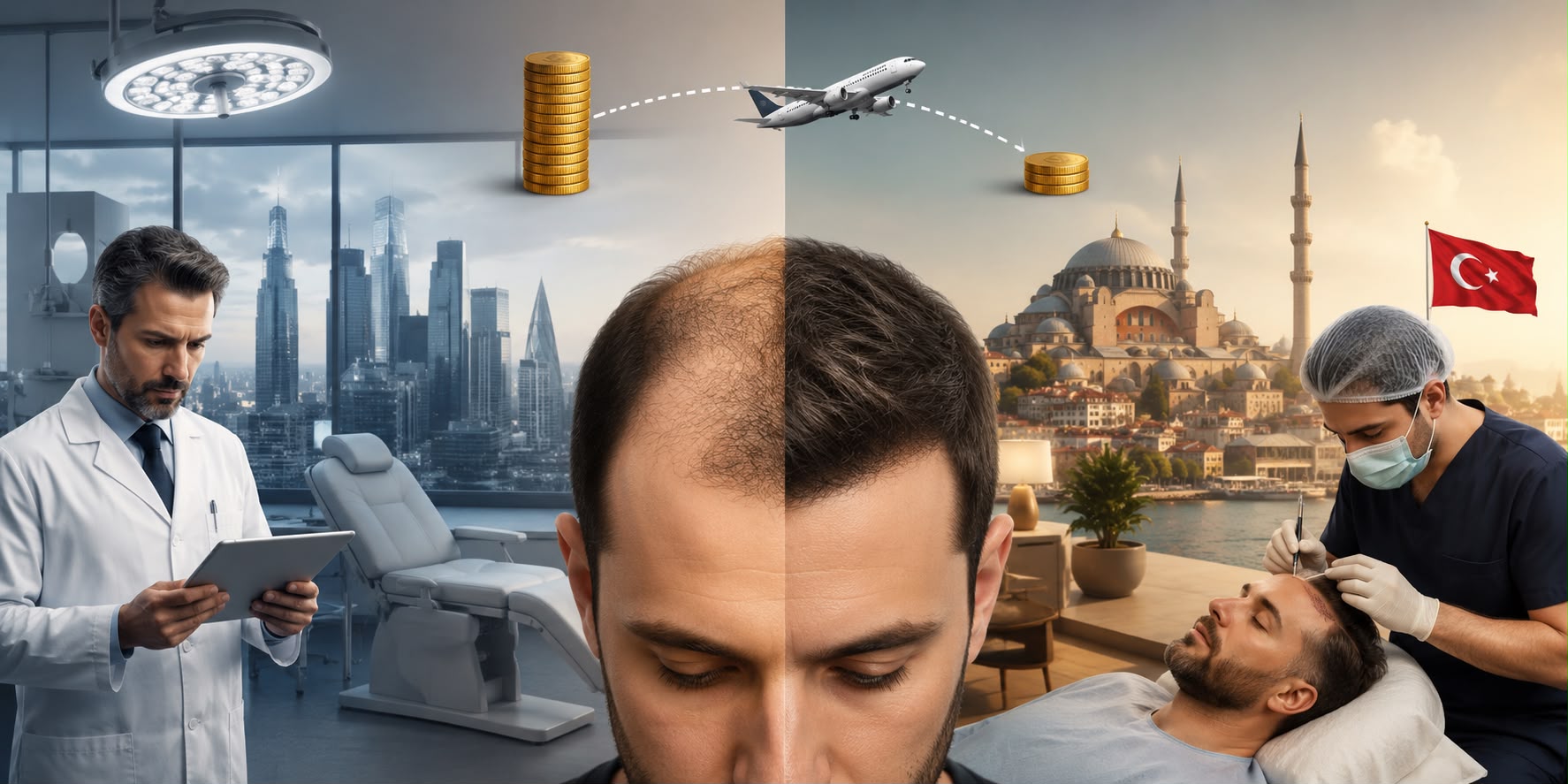
Why Low Price Doesn’t Automatically Mean Low Quality
The instinct that “cheaper must be worse” is understandable but, applied to Turkey, often wrong. The structural factors above mean a clinic can charge much less than a Western competitor while delivering equal or better work. In fact, the volume argument cuts the other way: because top Istanbul clinics perform so many procedures, their surgeons and technicians often have more hands-on experience than peers in countries where the procedure is rare. A team performing procedures daily develops a level of skill and consistency that’s hard to match in a market where a surgeon might do a few a month.
So the low price reflects a lower cost base, not necessarily a lower standard. A quality Istanbul clinic is not a worse version of a Western clinic sold at a discount — it’s a comparably good (sometimes better) clinic operating in a much cheaper economic environment. This is why hundreds of thousands of patients from wealthy countries travel to Turkey every year and return satisfied: they’re accessing genuine value, not a compromise.
Where the Genuinely-Too-Cheap Operations Cut Corners
Here’s the crucial other half of the picture. While much of Turkey’s price advantage is structural and legitimate, the very cheapest operations — the ones advertising prices that seem too good even by Turkish standards — often achieve those prices by cutting things that genuinely matter. The structural savings explain why a quality procedure in Istanbul costs a fraction of a Western European one. They do not explain the headline prices at the very bottom of the market. That extra reduction usually comes from somewhere real:
- Removing the surgeon. The biggest cost in a procedure is qualified medical time. Operations that have technicians perform the entire procedure unsupervised — with no real surgeon involvement — save the most money here, and it’s exactly the saving that most endangers the result. In Turkey, certain stages are legally required to involve a physician; bypassing this is both improper and a major cost cut.
- Running patients in parallel. Some operations process many patients simultaneously, assembly-line style, with staff moving between rooms. This maximizes daily revenue but collapses the individual attention each procedure needs.
- Cutting sterilization and facility standards. Proper sterile facilities and protocols cost money. The cheapest operations may economize here — a saving that directly raises infection and complication risk.
- Skipping proper screening. A genuine consultation and candidate assessment takes professional time. Operations that accept anyone who pays, without assessing suitability, save that cost but produce bad outcomes in unsuitable patients.
- Per-graft pricing tricks. A headline price may cover only a small number of grafts, with the real cost climbing once the patient’s actual needs are billed — so the advertised figure isn’t even the true price.
- Over-harvesting for speed. Taking too many grafts too quickly maximizes the apparent immediate result and throughput, while permanently damaging the donor area.
The key insight: legitimate structural factors get you from Western prices down to a fair Turkish price. The gap between a fair Turkish price and a rock-bottom one is usually bridged by cutting these specific corners. That’s why the cheapest quote is so often the riskiest — not because Turkey is cheap, but because that particular operation has economized on the things that protect you.
How to Tell a Fair Price From a Dangerous One
Understanding the economics gives you a practical filter. A fair Turkish price is low because of structural factors; a dangerous price is low because of corner-cutting. You distinguish them by checking what’s preserved at that price:
- Is a genuine surgeon involved in planning and the critical stages, and will you meet them? Structural savings don’t require removing the surgeon; dangerous savings do.
- Does the price cover your full required graft count, or is it a base figure with per-graft add-ons? A legitimate low price is still the real total.
- Is the clinic Ministry of Health authorized with a proper accredited facility? Licensing and sterile facilities are not where a legitimately-priced clinic economizes.
- Are patient volumes sensible, or is it an assembly line? Efficiency from specialization is legitimate; processing patients in parallel at the expense of care is not.
- Is there honest screening and a real consultation? A fair-priced quality clinic still assesses your suitability.
- Are there documented long-term results and verifiable reviews? Genuine value clinics can show real 12-month outcomes; the riskiest operations usually can’t.
When these are all preserved, a low price is simply Turkey’s structural economics working in your favour. When several are missing, the low price is being funded by cuts that put your result and safety at risk.
Curious how the trip itself works? Our guide to hair transplant in Turkey: the full process covers timing, packages and the days after you land back home.
The Bottom Line on Turkish Pricing
So why is a hair transplant so cheap in Turkey? Mostly for legitimate, structural reasons: a weak lira against strong Western currencies, lower labour and operating costs, the efficiency of enormous volume and specialization, intense competition, government support for health tourism, and the efficiency of bundled packages. These factors are real and they mean a genuinely excellent procedure can cost a fraction of the Western price without any compromise in care. The low price is not, in itself, a warning sign.
But the very cheapest operations push below even a fair Turkish price by cutting the things that protect patients — surgeon involvement, sterilization, sensible volumes, honest screening. The skill is in telling the two apart, and the economics make that possible: a fair low price keeps everything that matters and is simply cheaper to deliver; a dangerous low price is cheap because something essential has been removed. Choose based on what the price preserves, not just on the number — and Turkey’s genuine value becomes available without the genuine risk.
At Hairpol, the pricing reflects exactly the legitimate side of this equation: the structural advantages of operating in Istanbul passed on as genuine value, with none of the corner-cutting that makes the cheapest operations risky. That means Ministry of Health–authorized facilities, genuine surgeon-led planning and oversight, modern Sapphire FUE and DHI techniques, sensible patient volumes, honest candidate assessment, and transparent all-inclusive pricing with no per-graft surprises. The goal is the thing Turkey does best when it’s done right — a genuinely excellent result at a genuinely fair price.
Find this helpful? Add Hairpol as a preferred source on Google.
Get a Free Consultation
Answer a few questions and the medical team will review your situation.
