
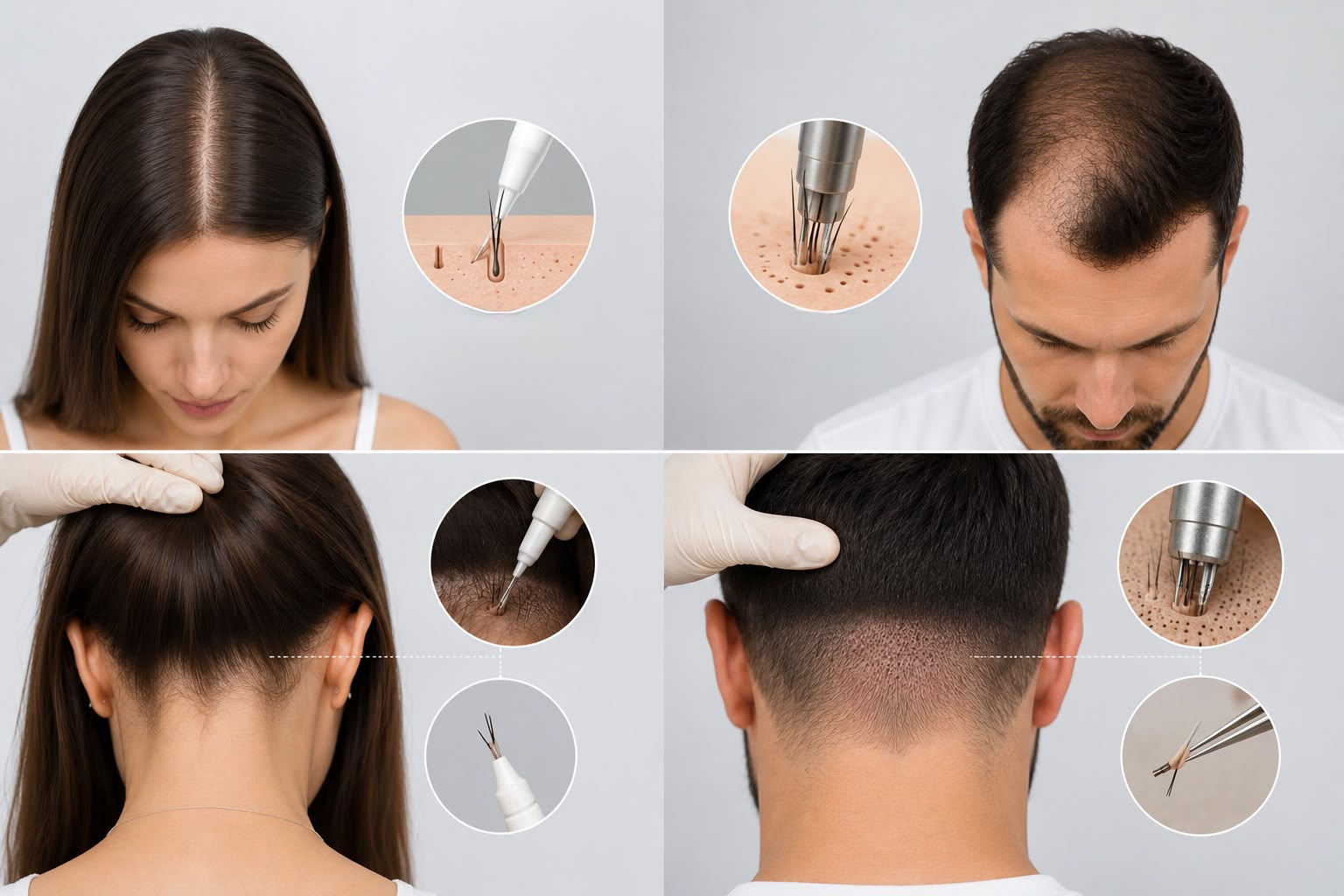
Most of what’s written about hair transplants is written about men — male pattern baldness, receding hairlines, the Norwood scale, the whole familiar landscape of male hair loss. Women experiencing hair loss often arrive at the topic assuming the same information applies to them, only to discover that female hair transplantation is a genuinely different field with different causes, different candidacy criteria, different surgical considerations, and different outcomes.
The differences aren’t cosmetic. They run all the way down to the biology of how women lose hair, which determines who is actually a suitable candidate, how the donor area must be assessed, what techniques are appropriate, and what results are realistic. A woman who approaches a hair transplant with a framework built for men can make poorly informed decisions — pursuing surgery when medical treatment is the better path, or choosing a clinic that treats her case as if it were a male one.
This guide walks through how female hair transplants genuinely differ from men’s. The distinct causes of female hair loss, why candidacy is more restrictive, the critical importance of donor area assessment, the technical and aesthetic differences in the procedure itself, and how women should think about whether surgery is the right choice for their specific situation. Understanding these distinctions is essential for any woman considering hair restoration.
The Fundamental Difference: How Women Lose Hair
The single most important difference between male and female hair loss is the pattern, and it shapes everything else.
Male androgenetic alopecia follows a predictable pattern: the hairline recedes, the temples deepen, the crown thins, and crucially, the hair at the back and sides of the scalp — the donor zone — is genetically resistant to the hormone DHT and remains permanent. This stable donor zone is what makes male hair transplantation possible. The surgeon moves DHT-resistant follicles from the back to the balding areas, where they continue resisting DHT and growing for life.
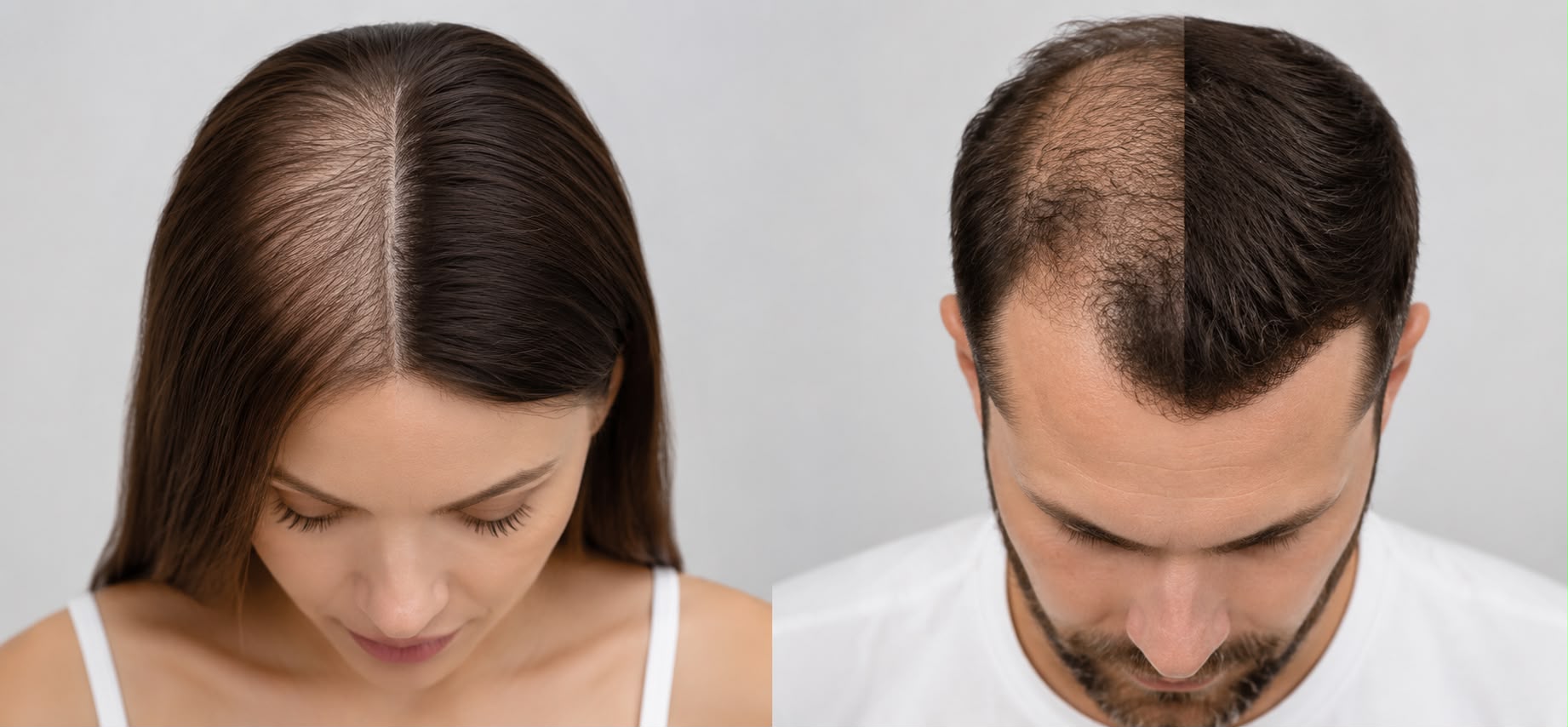
Female pattern hair loss — clinically called female pattern hair loss (FPHL) or female androgenetic alopecia — typically behaves very differently. Instead of receding at the hairline, women usually experience diffuse thinning across the top of the scalp, often described as a widening part. The frontal hairline is frequently preserved. The thinning is spread across a broad area rather than concentrated in specific zones.
The Ludwig scale, used to classify female pattern loss, describes this diffuse thinning in three grades — from mild widening of the part to extensive thinning across the crown — rather than the zone-by-zone progression of the Norwood scale used for men. The pattern matters enormously because it directly affects whether a stable donor area exists.
The Donor Area Problem
This is the most consequential difference, and the one most often misunderstood. For a hair transplant to work, there must be a stable donor area — a region of hair that’s resistant to whatever process is causing the loss, so that transplanted follicles continue growing permanently in their new location.
In men, the donor zone at the back and sides is reliably DHT-resistant in the vast majority of cases. In women, this is frequently not true. Many women with female pattern hair loss have what’s called diffuse unpatterned alopecia (DUPA) — thinning that affects the entire scalp including the donor area, with no truly stable zone to harvest from. If follicles are taken from a donor area that is itself thinning, those follicles will continue to thin after transplantation, and the procedure fails.
This is why donor area assessment is the central question in female hair transplant candidacy. A thorough evaluation examines the donor zone under magnification (trichoscopy) to assess whether the follicles there show signs of miniaturization. A stable, healthy donor area with consistent follicle caliber suggests the loss is patterned (localized) and transplantation may work. A donor area showing diffuse miniaturization suggests DUPA, in which case transplantation is generally not appropriate because there’s no reliable source of permanent hair.
The practical consequence: a smaller proportion of women than men are good surgical candidates. Estimates vary, but many specialists suggest that only a minority of women presenting with hair loss are suitable for transplantation — far fewer than the proportion of men. For women who aren’t candidates, medical management is the appropriate path, and a quality clinic will say so rather than performing a procedure unlikely to succeed.
Why Medical Workup Comes First for Women
Female hair loss has a much broader range of potential causes than male hair loss, many of which are treatable and reversible — and none of which are addressed by transplantation. Before any surgical consideration, women need a thorough medical evaluation to identify what’s actually causing the loss.
Common causes of female hair loss that require medical rather than surgical management:
- Telogen effluvium — diffuse shedding triggered by stress, illness, childbirth, surgery, or significant weight loss. This is temporary and resolves when the trigger is addressed. Transplanting during active telogen effluvium would be a serious mistake.
- Iron deficiency — low ferritin is a common and correctable cause of hair shedding in women. Blood testing identifies it; supplementation addresses it.
- Thyroid dysfunction — both underactive and overactive thyroid cause hair loss. Thyroid function testing is a standard part of the workup.
- Hormonal factors — polycystic ovary syndrome (PCOS), menopause, and other hormonal conditions affect hair. These require specific medical management.
- Nutritional deficiencies — protein, vitamin D, and other deficiencies can contribute to hair loss and are correctable.
- Medications — many drugs cause hair loss as a side effect. Identifying and adjusting these can resolve the problem.
- Autoimmune conditions — alopecia areata and other autoimmune hair loss conditions require completely different treatment than transplantation.
A responsible female hair loss evaluation includes blood work (ferritin, thyroid function, vitamin D, and other relevant markers), a detailed medical and family history, and examination of the scalp and hair under magnification. Only after reversible and medical causes have been identified and addressed does surgical candidacy come into the picture — and only for women whose loss is confirmed to be patterned androgenetic loss with a stable donor area.
The Reasons Women Seek Hair Transplants
When women are suitable candidates, the reasons for surgery often differ from men’s. The most common scenarios:
Female pattern hair loss with a stable donor. Women whose androgenetic thinning is genuinely patterned — concentrated in the top and crown with a healthy, stable donor zone — can be candidates for transplantation to add density to the thinning areas. This is the female equivalent of male androgenetic transplantation, but suitable for a smaller proportion of cases.
Traction alopecia. Hair loss caused by years of tension on the hair — tight ponytails, braids, extensions, certain hairstyles — produces a characteristic pattern of loss, often at the hairline and temples. If caught before the follicles are permanently scarred, the underlying hair may recover with behavior change. If the loss is established and permanent, transplantation into the affected areas can restore the hairline, and because the rest of the scalp is typically unaffected, the donor area is usually stable.
Hairline lowering / high forehead correction. Some women seek hair transplantation not for hair loss but to lower a naturally high hairline or reshape the hairline for aesthetic reasons. This is a cosmetic procedure rather than a treatment for loss, and because these women have full, stable hair, they’re often excellent surgical candidates.
Scarring and post-surgical restoration. Hair loss from scars — surgical scars, burns, accidents, or cosmetic procedures like facelifts that shift the hairline — can be addressed with transplantation. The surrounding scalp is typically stable, making these good candidates.
Eyebrow restoration. Eyebrow transplantation is common among women who have over-plucked, have naturally sparse brows, or have lost brow hair to medical conditions. The technique uses the same follicular unit principles adapted to the specific angles and growth patterns of eyebrow hair.
The Question of Shaving
One of the most significant practical differences in female hair transplantation is the approach to shaving the donor and recipient areas.
For men, shaving the donor area (and often the recipient area) is standard and rarely a major concern — short hair is normal and grows back quickly. For women, shaving a visible area of the scalp is often unacceptable, both practically and emotionally. A woman can’t easily disguise a shaved donor strip the way short hair conceals it on a man.
This has driven the development of techniques that minimize or avoid visible shaving for female patients:
- Unshaven FUE — extracting follicles from the donor area without shaving it, working through the existing long hair. This is more time-consuming and technically demanding, and limits the number of grafts that can be extracted efficiently, but it allows women to maintain their appearance throughout recovery.
- Partial shaving / window technique — shaving only a small donor area that can be covered by the surrounding longer hair. The shaved window is hidden beneath the hair above it, invisible once the hair is down.
- Long-hair FUE — specialized approaches that preserve hair length on the extracted grafts, allowing immediate visual coverage.
Not all clinics offer these unshaven or minimal-shave approaches, and they require specific expertise. For women, the availability of an appropriate shaving approach is an important part of clinic selection. The trade-off is that unshaven techniques are typically slower, sometimes more expensive, and may limit graft numbers compared to fully shaved procedures.
Technical and Aesthetic Differences in the Procedure
Beyond donor assessment and shaving, the procedure itself involves considerations specific to women.
Hairline design differs. Female hairlines are naturally different from male hairlines — typically rounder, lower, without the temporal recession that characterizes mature male hairlines, and often with subtle irregularities and sometimes a slightly lower central point. Designing a female hairline requires understanding these differences. A male-pattern hairline design on a woman looks wrong; the aesthetic goals are distinct.
Density and distribution priorities differ. Because female loss is typically diffuse thinning rather than complete baldness, the goal is often adding density to areas that still have some hair rather than creating coverage in completely bald zones. This requires careful work to place grafts between existing hairs without damaging them — a scenario where DHI‘s precision in placing grafts among existing follicles can be advantageous. Sapphire FUE also serves these cases well with its clean, fine channel creation.
Existing hair must be protected. Since women typically retain significant hair in the treatment area, protecting that existing hair during the procedure is critical. Damaging existing follicles while placing new grafts would be counterproductive. This demands precision and careful technique.
Graft numbers are often smaller. Female procedures frequently involve fewer grafts than male procedures, because the goal is adding density to thinning areas rather than reconstructing entirely bald zones. A typical female density procedure might involve 1,500 to 3,000 grafts, though this varies by case.
Medical Management for Women
The medications used for female hair loss differ from those used for men, and this is an important distinction.
Minoxidil is the primary approved medical treatment for female pattern hair loss. Topical minoxidil is well-established for women and is often the first-line treatment, used either instead of or alongside other approaches. It supports existing follicles and can produce meaningful improvement in many women, sometimes reducing or eliminating the perceived need for surgery.
Finasteride is more complicated for women. It’s the standard treatment for male androgenetic alopecia, but in women it carries significant considerations. It’s contraindicated in women who are pregnant or who may become pregnant because of risks to a male fetus, and its use in women is generally off-label and limited to specific circumstances under specialist supervision — typically postmenopausal women or those using reliable contraception, and even then its evidence base in women is weaker than in men. Women should not assume that the finasteride recommendations made for men apply to them.
Other treatments sometimes used for female hair loss include anti-androgen medications (like spirondolactone) for women with hormonal components to their loss, addressing underlying conditions like PCOS, and various supportive approaches. These require specialist guidance tailored to the individual.
The key point: medical management for women is genuinely different from medical management for men, and the male playbook doesn’t transfer. A woman’s treatment should be guided by appropriate evaluation of her specific situation, not by recommendations designed for male androgenetic loss.
Candidacy: Who Is a Good Female Candidate?
Bringing these factors together, the profile of a good female hair transplant candidate includes:
- A confirmed diagnosis of patterned hair loss (androgenetic, traction, or scarring) rather than diffuse unpatterned loss or a reversible medical cause.
- A stable, healthy donor area confirmed by trichoscopic examination showing no significant miniaturization.
- Reversible causes ruled out or addressed — thyroid, iron, hormonal factors, telogen effluvium all evaluated and managed.
- Realistic expectations about adding density rather than creating dramatic transformation, particularly for diffuse thinning cases.
- Stable rather than actively progressing loss, ideally with medical management in place to protect the result.
- Good candidates for cosmetic cases — women seeking hairline lowering or scar correction with full, stable surrounding hair are often excellent candidates.
Women who are typically not good candidates include those with diffuse unpatterned alopecia (no stable donor), those with active untreated telogen effluvium or reversible medical causes, those with unrealistic expectations about what density can be achieved, and those with active autoimmune hair loss conditions.
What Recovery Looks Like for Women
The recovery timeline for women follows the same biological arc as for men: initial healing in the first two weeks, shock loss in weeks two to six, the quiet phase through months two to four, new growth from months four to five, and maturation through twelve months.
A few female-specific recovery considerations:
- Shock loss can be particularly distressing for women because they typically start with more existing hair in the treatment area, and the temporary shedding of both transplanted and surrounding native hair can feel dramatic. Understanding that this is normal and temporary is especially important for female patients.
- Styling around the recovery is often easier for women with longer hair, who can arrange their existing hair to cover the treatment and donor areas during early healing — particularly with unshaven or window techniques.
- The same aftercare protocols apply — gentle washing, sleep position care, avoiding the high-risk behaviors during the vulnerable early period.
Choosing a Clinic for Female Hair Transplantation
For women, clinic selection involves everything that matters for men plus several female-specific considerations. The standard verification applies — Ministry of Health authorization, surgeons who perform the surgical work directly, ISHRS membership, and long-term result documentation. On top of this, women should specifically look for:
- Genuine experience with female cases. Female hair transplantation is a distinct skill set. Ask specifically about the clinic’s experience with women and to see long-term results on female patients.
- Thorough donor assessment. A clinic that examines the donor area under magnification and discusses donor stability honestly is approaching female candidacy correctly. A clinic that proposes surgery without careful donor evaluation is skipping the most important question.
- Willingness to recommend against surgery when appropriate. Because a smaller proportion of women are good candidates, a quality clinic will tell some women that medical management is the better path. A clinic that recommends surgery to every woman who consults is a warning sign.
- Appropriate shaving options. If maintaining your appearance through recovery matters, confirm the clinic offers unshaven or minimal-shave techniques and has real experience with them.
- Proper medical workup. A clinic that wants blood work and a medical history before discussing surgery is approaching female hair loss responsibly. One that moves straight to surgical planning is skipping the evaluation that protects you.
The Bigger Picture
Female hair transplantation is not simply male hair transplantation performed on women. It’s a distinct field with different underlying causes, more restrictive candidacy, a critical emphasis on donor area stability, different surgical and aesthetic considerations, different medical management, and different recovery dynamics. A woman who understands these differences approaches the decision with appropriate context; a woman who assumes the male framework applies risks poorly informed choices.
The most important takeaways for women: get a proper medical evaluation first, because many causes of female hair loss are reversible and none of them are fixed by surgery. Understand that a stable donor area is essential and that not all women have one. Recognize that medical management — particularly minoxidil — is often the appropriate first or only treatment. And if you are a surgical candidate, choose a clinic with genuine experience in female cases and the honesty to recommend against surgery when it isn’t the right answer.
At Hairpol, female hair transplant consultations begin with exactly this approach: thorough evaluation of the underlying cause, careful trichoscopic assessment of donor stability, honest discussion of whether surgery or medical management is the appropriate path, and — for suitable candidates — surgical planning that respects the distinct aesthetic and technical requirements of female cases, including appropriate shaving options that protect a woman’s appearance through recovery. Female hair loss deserves to be treated as the distinct condition it is, with the specific expertise that doing it well requires, rather than as a variation on the male procedure.
Find this helpful? Add Hairpol as a preferred source on Google.
Get a Free Consultation
Answer a few questions and the medical team will review your situation.
