
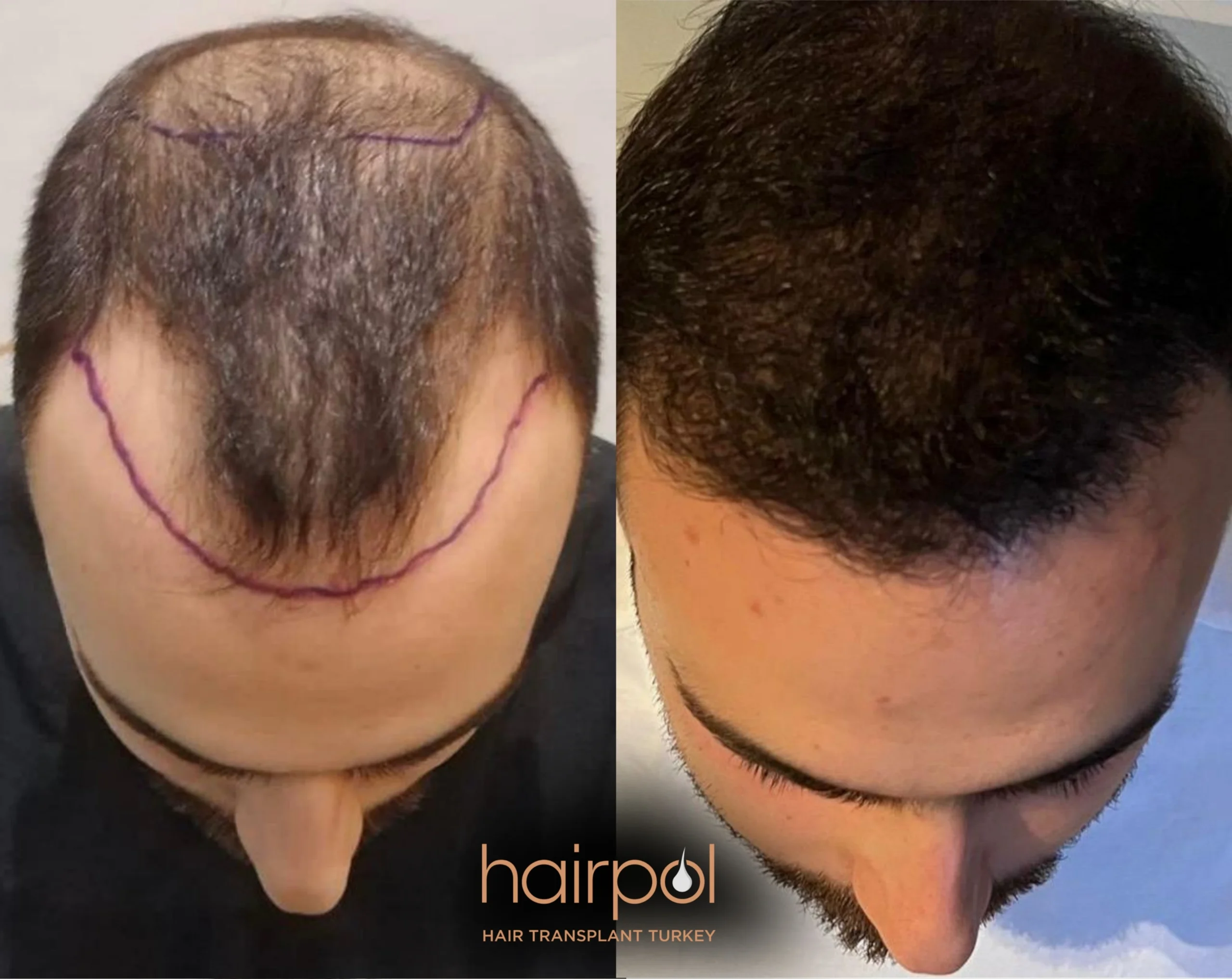
Scroll through any Turkish clinic’s Instagram and you will see the same format over and over: a thinning scalp on the left, a full head of hair on the right, and a caption with a number in it. “3,500 grafts.” “4,200 grafts, Sapphire FUE.” The number is meant to do the persuading. The trouble is that, on its own, it tells you surprisingly little about whether the same result is possible for you.
This is not an argument against before-and-after photos. They are one of the few genuinely useful tools you have when choosing a clinic. But they work only when you read them with the right questions, and the first of those questions is: how many grafts went where, and what was the starting point?
Read it this way: in Turkey hair transplant before and after photos, graft count only makes sense next to the area treated. Roughly, 1,000 to 1,500 grafts refine temples or a hairline, 2,000 to 2,500 rebuild the front third, 3,000 to 3,500 cover front and mid-scalp, and Norwood 5 needs 4,000 or more. Judge the “after” at twelve months, in matching light.
Why the graft number in a caption tells you less than you think
A graft count is an input, not a result. The same 3,000 grafts can look dramatically different depending on how large the area was, how much native hair was still there, how thick and curly the hair is, and how many of those grafts actually survived and grew.
Consider two men who each received 3,000 grafts. One had a Norwood 3 pattern with thick, dark, wavy hair and moderate native hair still left in the mid-scalp. The other had a Norwood 5 pattern with fine, straight hair against a pale scalp. Their “afters” will not look alike, and neither man did anything wrong. The difference is in the starting point, and the caption rarely tells you about that.
So when you look at a before and after hair transplant in Turkey, read the photo first and the number second. Ask what area the grafts were spread across, and whether that area resembles yours.
1,000 to 2,500 grafts: from temple refinement to a full front
This is the range for refinement rather than reconstruction. It is typically used to rebuild receding temples, restore and soften a hairline that has crept back, or add density to a front edge that has thinned. In photos, the change is often most visible in the face rather than the scalp: the forehead looks smaller, the temples look framed, and the overall impression is of someone a few years younger.
Because the area is small, density can be high. Done well, this is one of the most natural-looking categories of result, precisely because there is still plenty of native hair behind the new line. The risk is that it looks so successful that the patient forgets about the hair behind it, which may continue to thin over the next decade.
When you look at results in this range, pay attention to the side view. Temples are where small cases succeed or fail, and a front-on photo can hide a temple angle that has been closed too far or left too open. A good refinement case should look unremarkable from every direction, which is exactly the point.
One step up, the change moves from the face to the whole front of the head.
This range usually covers a full Norwood 3 front: the hairline, both temples and the first few centimetres behind them. In before-and-after photos, this is where the “transformation” posts tend to come from, because the frontal third is the part of the head people notice first in conversation.
What you should look for here is the transition from the new hairline into the native hair behind it. A good result blends without a visible step in density. A less careful one looks like a strip of thicker hair laid across the front, which is noticeable when the hair is wet or styled back. Look at photos taken from above and from the side, not only head-on.
3,000 grafts and above: mid-scalp, Norwood 5 and the limits of one day
At this level, the grafts are usually spread over the front and the mid-scalp, or the front plus a light treatment of the crown. This range appears often in clinic galleries, and it is also where the gap between average and good work widens.
The trade-off is between coverage and density. Spread 3,500 grafts over a large area and you get good coverage that looks full with the hair styled, but thinner under strong overhead light. Concentrate them and you get impressive density in a smaller zone. Neither is wrong. Our article on density versus coverage explains why this is the single most important conversation at consultation.
Beyond that, the question becomes how much can safely happen in one day.
Once the loss reaches Norwood 5 or beyond, the area to cover is large, and 4,000 grafts or more becomes realistic. One-day sessions of this size are sometimes offered. Some cases can, safely, depending on donor density and the patient. Others are better split into two sessions, roughly a year apart, so that the donor area is not over-harvested and the second session can be planned around how the first one grew.
Results at this scale can be genuinely life-changing, but before-and-after photos often flatter them. Look for photos at twelve months or later, from above, with dry hair at a natural length. Look at the donor area too. A full front with a visibly thinned back of the head is not the result you want.
Real cases from our gallery: 3,000 to 4,500 grafts at twelve months
Here is what that ladder looks like on real patients. The three cases below come from our before and after gallery, each photographed at around twelve months. Read them with the checklist from this article: compare lighting, hair length and angle between the two halves before you judge the change.
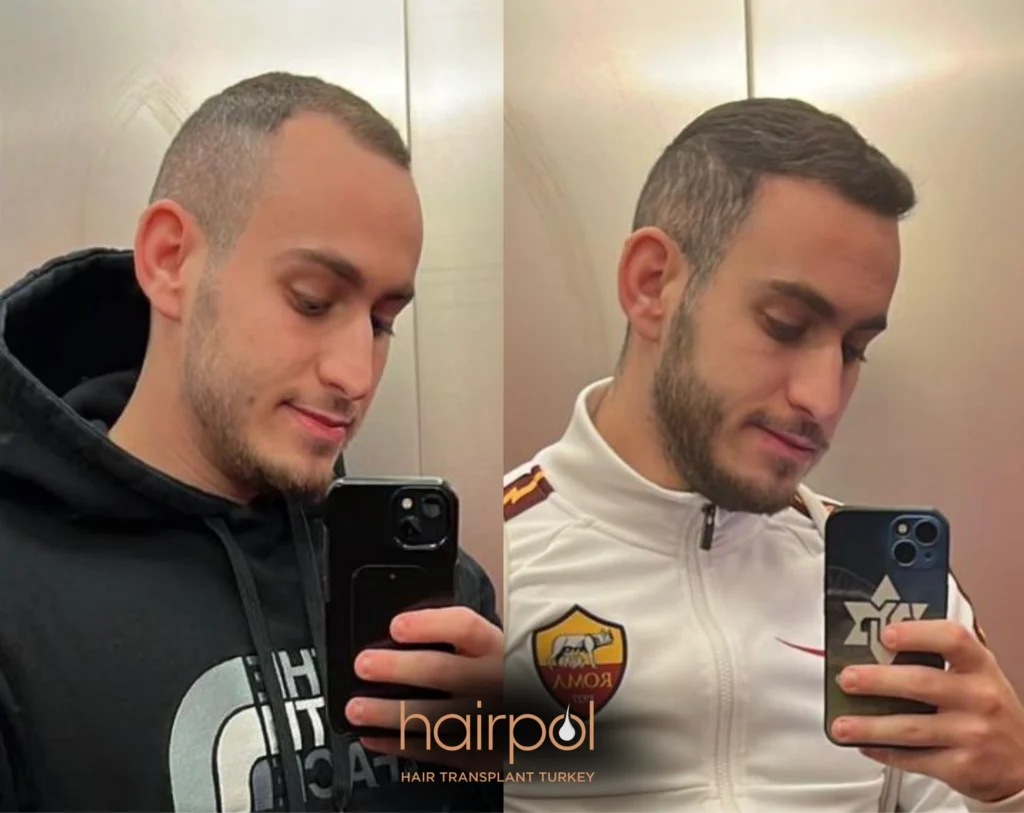
3,000 grafts, DHI. The change sits mostly at the temples and the front edge. Both halves are mirror photos with short hair in similar light, which makes this one of the fairer comparisons: what you see is the hairline, not the styling.
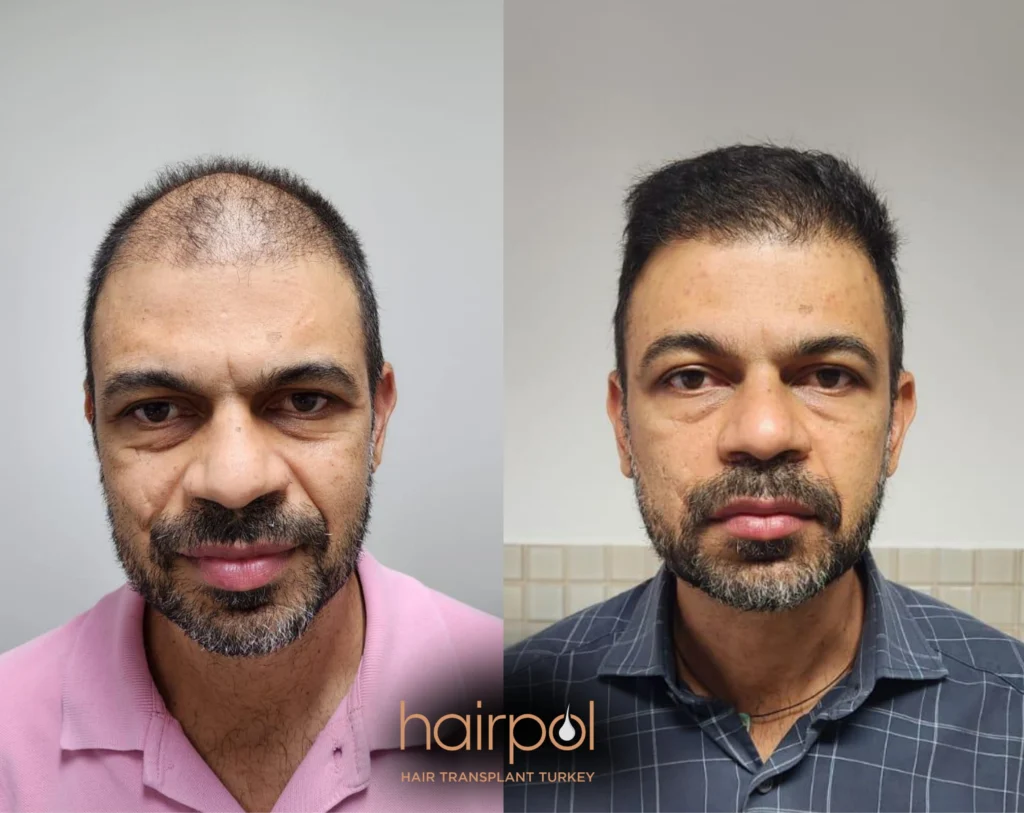
3,500 grafts, DHI. A front-on comparison at a similar distance and hair length. The frontal zone that showed scalp in the “before” now reads as continuous hair; to judge the mid-scalp properly you would also want a view from above.
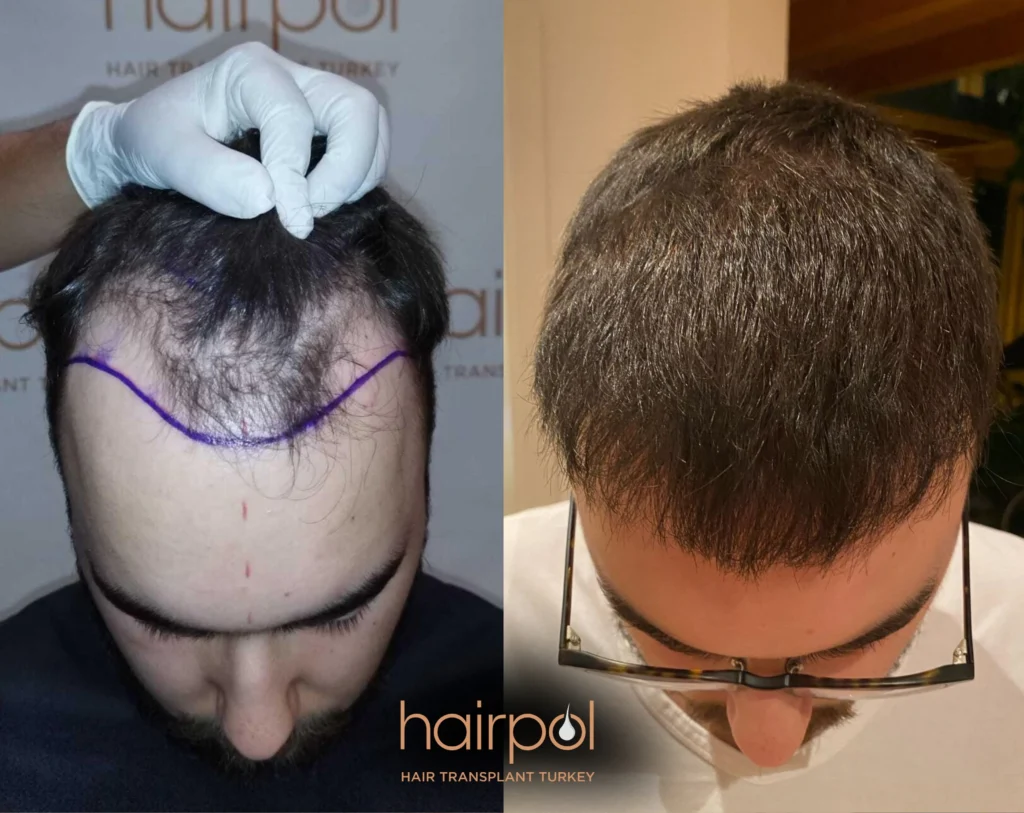
4,500 grafts, FUE. Shot from above, the angle that shows real coverage across the front and mid-scalp. The marked line and the held-back hair in the “before” make the treated area easy to see, and the “after” is taken from the same viewpoint.
Where are the donor area photos?
Every before-and-after story has a second scalp in it: the back of the head, where the grafts came from. In an honest gallery, you will see it. In many, you will not. Yet the donor area tells you more about the clinic’s judgement than the front does, because it shows whether the team took what was safe or what was sold.
A well-harvested donor area at twelve months looks evenly a little less dense than before, with no visible patches, no “moth-eaten” look and no obvious band where extraction was concentrated. With the hair at a normal length, you should not be able to tell where the grafts came from. With a very short buzz cut, faint dots are normal after large sessions.
If a clinic shows a dramatic front for a 4,500-graft case but never shows the back, ask to see it. If they cannot or will not, that tells you something about how they plan. Over-harvesting is one of the few transplant mistakes that cannot be repaired, because the donor area does not regrow.
Can you tell FUE, Sapphire FUE or DHI apart in a photo?
Usually not, and you should be wary of anyone who claims otherwise. At twelve months, a well-performed FUE, Sapphire FUE or DHI case looks like hair. The technique influences how the recipient channels are made and how the grafts are placed; it does not leave a visible signature on the finished result when the work is done carefully.
What you can see in a photo is the quality of the design and the placement: the hairline shape, the angle of the hairs at the front, the smoothness of the transition into native hair, and the density across the treated area. Those are the things to judge. A caption that leads with the technique name and says nothing about the plan is selling the method rather than the result.
This matters when you compare clinics, because it is easy to assume that a gallery full of one technique proves that technique is the right one for you. It does not. The right technique depends on your hair, your pattern and whether you need to stay unshaven, and that is decided at consultation, not from photos.
The crown: why crown photos need more patience
Crown results come in later and more slowly than the front. The whorl pattern, the angle of view and the way light hits the top of the head all make the crown harder to fill and harder to photograph honestly. Many crown “afters” in galleries are taken too early, when the hair is still growing in, or are lit so that the scalp disappears.
A crown result at eight months is often still well short of its final appearance. We have written separately about what 2,000 grafts for the crown can realistically achieve; the short version is that the crown needs both more patience and more honest lighting than the hairline.
How light, length, styling and timing change a photo
The same scalp can look very different depending on how it is photographed. Before you trust an “after”, check for the factors that change the picture without changing the hair:
- Lighting: soft, diffused light hides scalp; harsh overhead light reveals it. Before and after should be lit the same way.
- Hair length: longer hair covers more scalp. An “after” with much longer hair than the “before” is not a fair comparison.
- Wet or dry: wet hair clumps and exposes scalp; styling products can do the opposite.
- Angle: a straight-on shot hides the crown and mid-scalp; photos from above show the real coverage.
- Timing: results continue to change until twelve to eighteen months.
None of this means galleries are dishonest. It means a good gallery takes the trouble to keep these variables constant, and you should give more weight to the clinics that do.
Twelve months is the minimum for a fair judgement of the front, and fifteen to eighteen months for the crown. Before that, the hair is still thickening, changing texture and settling into its direction. A photo at four months shows early growth, which is reassuring for the patient but tells you very little about the final result.
If a clinic’s gallery is full of three- and four-month photos and short on twelve-month ones, it may simply be young, or it may be choosing the photos that look most dramatic. Ask. Our article on why results look different at 3, 6 and 12 months explains what changes at each stage.
What photos cannot show, and how to find cases that match yours
A photo shows the hair. It does not show what was left behind in the donor area, how many grafts were really transplanted versus quoted, how the patient’s native hair will behave over the next ten years, or whether the patient is on medication that is propping up the result. It also does not show the cases that went less well.
That is why photos should be one input among several. Our article on what before-and-after photos don’t show you goes through the blind spots in detail, and the questions that fill them.
The practical answer to those blind spots is comparison with cases like yours.
The most useful before-and-after is not the most dramatic one. It is the one that starts closest to where you are now. Look for a similar Norwood stage, similar hair colour and thickness, similar skin tone and a similar age. Then look at what that patient’s scalp looked like a year later, from several angles.
Not sure which category your own scalp falls into? That is the question that makes a gallery useful. Send a few photos and ask which gallery case matches your pattern: the answer comes with the graft range your pattern points to and the cases that make a fair comparison, not the most dramatic ones.
Does a Turkey package change the result?
The result depends on the plan and the team, not the package format. But the package does change what you can verify in advance. A well-defined package states the graft range, the technique and who performs each step, which makes it much easier to compare against before-and-after photos from the same clinic.
If you are comparing offers, our hair transplant Turkey package page sets out what a package covers and what to check in writing before you travel. That way, the results you are looking at in the gallery and the procedure you are booking describe the same thing.
Why your result may differ from the gallery, and how to protect it
Every gallery leads with its best cases. That is human, not sinister. But it means your realistic expectation should sit somewhere in the middle of the gallery, not at the top. Hair calibre, curl, colour contrast, donor density, graft survival, how closely you follow aftercare and how your native hair behaves all pull the result up or down.
For the front edge, technique can matter too. DHI hair transplantation is often used where fine control over angle is important, but the biggest variable is still the design and the hands behind it. A clinic that tells you which of its gallery cases is a realistic comparison for you, rather than pointing at the most impressive one, is doing you a favour.
It also helps to remember that a gallery photo is a single moment. The patient may have had a fresh haircut, a good night’s sleep and a photographer who knew which side to shoot. Your own mirror, at seven in the morning under a bathroom light, will always be a harsher judge. Set your expectations by the middle of the gallery and you are far more likely to be pleased by the end of the first year.
And a result at twelve months still has to be looked after.
A twelve-month photo is a snapshot, not a guarantee of how things look in ten years. Transplanted hair from the donor zone is resistant to the hormone that drives pattern loss, but the native hair around it is not. For many patients, slowing that loss is part of protecting the result.
Options include medication, which should only ever be started and monitored with a physician’s approval, and other treatments your doctor may suggest. Which of these suits you is a medical decision rather than part of a package.
Red flags in before-and-after galleries
A few patterns should make you look harder. Before and after shot in very different light. Hair noticeably longer in the “after”. Only front-on photos, never the crown or top. Every case dated three or four months after surgery. No donor area photos at all. Watermarks from other clinics, or the same patient appearing in several clinics’ galleries.
Any of these on its own may have an innocent explanation. Several together suggest a gallery built to sell rather than to inform. You can browse our before and after gallery with exactly this checklist in mind.
Choosing your three comparison photos
Before you judge any clinic, ours included, pick three cases from its gallery that start where you are: same stage, similar hair, similar age. Then look at those three alone, at twelve months, from the front, the side and above. That small, honest set will tell you more than a hundred transformations that began somewhere else.
It is the comparison we would rather you made with Hairpol too. Behind every photo is a plan, and the way we build that plan is the core of our hair transplantation work; ask, and we will point you to the gallery results that genuinely resemble your starting point.
Find this helpful? Add Hairpol as a preferred source on Google.
Graft Range Calculator
Answer three questions to see the typical graft range for your situation — based on our published clinical guides.
This is a preliminary estimate, not a medical assessment. The exact number can only be determined by a doctor after examining your donor area and hair characteristics.
Get a Free Consultation
Answer a few questions and the medical team will review your situation.
