

There is a particular kind of quiet frustration in growing a beard that stops halfway. The moustache connects to nothing. One cheek fills in, the other stays sparse. Three weeks of patience produce something that looks less deliberate than the clean shave you started from.
The advice you get is useless in a specific way: give it time, try this oil, take these vitamins. None of it addresses the actual reason, which is usually decided long before anyone hands you a supplement.
The short answer: a patchy beard is nearly always genetic, and beard density is not finished developing until the late twenties or even the early thirties. The real medical causes worth ruling out are alopecia areata of the beard, scarring from acne or injury, and thyroid or iron problems. A beard transplant is the reliable answer only when the pattern is stable, the gaps are permanent and there is enough scalp donor hair to fill them — typically 1,500 to 3,500 grafts depending on the area.
Why beard density is decided before you can do anything about it
Facial hair follicles are laid down before birth. How many you have, where they sit and how sensitive they are to androgens is inherited, and no product applied to the surface of your skin adds follicles that were never there. This is the single fact that most beard advice quietly avoids, because there is nothing to sell in it.
What varies between men is not really willpower or routine, it is receptor sensitivity. Two brothers with identical testosterone levels can have completely different beards because their facial follicles respond differently to the same hormonal signal. The one with the full beard did not do anything the other failed to do.
At Hairpol we spend a good part of every beard consultation dismantling this belief, because men arrive convinced they caused the problem. They did not. The useful question is not what went wrong but what the current pattern will look like in five years, and whether it can be improved surgically.
How late can a beard still fill in?
Later than most men expect. Beard development continues well past the point where scalp hair has settled — commonly into the mid-twenties, and in a significant number of men into the early thirties.
The typical sequence starts with the moustache and chin in the teens, moves to the area under the lower lip, then the jawline, and finishes with the cheeks and the connection between moustache and beard. The cheeks are last and are the most likely to remain thin permanently.
This matters for decision-making. A nineteen-year-old with sparse cheeks is describing a normal stage, not a permanent state, and operating at that age risks placing grafts into an area that would have filled in anyway. We are cautious with anyone under about twenty-four for exactly this reason, which is the same conservative logic we apply to early scalp surgery.
Testosterone, DHT and why the beard behaves the opposite way
Here is the paradox that confuses almost everyone. DHT miniaturises follicles on the scalp and stimulates them on the face. The same hormone, the same man, opposite outcomes depending on the location of the follicle.
This is why men with strong beards can lose scalp hair early, and why some men with excellent scalp density never develop much facial hair. It is also why testosterone testing is rarely useful when a young man complains about his beard. Levels are usually normal; the difference sits in the follicle, not the bloodstream. The mechanism is explained in more depth in what DHT is and why it causes hair loss.
Testosterone therapy is not a beard treatment and should never be taken for that purpose. In a man with normal levels it carries real risks, including suppression of his own production and fertility effects, and it does not reliably create facial hair where the follicles are not receptive.
Patchy in one round spot: beard alopecia areata
There is one pattern that is not genetic and that you should recognise immediately. A smooth, round, completely bald coin-sized area that appeared over a few weeks, with no hair at all rather than fine hair, is likely to be alopecia areata barbae.
This is an autoimmune condition, it is relatively common in the beard, and it often resolves on its own or responds to dermatological treatment. What it definitely is not is a surgical problem — transplanting into an active autoimmune patch wastes grafts, because the same immune process that removed the original hair can attack the transplanted hair too.
If a bald spot in your beard appeared quickly, has a defined circular border, and the skin inside it looks normal and smooth, see a dermatologist before you see a surgeon. We explain the distinction between this condition and pattern loss in alopecia areata versus pattern hair loss.
Scars, acne and old injuries
Scar tissue does not grow hair. Severe cystic acne through the teenage years, a childhood injury, a burn or a surgical scar all leave permanent gaps, and these are among the most satisfying beard cases to treat because the cause is obvious and the surrounding growth is normal.
Scarred skin does have reduced blood supply, which means graft survival in a scar is generally lower than in healthy skin. A realistic plan usually allows for a second, smaller session to add density after the first has healed, rather than over-packing a scar in one go and losing grafts.
Cleft lip repair scars, tracheostomy scars and jaw surgery scars are all routinely treated this way. If your patch corresponds exactly to an old injury, you are probably a straightforward candidate, and our beard transplantation page covers how these cases are planned.
Thyroid, iron and rapid weight loss
Medical causes of thin facial hair are less common than genetic ones but worth excluding, particularly when the change is recent. A beard that used to be full and is now thinning is a different problem from one that never came in.
Thyroid dysfunction, low ferritin and severe caloric restriction all affect facial hair the same way they affect scalp hair, and all three are simple to test. Anyone who has lost a large amount of weight quickly, or eats very little, may see facial hair thin along with everything else.
Our guide to the blood tests that matter in hair loss lists exactly what to request. If your beard changed over months rather than never developing at all, start there before you consider surgery.
What minoxidil actually does for a beard
Topical minoxidil is used off-label on the face by a large number of men, and it does produce results in some of them — usually thicker, darker versions of existing vellus hairs rather than entirely new growth in genuinely empty skin.
Two honest caveats. First, it needs to be continued; gains are typically lost within months of stopping, which turns a cosmetic decision into a long-term commitment. Second, facial skin is more prone to irritation and dryness than the scalp, and the eye area needs care.
Because this is off-label use, it should be discussed with a doctor rather than started from a forum post — particularly if you take other medications or have blood pressure issues. Results vary considerably between individuals, and there is no way to predict in advance whether you will be a responder.
What oils, supplements and rollers cannot do
Beard oils condition the hair you already have and the skin underneath. They are pleasant and reduce itch. They do not create follicles, and no oil has been shown to convert a bald area into a growing one.
Supplements only help if you are deficient, which is why testing before buying is the sensible order of operations. Biotin in particular is heavily marketed for beards and does nothing for people who are not deficient, while high doses can distort several blood tests.
As for the various stimulation devices sold for facial hair, the honest position is that evidence for a permanent change in beard density is weak, and there is real potential for skin irritation and scarring when they are used aggressively at home. If a device promises new follicles, it is overpromising.
Does shaving make a beard grow thicker?
No, and this is one of the most persistent myths in men’s grooming. Shaving cuts the hair at the surface, where the shaft is at its thickest and has a blunt cut end rather than a tapered tip. That blunt end feels coarser and looks darker for a few days, which is where the illusion comes from.
Nothing happens below the skin. The follicle does not receive a signal to produce more hairs or thicker ones, and no study has shown a change in growth rate or density after repeated shaving. Men who shaved daily through their teens do not end up with denser beards than men who did not.
The same applies to dermaplaning, plucking and aggressive brushing. Plucking is actually the worst of these — repeated trauma to a follicle can cause permanent damage, and men who have spent years pulling at an irregular patch sometimes make it worse.
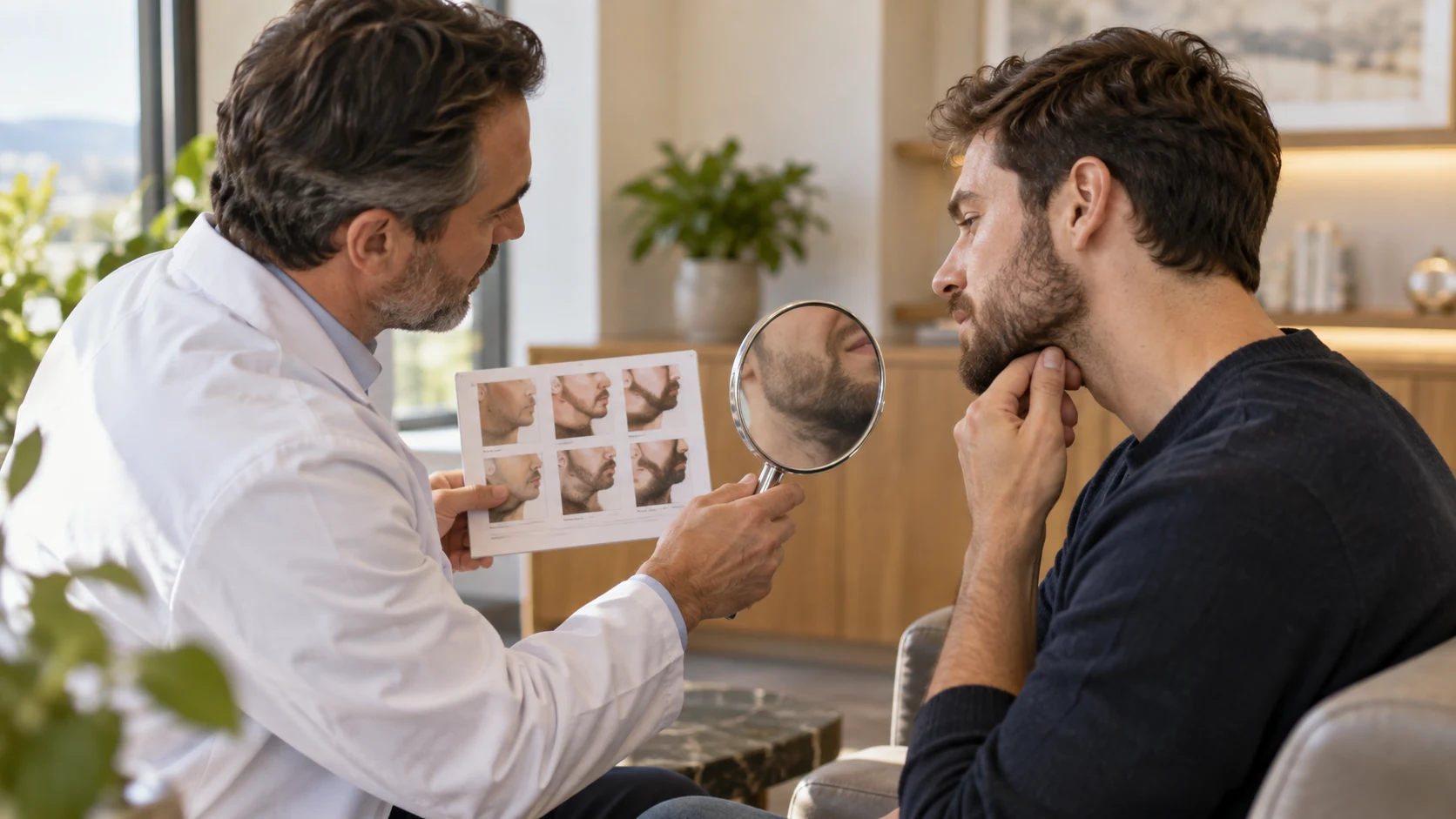
The one practical benefit of letting a beard grow untouched for four to six weeks is diagnostic. You cannot see your real pattern at three days of stubble, because short hairs from sparse areas still create visual shadow. Grow it out fully, photograph it in daylight, and you will see the actual map of where hair does and does not exist — which is exactly what a surgeon needs in order to plan anything.
When a beard transplant is the right answer
Three conditions have to be true at once. The pattern must be stable, meaning you are old enough that further natural filling is unlikely. The gaps must be permanent rather than inflammatory or temporary. And you must have adequate donor hair on the back of the scalp with a texture that will look plausible on a face.
When those three line up, results are consistent, because the transplanted hair keeps the characteristics of its origin and continues growing permanently in its new location. The technical work is essentially the same FUE process used on the scalp, with much finer control of angle — facial hair grows at an acute angle to the skin, and getting that angle wrong is what makes a beard look artificial.
If you are unsure whether your cheeks are still developing or genuinely finished, a photo assessment costs you nothing and settles the timing question. You can send photographs for an assessment and get a direct answer about whether to operate now or wait two years.
Who is not a good candidate
Men under about twenty-two, in most cases, because the pattern has not finished. Men with active alopecia areata, until it has been dormant for a long period and a dermatologist agrees. Men with keloid scarring tendencies, where any incision carries a risk of raised scars on the face.
Also, men whose scalp donor area is limited and who may need those grafts for their own hairline later. Donor supply is finite, and grafts spent on the beard are not available for the scalp in ten years. That trade-off deserves an honest conversation rather than a sales pitch, and it works in both directions — beard hair can also be used as a donor source for the scalp, as described in beard-to-scalp grafts.
Finally, anyone whose expectation is a beard that their genetics could never have produced. Density can be improved dramatically, but the result still has to be built from the donor hair available.
How many grafts a patchy beard usually needs
Numbers depend entirely on which zones need work. Filling the cheeks alone is usually the largest job. A moustache-to-beard connection is much smaller. A single scar might need only a few hundred grafts.
As broad ranges: cheeks and jawline together commonly fall between 1,500 and 3,000 grafts, a full facial reconstruction can reach 3,500, the moustache typically takes 400 to 800, and the chin 600 to 1,200. These are planning ranges, not quotes, and your own figure depends on the area to be covered and the density you want.
Density expectations matter here. A beard does not need scalp-level density to look full, because the hairs are coarser and the angle creates visual overlap. This is one of the reasons beard cases often satisfy patients with fewer grafts than they expected.
Where the grafts come from
Almost always the back and sides of the scalp, the same permanent zone used for hair transplants. Hair from the lower occipital area is often chosen because it tends to be finer and single-haired, which suits the face better than thick multi-hair grafts.
The texture question is worth raising in consultation. Scalp hair transplanted to the face keeps its original characteristics — if your scalp hair is straight and your natural beard is curly, the transplanted hairs will grow straighter, and the difference is visible at short lengths. An experienced planner selects donor zones with this in mind.
Body hair is occasionally used in specific situations, which we cover in body hair transplantation. It is a solution for limited donor cases rather than a default choice.
What the first year looks like
The timeline follows the same pattern as scalp surgery, which surprises men expecting a faster result. Crusting settles in the first week. The transplanted hairs shed between weeks two and six, which is the stage that causes the most anxiety and is entirely normal.
New growth begins around month three to four, most of the beard is visible by month six, and the final texture and density arrive between months nine and twelve. Shaving is usually permitted after ten to fourteen days depending on healing, and normal trimming resumes once growth is established.
Our detailed account of the process is in the beard transplant recovery timeline, and you can see how facial cases are documented on our before and after page. Judge any beard result at month twelve, never at month three.
What to do if your beard still hasn’t filled in at 25
At twenty-five, with a pattern that has not changed for two or three years, you are probably looking at your permanent beard. That is the point at which the decision becomes real rather than premature.
Start by excluding the treatable causes: look closely for round, sharply defined bald patches, check whether the thinning is recent rather than lifelong, and get ferritin and thyroid values checked if anything has changed. If all of that is clear, what remains is a genetic pattern, and the only intervention that reliably adds hair to empty skin is transplantation.
If you want a straight answer rather than another year of beard oils, send photographs through our contact page with your cheeks grown out as far as they will go. We will tell you what the donor area can support, roughly how many grafts the plan needs, and — if you are twenty and still filling in — that the right move is to wait.
Find this helpful? Add Hairpol as a preferred source on Google.
Get a Free Consultation
Answer a few questions and the medical team will review your situation.
