

A man in Manchester gets two quotes for the same operation. The first comes from a clinic forty minutes from his front door. The second comes from Istanbul, and it includes his flights, four nights in a hotel, a driver who meets him at arrivals and a nurse who answers his messages at eleven at night. The Istanbul quote is about a third of the local one.
His first instinct is that something must be missing from it. That instinct is reasonable. It is also where most people stop thinking and start scrolling through forum threads at two in the morning. The honest version of the answer is less dramatic than either the marketing or the horror stories: most of the price gap is economics rather than medicine — and learning which part of it is economics and which part is corner-cutting is the single most useful thing you can do before you book anything.
The short answer: People go to Turkey for hair transplants because the same operation usually costs a fraction of what it costs in the UK, Germany or the United States — commonly somewhere between a quarter and a half of the local price — while the surgical technique itself is the same everywhere. The gap comes from lower labour and facility costs, a weak lira against the euro and pound, enormous case volume concentrated in Istanbul, fierce local competition and a health tourism sector the state has deliberately built. A low price is not proof of low quality. It is not proof of the opposite either.
What Actually Makes a Hair Transplant Cheaper in Turkey?
Take the price of any hair transplant apart and you find five things: staff time, consumables, the facility, patient acquisition, and profit.
Only one of those is roughly the same worldwide. Punches, sapphire or steel blades, implanter tips, needles, saline, local anaesthetic and dressings are imported and priced in dollars, so a clinic in Istanbul pays close to what a clinic in Frankfurt pays. That slice is also the smallest one. Everything else in the list is local, and local is where Turkey is cheap.
A hair transplant is unusually labour-heavy. It is not a twenty-minute procedure with an expensive machine; it is six to eight hours of skilled human hands, usually a surgeon plus a team of two to four technicians, working on one patient for a full day. In a high-wage economy, a full day of five people is the dominant cost of the operation and nothing else comes close. In Istanbul, that same day of five people costs a fraction of what it costs in London or Munich, and the whole quote moves with it.
Then add the building. A licensed clinic in a district like Ataşehir carries rent, utilities and municipal costs that would not cover a reception desk on Harley Street. None of that has anything to do with what happens to your follicles.
The Exchange Rate Does More Work Than Anything Else
Here is the part almost nobody explains. A Turkish clinic pays its costs in lira and collects its revenue in euros, pounds and dollars. When the lira loses value against those currencies — as it has repeatedly over the past decade — the clinic can raise its domestic prices in lira, keep its margins intact, and still look cheaper than last year to a foreign patient.
That single mechanism explains most of what people find suspicious about Turkish pricing. It is not that anyone found a way to do the surgery for less. It is that the currency the surgery is sold in and the currency it costs in have been drifting apart for years.
It also explains something patients notice and misread: prices that seem to change between one enquiry and the next. Two clinics quoting the same lira figure can quote very different euro figures depending on when they last updated their rate. This is worth knowing for a practical reason. Ask for your quote in your own currency, in writing, with a validity date on it. A clinic that will not fix a number in the currency you are paying in is telling you something about how it does business.
Volume: What Happens When a City Does Thousands of Cases a Month
Price is only half of it. The other half is that Istanbul has become genuinely specialised in this one operation, and specialisation is not a marketing claim — it is a consequence of repetition.
A plastic surgeon in a mid-sized European city might do a handful of hair transplants a month between other procedures. An Istanbul clinic that does nothing else runs cases nearly every working day, and its technicians place grafts continuously. Extraction under a punch and placement into an incision are motor skills. They improve with thousands of repetitions and they decay without them. That is the real advantage, and it is the one that survives when you strip the marketing away.
Volume also shapes everything around the operation. Supply chains are local and stocked. Anaesthesia routines, graft-holding protocols and washing appointments are standardised because the same sequence runs every day. Support staff speak the languages patients arrive with. Fixed costs — the building, the licences, the equipment — spread across many more cases per year, which pushes the per-case price down again.
The same volume, pushed too far, is also what produces the worst clinics in the country. We will come back to that, because it is the honest half of the story.
Why Is Hair Transplant Cheap in Turkey — and Is Cheap the Same as Bad?
There are two completely different reasons a quote can be low, and they look identical on a price list.
The first is structural. Lower wages, lower rent, a favourable exchange rate, high volume. Nothing has been removed from your operation; the same day of work simply costs less to deliver. This is the majority of the Turkish price advantage and it is entirely legitimate.
The second is subtractive. The price is low because something that should be in the operation has been taken out of it — surgeon involvement reduced to a ten-minute hairline marking, the session compressed so a second patient can start after lunch, grafts left outside the body longer than they should be, no proper follow-up, no revision policy. That is not a cheaper version of the same thing. It is a different thing sold under the same name.
You cannot tell these apart by looking at the number. You can only tell them apart by asking what the number buys. How many hours is the session? How many patients does the surgeon have that day? Who makes the incisions? What happens if something goes wrong at month eight? We broke the pricing itself down in detail in our guide to hair transplant cost in Turkey for 2026, and the current ranges for different graft counts sit on our hair transplant cost page. Read both before you compare a single euro figure to another euro figure, because the figures are not describing the same product.
The Package Model: Flights, Hotel, Transfers and Why It Exists
The all-inclusive package is the second reason people travel, and it is not generosity. It is friction removal.
A clinic in Istanbul is not really competing with the clinic down the street. It is competing with the reasons you might not get on a plane at all: the hotel you would have to research, the transfer from an unfamiliar airport, the fear of being alone in a city where you do not speak the language after a six-hour operation. Bundling those things into the quote removes the friction that stops people booking. Clinics also buy hotel nights in bulk, so the bundle costs them less than it would cost you to assemble.
A typical package covers airport transfers, three to four nights in a partner hotel, a translator, the operation itself, the first wash, and a starter kit of medication and lotion. It typically does not cover your flights unless it says so explicitly, long-term medication, later PRP or mesotherapy sessions, or a second procedure. Our hair transplant package page sets out what sits inside and outside a package in plain terms. The one thing worth checking on any package, anywhere: does the price change if your final graft count turns out higher than the estimate?
Health Tourism as Policy, Not Accident
None of this happened by chance. Turkey built a health tourism sector on purpose, and the infrastructure around your operation is a policy outcome rather than a lucky coincidence.
Clinics treating international patients require authorisation from the Ministry of Health for health tourism, which brings requirements around facilities, staffing and interpreting services. Istanbul sits on a hub airport with direct flights from most of Europe, the Gulf and North Africa, so the trip is usually one flight rather than two. Many nationalities enter without a visa or with a straightforward e-visa. Hotels near clinic districts are used to guests arriving with bandaged heads and leaving four days later.
The practical effect is that the logistics work. You are not improvising a medical trip; you are stepping into a system that thousands of people move through every week. That system is described end to end on our hair transplant in Turkey page, including what the days around the operation actually look like.
A system this efficient has a downside, and it is worth naming: it is just as efficient at moving patients through bad clinics as good ones. Authorisation is a floor, not a ranking.
Is Turkey Good for Hair Transplants? The Honest Split
The country is not a single standard, and treating it as one is the mistake underneath both the enthusiasm and the horror stories.
Turkey contains surgeons whose work would be considered excellent anywhere in the world, running small case loads, designing hairlines personally, turning down patients who are too young or whose loss is not stable. It also contains high-throughput operations where the doctor’s role is largely administrative and the patient is a slot in a schedule. Both are real. Both advertise on the same platforms, use the same stock language, and often quote within a few hundred euros of each other.
Which means the country tells you almost nothing. “I had it done in Turkey” is roughly as informative as “I had it done in Europe.” The clinic is the unit that matters, and the doctor inside the clinic is the unit inside that.
If you already have two or three quotes on the table and you are not sure whether the graft numbers in them are realistic for your pattern of loss, that is a question a photograph can settle quickly. At Hairpol we look at your images and tell you what we think your donor area can actually fund — you can send them through our appointment form, and if we think one of the other quotes is more sensible than ours, we will say so.
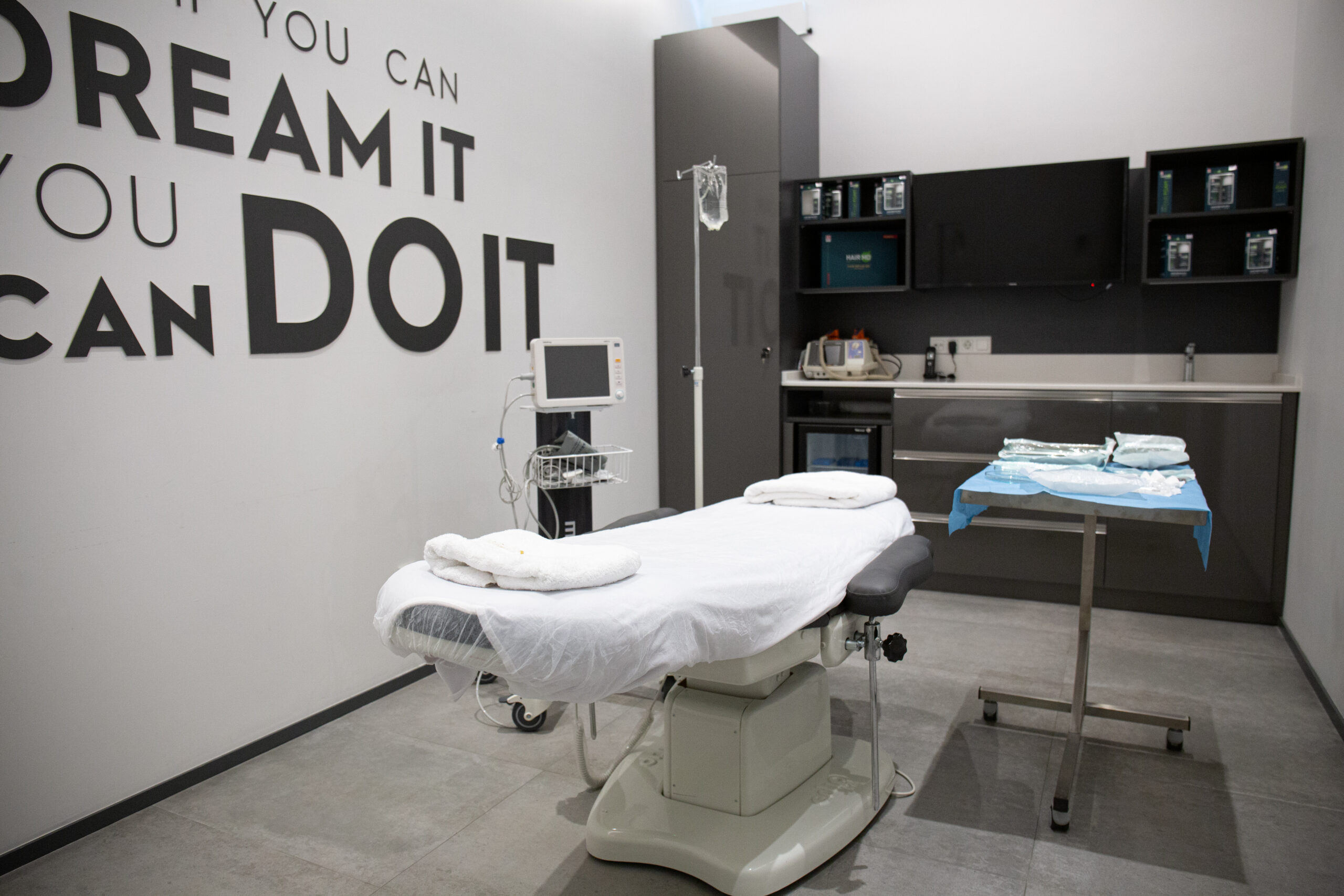
The Factory Clinics: What the High-Volume End Really Looks Like
Any honest account of why Turkey is cheap has to include the part the industry prefers to leave out.
At the extreme end of the volume model, a centre may run ten or more patients through the same building in a day. The doctor appears for the consultation and the hairline marking, then moves to the next room. Technicians handle extraction and implantation with limited supervision. Sessions are compressed, because the building has to clear one patient to make room for the next. Graft counts are self-reported and inflated. Grafts spend longer outside the body than they should, which quietly reduces how many survive. Nobody is available at month four when the shedding phase frightens the patient.
These are not internet myths. They are a real segment of the market, and they exist because a certain kind of buyer shops on price alone and a certain kind of operator is happy to serve them.
They are also not the whole country, and the difference between the two ends is visible before you travel if you ask the right questions. We went through the safety side of this in detail — infection risk, unlicensed operators, what actually goes wrong and how often — in is it safe to get a hair transplant in Turkey. If safety is your main worry rather than price, start there.
Who Actually Performs Your Surgery?
This is the question that separates clinics more reliably than any other, and it deserves care, because the popular version of it is misleading.
Technicians perform parts of hair transplant surgery in most countries, including the United States and across Europe. Graft placement by trained technicians is normal international practice, not a Turkish shortcut. The meaningful questions are narrower: does a licensed doctor design the hairline and make the recipient incisions, is the doctor physically present and supervising through the session, and how many patients is that doctor responsible for on your day?
Ask for the doctor’s name and check the licence yourself. Ask whether you will meet them before the morning of surgery or only on the day. Ask how many operations the clinic runs on the day you are booked. Ask who you contact at month three, and who answers. The answers arrive quickly and confidently at good clinics, because those conversations have already happened internally. Vague answers are themselves the answer. Our practical clinic selection checklist lays out the full set of questions in the order worth asking them.
Per-Graft or Per-Package: How Pricing Language Hides Things
Two clinics can quote the same total and mean entirely different things.
Per-graft pricing sounds transparent, and it is — until you realise that the clinic counts the grafts. A graft is a follicular unit containing one to four hairs, and there is no independent audit at the end of the day. A clinic paid per graft has an obvious incentive to report a generous number, and a patient has no way to check it. Per-graft pricing works when the count is agreed in advance from photographs and recorded, and it works poorly when the number is announced after the operation.
Package pricing sounds simpler and hides a different thing. “Up to 4,000 grafts” is elastic language. It can mean you receive 4,000 or it can mean you receive 2,200 and the extraction stopped when the schedule said so. It can also become a day-of upsell: the estimate is revised upward in the chair, when you are already there, already committed, and in no position to negotiate.
The fix for both is the same. Get the estimated graft range agreed from photographs before you travel, get the price fixed against that range in writing, and get a stated position on what happens if the surgeon finds you need more. Also treat any offer of “unlimited grafts” as a claim about marketing rather than biology — your donor area has a finite lifetime supply, and no clinic can conjure more of it.
Red Flags That Should Slow You Down
Most bad outcomes are visible in the sales process, weeks before anyone touches a scalp. The warning signs repeat across clinics and countries.
- A firm price quoted before anyone has looked at a photograph of your scalp.
- Graft numbers promised in a single day that sit far above what a donor area realistically supports — treat very large single-session figures as a claim to be justified, not a bonus.
- No named doctor anywhere on the website, or a name that returns nothing when you search the medical register.
- The entire consultation handled by a sales agent on a messaging app, with no clinical contact before the day of surgery.
- Before-and-after photographs with no dates, no consistent lighting, and no way to identify whose work they are — a dated before and after gallery is the minimum you should expect.
- Discounts that expire this week, and pressure to pay a deposit during the first conversation.
- No written aftercare protocol, no follow-up schedule, and no stated policy on what happens if growth disappoints at twelve months.
None of these is about Turkey. They are about how a clinic sells, and they read the same in Istanbul, Warsaw or Los Angeles.
What a Good Istanbul Clinic Does Differently
The positive version is less dramatic and more boring, which is generally a good sign in surgery.
A serious clinic assesses before it quotes. It asks for photographs from several angles, asks about family history and how fast the loss has moved, and gives a graft range rather than a round number. It designs the hairline for a face that will be fifteen years older, not for the photograph you will take on the flight home. The doctor makes the incisions and is present through the session. The number of patients booked that day is a number the clinic is comfortable telling you.
It also says no. To men in their early twenties whose loss has not stabilised, to donor areas that cannot fund the coverage being asked for, to patients whose expectations no operation will meet. A clinic that has never refused a case is not lucky; it is not assessing.
At Hairpol, quotes follow the photographs rather than the other way around, and the graft plan is built around what your donor area can support across a lifetime rather than what fits into one session. When we think a smaller procedure, medical treatment or no surgery at all is the better answer, that is what you will hear — even when it is the less profitable thing to say.
Should You Choose Turkey — or Stay Home?
Travelling is not automatically right, and the honest answer depends on the size of your case and the shape of your life.
Staying local makes more sense than people admit when the procedure is small. If you need 1,200 grafts to rebuild temple points, the absolute saving may not justify the flights, the days off and the aftercare distance. It also makes sense when your case is a complicated repair that will need several in-person reviews, when a health condition means you want your own doctors nearby, or when you simply cannot take a week away.
Travelling makes sense when the case is large enough that the gap runs into thousands rather than hundreds, when you want a team that performs this operation daily rather than occasionally, and when you are able to protect the recovery window properly rather than flying home into a heavy work schedule.
Follow-up is the part people underestimate in both directions. A clinic three hours away by plane that answers messages within a day is more available than a clinic across town that stops replying once you have paid. Ask how follow-up works before you decide where to go, and put more weight on that answer than on the distance. Istanbul’s role in all of this is set out in more depth in why Istanbul became the world’s hair transplant capital.
How to Turn a Shortlist Into a Decision
Three clinics is enough. More than that and the comparison stops being a comparison and turns into anxiety.
Send all three the same photographs, taken in the same light, from the front, the top, both sides and the back. Ask all three the same questions: who operates, how many hours, how many patients that day, what graft range and why, what is included, what happens at month twelve if the result disappoints. Then compare the answers rather than the prices. Two clinics quoting 3,500 grafts and one quoting 5,500 for the same head is a clinical disagreement worth understanding before you pay anyone.
Notice which clinic tells you something you did not want to hear. That is usually the one assessing rather than selling. And give the decision a week. Nothing about hair loss moves fast enough that a discount expiring on Friday should decide where you have surgery.
At Hairpol, in Istanbul, we would rather be the second opinion that made your decision clearer than the clinic that rushed you into one. Send your photographs, tell us what the other quotes say, and we will give you a straight assessment of what your donor area can realistically deliver — you can start from our hair transplantation department, and take as long as you need with the answer.
Find this helpful? Add Hairpol as a preferred source on Google.
Get a Free Consultation
Answer a few questions and the medical team will review your situation.
