
Every eighteen months or so, a headline goes around claiming that baldness has been solved. A laboratory somewhere grew hair on a mouse, a biotech company published a press release, and within a week the story has been rewritten a hundred times with the words cure for baldness in the title. Then nothing changes in the clinic. The people who read that headline still come in with the same thinning crown, the same receding temples, the same question about whether they should wait for the miracle or do something now.
Somewhere between that headline and the reality of a treatment room sits a genuinely interesting group of therapies. Stem cell and exosome treatments for hair are not fiction, and they are not a cure. They are a set of biological signalling tools that, used on the right scalp at the right moment, can nudge weakening follicles in a better direction. Used on the wrong scalp, they are an expensive way to feel like you are doing something. The difference between those two outcomes is almost entirely a matter of patient selection and honest expectation.
The Family of Treatments Hiding Behind One Word
People say “stem cell treatment” as if it describes one procedure. It does not. It is a category label stretched across several quite different things: applications derived from stem cell cultures, concentrated growth factor preparations, conditioned media, and exosome therapies. What they share is a philosophy rather than a mechanism. All of them attempt to change the biochemical environment around a follicle instead of moving hair from one place to another.
That distinction matters more than any brand name. Surgery is mechanical. You take follicles from a zone that is genetically resistant to hormonal miniaturization and you place them where they are needed. Regenerative hair treatments do nothing mechanical at all. They deliver signals, and signals only work if there is still something alive to receive them. This is why the entire category lives upstream of surgery rather than in competition with it.
At Hairpol these applications sit within a wider set of non-surgical hair treatments alongside mesotherapy and PRP, and we group them that way deliberately. They are maintenance and support tools. Framing them as anything larger is where patients start getting disappointed.
How This Differs From the PRP You Have Already Heard About
Most people arriving at a consultation already know what platelet-rich plasma is, at least roughly. Blood is drawn, spun in a centrifuge, and the platelet-dense fraction is injected back into the scalp. The active ingredients are the growth factors that platelets release when they degranulate. It is autologous, it is cheap relative to newer options, and it has been studied for long enough that there is a reasonable body of literature behind it.
The regenerative therapies sit one step further along. Instead of relying on whatever concentration of growth factors your own platelets happen to produce on the day, they use standardised preparations with a defined signalling payload. In principle this removes some of the variability that makes PRP results uneven between patients and even between sessions for the same patient. In principle. Whether that theoretical advantage translates into visibly better hair is exactly the question the evidence has not fully answered.
If you want the fuller picture of what platelet therapy adds around surgery, we wrote about it separately in our piece on PRP therapy with hair transplants. The honest summary is that PRP is a modest, real, supportive effect rather than a transformation, and the newer therapies are best understood as an attempt to make that modest effect more consistent and more potent.
What an Exosome Actually Is
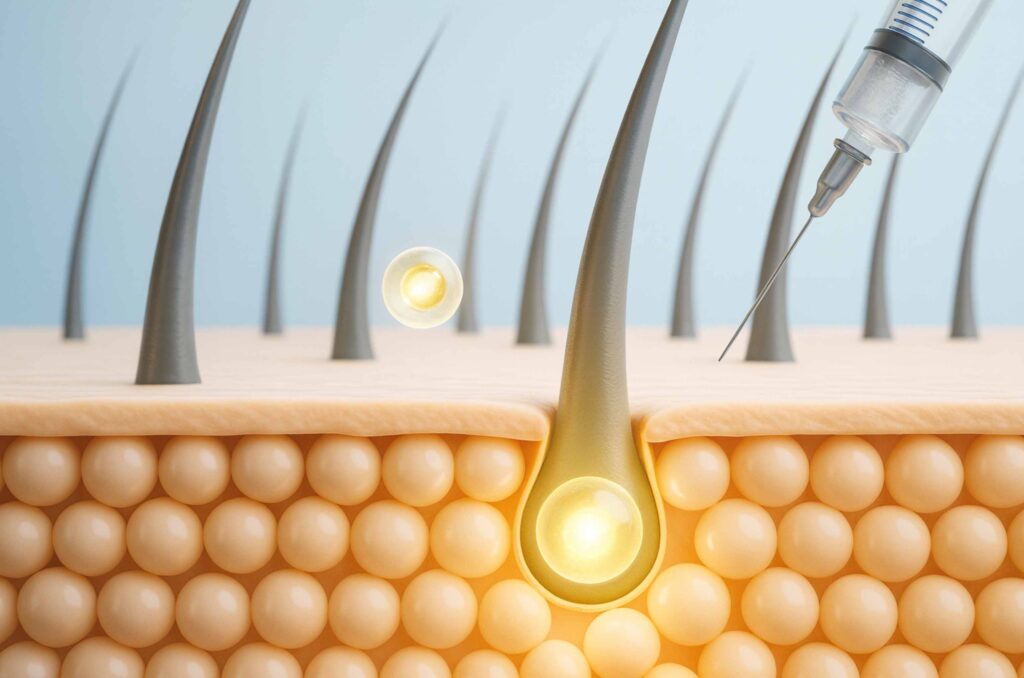
Cells talk to each other. That sounds like a slogan but it is a literal description of how tissue behaves. One way they do it is by packaging molecules into tiny membrane-bound vesicles and releasing them into the surrounding environment, where neighbouring cells absorb them and respond to their contents. Those vesicles are exosomes. They are not cells. They cannot divide, they cannot become new tissue, and they do not engraft anywhere.
Think of them as messages rather than building materials. Inside an exosome you find proteins, lipids, and various forms of RNA that can influence how a receiving cell behaves for a period of time. In hair biology the interest is in whether these messages can push a miniaturizing follicle back toward a longer growth phase, improve the blood supply feeding it, and calm the low-grade inflammation that often accompanies pattern loss.
The appeal is obvious. If you can borrow the useful signals produced by stem cells without introducing the cells themselves, you sidestep a great deal of complexity. The catch is equally obvious. A message only helps if the recipient is still there and still capable of acting on it. Deliver the most sophisticated signal in the world to scalp where the follicle has already fibrosed away, and nothing happens.
Why the Miniaturizing Follicle Is the Target
Pattern hair loss is not an event, it is a slope. Under hormonal influence, susceptible follicles shorten their growth phase with each cycle and produce progressively finer, shorter, less pigmented hairs. The follicle is still there for a long time during this process. It is smaller, it is sitting shallower, it is producing something closer to vellus fluff than real hair, but it is alive and it is still cycling.
That window is where every regenerative approach lives. A follicle in the middle of that slope is biologically responsive. It can, in principle, be pushed back toward a thicker output if the environment around it improves. This is also why early to moderate thinning is the profile where these treatments are worth discussing at all, and why the same treatment applied to a scalp that has been smooth for a decade produces nothing but a bill.
At Hairpol we spend a disproportionate amount of consultation time on this single point, because it determines everything else. If the follicles are gone, no signal brings them back. If they are struggling, signals are worth trying. A proper scalp examination, ideally with magnification, is what separates those two situations, and it should happen before anyone quotes you a price.
Who These Therapies Are Genuinely Aimed At
Four groups come up repeatedly, and it is worth being specific about them.
- People in early or moderate thinning who still have visible hair across the affected zone and want to slow the trajectory rather than reverse it dramatically.
- Patients who have recently had a transplant and want to support the healing environment and the surrounding native hair through the shedding phase.
- People who are not yet surgical candidates, either because the loss is still evolving or because they are too young for a stable long-term plan.
- Patients who cannot or will not use medical therapy, and are looking for something to occupy the gap without pretending it is equivalent.
Notice that none of those descriptions involve someone with a large bald area asking for coverage. That patient needs grafts. Offering them injections instead is not conservative medicine, it is avoidance, and it wastes both money and the years during which surgery would have been most straightforward to plan.
Who Should Not Expect Much
There is a version of this conversation nobody enjoys having, but skipping it produces unhappy patients twelve months later. If your scalp is shiny and smooth over the affected zone, if there has been no visible hair there for years, if the skin looks thinner and the follicular openings are no longer apparent under magnification, regenerative therapy will not change that. Not with more sessions, not with a stronger formulation, not with a different brand.
Similarly, if your hair loss is being driven by something other than pattern genetics, treating the scalp with growth signals addresses none of the cause. Thyroid dysfunction, iron deficiency, certain autoimmune conditions, medication side effects, and severe nutritional restriction all cause hair to fall for reasons that need their own investigation. We would rather send you for blood work than sell you a package that cannot solve the problem you actually have.
And if you are in the middle of a rapidly progressing diffuse loss, injections are not a substitute for a dermatological work-up. Speed of change is a clinical signal in its own right.
What the Evidence Actually Says
Here is the part that most marketing pages skip. The published literature on exosome and stem cell derived therapies for hair is genuinely promising and genuinely immature at the same time. Early studies, case series and small trials have reported improvements in hair density and shaft thickness over several months. Laboratory work provides a plausible biological rationale for why those improvements might occur. That is real, and it is not nothing.
What does not yet exist in convincing quantity is the thing that would settle the argument: large, well-designed, randomised controlled trials with long follow-up, standardised products, and objective measurement. Most of the available work involves small numbers of participants, short observation windows, variable outcome measures, and preparations that differ from one another in ways that make direct comparison difficult. When you cannot be sure that two studies used comparable material, pooling their conclusions becomes shaky.
The reasonable position, and the one we take at Hairpol, is that these are supportive treatments with encouraging early data and unproven long-term superiority. Anyone telling you the evidence is settled, in either direction, is overreaching. Our stem cell treatment discussions with patients start from that framing rather than from a promise.
Why the Cure for Baldness Headline Keeps Coming Back
Media coverage of hair science has a structural problem. A study on cultured cells or a mouse model is a legitimate scientific result, and it is also roughly a decade and several regulatory mountains away from anything you could book an appointment for. The gap between “this worked in a dish” and “this is a licensed treatment for humans” is where almost every promising result quietly dies, and that stage is not newsworthy, so nobody reports it.
The result is a public that has been told baldness is nearly cured, repeatedly, for thirty years. It creates a peculiar kind of paralysis in patients. Some delay treatment for years while waiting for the breakthrough, losing the very follicles that would have responded to intervention, and arriving eventually at a stage where only surgery can help. The waiting itself has a cost that is rarely counted.
Our advice is unromantic. Treat the scalp you have now with what genuinely exists now. If something transformative arrives later, wonderful, and you will be in a far better position to benefit from it if you preserved what you had in the meantime.
Hair Cloning and Follicle Multiplication: Still Not a Clinic Service
The genuine holy grail of this field is not exosomes. It is hair multiplication: taking a small number of donor follicles, expanding them in culture, and producing an effectively unlimited supply of transplantable hair. That would end the fundamental constraint of every surgical plan, which is that donor hair is finite and cannot be manufactured.
It has not happened, and the reasons are instructive. Hair follicles are not simple structures. They are miniature organs with several interacting cell populations, a specific three-dimensional architecture, and a growth cycle governed by signals from surrounding tissue. Cells that behave beautifully in a dish frequently lose their hair-inducing capability once removed from that context. Producing hairs that grow at a controlled angle, with normal calibre, correct pigmentation and predictable cycling has proven far harder than producing hairs at all.
Serious research groups continue to work on it and progress is real. But when a clinic implies that it offers cloning today, what is actually being sold is a signalling therapy under an ambitious name. Ask precisely what is in the syringe, and the picture usually clarifies quickly.
Product Variability Is the Uncomfortable Part
If there is one practical thing worth knowing before you commit money to this category, it is that not all preparations are equivalent, and the labelling does not always help you tell. Source material, isolation method, concentration, storage conditions and handling all influence what actually reaches your scalp. Two products bearing the same general description can be quite different in composition.
Regulatory status also varies by country and by product type, and it changes over time. A responsible clinic should be able to tell you what it is using, where it comes from, and on what basis it is being administered. If those questions produce vagueness, brand names, or a change of subject, that is information in itself.
At Hairpol we would rather explain the limits of what we know than perform certainty we do not have. It occasionally costs us a booking from someone who wanted to hear a guarantee. That trade is worth making, because the patients who stay are the ones who are still satisfied a year later.
Stem Cell Based Approaches at Hairpol
Within our regenerative offering, several distinct applications exist and they are not interchangeable. Some focus on delivering concentrated signalling material to the scalp. Others use preparations derived from stem cell sources with the aim of improving the tissue environment more broadly. What we recommend depends on your pattern, your stage, your general health and what you are realistically trying to achieve.
What none of them do is create follicles where none remain. It is worth repeating because it is the single most common misunderstanding we encounter. A patient will ask whether stem cell therapy can regrow the crown that has been bare since their late twenties, and the answer is no. What it may do is help protect and strengthen the hair that borders that region, which is a smaller claim and a far more defensible one.
Detail on the specific protocols we offer sits on our stem cell applications page, but the consultation matters more than the page. Nothing in this field should be selected from a menu without an examination.
G-Cell and Where It Fits
Among the applications we discuss with suitable patients is G-Cell, which belongs to the same broad family of regenerative scalp treatments. Like the others, it is a support therapy: something that works alongside a plan rather than constituting the plan by itself. It comes up most often for patients with active thinning who want to reinforce their existing hair, and for those building a maintenance routine after surgery.
The realistic ambition with any of these protocols is measured in shaft calibre, shedding rate and overall scalp condition rather than in dramatic before-and-after photographs. When they work, the change is the kind you notice gradually. Your hair holds shape better. You see fewer strands in the shower. The thinning zone stops advancing as quickly as it was.
That is a worthwhile outcome. It is simply not the outcome that a bald crown filled with dense hair would represent, and conflating the two is how disappointment gets manufactured.
Placental Stem Cell Applications
We also offer placental stem cell applications, another route within the same regenerative philosophy. Placental tissue is rich in signalling molecules and growth factors, which is why it has attracted interest across several areas of regenerative medicine, hair among them.
The same caveats apply, and we apply them consistently. The mechanism is plausible, the early observations are encouraging, and the long-term comparative evidence is still developing. Suitability is individual and depends on your medical history as much as your hair pattern. This is not a treatment anyone should undertake on the basis of a social media clip.
Where it tends to be considered is in patients who want to give a struggling scalp every reasonable biological advantage, often in combination with medical therapy and sometimes in the year around a surgical procedure. As with everything else in this category, it is an adjunct.
What a Course of Treatment Looks Like
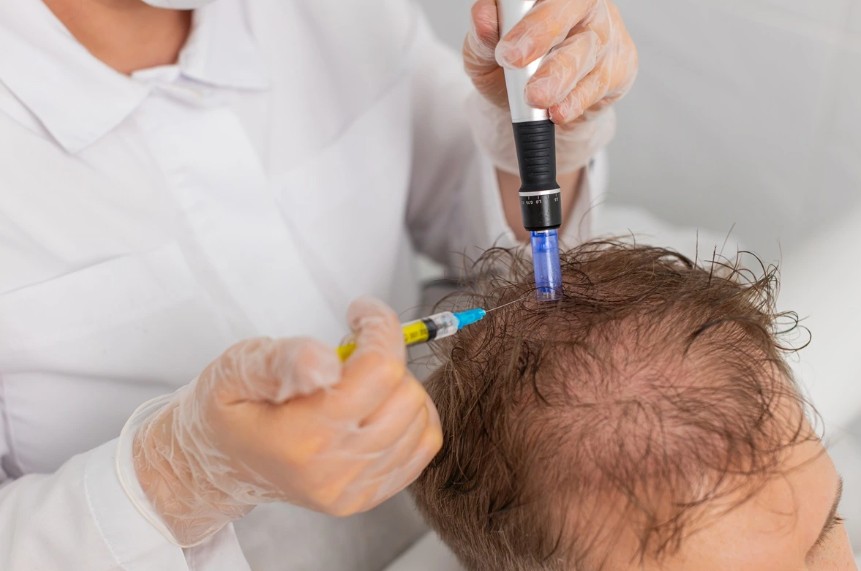
Practically, these are outpatient sessions. The scalp is cleaned, the preparation is delivered into the affected zone through fine needle injections or a mesotherapy-style device, and you walk out afterwards. Sessions typically take under an hour. Discomfort is modest and manageable, and most patients return to normal activity the same day with some sensitivity for a few hours.
Protocols usually involve an initial series spaced weeks apart, followed by maintenance sessions at longer intervals. The initial series is where any measurable change would appear, generally over three to six months rather than immediately, because you are waiting on hair cycles rather than on the injection itself.
Maintenance is not an upsell, it is the nature of the intervention. Pattern hair loss is a chronic, progressive, hormonally driven process. Nothing that modifies the environment around a follicle changes the underlying genetics, which means that when you stop supporting the scalp, it gradually returns to its own trajectory. Anyone planning a single course and expecting a permanent result has misunderstood the mechanism.
Regenerative Therapy Around a Transplant
The most defensible use of these therapies, in our experience, is around surgery rather than instead of it. A transplant relocates resistant follicles into a thinning area. It does not protect the native hair still sitting between those grafts, and that native hair is often the first thing to disappear in the years afterwards, producing the frustrating impression that the transplant faded when in fact the surrounding hair thinned around it.
Supporting the scalp before and after a procedure targets exactly that vulnerability. It also addresses the shock shedding phase that commonly follows surgery, when existing hairs in the operated zone temporarily drop before regrowing. Anything that improves the healing environment during that window is worth considering, provided it is presented as support rather than insurance.
Combination is generally how the best long-term results are built. Surgery for coverage. Medical therapy for the hormonal driver. Regenerative sessions for the environment. No single one of those three does the work of the other two.
It Does Not Replace Surgery, and It Never Will
This deserves its own section because it is where money is most often wasted. A dead follicle does not come back. Once the structure has involuted and been replaced by fibrous tissue, there is nothing left to stimulate. No injection, no course, no formulation currently available to any clinic anywhere reverses that.
Coverage of a genuinely bald area requires moving hair into it. That is the entire premise of hair transplantation, and it remains the only reliable method of putting hair where there is none. Regenerative therapy is a way of protecting what remains and improving the ground you are working on. Those are different jobs.
The clinics that blur this line tend to do so because injections are easier to sell, require no surgical capability and can be repeated indefinitely. Ask directly whether a proposed treatment is intended to regrow lost hair or to support existing hair. The answer tells you a great deal about who you are talking to.
Cost Against Realistic Expectation
These are not one-off costs, and that is the calculation people most often get wrong. A course plus ongoing maintenance accumulates. Over three or four years the total can approach or exceed what a well-planned surgical procedure would have cost, which is a fair reason to think carefully about sequencing.
The question we encourage patients to ask is not whether the treatment is expensive but what specific outcome they are buying. If the honest answer is a slower rate of loss and a modest improvement in shaft thickness in an area that still has hair, then price it against that. If someone is implying coverage of a bald zone for the same money, the arithmetic is not the problem, the promise is.
For some patients the value is clear, particularly those wanting to defer surgery for legitimate reasons or protect a result they have already paid for. For others, putting the same budget toward a properly planned procedure and a solid medical routine produces more visible hair per unit of money spent. There is no universal answer, and we would rather help you work out which situation you are in than sell you the more profitable one.
How to Judge Whether It Is Working
Memory is a poor instrument for assessing hair. Daily observation in changing light, with changing hairstyles and varying stress levels, produces confident conclusions that are frequently wrong in both directions. If you undertake a course of treatment, measure it properly or accept that you will never really know.
Standardised photographs are the practical minimum: same angles, same lighting, same distance, dry hair, taken at baseline and then at three, six and twelve months. Trichoscopic imaging, where available, adds objective measures of density and calibre that are far more informative than an impression. A simple note on shedding volume is also useful, since a reduction in daily shed is often the first change patients experience.
At Hairpol we would rather you judge our work on documented comparison than on how you feel about it on a given morning. That standard protects you, and frankly it protects us, because it distinguishes real change from the ordinary fluctuation every scalp goes through.
Having the Honest Conversation
If you have read this far hoping for a verdict, here it is. Stem cell and exosome therapies for hair are legitimate supportive treatments with a plausible mechanism and encouraging early data, aimed squarely at scalps that still have living follicles to work with. They are not a cure, they are not a substitute for surgery, and they are not settled science. Anyone who tells you otherwise is either badly informed or selling something.
What they can offer, in the right patient, is a slower decline and a better environment for the hair you still have. Combined with a sound medical routine and, where appropriate, a well-planned procedure, they form part of a long-term strategy rather than a shortcut past one.
At Hairpol, in Ataşehir, Istanbul, we assess your scalp before recommending anything from this category, and we will tell you plainly if we think your money is better spent elsewhere. If you would like to understand where regenerative treatment could fit into your own plan, or whether hair transplantation is the more sensible next step, book a consultation and let us look properly. A clear picture of what your scalp can and cannot do is worth more than any headline.
Find this helpful? Add Hairpol as a preferred source on Google.
Get a Free Consultation
Answer a few questions and the medical team will review your situation.
