
The first time a surgeon points at your jaw and tells you that part of the answer to your thinning crown is already growing there, it sounds like a joke. Or a sales pitch. It is neither. For a specific group of patients, the hair under the chin is the most useful reserve they have left, and pretending it does not exist means walking away with less coverage than was actually available.
We have already covered body hair transplantation as a whole — the broader case where beard, chest and other body sites get recruited once the scalp runs short. This piece is deliberately narrower. Beard-to-scalp grafts behave so differently from every other non-scalp source that they deserve their own conversation: how that hair actually grows, where it earns its place on the scalp, where it has no business being, and what your face looks like once the grafts are gone.
The Problem That Puts the Beard on the Table
Nobody harvests facial hair for fun. It enters the plan for one reason: the back and sides of the head cannot cover everything that has been lost. That ceiling is real and it is fixed. You are born with a certain number of follicles in the safe zone, and once they have been moved, no treatment regrows them there. We went through the arithmetic of that limit in detail in our piece on how many grafts a donor area can give in a lifetime, and the short version is uncomfortable for advanced cases: a strong scalp donor might yield six to seven thousand grafts across a lifetime, while a fully bald Norwood 6 or 7 scalp would happily absorb ten thousand.
That gap is where the beard comes in. It is also where a lot of patients arrive after one or two previous surgeries elsewhere, having already spent most of their occipital reserve on a hairline that was drawn too low or a crown that was chased too early. At Hairpol, a meaningful share of the beard-donor plans we build are repair cases rather than first procedures. The scalp donor was not managed carefully, and the only remaining route to real coverage runs through the face.
Beard Hair Is Not Scalp Hair — Start There
Everything sensible about this technique follows from one fact: the hair on your jaw is a genuinely different fibre from the hair on your head. Beard hair is thicker — commonly 100 to 130 microns in diameter against roughly 60 to 80 for scalp hair. Under a microscope it usually carries a fuller medulla, the hollow core that gives coarse hair its stiffness. It resists bending. It reflects light differently.
It also grows differently at the root. Most beard follicular units contain a single hair, whereas scalp units routinely carry two or three. So a thousand beard grafts do not deliver the same number of hairs as a thousand scalp grafts — usually closer to 1,100 hairs versus 2,000 or more. That arithmetic matters a great deal when a clinic quotes you a graft number without saying where those grafts are coming from.
Then there is the cycle. Beard follicles spend less time in active growth and a larger proportion in rest than scalp follicles, and they are not synchronised with one another in the same way. And unlike the crown, beard hair is androgen-driven in the opposite direction: the same hormonal environment that thins the top of your head is what thickened your beard in the first place. That is precisely why beard grafts are stable once transplanted. They were never vulnerable to DHT to begin with, and moving them to the scalp does not make them vulnerable.
Why the Beard Outranks Every Other Body Site
If you have read anything about body hair grafts, you will have seen chest, abdomen, shoulders and legs mentioned in the same breath. In practice they are not equals. Chest hair is finer, its growth phase is short, and its yield is unpredictable enough that most careful clinics treat it as a last resort rather than a plan. Leg hair is finer still and rarely worth the trauma of harvesting.
Beard hair sits far ahead of all of them. The submental region under the jaw carries high follicular density, the follicles are robust, and survival after transplantation is the best of any non-scalp source when the extraction is done properly. Reported growth rates for beard grafts in experienced hands sit close to scalp figures, which is not something anyone can honestly claim for chest or leg hair.
The trade-off is character. Chest hair is soft and its texture blends more forgivingly; beard hair is coarse and announces itself if you place it carelessly. So you get better survival and better visual bulk in exchange for a harder placement problem. That trade is worth making almost every time, provided the surgeon respects the second half of it rather than treating beard grafts as interchangeable with scalp grafts on a spreadsheet.
Where the Grafts Actually Come From
Not from your cheeks. This is the single most common misunderstanding, and it matters because harvesting from the visible beard line is how people end up with a patchy face.
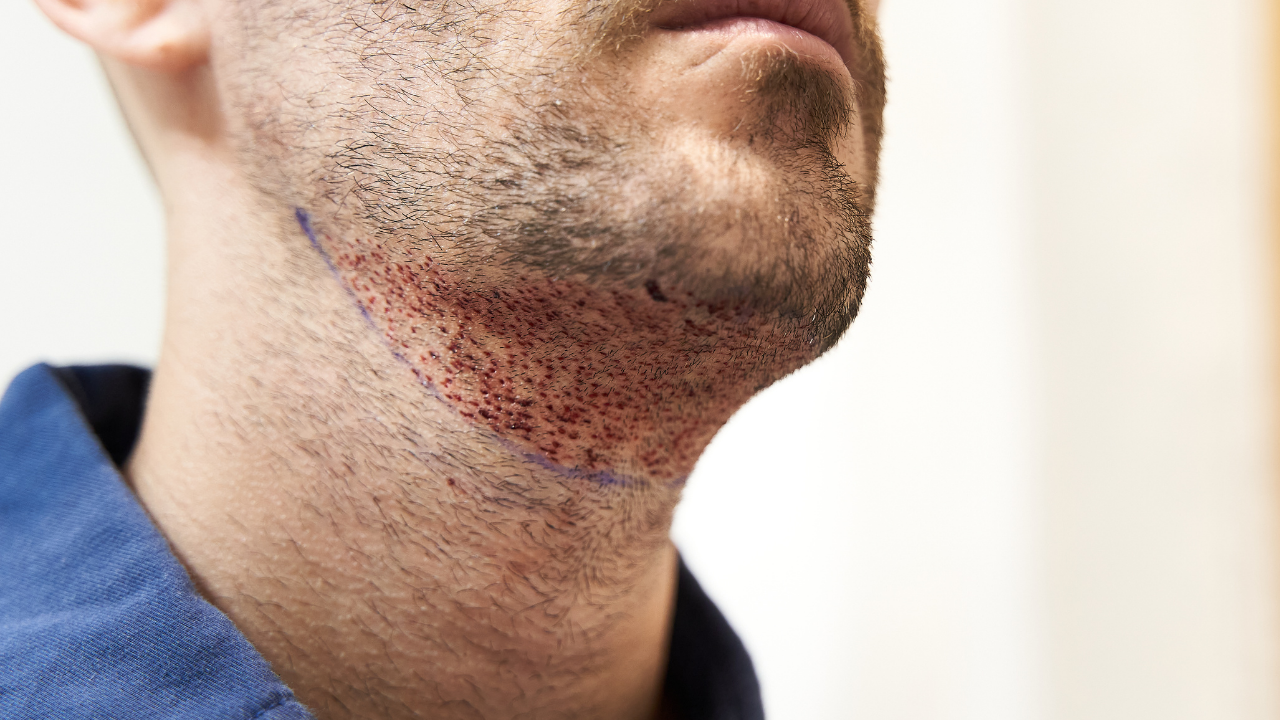
The working donor zone is the submental area — under the chin and along the upper neck, below the jawline, in the region that stays in shadow when someone looks at you straight on. Density there is high, the skin is loose and mobile, and any residual marks fall in a place that is essentially invisible in normal conversation. Some surgeons will extend cautiously into the lower cheek and the angle of the jaw when a patient has an unusually dense beard and needs volume, but the moustache, the beard outline that frames the face, and the sideburn architecture are left alone.
The extraction itself is not simply FUE done lower down. Punches are smaller — typically 0.7 to 0.8 mm against the 0.8 to 0.9 used on the scalp — because facial follicular units are compact. The skin is more elastic and slides under the punch, so the technician has to counter-tension it constantly. Follicles sit at a different angle and often curve beneath the surface, which means transection risk is higher for anyone who has not done a lot of it. At Hairpol this is treated as a distinct skill rather than an extension of scalp harvesting, and it is scheduled with that in mind.
What the Face Looks Like Afterwards: The Honest Version
You will have marks. Anyone who tells you otherwise is managing your emotions rather than informing you.
What you get are pinpoint dots where each follicle was removed, and after the redness settles over several weeks they usually fade to slightly pale spots, a shade lighter than the surrounding skin. Under the chin, with normal daylight and a normal viewing angle, they are difficult to see. Under a bathroom mirror with a clean shave and harsh overhead lighting, you can find them if you go looking. With even two or three days of stubble, they disappear entirely.
The variables that change this picture are worth knowing. Very fair skin shows the redness phase longer but hides the final pale dots better once healed. Darker skin can go the other way, with post-inflammatory pigment changes that take a few months to even out. A tendency to keloid or hypertrophic scarring is a genuine contraindication for facial harvesting, not a detail to be waved through in a consultation. And the thing that reliably produces a visibly damaged donor beard is not the technique but the greed: too many grafts pulled from too small an area, leaving thin patches that show whenever the beard grows out.
Where Beard Grafts Belong on the Scalp
The right answer is: anywhere the eye does not scrutinise individual hairs against bare skin.
The crown is the classic destination. It is a large surface that eats grafts, it is viewed from above and at a distance rather than head-on in a mirror, and the whorl pattern there already scatters light unpredictably. Coarse hair adds visual mass efficiently in exactly the place where mass is expensive to buy with scalp grafts alone.
The mid-scalp is the second natural home, especially the zone behind an established hairline where the job is bulk rather than finesse. Beard grafts also do useful work camouflaging old strip scars, filling between previously placed plugs in repair cases, and adding a second layer of density over an area that was grafted thinly years ago and never looked convincing.
There is a shared logic to all of these placements: the hair is being asked to block light and create the impression of density, not to build a soft, irregular, believable edge. Ask beard hair to do the first job and it excels. Ask it to do the second and it fails visibly, in daylight, to everyone.
Where They Do Not Belong: The Front Hairline
This is the rule that separates a good beard-donor plan from a regrettable one, and it is not negotiable at Hairpol.
The frontal hairline is the most scrutinised strip of skin on the human head. It is seen straight on, close up, in every mirror and photograph, and its believability depends on softness — fine single hairs, irregular spacing, a gradual transition rather than a line. Beard hair cannot deliver softness. It is thick, often wiry, frequently curved or kinked below the skin, and it catches light in a way that reads as artificial when it sits at the leading edge against bare forehead.
Patients who have had beard grafts placed in a hairline describe the same thing every time: it looks acceptable in photographs and wrong in person. The hairs stand differently, they resist lying flat, and where the transition zone should dissolve into skin, it instead forms a distinct coarse fringe. Repairing that means extracting those hairs again, which costs a second procedure and further donor damage on top of the original mistake.
The practical boundary we work to is the front one and a half to two centimetres. That band is scalp hair only, always, no matter how tight the donor budget is. If the scalp donor cannot fund a proper frontal zone, the answer is a smaller design, not a coarser one.
The Blend: Ratios That Actually Look Natural
Beard grafts are rarely placed as a solid block. The technique that holds up over years is mixing, and the ratio shifts as you move backwards over the scalp.
Immediately behind the frontal zone, you might be looking at something like one beard graft for every two or three scalp grafts — enough to extend coverage, diluted enough that the texture difference never resolves into a visible patch. Further back through the mid-scalp the ratio can even out to roughly one to one. In the crown, where scrutiny is lowest and demand is highest, beard grafts can carry the majority of the work without anyone noticing.
Distribution within each zone matters as much as the ratio itself. Beard grafts scattered evenly among scalp grafts read as a slightly coarser head of hair. The same number clustered together read as a repair that went wrong. This is placement work that cannot be rushed, and it is one of the reasons a mixed-donor case takes longer per graft than a straightforward scalp procedure and should be priced and scheduled accordingly.
How Many Grafts the Beard Can Realistically Give
A dense beard typically supports somewhere between 1,000 and 1,500 grafts in a single session without any visible thinning of the donor. Across staged sessions, patients with genuinely heavy facial hair have supplied 2,000 to 2,500, occasionally more. A patchy or light beard may support only a few hundred, which usually means the plan is not worth building around it.
Two constraints govern those numbers. First, extracted follicles do not come back — this is exactly as permanent on the face as it is on the scalp, and the same overharvesting arithmetic applies. Second, the harvest has to be scattered rather than concentrated. Taking roughly one follicle in four across a wide area preserves the visual density of the beard; taking everything from one patch does not, and the result shows up the moment the patient decides to grow a beard again three years later.
It is also worth pausing on the direction of travel. Some patients arrive wanting the opposite operation — scalp hair moved into a sparse jaw through beard transplantation. If a fuller beard is something you value, spending it on your scalp is a decision to make consciously and in advance, not one to discover afterwards.
Who Is a Reasonable Candidate
The profile that benefits most is fairly specific. Advanced loss, typically Norwood 5 to 7, with a scalp donor that has already been used or was never generous enough to begin with. A visibly dense beard. Loss that has stabilised, ideally with medical treatment holding the native hair in place. And a set of expectations that centres on coverage and framing rather than on the density of a twenty-year-old.
Repair patients form the second large group. When someone has had two previous surgeries, a depleted occipital donor and an unresolved crown, beard grafts are frequently the only remaining route to a result that changes how they look in a mirror rather than only in a report.
The people we turn down matter just as much. Young patients in early, active loss with an untouched scalp donor should not be spending facial hair — their scalp reserve is intact and their pattern has not declared itself. Anyone with a sparse beard is investing a lot of discomfort for a few hundred grafts. A history of keloid scarring, recurrent folliculitis in the beard area, or active inflammatory skin disease on the face pushes the risk past what the benefit justifies. At Hairpol we would rather have that conversation at consultation than manage disappointment eighteen months later.
Harvest Day: What It Actually Feels Like
The beard area is shaved to a uniform very short length beforehand — usually on the day of the procedure, in the clinic, so that follicle angles remain readable. The scalp donor is prepared as normal if both sources are being used in the same session.
Anaesthesia on the face is more sensitive than on the scalp. There are more nerve endings, the skin is thinner, and the first injections along the jawline are genuinely uncomfortable for a few seconds in a way that the occipital scalp is not. Once the field is numb, the sensation is pressure rather than pain. Most surgeons take the scalp grafts first and move to the beard afterwards, which spreads the least comfortable part of the day away from the very beginning.
Add roughly one to two hours to the length of the procedure for a beard harvest of a thousand grafts or so. You lie with your head extended for part of it, which some patients find more tiring than the extraction itself. Afterwards, expect mild swelling under the jaw for a day or two, a stiff feeling when you open your mouth wide, and a preference for soft food on the first evening. None of this is dramatic. It is simply different from the scalp-only experience most people have prepared for.
Healing on the Face: The First Two Weeks
Facial skin heals fast. Tiny crusts form over each extraction point within the first day and generally clear between days five and eight — often quicker than the scalp equivalent, because the face has a richer blood supply. Redness is the part that lingers, and it is the part that determines when you feel comfortable in public. Two to three weeks is typical; fair skin can hold a pink flush for longer.
Shaving comes back gradually. An electric shaver over the harvested zone is usually reasonable at around ten days, a blade closer to two or three weeks, and both should be approached without pressure. Ingrown hairs are common in the first month as the surviving follicles push back through healing skin — warm compresses and a gentle exfoliant handle almost all of them, and picking at them is the reliable route to a mark that lasts. A light non-comedogenic moisturiser and daily sun protection over the healing area meaningfully reduce the chance of lasting pigment change.
Numbness or a slightly odd sensation under the chin is normal for a few weeks and occasionally a few months. It resolves. So does the tightness. If you develop spreading redness, warmth, real pain or discharge, that is not part of the timeline and it needs to be seen — facial skin is forgiving, but folliculitis in a freshly harvested beard should be treated early rather than watched hopefully.
The Growth Timeline Runs on Its Own Schedule
Transplanted beard grafts shed like any other graft in the first weeks. What differs is what happens next. Because beard follicles cycle differently and are not synchronised with each other, emergence on the scalp tends to be later and more staggered than with scalp grafts. Where a scalp case shows meaningful growth at four to six months, a beard-donor case can look disappointingly quiet at that point and only fill in convincingly between eight and twelve months.
Eighteen months is a fair point at which to judge the final result, and it is worth waiting for. Patients who panic at month six about a crown that looks barely different are usually looking at grafts that simply have not started yet.
The texture question deserves honesty. Transplanted hair broadly keeps the character of where it came from — beard hair stays coarser than scalp hair, and it does not transform into something else. Many patients do report that after a year or two the difference feels less noticeable, partly because the hair grows longer and lies down more, partly because it is surrounded by scalp hair and reads as part of the whole. What it will not do is become fine. Any plan built on the assumption that it might is a plan built on hope.
Deciding Whether Your Beard Should Become Donor
The decision comes down to a trade you should make with your eyes open. You are converting a facial asset into scalp coverage, permanently, and the exchange rate depends on how dense your beard is, how much scalp donor remains, and where on your head the coverage is needed. For an advanced pattern with a spent occipital donor, it is often the difference between a partial result and a proper one. For someone in their late twenties with an intact donor and an anxious hairline, it is almost always premature.
What a good consultation should give you is a graft budget that names its sources: this many from the scalp, this many from the beard, going to these zones in these ratios, with the frontal band reserved for scalp hair. If a clinic quotes a single number without that breakdown, ask for it. The breakdown is where the plan is either sound or careless, and it is the fastest way to tell which kind of clinic you are sitting in.
At Hairpol, beard-donor planning starts with measuring what your scalp can actually give before anyone looks at your jaw, because facial hair should extend a good plan rather than rescue a bad one. If you want to know whether your donor situation makes beard grafts sensible or unnecessary, our team can walk you through hair transplantation planning in a consultation and tell you honestly which of the two you are.
Frequently Asked Questions (FAQ)
Can beard hair really be transplanted to the scalp?
Yes. Beard follicles survive and grow permanently on the scalp when they are extracted and placed correctly, and among all non-scalp donor sources they have the best survival record. They are usually taken from under the chin and along the upper neck, then mixed with scalp grafts in the crown and mid-scalp. What they cannot do is replace scalp hair in the frontal hairline, where their coarse texture becomes obvious.
How is beard hair different from scalp hair?
It is thicker, roughly 100 to 130 microns in diameter compared with 60 to 80 for scalp hair, and it usually grows as a single hair per follicular unit rather than two or three. Its growth cycle is different too, with a shorter active phase and less synchronisation between follicles. It is also androgen-driven in the opposite direction, which is why it stays permanent once transplanted.
Where on the face are the grafts taken from?
Almost always the submental area, meaning under the chin and along the upper neck below the jawline. That zone has high density and stays in shadow at normal viewing angles. The moustache, the visible beard outline that frames the face and the sideburns are left alone, because harvesting from those areas is what creates a patchy appearance.
Will the extraction leave visible scars on my face?
You will have pinpoint marks that fade to slightly pale dots over several weeks. Under the chin, in normal light, they are difficult to see, and even two or three days of stubble hides them completely. Visible damage almost always comes from taking too many grafts out of too small an area rather than from the technique itself. A history of keloid scarring is a genuine reason not to harvest from the face.
Why can beard grafts not be used in the hairline?
The frontal hairline is judged at close range and its believability depends on fine, soft, irregularly spaced hairs. Beard hair is thick, often wiry and frequently curved under the skin, so at the leading edge it forms a distinct coarse fringe against bare forehead. At Hairpol the front one and a half to two centimetres is reserved for scalp hair regardless of how tight the donor budget is.
How many grafts can a beard provide?
A dense beard usually supports 1,000 to 1,500 grafts in one session without visible thinning, and staged sessions can reach 2,000 to 2,500 in patients with particularly heavy facial hair. A sparse beard may only give a few hundred, which often means it is not worth building a plan around. Extracted follicles do not grow back, so the harvest has to be scattered rather than concentrated in one patch.
How long does it take for beard grafts to grow on the scalp?
Longer and less evenly than scalp grafts. Because beard follicles cycle differently and are not synchronised, emergence tends to be staggered, and a case that looks quiet at four to six months often fills in between eight and twelve months. Eighteen months is a fair point at which to judge the final result.
Does transplanted beard hair eventually become softer?
Not really. Transplanted hair largely keeps the character of where it came from, so beard hair stays coarser than scalp hair. Many patients say the difference becomes less noticeable after a year or two as the hair grows longer, lies flatter and blends visually with the surrounding scalp hair, but it will not turn fine. Any plan that depends on it becoming fine is unrealistic.
Find this helpful? Add Hairpol as a preferred source on Google.
Get a Free Consultation
Answer a few questions and the medical team will review your situation.
