The question almost never arrives as a question about surgery. It arrives as a logistics problem. You have a job where people look at you, a wedding in six weeks, a partner who does not know you have been researching this for two years, or simply a scalp you are not ready to explain to anyone. And somewhere in the middle of that, you find out that most hair transplants start with a razor.
That single detail stops more people than pain, price or travel ever do. Which is exactly why unshaven hair transplant techniques exist, and why they get marketed harder than almost anything else in this industry. At Hairpol, we perform them regularly, and we also talk people out of them regularly. Both of those facts belong in the same article, because the honest version of U-FUE is more useful to you than the brochure version.
What “Unshaven” Actually Covers
The label is doing a lot of work, and it is not doing it consistently. When a clinic says unshaven FUE, they might mean one of three quite different things, and the difference matters enormously for what you can realistically achieve in a single day.
The strictest version, sometimes called full U-FUE or long-hair FUE, means nothing is shaved anywhere. Your donor area keeps its full length, your recipient area keeps its full length, and grafts are harvested and implanted between existing hairs that are still four, eight or fifteen centimetres long. The second version trims only the individual grafts being extracted, cutting them down inside an otherwise untouched donor zone so the surrounding hair curtains the work. The third version, and by far the most common in practice, is a partial or hidden-window shave: a strip or patch of the donor area is clipped short and then covered by the longer hair above it.
All three get sold under the same word. Ask which one you are actually being offered, because the graft numbers, the time in the chair and the price attached to each are not comparable.
Why Clinics Shave in the First Place
It helps to understand what the razor buys, because then the trade-off stops feeling arbitrary. Shaving is not a tradition. It is a working condition.
When donor hair is trimmed to one or two millimetres, the surgeon can see the exit angle of every follicle, the direction each hair leaves the skin, and the density of the surrounding grouping. That visibility is what allows a punch to be aligned along the follicle rather than across it. Misalignment is how grafts get transected, and transection is how a session quietly loses fifteen percent of its yield before a single hair is implanted.
Shaving also gives the team speed and rhythm. A large session is thousands of individual extractions performed over several hours, and anything that slows each extraction by two seconds adds more than an hour across the day. It keeps the field clean, keeps grafts easy to spot when they are placed in solution, and keeps the recipient area legible while incisions are made at precise angles and depths.
So when you ask for an unshaven approach, you are asking the team to give up visibility, speed and margin for error. That can absolutely be worth it. It is just never free.
Full U-FUE, Partial Shave, and the Hidden Window
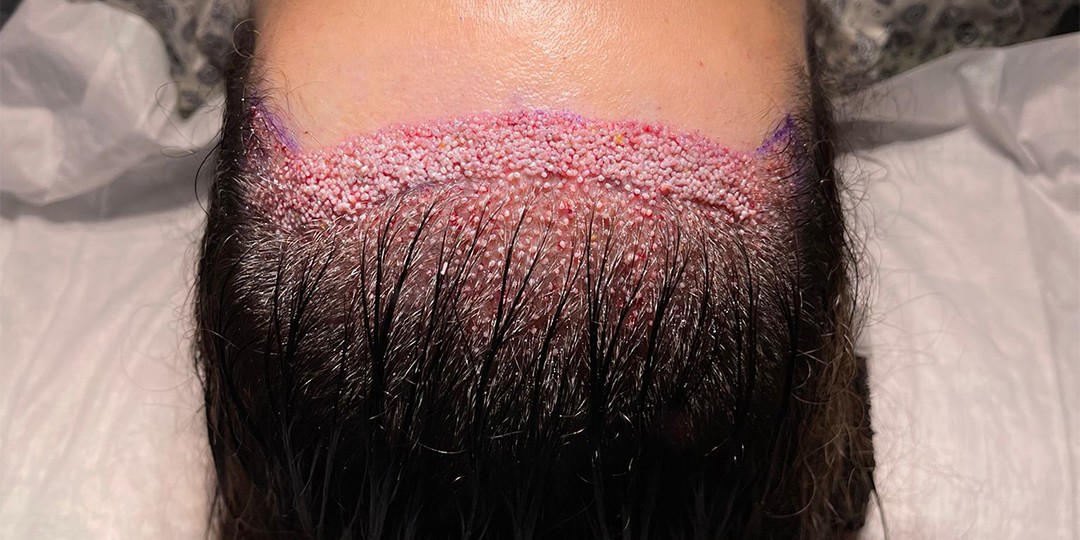
In real clinical practice, the hidden-window approach is the workhorse, and it is the one we most often recommend when discretion is the priority. A rectangular section of the donor area is clipped, usually low and central where the surrounding hair falls naturally over it. Grafts come from that window. When you comb your hair down afterwards, the clipped zone disappears completely.
The compromise is that a window has a finite surface area, and donor extraction should never be concentrated too heavily in one small region. Take too much from too little space and you create a visible density drop that becomes permanent. So the window can be widened, or a second window can be opened, but each expansion pushes you closer to something that no longer hides under normal hair length.
Full long-hair U-FUE avoids the window entirely by extracting individual follicles from across a broad donor area, each one trimmed in isolation. It is elegant when it works, and it is genuinely slower. Hairpol reserves it for smaller, precise cases where the priority is that nobody, including the patient looking in a mirror on day two, sees evidence of anything having happened.
Who Unshaven FUE Genuinely Suits
The strongest candidates share a pattern, and it is worth checking yourself against it honestly.
You have enough existing hair length to provide cover, ideally four centimetres or more in the donor region. You need a small to moderate session, roughly in the 800 to 2,000 graft range depending on your donor characteristics. Your loss is concentrated rather than diffuse, so the recipient area is a defined zone rather than a whole scalp. And your reason for wanting it is real: visibility at work, a role in front of camera or clients, a short recovery window before a fixed event, or a personal preference for privacy that you should not have to justify to anybody.
Hairline refinements, temple point restoration, scar camouflage, a modest frontal reinforcement, and follow-up sessions layered onto an earlier transplant all sit comfortably here. So do patients who have kept the same hairstyle for a decade and would find a full shave more distressing than the surgery itself. At Hairpol, we treat that distress as a legitimate clinical input, not a vanity footnote, because a patient who dreads the process is a patient who delays care for years.
Women and the Unshaven Approach
For many women, an unshaven technique is not a preference. It is the only version of the procedure they will consider, and that is entirely reasonable.
Female pattern loss tends to present as diffuse thinning behind an intact frontal line, or as widening at the part, rather than as the receding shorelines seen in male pattern loss. Long hair is often central to identity, and the social cost of a shaved scalp is calculated differently. This is why hair transplantation for women so often runs on partial-shave or fully unshaven protocols, with donor windows placed where they vanish under a normal parting.
The clinical caveats are real, though. Diffuse thinning means the donor region may itself be affected by miniaturisation, which limits how much can be safely taken. Female hair loss also has a longer list of medical drivers, from thyroid dysfunction to iron deficiency to traction damage, and surgery on an unstable, untreated cause is a poor investment. Bloodwork and a proper diagnosis come first. Once those are settled, unshaven work in a well-planned window is often the ideal route, and recovery hidden under existing length is genuinely discreet.
The Extraction Problem: Working Between Long Hairs
Here is the part that explains almost every limitation that follows. Extracting a graft from a long-haired donor area is mechanically harder in specific, unglamorous ways.
Each target follicle has to be isolated from the hairs around it, which means the technician is parting and holding surrounding strands out of the way while aligning a punch that is under a millimetre in diameter. Long hairs obscure the exit angle, and exit angle is the single most important piece of information when placing a punch. Long hairs also wrap around the rotating punch if the field is not managed meticulously, which drags on the graft and damages it.
Then there is the graft itself. An extracted follicle with a long hair attached is more delicate to handle, harder to sort under magnification, and easier to lose track of during counting. Each of these small frictions costs seconds, and thousands of seconds become a fundamentally different day.
None of this makes unshaven work unsafe in experienced hands. It does mean the technique is intolerant of rushed teams and high-volume schedules, which is exactly the environment a lot of cheap packages are built around.
Time, Team Size, and Why the Day Runs Longer
A conventional shaved session of 3,000 grafts might run seven to nine hours including breaks. The same graft count attempted unshaven can stretch well beyond that, and beyond a certain point the extension itself becomes the risk.
Grafts do not improve while they wait. Every hour outside the body, even in optimal holding solution at controlled temperature, chips away at survival potential. So a longer day is not a neutral inconvenience. It is a direct trade against the yield you came for. This is why responsible clinics cap unshaven sessions rather than letting them sprawl.
Team composition matters more here than in almost any other scenario. Unshaven extraction rewards experienced technicians who have done it hundreds of times and can work efficiently between long hairs without repeated repositioning. At Hairpol, unshaven cases are scheduled with that in mind, with a realistic graft target set before the day begins rather than an optimistic one revised downward at hour six.
If a clinic quotes you an unshaven session at the same duration and the same price as a shaved one of identical size, that is worth a second question.
The Graft Ceiling Nobody Advertises
This is the single most important limitation, and the one most often left out of the sales conversation.
Unshaven techniques have a practical upper bound. Depending on the clinic, the technique variant and your donor characteristics, meaningful U-FUE sessions typically land somewhere between 1,000 and 2,500 grafts. Some centres push higher across multi-day sessions. Very few can do it well in a single day without either extending dangerously or compromising extraction quality.
Compare that to a standard shaved session, where 3,500 to 4,500 grafts in a day is routine for a suitable candidate with a strong donor. If your pattern requires 4,000 grafts to achieve the coverage you want, the unshaven route does not simply cost more. It either takes two or three separate procedures, or it delivers a thinner result than the one in your head.
That is a real choice, and some patients make it deliberately and happily. Staged sessions have their own advantages for long-term planning. But the choice has to be made with the numbers in front of you, not discovered eight months later when coverage plateaus below expectation.
When Unshaven Is the Wrong Choice
There are cases where we will tell you plainly that the unshaven route is working against your own goal.
Advanced pattern loss, broadly Norwood V and above, needs volume. When the recipient area spans the frontal third, the midscalp and the crown, no unshaven protocol is going to deliver the graft count required in a sensible timeframe. Attempting it produces a scattered result across a large area, which reads as thin rather than restored.
Very short existing hair is another disqualifier, and an obvious one once stated. If your donor hair is already two centimetres, there is nothing to hide the work under, and you are paying a premium for camouflage that does not exist. Extremely curly or tightly coiled hair complicates alignment further, since the follicle path beneath the skin curves and long strands make that path harder to read.
Repair work over previous transplants, dense-packing goals, and cases where the donor is already limited and every single graft must be extracted with maximum precision are all better served by clear visibility. Hairpol would rather explain this at consultation than compromise a result to satisfy a preference.
Implantation: Where DHI and Sapphire Fit
Extraction is only half the operation. The recipient side has its own unshaven complications, and this is where technique selection genuinely changes what is possible.
Implanting into an area with existing long hair means every incision has to be placed between surviving follicles without damaging them, at an angle that matches neighbours you can barely see. Implanter pens used in DHI hair transplantation are well suited to this, because the graft is loaded into the pen and delivered directly, creating the channel and placing the follicle in one movement. That reduces the handling of long, fragile grafts and allows placement in dense existing hair with less disturbance.
Where channels are opened separately, blade quality and precision carry the load. The fine, sharp incisions associated with sapphire FUE hair transplant work help here, since smaller channels mean less trauma to the native hairs you are threading between. Neither technique magically removes the unshaven constraint on volume. What they do is protect the hair you still have while adding to it, which is the entire point when the recipient zone is thinning rather than bare.
Recovery Is Different, Not Easier
Unshaven recovery gets described as gentler. It is more accurate to call it more discreet and slightly more demanding.
The visible advantage is immediate and real. With long hair falling over both the donor window and the recipient zone, redness and small crusts are substantially concealed from day one. Many patients return to office environments within a week looking unremarkable, and that is the entire reason they chose this.
The practical cost is that washing and aftercare require more care. Long hair around healing grafts can tangle, and tangling near new implants is exactly what you want to avoid in the first ten days. Crusts are harder to see, which means they are harder to soften and clear properly, and residual crusting that sits too long is not helpful for the follicle underneath. You cannot casually towel-dry, you cannot brush normally, and you should not tie hair back tightly over the donor area.
At Hairpol, unshaven patients get a modified washing protocol for this reason, with slower, more deliberate technique and clear guidance on detangling. It is manageable. It just is not automatic.
Managing the Invisibility Promise
The word discreet is doing heavy lifting in most unshaven marketing, so it is worth defining what it can and cannot deliver.
What it delivers well: nobody sees a shaved head. There is no dramatic before-and-after moment where your appearance changes overnight in a way that invites questions. You do not have to explain a bandage, a buzz cut or a suddenly different silhouette. That alone resolves the problem most patients came in with.
What it does not deliver: complete invisibility during the first week or two. There is still swelling for some patients, still redness in the recipient zone if your hair is fine or light, still a period where you are being careful with your head in ways observant people may notice. And the transplanted hairs themselves will shed within weeks regardless of technique, so the flush of new hair you see on day one is temporary and always was.
If total discretion across the entire timeline is the goal, the broader strategy matters as much as the shave decision. Our guide on how to get a hair transplant that no one notices covers the planning side in detail.
Cost, Consultation, and the Questions Worth Asking
Unshaven work usually costs more per graft, and the reason is straightforward: it consumes more skilled hours for fewer grafts. A clinic that charges the same for both is either subsidising one, rushing one, or quietly redefining what unshaven means in your case.
Ask which variant you are being offered, and ask to see it described precisely. Ask for the realistic graft ceiling for your specific donor, not a general figure. Ask how many hours the day will run and whether a second session is anticipated. Ask who performs the extractions and how much unshaven experience that specific team has. Ask what happens if, once your donor is examined in person, the honest recommendation changes.
That last question matters. Photographs flatten density, and a plan built from phone images sometimes shifts on the day. At Hairpol, we would rather have that conversation before you commit than after, and a clinic unwilling to revise a plan in front of you is telling you something about how it operates.
Making the Decision Without Regret
Reduce it to one honest exchange. You are trading graft volume and, often, money, for discretion and continuity of appearance. If the coverage you need fits inside the unshaven ceiling, that is an easy trade and you should take it. If it does not, you are choosing between a slower staged plan and a single shaved session that reaches your goal faster.
Neither answer is superior in the abstract. The mistake is choosing unshaven because it sounds more advanced. It is not more advanced. It is a different set of compromises, better suited to some patterns and clearly worse suited to others, and any clinic presenting it as a strict upgrade is not being straight with you.
If you are weighing an unshaven hair transplant and want to know what is genuinely achievable for your donor area, pattern and timeline, our team in Ataşehir will assess you properly and tell you when the answer is no. You can explore the full hair transplantation options at Hairpol and book a consultation where the plan is built around your scalp rather than around a technique someone wants to sell.
Frequently Asked Questions (FAQ)
What does an unshaven (U-FUE) hair transplant actually mean?
It means grafts are harvested and implanted without shaving your head, but the term covers three different approaches. Full long-hair U-FUE shaves nothing at all. A second variant trims only the individual grafts being extracted inside an otherwise untouched donor area. The most common version is a hidden-window or partial shave, where a small section of the donor area is clipped and then covered by longer hair above it. Always ask a clinic which of the three they are offering, because graft capacity, duration and price differ significantly between them.
How many grafts can be done in one unshaven session?
Realistically between 1,000 and 2,500 grafts for most patients, depending on donor characteristics, the technique variant and the experience of the team. Some clinics push higher across multi-day sessions. By comparison, a standard shaved session can comfortably deliver 3,500 to 4,500 grafts in a single day for a suitable candidate. If a clinic promises 4,000 unshaven grafts in one day at a normal duration, that claim deserves careful scrutiny before you commit.
Is unshaven FUE better than a shaved transplant?
No, it is a different set of trade-offs rather than an upgrade. Unshaven work gives you discretion and continuity of appearance, but it costs graft volume, takes longer per graft and usually costs more money. Shaved sessions give the surgeon full visibility of follicle angles, faster extraction and higher volume in one day. The right choice depends on how much coverage you need, how long your hair is, and how important immediate discretion is in your situation.
Who is not a good candidate for an unshaven hair transplant?
Patients with advanced pattern loss, broadly Norwood V and above, generally are not, because the graft volume needed cannot be delivered in a sensible timeframe. Very short existing hair is also disqualifying, since there is nothing to hide the work beneath. Extremely curly or tightly coiled hair complicates alignment, and repair cases, dense-packing goals and limited donor areas all benefit from the full visibility a shave provides.
Why is unshaven FUE more expensive per graft?
Because it consumes more skilled hours for fewer grafts. Isolating each follicle among long hairs, aligning the punch without seeing the exit angle clearly, and handling grafts with long strands attached all slow the process down considerably. The technique also requires experienced technicians who have performed it many times. A clinic charging identical prices for shaved and unshaven sessions of the same size is worth questioning.
Is recovery easier after an unshaven transplant?
It is more discreet rather than easier. Long hair conceals redness and crusting from day one, which is why many patients return to work within a week looking unremarkable. However, washing requires more care because long hair around healing grafts can tangle, crusts are harder to see and soften properly, and you cannot towel-dry or brush normally. Most clinics, including Hairpol, provide a modified washing protocol for unshaven patients.
Do transplanted hairs still shed after an unshaven procedure?
Yes. Shock shedding happens regardless of technique, usually between two and six weeks after the procedure. The hairs you see immediately after an unshaven session are the original shafts attached to the transplanted grafts, and they fall out as the follicle enters a resting phase. New growth typically begins around month three to four, with meaningful results at six to eight months and final density at twelve to eighteen months.
Can unshaven techniques be combined with DHI or sapphire blades?
Yes, and often they should be. DHI implanter pens suit unshaven work well because the graft is delivered directly, creating the channel and placing the follicle in one movement, which reduces handling of fragile long grafts and disturbance of existing hair. Sapphire blades produce fine incisions that cause less trauma to native follicles when implanting between them. Neither technique removes the volume ceiling that comes with working unshaven.
Find this helpful? Add Hairpol as a preferred source on Google.
Get a Free Consultation
Answer a few questions and the medical team will review your situation.
