
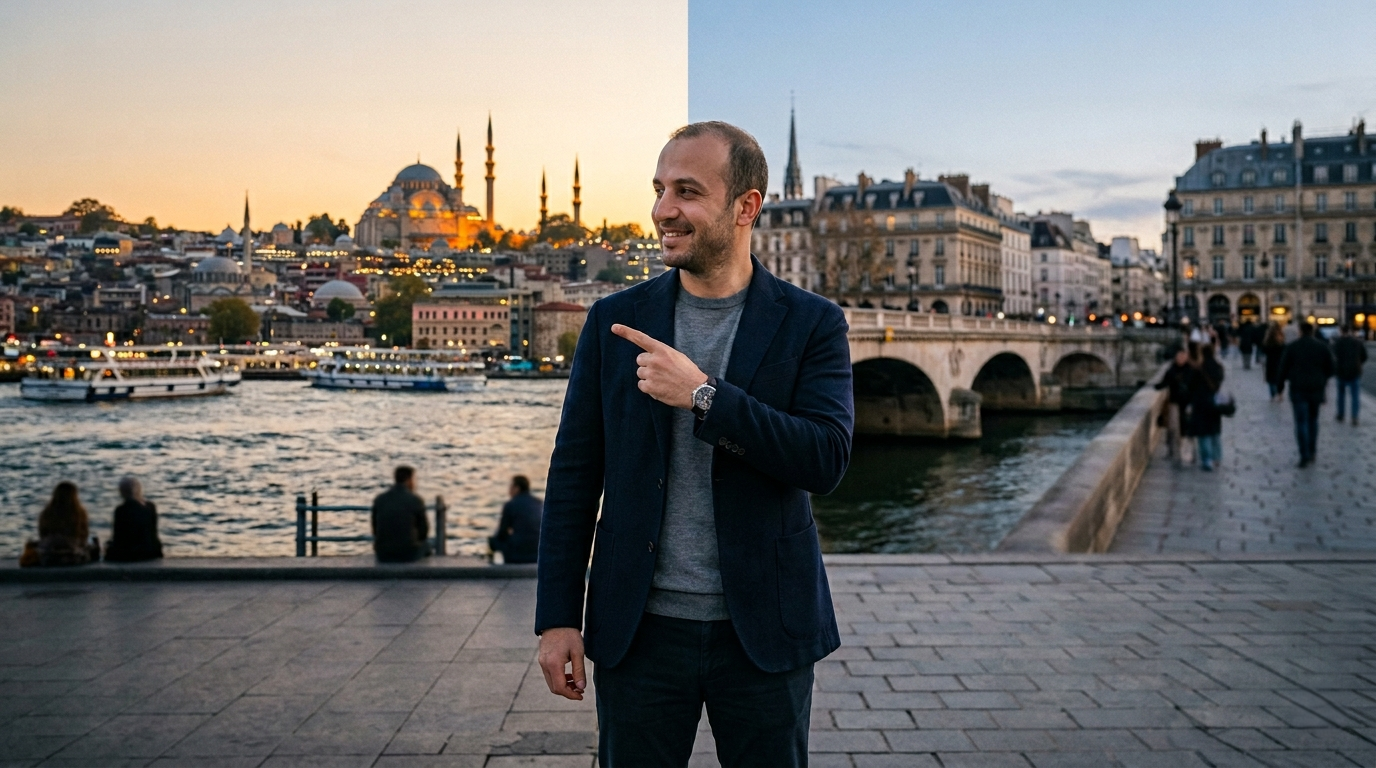
The price difference between a hair transplant in Turkey and the same procedure in the UK, Germany, or France is not subtle. The NHS puts private hair transplant treatment in the UK anywhere between £1,000 and £30,000, and the same procedure can be performed in Istanbul well below the upper end of that range, including accommodation, transfers, and aftercare. For many patients, that gap is the starting point of their research — and also the starting point of their uncertainty.
The natural question the price difference raises is whether it reflects a difference in quality. If the procedure costs a fraction of the price, something must be different. Either the materials are inferior, the surgical standards are lower, the experience is less reliable, or some combination of all three. This is the assumption that underlies most skepticism about hair transplant Turkey options — and it deserves honest examination rather than either blanket dismissal or uncritical acceptance.
The reality is more nuanced than either “Turkey is just as good for a fraction of the price” or “you get what you pay for.” Understanding what actually drives the price difference, where genuine quality differences exist, and how to evaluate a Turkish clinic against European alternatives gives patients a framework for making a genuinely informed decision rather than one driven by either price attraction or price anxiety.
Before comparing offers, see what shapes hair transplant costs in Turkey and what a package should include.
What Actually Drives the Price Difference
The cost of a hair transplant in any country reflects the operating costs of delivering medical services in that economy. The largest components of procedure cost are surgical team salaries, clinic facility costs, administrative overhead, and the cost of materials and equipment.
Turkey’s significantly lower cost of living and operating costs relative to Western Europe means that the same quality of inputs — experienced surgeons, modern facilities, quality materials — can be delivered at substantially lower cost in Istanbul than in London or Paris. A highly experienced Turkish surgeon commanding an excellent salary by local standards earns significantly less in absolute terms than a comparably experienced British or German surgeon. A modern clinic facility in Istanbul costs substantially less to operate per patient than an equivalent facility in a major Western European city.
This is the same economic principle that makes high-quality manufacturing, software development, and professional services available at lower cost in emerging economies — not because quality is lower, but because the cost of producing equivalent quality is genuinely lower in those economies. The price difference between Turkey and Western Europe is primarily a reflection of economic geography rather than clinical quality differential.
This doesn’t mean all Turkish clinics are equivalent to all European clinics. It means the price difference alone is not evidence of a quality difference. There are excellent clinics and poor-quality operators at every price point in every market. The question of quality requires evaluation beyond price comparison.
Where Turkey Has Genuine Advantages
Beyond the cost differential, Istanbul has developed specific structural advantages as a hair transplant destination that are worth understanding on their own terms.
Procedure volume and specialization are the most clinically significant. Istanbul’s leading hair transplant clinics perform procedures at a scale that is simply not achievable in most European markets. The concentration of demand from both domestic patients and international medical tourists means that top Turkish surgeons and their teams accumulate procedural experience at a rate that takes European surgeons significantly longer to match. Experience matters in hair transplant surgery — the judgment, the speed, the technical efficiency, and the aesthetic eye that come from performing thousands of cases develop faster when case volumes are high.
Considering treatment in Turkey? Here is how a hair transplant at Hairpol works, from consultation to follow-up.
This is not a theoretical advantage. In several areas of surgery, high-volume specialized centers consistently produce better outcomes than lower-volume generalist facilities, and hair restoration is an area where this principle applies clearly. A surgeon who has performed 3,000 Sapphire FUE procedures has developed a level of judgment and refinement that is difficult to replicate at a lower volume regardless of formal training.
Infrastructure investment in the leading Turkish clinics has kept pace with or exceeded what is typical in European markets. The competitive pressure of the medical tourism market has driven significant investment in modern equipment, facility quality, and technique refinement. Clinics competing for international patients have strong incentives to maintain high standards, and the leading facilities in Istanbul use the same instruments, techniques, and protocols as the best European clinics.
Clinical specialization is another genuine advantage. In most European countries, hair transplants are performed by plastic surgeons or dermatologists who also perform many other procedures. In Istanbul’s leading clinics, the entire team — surgeons, technicians, coordinators — works exclusively in hair restoration. This specialization produces a depth of focus and institutional knowledge that generalist practices cannot match.
Where Genuine Risks Exist in the Turkish Market
The same market conditions that created Istanbul’s advantages also created its most significant problem: a proliferation of low-quality operators attracted by high demand and willing to cut corners in ways that produce poor outcomes and harm patients.
The Turkish hair transplant market includes a wide range of operators, from genuinely excellent clinics with experienced surgeons and rigorous standards to facilities that prioritize patient acquisition over clinical quality, use unqualified or minimally trained staff for surgical steps, and process patients at volumes that make individual quality control impossible.
The most significant risk in the Turkish market is technician-only procedures — cases where the surgeon’s involvement is limited to a brief appearance at the beginning and end while unlicensed technicians perform the extraction, channel creation, and implantation without adequate medical supervision. This model allows clinics to process multiple patients simultaneously and at high volume, reducing per-patient surgeon costs dramatically. The results, predictably, are inconsistent — technically competent in some cases, significantly below standard in others, with patients having no reliable way to know in advance which outcome they’ll receive.
The marketing environment compounds this risk. Turkish clinics have become highly sophisticated at presenting polished digital presences, compelling before-and-after galleries, and persuasive consultation experiences that don’t reliably reflect clinical quality. The gap between marketing quality and clinical quality can be enormous in this market, and patients who evaluate clinics primarily through their websites and social media content are working with information that is designed to attract bookings rather than accurately represent outcomes.
These risks are real and documented in the experiences of patients who have had poor outcomes from low-quality Turkish operations. They are also not unique to Turkey — substandard operators exist in every market, including the UK and across Europe. But the concentration of medical tourism demand in Istanbul has created a particularly high density of operators competing on price rather than quality, which requires specific vigilance when evaluating options.
How European Clinics Differ
European hair transplant clinics operate under different structural conditions that produce both genuine advantages and genuine limitations compared to the Turkish market.
Regulatory frameworks in most European countries provide stronger baseline protections for patients. Licensing requirements for surgeons are more uniformly enforced, facility standards are subject to regular inspection, and the legal framework for patient recourse when outcomes fall short is more developed. For patients who value these structural protections and want the reassurance of operating within a familiar regulatory environment, European clinics offer something that Turkish options cannot fully replicate from a distance.
The follow-up care model is genuinely more convenient in a domestic or near-domestic European setting. Post-procedure check-ins, addressing concerns during recovery, and any needed revision work are practically easier when the clinic is accessible without international travel. For patients who anticipate wanting regular in-person contact with their clinical team during the twelve to eighteen month hair transplant timeline, proximity matters.
Where European clinics are genuinely limited is in value — the cost premium over Turkish options rarely reflects a proportional quality premium, particularly for experienced European patients who can evaluate quality independently. Paying three to five times more for a procedure at a mid-tier European clinic than at a top-tier Turkish clinic produces lower clinical quality at higher cost, which represents poor value regardless of the regulatory comfort it provides.
The European clinics that justify their premium are those at the genuine top of the market — highly experienced specialized surgeons with strong and verifiable track records who use conservative donor management, thoughtful hairline design, and patient-centered long-term planning. These clinics exist and are worth the premium for patients who find them. They are also not typical of the broad European market.

The Surgeon Question Doesn’t Change by Geography
The single most important quality variable in a hair transplant is the surgeon — their experience, judgment, aesthetic sensibility, and direct involvement in the procedure. This doesn’t change whether the clinic is in Istanbul, London, or Berlin.
A highly experienced Turkish surgeon with strong aesthetic judgment, conservative donor management practices, and genuine surgical involvement throughout the procedure will produce better results than a less experienced European surgeon performing the procedure at lower volume regardless of the price or geography.
The practical implication is that geography should not be a primary filter in evaluating clinics. The questions that determine quality — who performs the hairline design, who creates the recipient channels, who performs extraction and implantation, how many procedures the lead surgeon performs per day, what evidence exists of their long-term results — are the same questions regardless of where the clinic is located. A Turkish clinic that answers these questions well is a better choice than a European clinic that answers them poorly, at any price point.
What Istanbul Specifically Offers Beyond Price
Istanbul deserves specific discussion not just as a price comparison point but as a destination with genuine strengths for international patients.
The concentration of specialized expertise in Istanbul is real and meaningful. The city has become the global center of hair restoration volume, and the best clinics there have accumulated institutional knowledge, technical refinement, and experienced teams that represent genuine clinical assets rather than just cost advantages.
The infrastructure for international patients is well-developed. Coordination of travel, accommodation, transfers, and procedure logistics is routine for Istanbul clinics serving international patients, and the experience of traveling for the procedure is typically well-managed at the top clinics. Language support in English and other European languages is standard.
The techniques available — Sapphire FUE, DHI, and combinations — are the same techniques used at European clinics, with the same instruments and protocols. There is no technical disadvantage in Istanbul relative to European markets at the clinical level.
At Hairpol, located in Istanbul’s Ataşehir district, these advantages are combined with the clinical standards that differentiate genuine quality from the broader market. Ministry of Health authorization, international certification, experienced surgical team involvement throughout procedures, and long-term patient relationship management represent the combination that makes Istanbul a genuine clinical destination rather than simply a cost-saving option.
How to Evaluate a Turkish Clinic Against European Alternatives
Evaluating a Turkish clinic rigorously requires the same framework as evaluating any clinic — and the same red flags apply regardless of geography.
Verify surgeon involvement specifically. Ask directly who performs each stage of the procedure — hairline design, channel creation, extraction, implantation — and how many procedures the lead surgeon performs per day. Clinics where the surgeon is genuinely present and involved throughout answer these questions specifically. Clinics where technicians perform most of the work deflect toward technique discussions or give vague team answers.
Check credentials verifiably. Ministry of Health health tourism authorization is the baseline certification for Turkish clinics serving international patients. Its presence confirms minimum facility and staffing standards. International society membership — particularly ISHRS membership — indicates engagement with professional standards beyond the local regulatory minimum.
Evaluate before-and-after galleries critically. Look for cases similar to your own rather than only the most dramatic transformations. Look for results photographed under consistent lighting rather than the unflattering-before, flattering-after asymmetry that characterizes gallery manipulation. Look for long-term results at twelve months or beyond rather than early post-procedure images.
Seek reviews at twelve months or later. Early reviews capture logistics and hospitality. Twelve-month reviews capture the actual clinical outcome. Patient forum communities dedicated to hair restoration contain detailed long-term outcome reports for specific clinics that provide more reliable signal than aggregate review platforms dominated by early-stage enthusiasm.
Consult with multiple clinics. The quality of the consultation itself — whether it involves genuine assessment of your specific hair loss pattern, donor characteristics, and long-term trajectory, or moves directly to graft count and price — tells you more about clinical priorities than any marketing material.
The Honest Summary
The price difference between hair transplant Turkey and European alternatives is primarily economic geography rather than clinical quality differential. Turkey’s lower operating costs allow equivalent clinical quality to be delivered at significantly lower price. This means the best Turkish clinics represent genuinely excellent value — not because they cut corners, but because they don’t need to charge European prices to operate sustainably.
The risk in the Turkish market is not inherent to Turkey — it’s the concentration of low-quality operators attracted by high demand, which requires more careful evaluation than a domestic European market where the range of quality variation is narrower. The tools for navigating that evaluation are the same tools that apply to clinic selection anywhere: verifying surgeon involvement, checking credentials, evaluating galleries critically, seeking long-term reviews, and consulting with multiple clinics before committing.
Patients who apply these evaluation tools rigorously and identify a top-tier Turkish clinic like Hairpol can access clinical quality that matches or exceeds what’s available in European markets, at a price point that makes the procedure genuinely accessible rather than prohibitively expensive. The combination of Istanbul’s specialized expertise, competitive infrastructure, and lower operating costs represents a genuine clinical opportunity — for patients who know how to evaluate it.
Find this helpful? Add Hairpol as a preferred source on Google.
Get a Free Consultation
Answer a few questions and the medical team will review your situation.
