
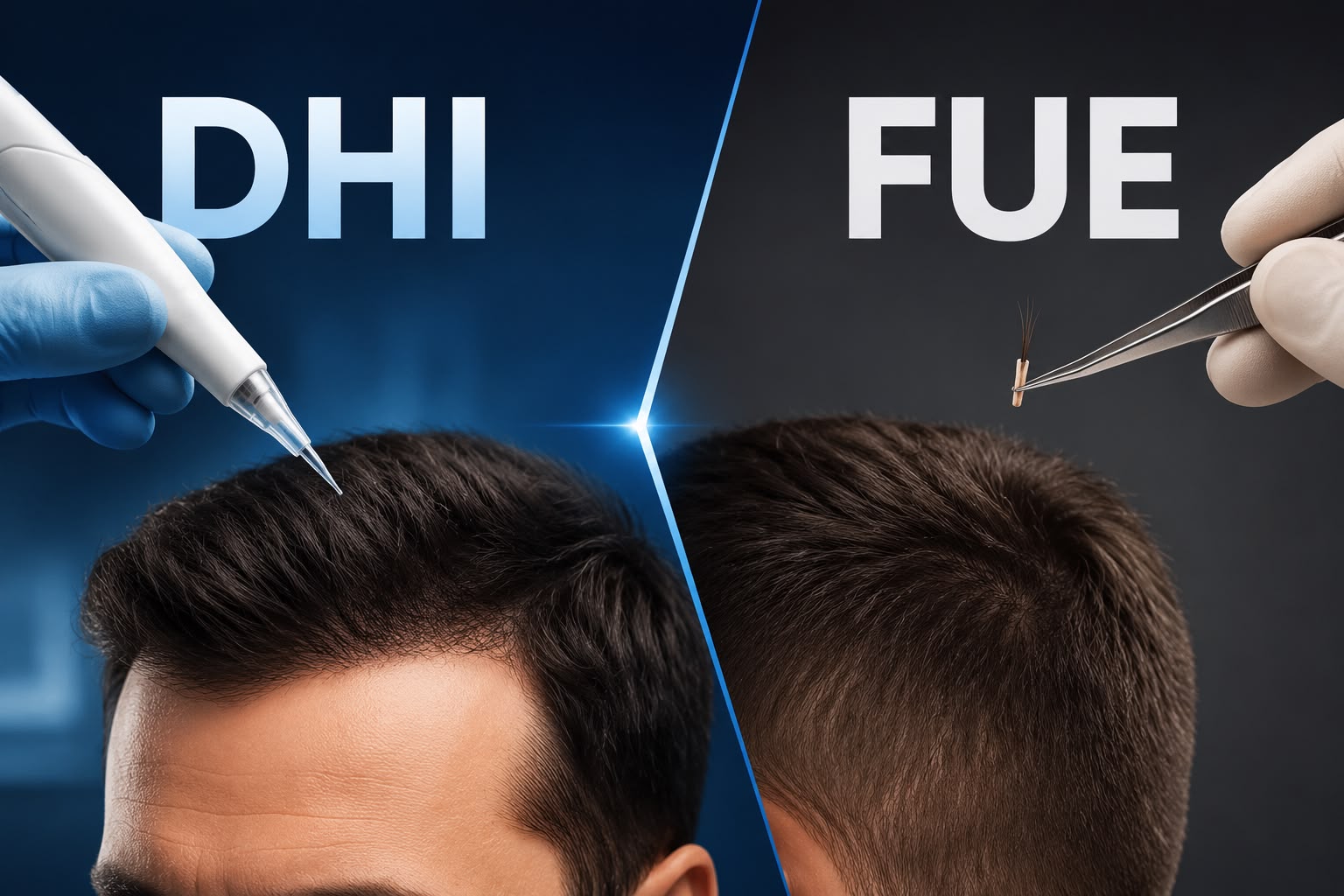
Patients researching hair transplants quickly encounter the DHI vs FUE comparison. Most clinic websites promote one technique or the other as superior, marketing materials emphasize specific advantages, and patient forums debate which approach produces better results. The framing usually suggests that one technique is objectively better than the other, and the question for the patient is which one to choose.
The reality is more nuanced. DHI and FUE aren’t really competing techniques in the way the marketing presents them — they’re related approaches with overlapping methodology, and the appropriate choice for any specific patient depends on case characteristics that the marketing comparisons don’t address. A patient choosing based on which technique sounds more advanced often makes a suboptimal decision; a patient choosing based on which technique fits their specific situation makes a better one.
This guide works through the DHI vs FUE comparison seriously. What the techniques actually involve, how they genuinely differ, which case characteristics make one preferable over the other, and how patients should think about the choice rather than defaulting to whichever technique their first clinic happens to promote. The goal is to help you understand the comparison well enough to have a substantive conversation with the clinic you choose rather than accepting whatever they recommend without context.
What FUE Actually Is
FUE — follicular unit extraction — is the foundational technique that underpins most modern hair transplant approaches. The procedure involves three distinct phases:
Extraction. Individual follicular units are removed from the donor area at the back and sides of the scalp using a small punch tool (typically 0.7mm to 1.0mm in diameter). Each follicular unit — a natural grouping of one to four hairs — is extracted intact along with the surrounding tissue that contains the cellular machinery for hair production.
Recipient channel creation. Small incisions are made in the recipient area where the grafts will be implanted. The angle, depth, and density of these channels determine how the final result will look — channel creation is essentially the design phase of the procedure, where the surgeon plans where each graft will go and at what angle it will grow.
Implantation. The extracted follicular units are placed into the prepared channels using forceps or similar instruments. The graft is positioned in the channel with the proper orientation and depth, where it will integrate into the surrounding tissue and eventually produce hair from its new location.
Standard FUE uses steel punches for extraction. Sapphire FUE is a variation that uses sapphire-tipped blades for the channel creation phase — the sapphire blade produces cleaner incisions with less tissue trauma than standard steel, resulting in faster healing and less scabbing.
What DHI Actually Is
DHI — direct hair implantation — is a variation of the FUE methodology that uses a specialized instrument called the Choi pen (also called Choi implanter) to combine the channel creation and implantation phases into a single step.
The Choi pen is essentially a hollow needle with a plunger mechanism. The graft is loaded into the needle, the needle is inserted into the recipient area at the desired angle and depth, and the plunger pushes the graft into the channel as the needle is withdrawn. The channel is created and the graft is placed in the same motion.
The extraction phase in DHI is identical to standard FUE — individual follicular units are removed from the donor area using a punch tool. Where DHI differs is in the recipient phase, where channel creation and implantation become unified rather than sequential.
This single difference is actually important. Combining the steps means the graft spends less time outside the body before being implanted (since it’s loaded into the implanter immediately after extraction rather than waiting for separate channel creation). It also means the implantation angle and depth are controlled by the implanter mechanism rather than by separate channel creation followed by graft placement.
How DHI and FUE Genuinely Differ
With the technical details established, here are the practical differences between DHI and FUE that actually matter for patient outcomes.
Out-of-Body Time for Grafts
In standard FUE, grafts are extracted, held in a preservation solution while channels are created, and then implanted. The out-of-body time can range from a few minutes to several hours depending on procedure size and workflow.
In DHI, grafts are loaded into the Choi pen immediately after extraction and implanted shortly thereafter. Out-of-body time is typically shorter.
Shorter out-of-body time can theoretically improve graft survival rates. In practice, however, modern preservation solutions and quality clinic workflows manage extended out-of-body time well, and the survival rate difference between the techniques in real-world conditions is small enough that other factors usually matter more.
Implantation Precision and Angle Control
The Choi pen used in DHI allows very precise control over the angle and depth of implantation. The mechanism places the graft at exactly the angle the surgeon directs.
In standard FUE, the implantation angle is determined by the channel that was created, with the graft following the path of the existing channel. Quality surgeons create channels at precise angles, but the two-step process means precision depends on the alignment between channel creation and subsequent implantation.
For applications requiring very precise angle control — beard transplants, eyebrow transplants, hairline work where the natural growth angle is acute — DHI’s angle precision can be genuinely advantageous.
Recipient Area Trauma
In standard FUE, the recipient area undergoes two separate phases of work: channel creation followed by graft placement. Each phase involves some tissue disruption.
In DHI, the recipient area undergoes a single phase of work where channel creation and implantation happen simultaneously. Total tissue trauma can be lower because there’s no gap between channel creation and graft placement where the channel sits open.
For patients with existing hair in the recipient area — common in early-stage hair loss where transplantation is adding density to thinning zones rather than replacing fully bald areas — the reduced trauma in the recipient area can mean better preservation of existing hair.
Procedure Time and Graft Capacity
DHI procedures typically take longer per graft than standard FUE procedures, partly because the single-step process involves more careful preparation per graft and partly because the Choi pens need to be reloaded between grafts.
For very large procedures — 4,000+ grafts — the time difference can affect what’s practical to complete in a single session. Some clinics split large DHI procedures across two days while completing the same volume in standard FUE in a single day.
For moderate procedures, the time difference is meaningful but not procedure-limiting. For smaller procedures, the difference is minimal.
Donor Area: Identical
Both DHI and FUE use the same extraction technique. The donor area appearance, healing, and constraints are identical between the two approaches. Patients evaluating which technique is better for donor area considerations are evaluating the wrong variable — the donor area work is the same either way.
When DHI Is the Better Choice
Several specific case characteristics make DHI the more appropriate technique. Patients with these characteristics often get better results from DHI than from standard FUE.
Adding Density to Thinning Hair
Patients with existing hair in the treatment area who want to add density rather than restore full bald zones benefit from DHI’s reduced recipient area trauma. The combined channel creation and implantation phase means existing follicles in the treatment zone are less disrupted than they would be in a two-phase standard FUE procedure.
For patients in early-stage androgenetic loss who still have substantial native hair that they want to preserve while supplementing it, DHI is often the technically appropriate choice.
Hairline Work Requiring Acute Angles
The natural growth angle at the hairline is quite acute — typically 15 to 25 degrees from the scalp surface for most patients. Achieving this angle precisely is essential for natural-looking results. DHI’s angle control through the Choi pen mechanism makes very precise angle achievement easier than channel creation followed by separate implantation.
For hairline-focused procedures where angle precision is critical, DHI can deliver better aesthetic outcomes.
Beard and Eyebrow Transplants
Facial hair grows at different angles than scalp hair, with beard hair growing nearly flat against the skin in some areas and eyebrows growing in specific directional patterns that vary across the brow. The angle precision required for facial hair restoration is even more demanding than scalp hairline work.
DHI is the preferred technique for most facial hair restoration procedures because of this angle precision requirement. Standard FUE can be used for facial hair, but DHI’s mechanism-controlled implantation angle is typically better suited to the precision facial hair work requires.
Smaller Procedures Where Time Isn’t a Constraint
For procedures involving 1,500 to 2,500 grafts, DHI’s per-graft time difference doesn’t create practical constraints. The smaller scope means the procedure completes in a reasonable timeframe regardless of technique, and the DHI advantages can be fully realized without scope limitations.
When FUE Is the Better Choice
Other case characteristics make standard FUE — including Sapphire FUE — the more appropriate technique. The framing that DHI is always superior or always more advanced is incorrect; for many cases, FUE is the better technical choice.
Large Restoration Cases
For procedures involving 4,000+ grafts, especially when the goal is restoring substantially bald areas rather than supplementing existing hair, FUE allows efficient completion in a single session. The faster per-graft pace of FUE makes large procedures practical without requiring multiple-day approaches.
The technical work in restoring bald areas with extensive coverage doesn’t benefit as much from DHI’s specific advantages, since there’s no existing hair to preserve and the angle requirements across large coverage areas are less acute than at the hairline edge.
Crown Coverage
The crown grows in a spiral pattern that requires specific channel angles distributed in a whorl. Standard FUE’s separate channel creation phase allows the surgeon to design the entire whorl pattern as a coherent plan before any grafts are placed. This planning step can be more effective for complex pattern work than DHI’s simultaneous channel-and-implant approach.
Crown work also tends to involve larger graft counts (since the area is substantial), making FUE’s faster pacing useful.
Patients with Tight Donor Supply
When donor supply is limited and every graft matters, the experience and judgment of the surgeon in selecting which follicular units to extract can be critical. Standard FUE workflows often involve more deliberate selection and inspection of grafts during the separation phase. For patients where donor management is a primary concern, this additional inspection can be valuable.
Cost Considerations
DHI typically costs more than standard FUE at the same clinic, reflecting the additional equipment (Choi pens are expensive consumables), longer procedure time, and specialized training required. For patients where cost is a meaningful factor, standard FUE delivers comparable outcomes for many case types at lower cost.
The price difference between FUE and DHI at the same clinic typically ranges from 15% to 40%, depending on the clinic.
The Marketing Confusion Worth Clarifying
Several marketing claims about DHI vs FUE deserve direct clarification because they distort patient decision-making.
“DHI is the most advanced technique”
DHI is a variation of FUE methodology, not a fundamentally different or more advanced approach. It uses different instruments for the recipient phase, with specific advantages for specific case types. The framing of DHI as universally more advanced is marketing language, not technical accuracy.
“FUE leaves more scarring than DHI”
The donor area appearance is identical between FUE and DHI — both techniques use the same extraction method. Any scarring difference between FUE and DHI in the donor area is illusory; the techniques don’t differ there.
In the recipient area, both techniques can produce minimal visible marks when performed by qualified surgeons. Sapphire FUE in particular produces very clean recipient area healing comparable to DHI in this respect.
“DHI doesn’t require shaving the recipient area”
Some marketing presents DHI as the only technique that allows transplantation without shaving the recipient area. This is misleading. Unshaved transplantation (sometimes called UFUE or U-DHI) is possible with both techniques in appropriate cases, depending on the clinic’s experience and the patient’s specific situation. The shaving question is somewhat independent of the FUE vs DHI distinction.
“DHI has higher graft survival rates”
Survival rates depend more on surgical skill, graft handling, and aftercare compliance than on which specific technique is used. Quality clinics achieve 85-95% survival rates with both FUE and DHI when the case is appropriate for the chosen technique. The marketing claim that one technique inherently produces higher survival rates than the other is not well-supported.
How the Choice Actually Gets Made
In a quality consultation, the choice between DHI and FUE is made based on case characteristics rather than as a generic preference. The surgeon evaluates:
- How much existing hair is in the recipient area and whether preserving it is a priority.
- The total graft count required and whether single-session completion is important.
- Which zones are being addressed and what angle requirements apply.
- Whether facial hair restoration is part of the procedure.
- Patient preferences around procedure timing, cost, and recovery experience.
- The specific donor supply and any constraints on graft availability.
Based on these factors, the surgeon recommends the technique that best fits the specific case. For some patients, the recommendation will be DHI. For others, standard or Sapphire FUE. For still others, a combination approach — for example, DHI for the hairline and standard FUE for the crown.
A consultation that recommends a technique without engaging with these case-specific factors is showing you something about the clinic’s approach rather than about the right technique for your case. Clinics that promote one technique universally regardless of case characteristics are typically optimizing for marketing differentiation rather than patient outcomes.
The Combination Approach
Some procedures use both techniques within the same session, with each technique applied to the zones where it offers specific advantages. A typical combination approach might involve:
- Standard or Sapphire FUE for crown coverage where larger graft counts and pattern planning are priorities.
- DHI for the hairline where acute angle precision matters most.
- Sometimes DHI for areas with existing thinning hair to preserve native follicles, with FUE for fully bald zones.
The combination approach allows the surgeon to use each technique where it offers the most benefit rather than committing to a single approach across the entire procedure. Not all clinics offer combination procedures, and the additional planning and execution complexity means it’s typically more available at higher-tier clinics.
What to Ask Your Clinic
When evaluating clinics and discussing technique selection, specific questions help separate substantive recommendations from marketing-driven defaults:
- What technique do you recommend for my specific case and why?
- What are the case characteristics that drive your recommendation?
- How would the recommended technique address my specific situation better than the alternatives?
- Do you offer combination approaches if the case benefits from them?
- Who specifically performs each phase of the procedure — extraction, channel creation, implantation?
- How does the price differ across techniques and what specifically accounts for the difference?
A clinic that engages substantively with these questions is showing how it approaches case-specific planning. A clinic that gives generic answers, defaults to whichever technique the marketing emphasizes, or doesn’t differentiate clearly between techniques is showing something different about its approach.
The Practical Summary
DHI vs FUE isn’t really a competition between superior and inferior techniques. Both are well-established approaches with overlapping methodology and specific advantages in specific situations. The right choice depends on case characteristics that quality consultations evaluate carefully and that marketing comparisons usually ignore.
For most patients, the technique question is less important than the clinic question. A quality clinic that performs the right technique well will deliver better outcomes than a problematic clinic that performs the marketed technique poorly, regardless of which technique either uses. Once you’ve identified quality clinics, the technique choice becomes a substantive conversation about your specific case rather than a binary preference between competing approaches.
At Hairpol, technique selection happens during consultation based on the specific patient case rather than as a default position. Some patients receive DHI recommendations, others receive Sapphire FUE recommendations, others receive combination approaches. The right technique is the one that fits the patient’s case characteristics — graft count needs, treatment area zones, existing hair preservation priorities, and the specific aesthetic goals being addressed. Both techniques are tools, and the question worth asking is which tool best serves the specific outcome you’re trying to achieve.
Frequently Asked Questions (FAQ)
What's the difference between DHI and FUE hair transplant?
DHI and FUE are related techniques that share the same extraction method but differ in how grafts are implanted in the recipient area. In FUE (follicular unit extraction), the procedure happens in two distinct phases: first the surgeon creates small channels in the recipient area at precise angles and depths, then the previously extracted grafts are placed into those channels using forceps. In DHI (direct hair implantation), channel creation and implantation are combined into a single step using a specialized Choi pen — the graft is loaded into the implanter, the needle creates the channel and places the graft simultaneously as it's inserted and withdrawn. The donor area work is identical between the two techniques. The difference matters primarily in the recipient area, affecting out-of-body time for grafts, implantation angle precision, and trauma to existing tissue in the recipient zone.
Which is better, DHI or FUE?
Neither DHI nor FUE is universally better — the appropriate technique depends on the specific case characteristics. DHI offers advantages for procedures requiring acute angle precision (hairlines, beard and eyebrow transplants), for cases with existing hair in the recipient area that needs preservation, and for smaller procedures where the longer per-graft time isn't a practical constraint. FUE offers advantages for large restoration cases where single-session completion of high graft counts matters, for crown work involving complex pattern planning, and for cases where cost is a meaningful factor. A quality consultation will recommend the technique based on these case-specific factors rather than as a generic preference. Clinics promoting one technique universally regardless of case characteristics are typically optimizing for marketing differentiation rather than patient outcomes. For some patients, a combination approach using both techniques in different zones of the same procedure is the optimal choice.
Is DHI more expensive than FUE?
Yes, DHI typically costs 15% to 40% more than standard FUE at the same clinic. The price difference reflects several factors: Choi pens are expensive consumable equipment that adds material cost per procedure, DHI procedures take longer per graft so surgical team time per procedure is greater, and specialized training is required for the technique. The price difference between Sapphire FUE and DHI is typically smaller than the difference between standard FUE and DHI, since Sapphire FUE already involves elevated equipment costs. For patients where cost is a meaningful factor, standard FUE delivers comparable outcomes for many case types at lower cost than DHI. For patients whose case characteristics specifically benefit from DHI's advantages — hairline angle precision, existing hair preservation, facial hair work — the additional cost may be justified by the better outcome for that specific case.
Does DHI hair transplant give better results than FUE?
DHI doesn't inherently produce better results than FUE — the technique selection should match the case characteristics. For procedures where DHI's specific advantages apply (acute angle precision, existing hair preservation, facial hair restoration), DHI can deliver better outcomes than standard FUE. For procedures where FUE's specific advantages apply (large restoration cases, crown pattern work, single-session completion of high graft counts), FUE delivers better outcomes than DHI. Graft survival rates with both techniques are similar at quality clinics — typically 85-95% — and depend more on surgical skill, graft handling, and aftercare compliance than on which technique is used. The marketing framing that DHI universally produces superior results doesn't match the actual technical reality. The right technique for any specific patient is the one that fits their case, and a quality consultation should make this case-specific assessment rather than defaulting to either technique as universally better.
Does DHI require shaving the head?
DHI procedures typically involve shaving the recipient area, similar to standard FUE — most procedures in most clinics shave the treatment zone to allow precise channel creation and implantation. Unshaved transplantation (sometimes called U-DHI or UFUE) is possible with both techniques in appropriate cases, depending on the clinic's experience and the patient's specific situation including hair length, area being treated, and graft count required. The marketing claim that DHI uniquely allows transplantation without shaving is misleading — the shaving question is somewhat independent of the FUE vs DHI distinction. For patients prioritizing the ability to keep existing hair length intact during the procedure, asking specifically about unshaved options at consultation is the right approach rather than choosing DHI based on the assumption that it automatically allows this. Unshaved procedures take longer, are typically more expensive, and have limitations on practical graft count, so they're not universally preferable even when possible.
How long does a DHI hair transplant take compared to FUE?
DHI procedures typically take longer than FUE procedures for comparable graft counts. A 3,000-graft FUE procedure typically runs 6-8 hours, while a 3,000-graft DHI procedure typically runs 8-10 hours. The longer time reflects the more careful per-graft work in the DHI implantation phase and the need to reload Choi pens between grafts. For very large procedures of 4,000+ grafts, the time difference can affect what's practical to complete in a single session — some clinics split large DHI procedures across two days while completing equivalent FUE procedures in a single day. For moderate procedures of 2,000-3,500 grafts, the time difference is meaningful but doesn't typically require splitting across sessions. For smaller procedures of 1,500 grafts or less, the time difference is minimal and not practically significant. Most patients find the additional time tolerable since they're seated comfortably throughout, but the longer day is worth noting as part of the practical experience of choosing DHI.
Can I combine DHI and FUE in the same procedure?
Yes, combination procedures using both DHI and FUE in different zones of the same session are increasingly common at quality clinics. A typical combination approach might use Sapphire FUE for crown coverage where larger graft counts and pattern planning are priorities while using DHI for the hairline where acute angle precision matters most. Combination approaches allow the surgeon to apply each technique where it offers the most benefit rather than committing to a single approach across the entire procedure. The result is that each zone receives the technique most appropriate to its specific requirements. Not all clinics offer combination procedures — the additional planning complexity and the need for surgical team expertise in both techniques means combination work is typically more available at higher-tier clinics. If a combination approach makes sense for your specific case, your consultation should discuss this option rather than defaulting to a single-technique recommendation.
Is FUE outdated compared to DHI?
FUE is not outdated compared to DHI — both techniques remain current and appropriate for different case types. FUE, including the Sapphire FUE variation that uses sapphire-tipped blades for cleaner channel creation, is the foundational methodology that underpins most modern hair transplant approaches including DHI itself. The framing that FUE is outdated reflects marketing positioning rather than technical reality. For many case types — large restoration procedures, crown pattern work, cases involving high graft counts where single-session completion matters — FUE remains the technically appropriate choice and delivers better outcomes than DHI would for those specific cases. For other case types — acute hairline angle work, existing hair preservation, facial hair restoration — DHI's specific advantages make it the better technical choice. Both techniques continue to be developed and refined by quality clinics. A consultation that suggests FUE is universally outdated is showing you something about how the clinic positions itself rather than about the technical reality of the two approaches.
