
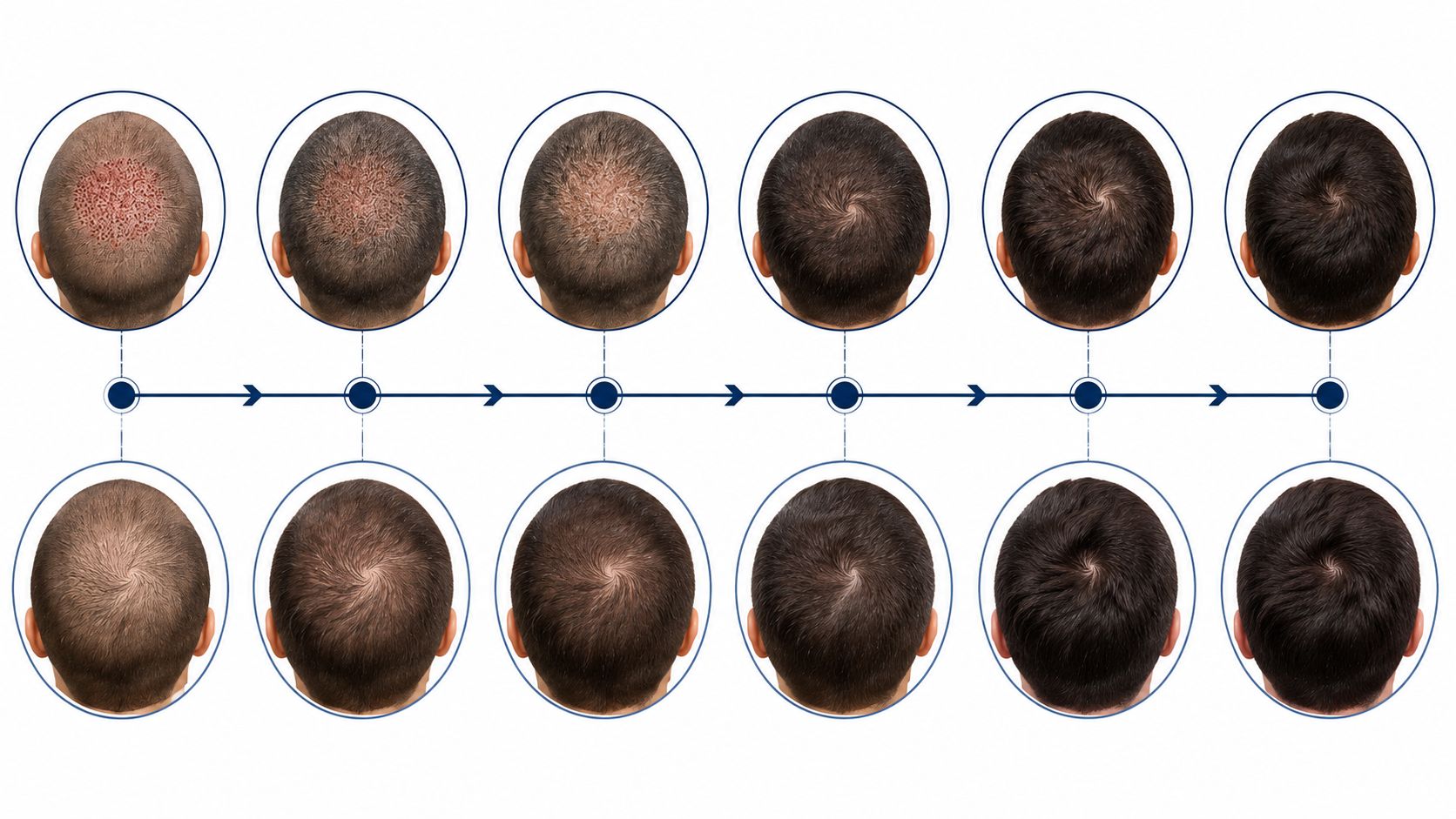
Crown results come slowly. The first four months are usually quiet — shedding, then little visible change. Around months 5-6 the first fine hairs appear, months 7-9 bring the real density gain, and 12-18 months is when the crown reaches its final look.
The crown is slower than the hairline because its whorl grows outward in a spiral, so coverage only reads as full once the hairs are long and thick enough to overlap.
The crown is the most patience-testing area of any hair transplant. Patients who have addressed both their hairline and their crown in the same procedure almost universally find that the crown shows up later, develops more slowly, and goes through phases that feel more discouraging than anything they experienced with the frontal zone.
Quick answer
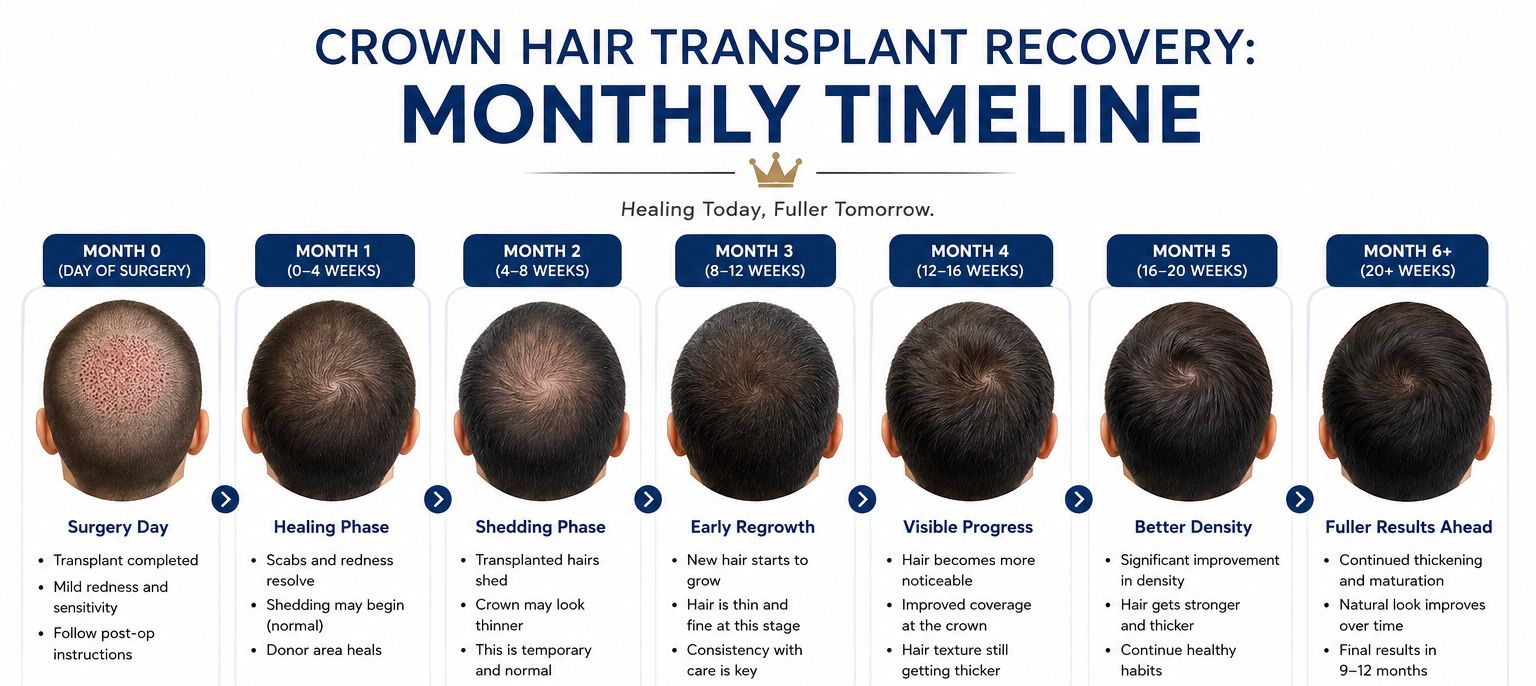
Crown recovery runs on a longer clock than the hairline. Scabbing and surface healing complete within the first two to three weeks. Shock loss occurs during weeks two to eight, and the crown often looks its sparsest around month two. New growth becomes meaningfully visible between months five and seven. The result is genuinely assessable at months ten to twelve, and full maturity is reached between months twelve and eighteen — typically two to four months longer than frontal work.
This isn’t a complication. It’s the normal biology of crown recovery — driven by the spiral growth pattern that makes the crown different from every other area of the scalp, the slower rate at which overlapping coverage builds, and the longer cycle that crown follicles run through before producing their mature result. Understanding this timeline in advance is one of the most useful things you can do before a crown procedure, because the difference between expecting a frontal-style timeline and getting a crown-specific one is the difference between months of unnecessary anxiety and months of patient confidence that the process is unfolding the way it’s supposed to.
If you are weighing up treatment abroad, our guide to hair transplants in Turkey walks through the full process step by step.
This guide walks through the crown recovery experience month by month — what’s happening biologically at each stage, what you’ll see in the mirror, what’s normal and what isn’t, and how to think about each phase as you move through it.
Crown recovery at a glance
| Period | What is happening | What it looks like |
|---|---|---|
| Week 1 | Surgical healing; grafts held by a thin fibrin seal | Visible evidence of the procedure at its most apparent |
| Weeks 2–3 | Scabs loosen and come away during gentle washing; transplanted shafts begin to shed | Surface looks close to normal, but the crown starts thinning |
| Month 2 | Shock loss fully underway; native hair may also shed | Often the worst point — sometimes sparser than before surgery |
| Months 3–4 | Follicles in telogen; new shafts forming below the surface | Biologically the most active phase, visually the most discouraging |
| Months 5–6 | New hairs emerge through the scalp | Roughly half of the final result |
| Months 7–9 | Density builds month to month; grafts firmly established | Majority of the eventual result is visible |
| Months 10–12 | Late grafts still emerging; hair caliber still maturing | Result genuinely assessable |
| Months 13–18 | Refinement rather than new growth | Full mature appearance |
Week 1: The Acute Recovery Phase
The first week after a crown hair transplant is dominated by the immediate aftermath of the surgical work itself. Your scalp is healing, and the visual evidence of the procedure is at its most apparent.
What you’ll see and experience:
- Small scabs around each implantation site across the crown — these are normal and protect the healing graft sites.
- Mild to moderate swelling, particularly if frontal work was done alongside the crown. Swelling tends to peak around days two to four and resolves by the end of the first week.
- Tenderness in the donor area at the back and sides of the scalp where grafts were extracted.
- Tightness in the recipient area as the skin responds to the implantation channels.
- Some redness across the treated crown area.
The most important thing during this week is following the washing protocol your clinic provided, sleeping with your head elevated at roughly 45 degrees to minimize swelling, and avoiding anything that puts pressure on the crown — including tight hats, lying directly on the back of your head, or anything that touches the implantation sites. Grafts in the first week are held in place only by a thin fibrin seal. Physical disturbance can dislodge them.
Weeks 2–3: Scabs Resolve and Initial Healing Settles
By the start of the second week, the visible scabs are loosening and beginning to come away naturally during gentle washing. By the end of week three, most of the scabbing has resolved and the surface of the scalp looks much closer to normal.
This is also when many patients start to notice something that can be alarming if they weren’t expecting it: the transplanted hair shafts themselves beginning to shed. Hairs that came through the procedure attached to their grafts now release as those follicles enter the resting phase of the growth cycle. Patients see hairs on their pillows, in the shower, in towels. The crown can start to look thinner than it did right after the procedure.
Wondering what actually determines the price? Our hair transplant cost guide breaks down what is included.
This is shock loss. It’s universal, it’s expected, and it’s not the grafts being lost — it’s the existing hair shafts shedding while the follicles themselves remain firmly in place beneath the surface, preparing to enter the next phase of their growth cycle.
Activity restrictions begin to graduate during this period. Light walking and normal daily activity are fine. Strenuous exercise, heavy lifting, and anything that significantly raises blood pressure should still be avoided. Sun exposure on the healing scalp also needs to be managed carefully — direct sun can cause prolonged redness and pigmentation changes.
Month 2: The Shock Loss Continues
The second month is when the crown often looks its worst. Shock loss is fully underway. Native hair in and around the treated area may also be shedding as a response to the procedural stress, compounding the visible thinning. Patients who didn’t know what to expect during this phase frequently panic at the appearance of their crown and worry that something has gone wrong with the procedure.
Nothing has gone wrong. What’s happening is the normal sequence:
- Transplanted follicles have entered the telogen phase (the resting phase of the hair cycle) in response to being moved.
- The hair shafts those follicles were producing have shed.
- The follicles themselves are intact beneath the surface, but they’re now in a resting state with no visible hair growing from them.
- Some native hair in the treated area has also entered telogen and shed in response to the procedural stress.
The result is that the crown can look genuinely sparse during the second month — sometimes sparser than it did before the procedure. This is the phase where understanding the timeline matters most. Patients who know that this is what month two looks like move through it with much less distress than those who interpret it as a failure of the procedure.
Activity can return to a more normal level during month two. Most clinics permit moderate exercise from around week three onward, with full intensity training typically returning by week six. Sun protection remains important.
Months 3–4: The Quiet Phase
Months three and four are biologically the most active period of recovery and visually the most discouraging. The follicles that shed their hair shafts during shock loss are now in telogen, preparing to re-enter the active growth phase. New hair shafts are forming below the surface, but they haven’t yet emerged.
What this means in practice:
- The crown looks largely unchanged from how it looked at the end of month two.
- New growth is happening, but it’s not yet visible.
- Patients often feel like nothing is improving and that progress has stalled.
Some patients begin to see the very first hairs emerging by the end of month four, particularly at the edges of the treated area. These early hairs are typically fine, sometimes lighter in color than the patient’s mature hair, and don’t yet contribute much to visible coverage. They’re a signal that the process is moving forward, not a representation of the final result.
The frontal zone, if it was treated in the same procedure, will often be showing clearer progress by this point — which can make the crown’s continued slow progress feel even more frustrating by comparison. Remember: the crown is on its own schedule, not the hairline’s.
Months 5–6: The First Real Signs of Growth
Month five is typically when the crown starts to show real evidence of new growth. Hairs that have been forming beneath the surface emerge through the scalp and become visible. The crown begins to look less sparse than it did during the quiet phase.
What’s happening during this phase:
- Transplanted follicles are now in anagen — the active growth phase — and producing new hair shafts.
- Hairs emerge at varying rates across the treated area, so coverage builds unevenly at first.
- The hair that emerges is typically fine in caliber and doesn’t yet have the thickness it will reach at full maturity.
- The spiral growth pattern of the crown means that overlapping coverage builds more slowly than it did in the frontal zone.
By the end of month six, most patients can see meaningful improvement compared to month two. The crown looks denser, the scalp shows through less, and the result is starting to become recognizable. This is also when patients often begin to feel that the procedure was worth the wait — the visible payoff finally starting to materialize.
Patience is still required, though. What you’re seeing at six months is typically about half of the final result. Hair caliber hasn’t reached its mature thickness yet, late-emerging grafts haven’t all come through, and the overlapping coverage effect that will define the mature result is still building.
Months 7–9: Density Builds Visibly
Through months seven, eight, and nine, the crown result develops noticeably from month to month. This is the period when patients tend to take the most progress photos because the changes are genuinely visible at this interval.
What’s developing:
- Hair caliber is increasing as the new follicles mature.
- Late-emerging grafts continue to come through, adding to density.
- The spiral growth pattern is becoming visible as hairs grow long enough to start covering the scalp from multiple directions.
- The whorl area starts to look natural rather than transplanted.
By month nine, most patients have a result that represents the majority of what they’ll see at full maturity. The crown looks substantially covered, the spiral pattern is functioning naturally, and the transition between transplanted and surrounding native hair is becoming less distinct. The grafts are now firmly established and producing their permanent contribution to coverage.
Hair styling becomes much more practical during this period. Patients who have been keeping their hair short to manage the appearance during early recovery can start growing it out and styling normally if they choose.
Months 10–12: The Result Becomes Assessable
By month ten through twelve, the crown result is genuinely assessable. This is the milestone most clinics use for their primary before-and-after documentation, and it’s the point at which patients can reasonably evaluate what their procedure has produced.
At twelve months, most patients are seeing roughly 80 to 90 percent of their final result. The remaining development happens in the months that follow as the last late-emerging grafts contribute and hair caliber reaches its full thickness.
What a twelve-month crown result typically looks like:
- Substantially improved coverage compared to the pre-procedure starting point.
- A natural-looking whorl pattern that integrates with surrounding hair.
- Density appropriate to the graft count placed and the area treated — typically 40 to 60 follicular units per square centimeter, which provides convincing coverage under normal viewing conditions.
- A result that holds up under various lighting conditions and viewing angles, not just under optimal photo conditions.
If you address both your hairline and your crown in the same procedure, you’ll notice that the frontal result has been mature for some time at this point while the crown has just caught up. This is the normal pattern.
Months 13–18: Full Maturity
The crown continues to develop subtly through the second year, particularly during months thirteen through eighteen. This phase is less about new growth and more about refinement of what’s already there.
What changes during this period:
- Hair caliber continues to thicken slightly as follicles reach their fully mature growth pattern.
- Any remaining late-emerging grafts come through.
- The integration between transplanted and surrounding native hair continues to refine.
- The whorl pattern becomes fully natural as hair flows in its mature direction.
By month eighteen, the crown result has reached its full mature appearance. This is the result that will hold steady going forward, with the caveat that ongoing native hair loss around the treated area will continue to follow its natural trajectory unless addressed with medical management.
The Long-Term Picture: Years 2–5 and Beyond
Once the crown result reaches full maturity at the eighteen-month mark, the transplanted hair itself is permanent. Donor dominance — the principle that follicles from the permanent donor zone retain their genetic characteristics in their new location — means that the transplanted crown hair will continue growing for life, just as it would have in its original location at the back and sides of the scalp.
The variable that matters long-term isn’t the transplanted hair — it’s the native hair around it. The crown is the area of the scalp most prone to continued androgenetic progression. Without medical management, native hair around and between the transplanted grafts can continue to thin over years, gradually changing the overall crown picture even though the transplanted grafts themselves are unchanged.
This is why finasteride and minoxidil are typically recommended as ongoing components of a crown hair transplant plan rather than treatments to be used for a defined period and then stopped. They protect the native hair that contributes to the overall crown coverage picture alongside the permanent transplanted grafts. Patients who commit to ongoing medical management typically maintain a crown picture similar to their twelve-month result for many years. Patients who don’t may find the picture changes as native hair continues its natural progression.
What’s Normal and What Isn’t During Crown Recovery
Most of what patients experience during crown recovery is normal and expected, even when it feels alarming. A few situations warrant contacting your clinic:
Normal during recovery:
- Scabbing during the first two weeks.
- Shock loss during weeks two through eight.
- The crown looking thinner during months two through four than it did right after the procedure.
- Slow visible progress during months three and four.
- The frontal zone showing visible progress before the crown.
- Different parts of the crown developing at different rates.
Worth contacting your clinic about:
- Unusual pain that increases rather than decreases over the first week.
- Yellow or green discharge from any graft site.
- Spreading redness beyond the treated area, particularly with fever.
- Sudden swelling that develops after the first week rather than during it.
- Bleeding from graft sites beyond the first 48 hours.
At Hairpol, post-procedure support includes ongoing access to the clinical team throughout the recovery timeline — because crown recovery is long enough that questions arise at multiple stages, and having a direct line back to the people who performed your procedure is part of what good aftercare actually means in practice.
How to Navigate the Long Wait
Crown recovery is psychologically demanding because the gap between expectation and visible reality is wider here than in any other area of hair restoration. A few practical things that help patients move through it:
- Take monthly progress photos in consistent lighting and angle. The progress between any two consecutive months can be hard to see; the progress between month three and month seven is obvious.
- Don’t compare your crown to before-and-after galleries you saw before the procedure. Those galleries show endpoint results, not intermediate stages, and the comparison will always feel discouraging during the early months.
- Don’t compare your crown progress to your hairline progress if you had both treated. They’re on different timelines and the comparison isn’t useful.
- Limit how often you look at the crown directly in the early months. The shock loss phase is unpleasant to monitor obsessively, and frequent checking won’t change anything.
- Build expectations around the twelve-to-eighteen-month timeline, not the twelve-week one. Setting your internal benchmark for assessing the result at one year, not three months, makes the early phases dramatically easier to navigate.
The patients who report the highest satisfaction with their crown results aren’t those whose procedures went better than other patients’ — they’re those whose expectations going in matched the actual recovery experience. The procedure does what it does on its own timeline. Aligning your expectations with that timeline is what makes the experience match the result.
Find this helpful? Add Hairpol as a preferred source on Google.
Get a Free Consultation
Answer a few questions and the medical team will review your situation.
Crown Results: More Questions
What should crown results look like at 8 months?
At eight months most people see clear, even coverage forming but not the finished result. Hairs are still thickening and some are shorter than the rest, so the crown can look patchy under bright overhead light while looking fine in daylight. Expect roughly 60-80% of your final density at this point, with the remaining fill arriving over the next four to ten months.
Why are my crown transplant results so slow?
Slow crown growth is normal, not a warning sign. Grafts placed in the crown enter a resting phase after surgery and restart in waves, so growth is uneven for months. The whorl also grows in a spiral, meaning hairs must reach a certain length before they lie down and cover scalp. Most crowns look thin until month six and only fill in properly between months seven and twelve.
When is a crown transplant considered failed vs still growing?
Before twelve months, judging failure is premature — crowns are still gaining density well into month eighteen. Genuine concern starts if there is almost no new growth by month twelve, or if density clearly drops after month fifteen. Take monthly photos in the same light, and if the crown looks unchanged at twelve months, ask your clinic to review graft counts and placement.
