

Most hair transplant marketing is built around one kind of hair: straight or wavy, usually light-skinned, photographed against a white background. If your hair is afro-textured, you have probably noticed that the before-and-after galleries rarely look like you, and that some clinics answer your questions about curl, keloids or line-ups with a vague reassurance rather than a plan.
That gap matters, because afro-textured hair genuinely changes how a transplant is done. It changes how grafts are extracted, how the hairline is designed, how many grafts are needed and what aftercare looks like. None of these are reasons to avoid a transplant. They are reasons to choose a team that knows the differences and talks about them openly.
The bottom line: a hairline transplant for black men is very achievable, but it needs a plan built for curved follicles below the skin, which makes extraction slower. Because tightly curled hair covers more scalp per graft, a hairline often needs about 1,000 to 2,000 grafts, and any keloid history is assessed first. At Hairpol the cost sits within our package range of typically $2,500–5,000; the exact figure follows a free hair analysis.
Why afro-textured hair changes the plan, starting with extraction
In straight hair, the follicle beneath the skin runs in a fairly straight line from the surface to the bulb. In afro-textured hair, the follicle itself is curved, sometimes into a gentle C shape, sometimes into a tighter spiral. What you see above the skin, the curl, continues below it.
That has a direct consequence for afro hair transplant surgery. An extraction punch that follows only the visible angle of the hair can cut across the curved follicle below the skin, damaging it. This is called transection, and it is the single biggest technical risk in afro cases. Avoiding it shapes almost every decision that follows.
To protect curved follicles, surgeons working with afro hair often use slightly larger or specially shaped punches, shallower initial scoring and more time per graft. Some test a small number of extractions first to see how the follicles curve in that particular scalp before committing to a technique for the whole session.
The result is that extraction in afro cases is usually slower than in straight hair. That is not a flaw in the plan; it is the plan. A team that rushes afro extraction to hit a graft number is likely to transect more follicles and deliver fewer living grafts than the count suggests. Our article on why curl pattern changes the surgical plan explains the extraction side in more detail.
Why curl can mean fewer grafts for the same coverage
Here is the good news. Tightly curled hair stands away from the scalp and overlaps itself, so each graft covers more skin than a straight hair would. That means the same visual density can often be achieved with fewer grafts, and a hairline that would need 2,500 grafts in fine straight hair might look full with noticeably fewer in afro-textured hair.
There is a second benefit: the contrast between dark hair and darker skin is often lower than between dark hair and pale skin, which makes small gaps less visible. Together, these factors mean that afro hairline cases can be very efficient uses of donor hair, provided the extraction is done carefully enough that the grafts survive.
Designing a hairline for black men, and what years of line-ups do to it
Hairline design is always personal, but there are patterns. Many black men prefer a more defined hairline, often slightly straighter across the front with crisper corners, especially if they keep their hair short and have it lined up regularly. That is a legitimate aesthetic choice, and a good design can deliver it while still looking natural.
The key is that “defined” should not mean “artificial”. The very edge still benefits from fine single-hair grafts and a little irregularity, so that the line looks sharp when cut but not drawn on. Temple angles should be preserved rather than closed completely. And the height should suit the face and the age, not a teenage photo. Our article on why hairline design matters more than graft count applies just as much here.
One more factor shapes the design: how the edge got where it is.
Not all hairline recession in black men is pattern hair loss. Years of very sharp line-ups, where the edge is pushed back a little with each cut, can gradually move the visible hairline upwards. Tight braids, cornrows, locs pulled back firmly, or heavy extensions can cause traction alopecia at the front and temples.
This matters for planning. Traction loss at the edges is often an excellent case for a transplant, provided the pulling has stopped, because the rest of the scalp, including the donor area, is usually healthy. A hairline pushed back by line-ups is also very treatable, but it helps to agree with your barber how the new edge will be cut afterwards, so the work is not slowly trimmed away again.
How many grafts does a hairline need for black men?
As a general guide, rebuilding a receding hairline and temples in afro-textured hair often needs 1,000 to 2,000 grafts. Smaller temple and edge restorations, typical in traction cases, can be fewer. A deeper Norwood 3 pattern with some frontal thinning can need more. Your hair calibre, curl tightness and donor density all move the number.
Your own number depends on curl, calibre and donor density, which photos show surprisingly well. Photos of your edge and temples are enough to get a graft range for your hairline, together with a note on how the design would sit with the way you wear and cut your hair.
Keloids, healing and pigmentation on darker skin
People with darker skin are, on average, more prone to keloids, which are raised scars that grow beyond the original wound. Not everyone is affected, and many black patients have transplants without any keloid formation. But a history of keloids, on the scalp, ears, chest or elsewhere, needs to be discussed openly before any procedure.
FUE leaves small, round extraction sites rather than a linear scar, which is generally preferable for patients concerned about scarring. In patients with a clear keloid history, some surgeons recommend a small test session first, or advise against surgery altogether. A clinic that never asks about keloids is missing an important step.
Darker skin can respond to small wounds with temporary changes in pigmentation: slightly darker or lighter spots around extraction sites or in the recipient area. In most cases these settle over weeks to months. Gentle aftercare, avoiding picking at scabs and protecting the scalp from strong sun all help.
Ingrown hairs and small bumps can also appear as curly transplanted hairs grow through the skin, especially around months two to four. Most settle on their own; persistent or painful ones should be shown to the clinic. Knowing this in advance makes the early months far less worrying.
Sun protection matters more than many people expect, even on darker skin. A healing scalp can darken in patches if it is exposed to strong sun in the first weeks, and those marks can take months to fade. A loose hat outdoors for the first month is a small price for an even result.
FUE or DHI, who is a good candidate, and who should wait?
Both can work. The critical step in afro cases is extraction, which is the same in FUE and DHI. For placement, DHI hair transplantation gives fine control over angle at the front, which helps when designing a defined edge. Channel-based FUE can produce equally good hairlines when channels are opened carefully to match the curl.
What matters more is that the team has experience with curly follicles and plans the session length around slower extraction. Ask how many afro-textured cases they have treated and whether they can show twelve-month results.
Technique is only half the decision; timing is the other half.
- Men with a receding hairline or temples from pattern hair loss, with a stable or slowly progressing pattern.
- Men with traction loss at the edges, once tight styles have stopped.
- Men whose hairline has been pushed back over years of sharp line-ups.
- Anyone with a healthy, dense donor area and no active scalp inflammation.
Candidacy also depends on age, family history and expectations. A young man with fast-moving loss may be advised to stabilise first; a man with stable loss in his thirties or forties is often an ideal candidate.
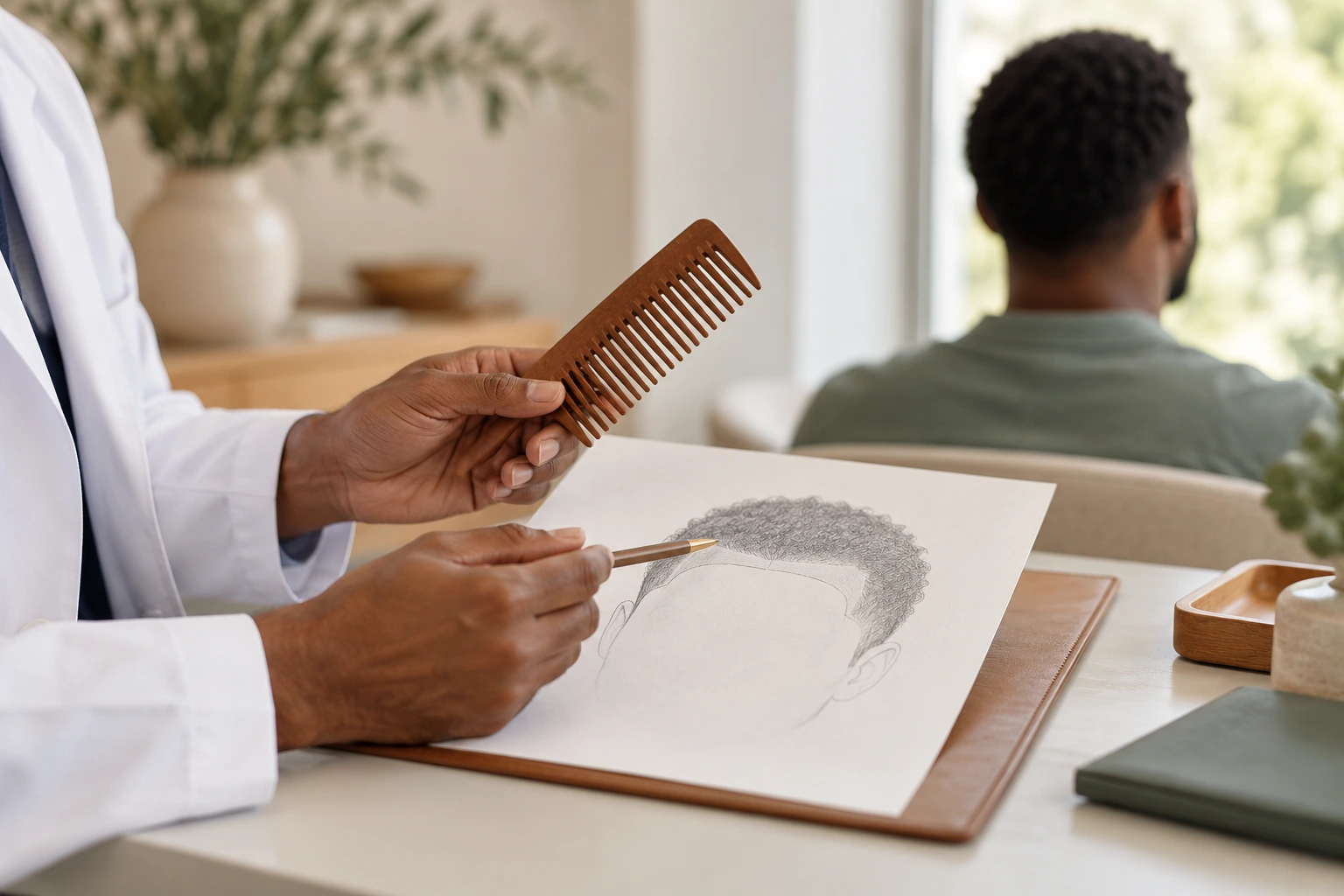
Active scalp conditions, such as ongoing folliculitis or inflammatory scarring hair loss, need to be treated and settled before surgery. Traction alopecia should only be transplanted once the styles causing it have stopped, otherwise the grafts will be lost the same way. And a strong keloid history needs careful assessment, sometimes ruling surgery out.
None of this means a transplant is impossible later. It means the order matters, and a clinic that tells you to wait is often protecting your result.
What does a hairline transplant for black men cost, and what should the plan include?
The cost of a hairline transplant for black men follows the same package logic as any other case. It depends mainly on the number of grafts and the technique, followed by session length and difficulty. Afro extraction often takes longer per graft, and that time is part of the session plan from the start.
Our hair transplant cost page sets out the typical package range, and our article on hairline transplant cost in Turkey breaks down how grafts and design translate into price. At Hairpol, your exact figure follows a free hair analysis.
A traction repair along the edges and a full hairline-and-temples rebuild do not land on the same number within our package range of typically $2,500–5,000. The exact price follows a free hair analysis of your photos.
Beyond the usual medical inclusions, an afro hairline plan should state how extraction will be adapted to curved follicles, how long the session is expected to take, and how the design will look when cut short and when grown out. It should also include a clear conversation about keloid history and aftercare for curly hair.
Our page on afro hair transplant explains how we approach these cases, including the extraction adjustments that protect curly follicles.
The time commitment is modest.
Three to four days covers most hairline cases: consultation and design, the procedure, the first wash and check-up, then the flight home. Afro sessions can run longer on the day itself because of slower extraction, so plan for a full day at the clinic.
Most men with desk jobs return to work after seven to ten days. If you keep your hair very short, the procedure will be visible for about two weeks while scabs fall away and redness settles.
Questions to ask a clinic, including about the crown and beard
Because the technical differences are real, the questions you ask matter. Ask how many afro-textured cases the team has treated, and whether they can show twelve-month results from patients with similar hair. Ask how they adapt extraction for curved follicles: punch size and shape, depth, and whether they test a few extractions first. Ask how long they expect the session to take, and whether the graft count is planned around that pace or squeezed into a standard day.
Ask too about the design. Will the hairline be cut as a defined edge or left soft, and how will it look both short and grown out? How will the temples be handled? And ask directly about keloids, pigmentation and ingrown hairs, and what the aftercare plan is for each. A clinic that answers these confidently, with examples, is a clinic that has done this before. One that answers with “every hair is the same to us” has not understood the question.
Many men also ask whether the same trip can cover more than the hairline.
Some patients with afro-textured hair also ask about the crown or the beard. The same principles apply. Crown work in curly hair benefits from the coverage that curl provides, though the crown still needs patience, often twelve to eighteen months for the final result. Beard transplants are also possible, and curly beard hair often blends naturally with transplanted grafts.
Whatever the area, extraction care remains the deciding factor, and the donor area must be shared wisely between current and future needs. If you are considering more than one area, raise it at the first assessment so the plan can be built around all of them.
Aftercare for afro-textured hair, and when to get a line-up again
The first ten days are about protecting the grafts: gentle washing from day two or three, no rubbing, no tight hats or durags pressing on the hairline, and sleeping with the head slightly raised for the first few nights. Oils and heavy styling products should wait until the scalp has healed, usually two to three weeks.
Braids, twists, locs and any style that pulls on the hairline should wait considerably longer, often several months, and should be worn loosely afterwards to avoid traction on the new grafts. Your clinic should give you a clear timeline for your own case.
Before your next line-up, clippers and razors should stay away from the transplanted edge until the grafts are fully anchored and the scalp has healed, usually at least three to four weeks for a gentle trim around, not on, the new hairline. Sharp line-ups that push into the edge are best avoided for longer.
When you return to your barber, show them where the new hairline is and ask them to cut to it, not behind it. A good barber becomes part of protecting the result.
Results timeline, and protecting the hairline afterwards
Transplanted hairs usually shed between weeks two and eight. New growth starts around month three or four and fills in through months six to twelve. Curly hair can make early growth look patchy, then come together quickly as it lengthens.
When you look at a clinic’s results, ask specifically for afro-textured cases at twelve months, photographed from the front and side. Our before and after gallery is a place to start; the honest comparison is a case with similar hair type and pattern.
If your recession is pattern hair loss, the native hair behind the new hairline may continue to thin. Medical treatment, always started and monitored with a doctor’s approval, can help slow that progression.
For traction cases, the most important protection is simply avoiding the styles that caused the loss.
Bring your barber into the conversation
It sounds like an odd last step, but it is a practical one. The person who cuts your hair every two or three weeks will shape how the new edge looks for years. Show them the design before surgery if you can, and again once the grafts have grown, so the line they cut follows the transplanted hairline instead of slowly trimming it back.
At Hairpol we plan afro hairlines around how they will actually be worn: short, lined up or grown out. The same thinking runs through our wider hair transplantation work, and for a first plan, photos of your edge, temples and donor area are all we need.
Find this helpful? Add Hairpol as a preferred source on Google.
Graft Range Calculator
Answer three questions to see the typical graft range for your situation — based on our published clinical guides.
This is a preliminary estimate, not a medical assessment. The exact number can only be determined by a doctor after examining your donor area and hair characteristics.
Get a Free Consultation
Answer a few questions and the medical team will review your situation.
