

Walk into any consultation in Istanbul and you will hear two acronyms thrown around as if they settle everything. FUE or DHI. One clinic tells you DHI is the premium option and worth the extra. Another tells you it is mostly marketing. Both sound confident, and neither explains what the pen in the surgeon’s hand actually changes about your result.
The truth sits somewhere less exciting and more useful. DHI is a genuinely different way of placing grafts, it suits some situations better than others, and in the wrong case it is simply slower without being better. Knowing which kind of case you are is what this article is about.
Who it suits, in short: a DHI hair transplant in Turkey places each graft with a pen-shaped implanter, often called a Choi pen, without pre-made channels. It suits hairlines, unshaven cases, women and dense packing between existing hair; very large areas usually go faster with channel-based FUE or a combination. Hairpol prices DHI in the same range as FUE, typically $2,500–5,000; the exact price follows a free hair analysis.
What makes DHI different from FUE?
Extraction is the same in both. Follicular units are removed one at a time from the donor area with a small punch. The difference starts after that. In classic FUE, the surgeon first opens hundreds or thousands of tiny channels in the recipient area, then the grafts are placed into those channels with fine forceps. Two separate steps, often done by different hands.
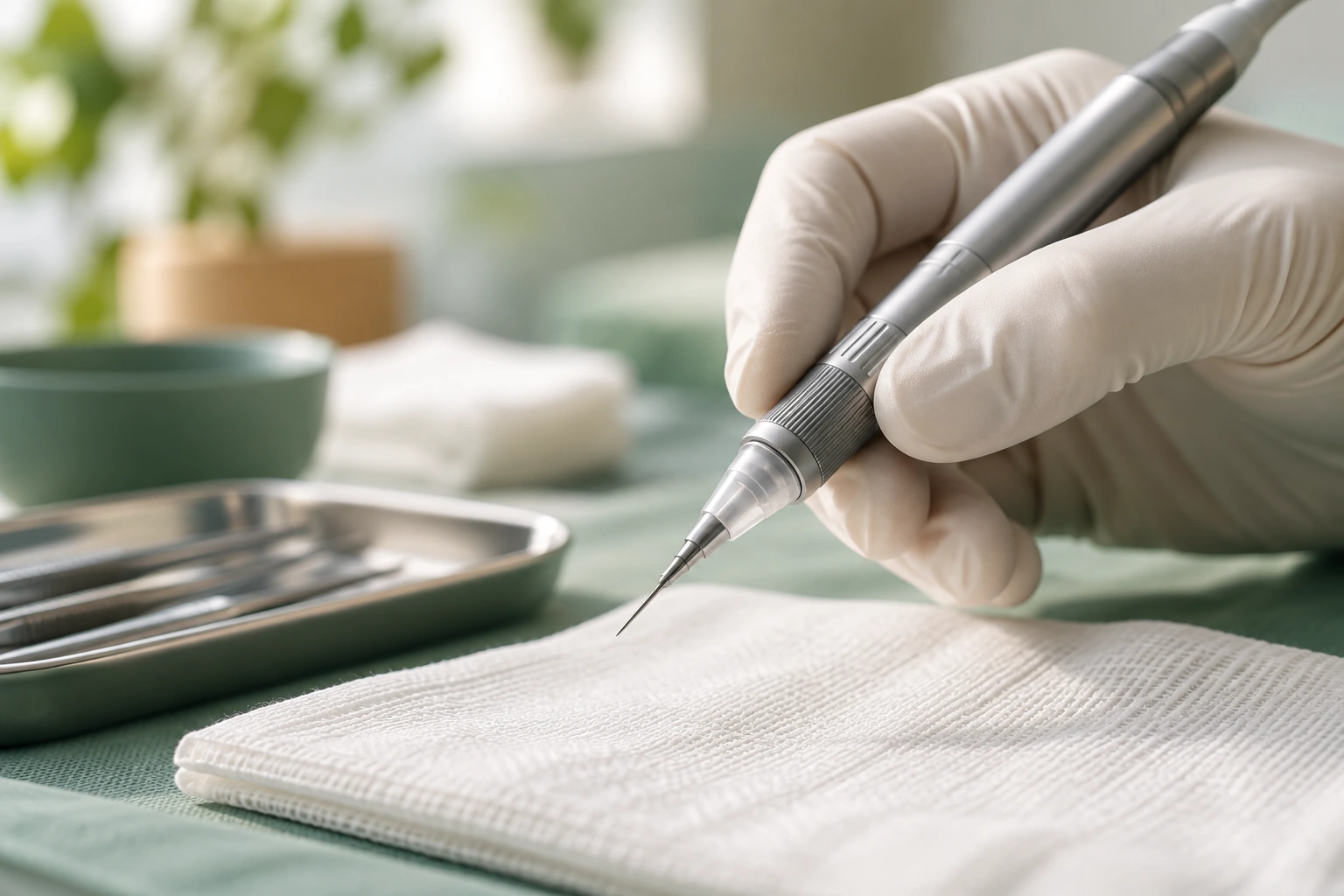
In DHI, the channel and the placement happen in a single movement. Each graft is loaded into the hollow needle of an implanter pen. The pen is pressed into the scalp at the chosen angle and depth, and a plunger pushes the graft into place as the needle withdraws. The angle, direction and depth are set by the person holding the pen, graft by graft.
That single fact explains most of DHI’s strengths and most of its limits. It gives very precise control at the level of each hair. It also makes placement slower, more labour-intensive and more dependent on the skill and stamina of the team. A clinic with many implanter pens and a well-drilled team can work efficiently; one without them cannot.
What changes on the day if your plan is DHI
The morning of a DHI day looks exactly like any FUE day: consultation, drawing, local anaesthesia and two to three hours of extraction. Our guide to the FUE day in Turkey walks through that part step by step, and none of it changes.
The difference arrives after lunch. Instead of a phase in which channels are opened across the recipient area, implantation starts straight away, with team members loading pens and handing them to the person placing the grafts. It is quieter, slower and more repetitive. For a case of around 2,500 grafts the whole day often runs seven to nine hours including breaks, an hour or two longer than the same count with channels. The stay, the first wash and the recovery afterwards are the same as for FUE, which is why the technique should never be the reason to book extra nights.
Who is a good candidate for DHI?
DHI makes most sense where precision at the level of each hair matters more than speed. The clearest examples are below.
Hairlines and temples. The front edge is where angle and direction are most visible. Natural hair here exits at a very shallow angle, and DHI’s graft-by-graft control makes it easier to reproduce that. Our article on why the Choi pen suits the front zone goes into this in more detail.
Dense packing between existing hair. When you still have a fair amount of native hair in the area, opening channels first risks damaging it. Placing grafts directly with a pen lets the team work between existing hairs with less disruption.
Unshaven and partially shaved cases, and women. These often go together, because many women and many men with work constraints cannot shave the recipient area. DHI is well suited to working through longer hair.
Most people can tell from these descriptions which group they probably sit in, but borderline cases are common. If you are one of them, a few photos are enough to ask whether DHI suits your scalp; the reply recommends DHI, FUE or a combination and gives the reason in a sentence.
When is DHI not the best choice?
DHI is not automatically better for everyone, and a clinic that sells it that way is skipping a step. For very large sessions, such as 4,000 grafts or more covering the front, mid-scalp and crown, the slower placement can stretch the day uncomfortably long. Time out of the body matters for graft survival, and a team that is placing grafts at the end of a twelve-hour day is not working at its best.
In those cases, channel-based FUE, or a combination where DHI is used for the hairline and channels for the larger area behind it, is often more sensible. Combination plans are common and perfectly legitimate. The goal is the best result for your scalp, not loyalty to a technique.
Some scalp types are also more forgiving with channels: very thick, tough scalps can make pen insertion harder, and very curly hair needs careful handling with either approach. These are case-by-case judgements, made in consultation.
Is DHI right for you? Five common situations
Most people who ask about DHI fall into one of a handful of situations. The verdicts below are general patterns rather than a diagnosis, and your own scalp can move you from one line to the next.
- Receding temples, short hair, stable loss: a good fit for DHI or a combination, because the work is concentrated at the edge where angle control shows.
- A thinning front with plenty of native hair left: often a good fit, since direct implantation lets the team work between existing hairs.
- You cannot shave for work or family reasons: DHI is usually part of the answer, with a smaller session size as the trade-off.
- Norwood 5 or 6 needing 4,000 grafts or more: usually a combination or a channel-based plan, with DHI kept for the hairline.
- Diffuse thinning across the whole scalp, donor area included: not a technique question at all; the first step is finding out whether surgery is suitable.
If you recognise yourself in the first three, look specifically at hairline and unshaven cases when you browse a before and after gallery. If you are in the last two, the conversation should start with your donor area rather than the pen.
Can DHI be done without shaving, or combined with FUE?
Often, yes, at least partially. Unshaven DHI is possible because DHI places each graft individually without a field of pre-opened channels, it adapts well to working through existing hair. Many unshaven and long-hair cases use DHI for exactly this reason.
The donor area usually still needs some shaving, though it can often be limited to strips hidden beneath longer hair. Unshaven work is slower, limits how many grafts can be placed in one session and is not suitable for every case. Our article on unshaven transplants and their limits sets out the trade-offs honestly, so you can decide whether discretion is worth the constraints.
Unshaven or not, many plans end up using more than one placement method.
Yes, and in many cases this is the most sensible plan. A combination plan typically uses DHI for the first centimetre or two of the hairline and the temples, where angle and direction are most visible, and channel-based FUE for the larger area behind it, where speed and even coverage matter more.
The benefit is that each part of the scalp gets the tool that suits it, and the day stays within a length that protects graft quality. The extraction is shared, so you are not paying for two procedures, only for one plan that uses two placement methods. If a clinic insists that your case must be done entirely with one technique, it is fair to ask why, and what would be lost by combining them.
Is DHI in Turkey different from DHI elsewhere?
The technique is the same wherever it is performed. What differs between Istanbul and London or Munich is mainly the cost structure around it: staff and rent. Experience and organisation, on the other hand, vary from clinic to clinic everywhere, and that is where your questions should go.
So the useful question is not whether DHI in Turkey is good or bad. It is how a particular clinic runs it: how many cases it takes on the same day, how many pens and implanting specialists work on each patient, and who is responsible for the hairline. Those answers vary far more between clinics in the same city than between countries.
If you are travelling for the procedure, it is also worth knowing that DHI is not a reason to stay longer. The recovery timeline is the same as FUE, and the stay is planned around the procedure day and the first wash rather than the technique.
DHI for women
Female hair loss is usually diffuse thinning across the top of the scalp rather than a receding hairline, and most women want to keep their hair long. Both of these point towards DHI. The implanter lets grafts be placed between existing hairs at a controlled angle, and the recipient area does not need to be shaved.
That said, not every woman with thinning hair is a candidate for surgery at all. The cause of the loss, the stability of the donor area and the pattern of thinning all need to be assessed first. Our hair transplantation for women page explains how that assessment works and when treatment rather than surgery is the better starting point.
DHI vs Sapphire FUE, and three myths worth dropping
Both techniques extract grafts the same way. Sapphire FUE opens recipient channels with a sapphire blade and then places grafts into them; DHI implants directly with a pen. In practice, Sapphire FUE tends to be efficient for larger areas, and DHI tends to be chosen where angle control and working between existing hair are priorities.
Neither technique is categorically better. A carefully planned Sapphire FUE and a carefully planned DHI can both produce natural results; a poorly planned version of either cannot. If you want the side-by-side detail, our practical comparison of DHI and Sapphire FUE walks through it case by case.
Comparisons tend to attract myths, and DHI has collected a few.
“DHI has higher graft survival.” Graft survival depends on handling, time out of the body, storage and placement technique. DHI can keep handling to a minimum, but a slow day with grafts waiting in pens for too long can undo that advantage. There is no technique that guarantees survival on its own.
“DHI leaves no scars.” Extraction is the same as in FUE, so the donor area has the same tiny dot-like marks. They are usually invisible at normal hair length.
“DHI is always more natural.” Naturalness comes from design, angle and the transition zone. DHI makes fine angle control easier, which helps, but it cannot rescue a hairline drawn too low or too straight.
How many grafts can DHI place in a day, and what does it cost in Turkey?
It depends on the team, the number of pens and implanting specialists, and the patient’s scalp. As a general guide, many teams work comfortably with 2,000 to 3,000 grafts in a DHI session, and some cases go higher with a larger team and a long day. Beyond that, combining DHI for the hairline with channel-based placement behind it, or splitting the work into two sessions, is often wiser.
Your graft count should come from the area you need covered and the density you want, not from the technique. If a clinic tells you that DHI requires fewer grafts for the same coverage, ask them to explain how. The number of follicles needed to cover an area does not change with the tool used to place them.
The DHI hair transplant cost in Turkey is quoted as a package that depends mainly on the number of grafts and the length of the session. At Hairpol, DHI sits in the same package range as FUE and Sapphire FUE. Because implantation takes longer per graft, a large DHI case can push a quote towards the upper end of that range.
Our hair transplant cost page sets out the typical package range and how it breaks down by technique and area. Your exact figure follows a free hair analysis, once your donor area and plan have been assessed. Be cautious of quotes that present DHI as a large premium without explaining what you get for it in your specific case.
Whichever technique is used, our packages are typically $2,500–5,000. A hairline-only DHI case and a 3,000-graft DHI plan land at different points in that band, and the exact price follows a free hair analysis.
What matters more than the pen: questions to ask a DHI clinic
The pen is a tool. What makes a DHI result good is the design, the speed and care of extraction, the way grafts are kept between extraction and placement, the experience of the people loading and implanting, and the rhythm of the day. A clinic that runs DHI well usually has enough pens and trained hands that grafts do not wait, and a clear answer to the question of who places them.
At Hairpol, the technique is chosen for your scalp rather than for the brochure. Sometimes that means DHI for the whole case, sometimes for the hairline only, sometimes not at all. We would rather explain that choice than sell you an acronym.
Five questions show quickly whether a clinic runs DHI that way:
- Why is DHI the right technique for my case, rather than FUE or a combination?
- How many grafts are planned, for which zones, and how many will remain in the donor area?
- Who loads the pens, and who places the grafts?
- How many pens and implanting specialists will work on my case?
- How long will grafts typically wait between extraction and implantation?
A clinic that answers these clearly has usually thought about your case. Vague answers are worth a follow-up question.
Asking for DHI the right way
If you walk into a consultation asking for DHI, you may get it whether or not it suits you. Ask instead what your scalp needs at the hairline, in the zone behind it and at the crown, and let the technique follow from the answer. A good team will often land on DHI for the front and something else for the rest, and it will be able to tell you why in a sentence or two.
That is how the choice is made at Hairpol. The method itself is described under DHI hair transplantation, and the wider plan it sits in under hair transplantation; for your own case, the conversation starts with photos rather than an acronym.
Find this helpful? Add Hairpol as a preferred source on Google.
Get a Free Consultation
Answer a few questions and the medical team will review your situation.
