

Search for an FUE hair transplant in Turkey and within ten minutes you will have three quotes, two before-and-after reels and a WhatsApp message from someone with the job title “patient consultant”. What you will not have is a clear picture of what happens to your scalp during the eight hours you spend in the chair, or why one clinic looked at your photos and said 3,200 grafts while another said 4,500.
That gap is where most bad decisions are made. Not because people are careless, but because the marketing version of FUE is a slogan and the real version is a sequence of small technical choices, each of which changes the result. This guide walks through the real version.
The essentials: an FUE hair transplant in Turkey is a one-day procedure under local anaesthesia: follicles are taken one by one from the back of the scalp and placed where hair is thinning. Most cases need 1,500 to 4,000 grafts, and you should plan three to four days in Istanbul. Hairpol packages are typically $2,500–5,000; the exact price is set after a free hair analysis.
What actually happens on an FUE day in Turkey?
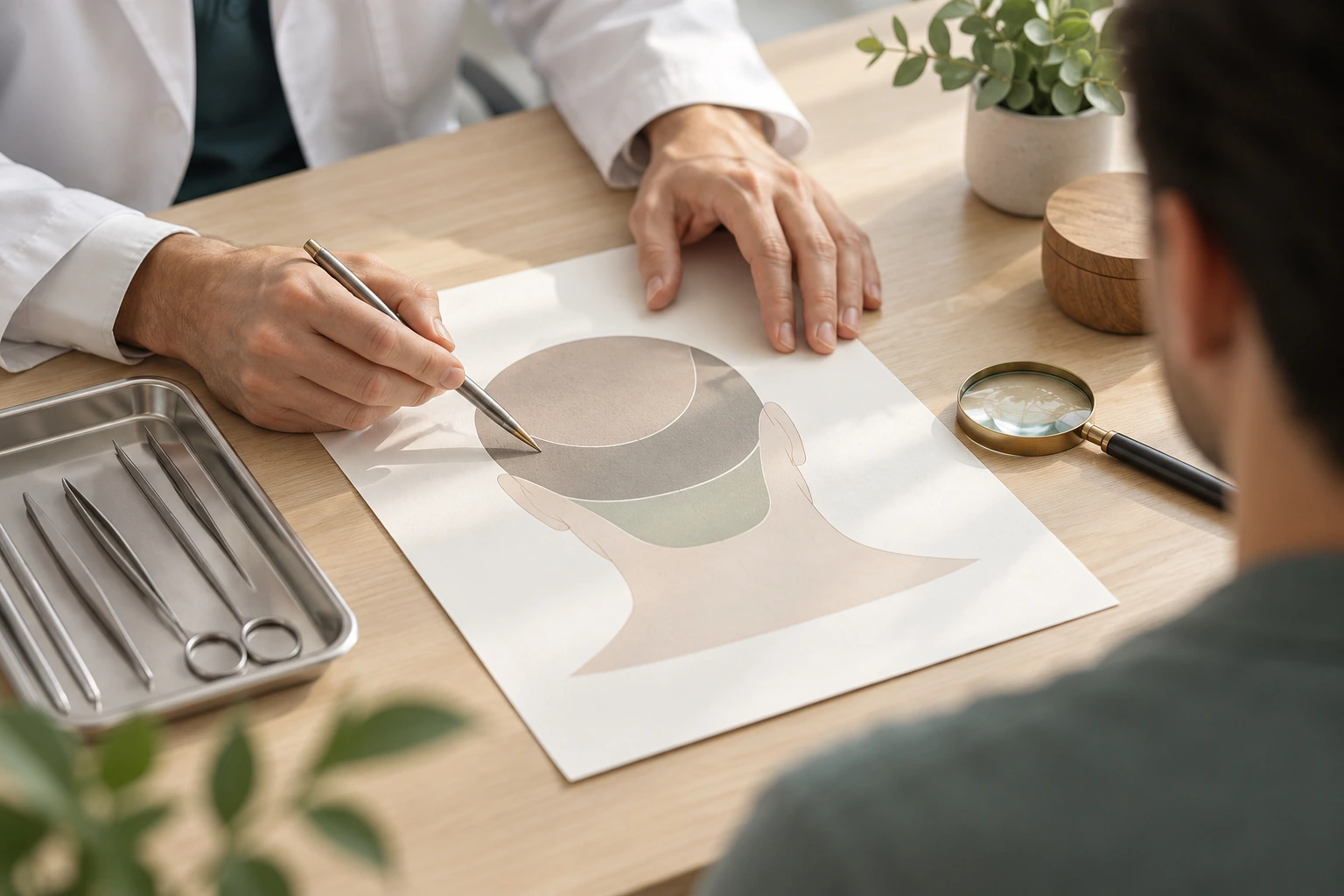
The FUE hair transplant process starts before anyone picks up an instrument. The morning begins with a final consultation, blood tests and the hairline drawing. That drawing deserves more of your attention than anything else that happens all day, because it is the one decision you will look at in the mirror for the next thirty years. Ask to see it from the side, from above and in a mirror held behind you. If something feels too low or too straight, say so then, not after the anaesthetic.
Next comes the shave and the local anaesthesia. The injections are the uncomfortable part; most patients describe them as a minute or two of sharp stinging, after which the area goes numb. Extraction follows. Using a small circular punch, usually between 0.7 and 1.0 mm, the team removes follicular units one by one from the donor zone at the back and sides of the head. Each unit carries one to four hairs. A typical extraction phase for 3,000 grafts takes two to three hours, with a break for lunch.
While the grafts sit in a cooled holding solution, they are sorted under magnification into singles, doubles and triples. Then the recipient channels are opened, and the grafts are placed: singles along the front edge, larger units behind them where they build density. The whole day usually ends by late afternoon. You leave with a bandage on the donor area, a clear plan for the first wash, and a scalp that looks considerably more dramatic than it feels.
How many grafts does an FUE hair transplant in Turkey need?
The graft count follows the size of the area and the density you want, not the price list. As a rough guide, a Norwood 2 temple refinement sits between 1,000 and 1,800 grafts. A Norwood 3 hairline with temples usually needs 1,800 to 2,800. Once the crown is involved, or the loss reaches Norwood 4, the figure climbs to 2,800 to 3,800. Norwood 5 and beyond tends to start around 3,500 and often needs a second session to finish the job properly.
Those ranges are wide for a reason. Two men with the same Norwood stage can have very different scalps: one has thick, coarse hair that covers well at moderate density, the other has fine hair against pale skin, where every gap shows. Hair calibre, curl, the colour contrast between hair and skin, and how much native hair is still left in the area all move the number.
The ceiling is set by your donor area, which is finite. An average donor can supply something in the region of 5,000 to 7,000 grafts across a lifetime by FUE. Every graft spent today is unavailable later, which is why a careful plan holds some in reserve for the hair you have not lost yet.
Why do two clinics quote different graft counts for the same photos?
This is the question we hear most often, and the honest answer is that the two numbers are usually answering different questions. One clinic is quoting for the area you are worried about now. The other is quoting for the area you will probably be worried about in eight years, and filling it at a higher density.
Neither is automatically wrong. But a quote that is far above what your pattern seems to justify deserves a direct question: which zones, at what density, and how many grafts will be left in the donor afterwards? A quote that is far below deserves the same question in reverse. Clinics that answer clearly are usually the ones planning carefully.
If you are unsure whether your case needs 2,000 grafts or 3,500, your own photos settle it faster than any sales pitch. Send them for a free FUE graft estimate and compare the range that comes back, zone by zone, with the other quotes in your inbox.
FUE, Sapphire FUE and DHI: the same family with different tools
All three techniques extract grafts in the same way. Where they differ is how the recipient site is prepared and how the grafts go in. In classic FUE, channels are opened with a fine steel blade and grafts are placed with forceps. Sapphire FUE uses the same approach but opens the channels with a blade made of sapphire, which some surgeons prefer for its sharpness and the shape of the incision it makes. With DHI hair transplantation, grafts are loaded into a pen-shaped implanter and inserted directly, without pre-made channels.
None of these is a magic upgrade over the others. Each suits different situations. DHI is often chosen for the front edge or for unshaven cases, because it gives fine control over angle and works well between existing hairs. Channel-based FUE tends to be efficient for larger areas. If you want the full comparison, our article on FUE vs DHI and which technique suits you goes through it case by case.
What matters more than the name of the technique is who is doing each step, how long the grafts spend outside the body, and how carefully the angle and direction of each graft follow your natural hair. A beautifully named method in tired hands still produces a tired result.
How much does FUE cost in Turkey, and what should the package include?
An FUE hair transplant cost in Turkey is usually quoted as a package rather than per graft. The main variables are the number of grafts your case needs and the technique, followed by session length and how difficult the case is. At Hairpol, FUE, Sapphire FUE and DHI sit in the same package range; DHI can push a quote towards the upper end simply because placement takes longer per graft.
Turkey is cheaper than the UK, Germany or the United States for reasons that have little to do with the surgery itself: mainly staff costs and rent. The economics are explained in more detail on our hair transplant cost page, along with the typical package range and how it breaks down by area and technique.
What we would warn against is choosing on price alone. Two quotes can look close on paper while the difference in who holds the instruments is enormous, and a second procedure to repair a poor first one costs far more than doing it carefully once.
Our packages are typically $2,500–5,000. A modest hairline refinement and a large Norwood 4 plan do not land on the same figure within that band, which is why the price comes together with the graft range rather than before it: the exact figure is set after a free hair analysis of your photos.
The figure only means something once you know what it buys.
Packages vary, and the word “all-inclusive” means different things to different clinics. Before you pay a deposit, get the following in writing:
- The planned graft range and the zones it covers, agreed before the operation day.
- The technique, and who performs extraction, channel opening and placement.
- Pre-operative blood tests, local anaesthesia, medication and the aftercare kit.
- The first wash at the clinic and how follow-up works once you are home.
- What happens to the price if the surgeon recommends more grafts on the day.
Accommodation and transfers are bundled by some clinics and billed separately by others. Neither is wrong, but you need to know which you are getting. Our page on getting a hair transplant in Turkey covers the practical side of the trip, from arrival to the flight home.
Day by day in Istanbul: how long to stay for FUE
Three to four days covers most cases. Day one is arrival and, ideally, a face-to-face consultation. Day two is the procedure. Day three is the first wash and a check of the donor and recipient areas. By day four you are usually free to fly home.
If you can spare a fifth day, take it. It gives the swelling around the forehead a chance to settle before a long flight, and it removes the pressure of racing from the clinic to the airport. Patients who arrive the night before surgery and leave the morning after the wash manage, but they rarely enjoy it.
Plan your return around work rather than the clinic. Most people with desk jobs go back after seven to ten days, often wearing a loose hat for the first stretch. Physical jobs and heavy training need closer to two weeks.
Graft survival: the number that matters more than the headline count
A 4,000-graft transplant with poor handling can look thinner than a 2,800-graft transplant done carefully. That is the uncomfortable truth behind every quote. Graft survival depends on how quickly the grafts are extracted and placed, how they are kept in between, how gently they are handled, and whether the channels match the size of the graft.
Well-run teams keep out-of-body time short, store grafts in a cooled holding solution, and work in a rhythm where extraction and placement overlap rather than one finishing hours before the other starts. You cannot see any of this from a photo gallery, which is why it is worth asking about directly. Our article on graft survival rate and how good clinics protect it explains what to listen for in the answer.
Recovery after FUE: the first two weeks and the long wait
The first ten days are about protecting the grafts. Scabs form around each one and fall away between days seven and twelve, helped along by gentle washing from day two or three. Swelling across the forehead is common around days two to four. The donor area usually feels tight and looks pink, then fades over two to three weeks.
Then comes the part nobody enjoys. Between weeks two and eight, most of the transplanted hairs shed. The follicles stay where they were placed; only the hair shaft falls out. New growth starts around month three or four, looks wiry and uneven at first, and builds through months six to nine. The final result arrives somewhere between twelve and eighteen months, with the crown typically last.
The patient who looks in the mirror at month four and books a panicked call is not unusual. If you know the timeline in advance, it is much easier to wait. Our comparison of FUE results at 6 months versus 12 months shows what typically changes in that second half-year.
Who should not have FUE yet?
Not everyone who wants a transplant should have one now. Men in their early twenties with rapidly progressing loss are the classic example: a hairline built today may end up stranded in front of new thinning behind it. Diffuse thinning across the whole scalp, including the donor area, is another, because there may not be enough stable hair to move.
Certain medical conditions need to be controlled first, and some medications affect bleeding or healing. A clinic that turns you away, or asks you to stabilise your loss with medication for a year before booking, is often doing you a favour. At Hairpol we would rather tell you to wait than plan a result that will not hold.
Do you have to shave your head for FUE in Turkey?
Most FUE hair transplants in Istanbul are done with the donor area and recipient zone shaved short, and for good reason. Shaving lets the team see the exit angle of every follicle during extraction and the direction of every remaining native hair during placement. For larger sessions, it is simply the most accurate way to work.
That said, a full shave is not the only option. Smaller cases, especially hairline refinements under roughly 1,500 grafts, can sometimes be done with only a strip of the donor area shaved and hidden under longer hair above it. Unshaven techniques exist too, but they are slower, they limit how many grafts can be moved in one day, and they are not right for everyone. Whether a partially shaved or unshaven approach fits your case depends on your hair length, the size of the area and how much native hair surrounds it.
If discretion matters because of work or family, raise it at the photo assessment stage rather than on the day. It changes the plan, the graft count achievable in one session and occasionally the technique. It is much easier to design around it from the start than to improvise in the chair.
For most people, the honest trade-off is this: a full shave buys you speed, accuracy and the largest possible session, at the cost of about two to three weeks during which the procedure is obvious to anyone who looks closely. After that, short regrowth in the donor area covers the extraction sites and the recipient area simply looks like a fresh haircut.
Red flags when comparing FUE clinics in Turkey
A few warning signs come up again and again. A graft count promised before anyone has seen your donor area. A price that changes on the day. Nobody able to say who performs the extraction and placement. A gallery full of results at three months but none at twelve. Pressure to pay a large deposit immediately to “hold the date”.
None of these alone proves a clinic is bad, but each is a reason to ask more questions. Results you can actually judge, photographed at twelve months in consistent lighting, are worth more than any number of testimonials. You can browse our before and after gallery with that in mind, and compare cases whose starting point looks like yours.
What to have in hand before you book the flight
By the time you buy a ticket, three things should already be on paper: the graft range with the zones it covers, the roles of the people doing extraction, channel opening and placement, and the price that goes with that plan. If any of the three is still “we’ll see on the day”, the trip is being planned around the clinic’s schedule rather than your scalp.
Everything else, from the hotel to the first wash, is logistics and easy to arrange. If you want to see how an FUE plan is put together before you write to anyone, start with how Hairpol approaches hair transplantation; the first step towards your own plan is a set of daylight photos rather than a deposit.
Find this helpful? Add Hairpol as a preferred source on Google.
Graft Range Calculator
Answer three questions to see the typical graft range for your situation — based on our published clinical guides.
This is a preliminary estimate, not a medical assessment. The exact number can only be determined by a doctor after examining your donor area and hair characteristics.
Get a Free Consultation
Answer a few questions and the medical team will review your situation.
