
There are two kinds of people searching for crown hair transplant before and after photos. The first has not had surgery yet and wants visual proof that a bald crown can genuinely be covered. The second had surgery months ago, held a phone above their head under the bathroom light, and is now quietly comparing their own crown to the polished galleries they scrolled through before booking. Both are usually reading the images wrong — not because they are careless, but because nobody explained what a crown photo actually shows, and what it hides.
The crown is the slowest region on the scalp to regrow, the hardest to photograph consistently, and the easiest to misjudge in the first year. At Hairpol, we spend more consultation time managing crown expectations than almost any other topic, because the gap between what patients expect at month six and what a healthy crown actually looks like at month six is where most of the anxiety lives. This guide walks through the real timeline — what crown hair transplant results look like at 6, 8, and 12 months, why they start slow and patchy, and how to read before-and-after photos like someone who knows exactly what to look for.
Why Crown Before-and-After Photos Are So Hard to Read
A hairline photo is honest almost by accident. You shoot it from the front, at eye level, in whatever light the room happens to have, and the result is more or less what people see when they talk to you. The crown offers no such favor. It sits on a curved surface at the top and back of your head, in a spot you never see directly, and it has to be photographed from above — a perspective that exaggerates every gap and flattens every bit of progress.
Small changes make enormous differences. Move the camera ten centimeters higher and more scalp appears. Tilt the head forward and the whorl opens up. Switch from soft window light to a bathroom LED and coverage that looked respectable a minute ago suddenly looks sparse. None of the hair changed. Only the conditions did.
This is why crown transplant results generate so much confusion online. Two photos of the same head, taken in the same week, can read as a success story or a disappointment depending on light and angle alone. Before you judge any clinic gallery — or your own progress — you need to understand those variables, because they are doing at least as much work as the grafts are.
What the Before Photo Actually Shows on a Crown
Every before-and-after comparison starts with a baseline, and crown baselines vary far more than hairline baselines do. Some crowns are a small thinning circle around the whorl. Others are a wide, fully bare zone stretching toward the mid-scalp. Some still carry a haze of miniaturized native hair; others are smooth skin. The same number of grafts will look dramatically different across those starting points, which is why comparing your outcome to a stranger’s photo is usually meaningless without knowing where they began.
An honest before photo is taken with dry hair, under direct overhead light, with the camera positioned straight above the whorl — deliberately unflattering conditions, because they document the true extent of loss. A less honest one is shot in dim light after the surrounding hair has been combed over the thinning area. If the before looks mysteriously mild and the after looks dramatic, ask which direction the manipulation went.
At Hairpol, planning starts with those unflattering photos, because a crown plan built on a flattering baseline is a plan built to disappoint. The whorl pattern, the diameter of the thinning zone, and how much native hair remains all shape both the surgical approach and what the after photo can realistically show.
Months 1 to 3: The Part Nobody Photographs
Galleries jump from surgery day to the finished result, but your mirror will not. In the first two to three weeks, the transplanted crown is covered in small scabs that outline every graft. Then comes the part that shocks people who skipped the fine print: most of the transplanted hairs shed. This is normal, expected, and temporary — the follicles remain safely under the skin, but the visible shafts fall out, and the crown returns to looking almost exactly like the before photo.
Months two and three are the dormant phase. The crown often looks no different from the day before surgery, and sometimes slightly worse if shock loss has temporarily thinned some native hair around the transplanted zone. There is nothing to see because the biology is happening below the surface, where follicles are rebuilding their growth machinery.
If you want the week-by-week detail of this stage, we have covered it in our month-by-month crown recovery timeline. For this article, the point is simpler: any before-and-after gallery that shows visible density before month four is either mislabeled or misleading.
Crown Hair Transplant Results at 6 Months: Real Progress, Honest Gaps
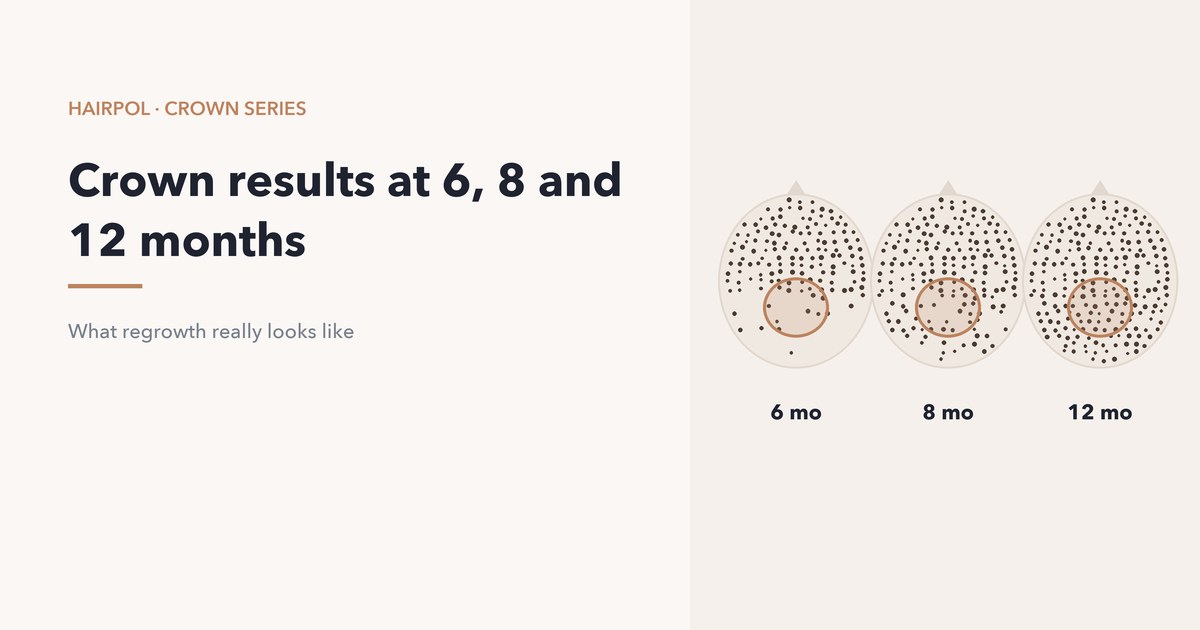
Six months is when the crown starts to answer back. New hairs have been emerging since roughly month three or four, and by now there is usually visible coverage — but the honest description is progress, not completion. On average, a crown at six months shows somewhere around half of its final density, often less, because the crown typically runs one to two months behind the frontal zone on the same head.
What does that look like in a photo? In soft, indirect light: a crown that reads as thinning rather than bald, with the whorl still visible but no longer stark. Under a harsh overhead bulb: scalp still showing through, especially at the center of the whorl, where hair radiates outward and coverage builds last. The new hairs themselves are thinner and softer than they will eventually be — early growth comes in fine and gradually thickens over subsequent cycles.
This is also the stage when many patients convince themselves the density is wrong. It usually is not; it is simply immature. We wrote a full explanation of why transplant density looks thin in the first months — the short version is that hair diameter, not just hair count, drives how dense a crown appears, and diameter is the last thing to mature.
Crown Hair Transplant Results at 8 Months: The Month Everyone Misjudges
Search data tells a story here: crown hair transplant results 8 months is one of the most anxious queries patients type. The reason is a cruel coincidence of timing. At eight months, the frontal zone — if it was transplanted in the same session — looks genuinely good. Hairline photos are satisfying. And right behind that success sits a crown at perhaps 60 to 70 percent of its final result, looking unfinished by comparison.
Patients read that contrast as failure. It is almost always physiology. The crown started later, grows on its own schedule, and matures on its own schedule. At eight months a typical crown shows meaningful coverage in most light, with a whorl center that still looks thin under direct overhead light and in wet hair. Hair texture is improving, individual shafts are thickening, and the patchiness of month six is usually smoothing out.
Two things are worth doing at eight months. First, compare your crown to your own month-four photo, not to your hairline. Second, resist judging under the worst light you can find. If eight months shows clearly more coverage than four months, the trajectory is working — the crown simply is not done.
12 Months and Beyond: When the Crown Finally Tells the Truth
Twelve months is the standard checkpoint for hair transplant results, and for the hairline it is usually the finish line. For the crown, it is more honest to call it the first trustworthy photo. By now density has typically reached 80 to 90 percent of its final level, hairs have thickened enough to reflect light like the surrounding hair, and the whorl pattern reads naturally in most conditions.
But crowns are famous for late improvement. Between months twelve and eighteen, many patients see a final push — not dramatic new growth, but a slow gain in caliber and coverage that makes the eighteen-month photo noticeably better than the twelve-month one. This is why responsible clinics photograph crowns at twelve months and again later, and why judging a crown permanently at the one-year mark can undersell the result.
What happens after that is a different question — one about native hair, maintenance, and how outcomes hold up over the years. We have written separately about what hair transplant results look like after 5 years; the short version is that transplanted crown hair is durable, but the native hair around it keeps its own agenda.
Why Crown Area Hair Transplant Results Are So Slow
If you have typed crown area hair transplant results very slow into a search bar, you are in good company, and the explanation is anatomical rather than alarming. Several factors stack on the crown:
- Blood supply. The vertex sits farther from the major supplying vessels than the frontal scalp, and grafts there establish circulation slightly more slowly — which delays the start of visible growth.
- The whorl. Crown hair grows in a spiral. Grafts must be placed at multiple angles radiating from a center point, and coverage only closes visually once enough hairs overlap across those directions.
- Geometry. Hair at the crown grows outward from the very surface you are looking at, rather than falling across it the way frontal hair does. Each hair covers less scalp, so the same density looks thinner for longer.
- Surface area. Crowns are larger than they appear in the mirror. A zone that looks like a small circle often measures many square centimeters once it is properly mapped.
Technique matters too, though less than patience does. Whether a crown is done with Sapphire FUE or DHI, the biological timetable is broadly the same — what technique influences is the precision of the angles in the whorl, which shapes how natural the final pattern looks rather than how fast it arrives.
Why Crown Results Start Patchy — and Why That Is Usually Normal
Patchiness is the other great crown worry, and the reasons behind patchy crown hair transplant results are worth taking one by one. The most common is staggered growth: transplanted follicles do not all wake in the same week. Some start producing hair at month three, others at month five or six, and until the late starters catch up, the crown looks uneven — islands of growth with thinner channels between them.
Second is shock loss recovery. If native hair around the grafts thinned temporarily after surgery, it regrows on its own timeline, and the interplay between returning native hair and incoming transplanted hair creates a shifting, uneven look for a few months.
Third is the whorl itself. Because crown hair radiates in a spiral, some sectors of the circle always look thinner from a given angle — the sector where hair grows away from the camera shows more scalp than the sector where hair grows toward it. That is not patchy growth; it is patchy viewing.
Patchiness earns real attention when it is geometric and static: a sharply bordered area with no growth at all by month eight to ten, while everything around it fills in. That pattern deserves a clinic review rather than more waiting. But soft-edged, shifting unevenness in the first eight months is simply the crown behaving like a crown.
Light, Angle, and Wet Hair: The Same Crown, Three Different Stories
Take one crown at nine months. Photograph it near a window in diffuse daylight and it looks covered. Photograph it under a single bathroom LED and a pale circle appears around the whorl. Wet it in the shower and it looks like month four again. Nothing changed but the conditions — yet each of those photos will trigger a completely different emotional response.
Overhead point lighting is the harshest judge, because it fires light straight down the hair shafts and reflects off the scalp between them. Wet hair is harsher still: water clumps hairs into strands, effectively reducing the number of covering units and exposing skin. Camera flash does the same at close range. Diffuse daylight is the kindest, scattering light so scalp reflections soften.
None of these is the one true crown — or rather, all of them are. Your crown will live in all of these conditions, which is why we wrote a full piece on why hair looks different under light after a transplant. For tracking progress, the rule is simpler: pick one condition and stick to it. Progress measured across changing conditions is not measurement; it is mood.
How to Read a Crown Before-and-After Gallery Like a Professional
When you evaluate a clinic gallery of crown hair transplant before and after photos, you are not really asking whether the results look good. You are asking whether the comparison is honest. A few checks separate documentation from marketing:
- Both photos share the same angle, distance, and head position — ideally with the camera directly above the whorl in both.
- Both photos share similar lighting. A dim before against a bright, diffuse after is a manipulated comparison even if the result underneath is real.
- Hair is dry in both, and roughly the same length. Longer, styled hair in the after can double apparent coverage without a single extra graft.
- The timeline is stated. An unlabeled after means little; after 13 months means something.
- The starting point is comparable to yours — a similar bald area and similar remaining native hair.
Video beats photography, because it forces the crown through angles and light continuously — much harder to stage. At Hairpol, we show documented outcomes rather than invented stories, and we would rather walk you through real cases that match your starting point than dazzle you with the best-case result of someone who started with half your bald area. You can review real cases on our before and after page.
Red Flags: How to Spot a Misleading Crown Gallery
Some warning signs are worth memorizing, because crown photos are the easiest of all transplant photos to game.
Be suspicious of wet or oily before photos paired with dry, voluminous afters — moisture in the before exaggerates the baldness the surgery then gets credit for fixing. Be suspicious of afters where the hair is dramatically longer, combed over the whorl, or clearly styled with fiber products. Be suspicious of full-density claims at four or five months: crown biology does not move that fast for anyone, and a gallery full of biologically implausible timelines tells you how the clinic treats the truth in general.
Filters and retouching leave traces too — skin texture that suddenly smooths, scalp that shifts color between photos, blurred zones around the whorl. And a gallery where every single patient shows a perfect, dense crown should raise rather than lower your guard, because honest crown outcomes vary with baseline, donor quality, and native hair. A clinic showing you a range of results — including good-but-not-perfect ones and planned second sessions — is showing you evidence. A clinic showing you only miracles is showing you advertising.
How to Track Your Own Crown Without Driving Yourself Crazy
The single best thing you can do for your own sanity is to build a boring, repeatable photo routine. Same bathroom, same bulb, same spot on the floor. Dry hair, at a similar length if you can manage it. Phone held at arm’s length directly above the whorl — a mirror or a second person helps — and one extra photo from a 45-degree angle behind. Once a month, on roughly the same date. That is the entire method.
Then follow two rules. First, compare across months, never across days: month four against month seven, month six against month nine. Crown growth is invisible week to week and unmistakable quarter to quarter. Second, never let a random photo — the elevator mirror, a flash photo at dinner, the gym locker room — override your controlled series. Those images carry every lighting distortion this article has described, concentrated into a single misleading frame.
Patients who track this way tend to relax somewhere around month seven, because the trajectory becomes undeniable even while the destination is still months away.
When Slow Stops Being Normal
Everything above defends the slow crown, so let us be equally clear about the opposite case. A crown that shows no visible change at all by months eight to ten — no new hairs against the light, no difference between the month-four and month-nine photos in identical conditions — deserves a proper review, not more reassurance. So does a sharply bordered zone with zero growth while its surroundings fill in, or a crown that appeared to grow and then measurably lost ground.
Sometimes the answer is still patience with a named reason: late-cycle follicles, recovering shock loss, or a large crown that was always going to need a planned second session to reach the density you pictured — something an honest clinic discusses before the first surgery, not after the complaint. Sometimes supportive care has a role; options like PRP and medical support are covered in our hair treatments department. And occasionally the honest conclusion is that graft survival underperformed, which is exactly the conversation a documented photo series makes possible. At Hairpol, follow-up reviews compare your controlled photos over time — one more reason to take them.
The Bottom Line on Crown Before-and-After Results
A crown transplant is a slow story with a good ending more often than a fast story with any ending. The before-and-after photos that convinced you to consider surgery compress twelve to eighteen months of biology into a single satisfying swipe — and the middle of that story, the part you will actually live through, looks patchy, uneven, and unfinished under exactly the bathroom light you keep checking it in. That is not the result. That is the process.
Judge galleries by their honesty, judge your own crown by controlled photos across months, and judge clinics by whether they explain the slow middle before you pay rather than after you panic. If you are weighing a crown procedure and want a realistic assessment of your baseline, your graft needs, and what your 6, 8, and 12-month photos are likely to show, our team at the Hairpol hair transplantation department will give you the version with the boring middle included — because that is the version that turns out to be true.
Frequently Asked Questions (FAQ)
What do crown hair transplant results look like at 6 months?
At six months a typical crown shows roughly half of its final density, sometimes less. Coverage is visible in soft light, but scalp still shows through under harsh overhead light, especially at the center of the whorl. The new hairs are also thinner than they will eventually be, so the area reads as thinning rather than finished. This is normal progress, not a final result.
Are crown hair transplant results at 8 months supposed to look unfinished?
Usually, yes. At eight months most crowns are at around 60 to 70 percent of the final outcome. The frontal zone matures faster, so comparing your crown to your hairline at this stage almost always makes the crown look worse than it is. Compare your eight-month photos to your own four-month photos in the same light instead.
Why are crown area hair transplant results so slow?
The crown has a comparatively weaker blood supply than the frontal scalp, a spiral whorl pattern that needs overlapping growth from several directions before it looks closed, and a geometry where each hair covers less visible scalp. It is also a larger area than it appears. Together these factors make the crown the slowest region to show its result, often needing 12 to 18 months.
Why do crown hair transplant results look patchy at first?
Transplanted follicles do not all start growing in the same week, so early growth comes in unevenly. Shock loss recovery in surrounding native hair and the spiral direction of whorl growth also create temporary uneven patches. Soft-edged patchiness that keeps improving is normal; a sharply bordered zone with no growth at all by months eight to ten deserves a clinic review.
When is a crown hair transplant result final?
Treat twelve months as the first reliable photo rather than the finish line. Most crowns reach about 80 to 90 percent of their final density by month twelve and continue to gain thickness and coverage until around month fifteen to eighteen. Judging a crown permanently at the one-year mark can undersell the eventual result.
Why does my crown look worse in some photos or mirrors than others?
Lighting and angle change crown photos dramatically. Direct overhead light and camera flash reflect off the scalp between hairs, wet hair clumps into strands and exposes skin, and small changes in camera height alter how much scalp shows. To track progress fairly, photograph your crown monthly in the same room, light, and position, and only compare those controlled photos.
How can I tell if a crown before-and-after gallery is honest?
Check that the before and after photos share the same angle, distance, and lighting, with dry hair at a similar length in both, and that the timeline is stated in months. Be wary of wet-hair befores, styled or longer-haired afters, full density claimed before month six, visible retouching, and galleries where every result looks perfect. Video results are much harder to stage than photos.
What if my crown still looks thin after 12 months?
First compare controlled photos: if month twelve clearly beats month eight, growth is likely still maturing and months fifteen to eighteen may improve further. If there has been no meaningful change since month eight, ask your clinic for a documented review. Large crowns sometimes need a planned second session to reach target density, and supportive treatments can help in selected cases.
Find this helpful? Add Hairpol as a preferred source on Google.
Get a Free Consultation
Answer a few questions and the medical team will review your situation.
