
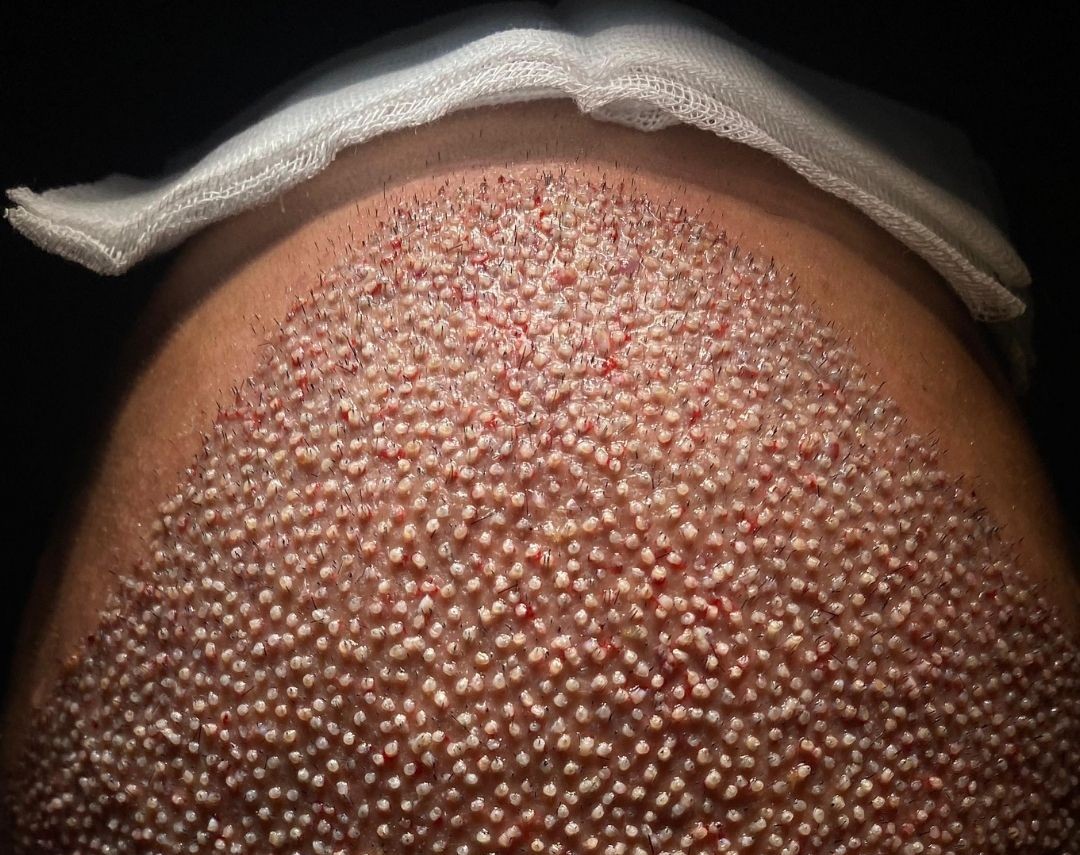
Nobody warns you about the itching. They warn you about swelling, about sleeping on your back, about the scabs and the shedding and the awkward month three. But the itch? The itch arrives quietly around day eight or nine, and within forty-eight hours it has become the single loudest thing in your life.
You are sitting in a meeting and thinking about your scalp. You are lying in bed at 2 a.m. with your hands under the pillow, deliberately trapped, because you know what happens if you let them go. It is not painful. That is almost the cruel part. Pain you could justify. This is just a maddening, crawling, electric prickle across the exact square inches of your head you are least allowed to touch.
At Hairpol, this is one of the most common messages we get in the second week. And almost every one of them carries the same undertone of worry underneath the complaint: is something wrong with me? Usually, no. Usually the itch is the most boring possible thing — it is your scalp healing on schedule. But “normal” and “manageable” are two different problems, and this guide is about both.
The Itch Is a Healing Signal, Not a Malfunction
Here is the reframe that helps most people: itching is not a sign that something went wrong. It is a sign that a very specific biological process is running correctly.
During your procedure, thousands of tiny channels were opened in your recipient area, and thousands of micro-punches were made in your donor zone. Each of those is a small wound. Small wounds heal through a predictable sequence — inflammation, then tissue rebuilding, then remodelling. The itch belongs to that middle phase, when your body is closing wounds, laying down new collagen, and re-establishing the nerve endings that were briefly interrupted.
Histamine is part of it. So is the simple mechanical fact that healing skin contracts and dries as it closes. So are the nerve fibres themselves, which regenerate somewhat chaotically and fire off strange signals while they reconnect. Put all three together and you get a sensation that has no useful purpose whatsoever but is nonetheless completely expected.
The patients who never itch at all are not the lucky ones. They are simply the ones whose nerve density, skin type, or scab volume happened to produce a quieter version of the same process. Itching intensity does not correlate with result quality. We have seen ferociously itchy heads grow beautifully and calm ones grow beautifully, and the itch predicted nothing in either direction.
Why It Starts Around Day Seven to Ten
The timing is not random. In the first week, your scalp is mostly numb, swollen, and covered in fresh crusts. Local anaesthetic wears off within hours, but the tissue itself stays somewhat dulled — inflammation and swelling suppress fine sensation. You feel tightness and soreness, not itch.
Then the swelling resolves. Around days six to eight, sensation returns to a scalp that is now dry, crusted, and mid-repair. That is when the signal finally reaches you. It is not that the itch begins on day eight; it is that you finally become able to perceive what has been building since day three.
The scabs matter enormously here. Each crust sits over a graft like a tiny scab-shaped tent, tugging slightly at the surrounding skin as it dries and shrinks. Multiply that by two, three, four thousand and you have a scalp under thousands of points of micro-tension. This is why the itch tends to peak precisely when the crusts are at their driest and tightest, usually days eight through twelve, and why it drops off sharply once the crusts release.
This is also the exact window when people panic and start scrubbing. Which brings us to the part that actually matters.
What Scratching Actually Costs You
Let’s be blunt about the stakes, because vague warnings do not stop anyone at 3 a.m.
Before roughly day ten, grafts are still anchoring. Their blood supply has connected, but the physical grip between graft and surrounding tissue is not yet at full strength. A fingernail dragged across the recipient zone can lift a graft cleanly out. Not damage it — remove it. And a graft removed at day nine is not replaceable. That follicle is gone from your head permanently, along with whatever it would have grown for the next forty years.
After day ten to twelve, the grafts themselves are considerably safer. The risk shifts. Now scratching means bacteria under a fingernail meeting an open micro-wound, which means folliculitis, which means inflammation around a follicle that is trying to enter its growth phase. Inflammation is the enemy of early growth. It will not usually destroy the graft, but it can delay it and it can leave you with pustules and redness you did not need.
The donor area has its own logic. It is more forgiving than the recipient zone — there are no loose grafts to dislodge — but it is also frequently itchier, and aggressive scratching there can widen or irritate healing punch sites in a way that affects how invisibly your donor zone recovers. At Hairpol we tell patients to treat the donor as “less catastrophic, still not free.”
The Single Most Effective Thing: Get the Scabs Off Properly
Most of the itch lives in the crusts. Remove the crusts on schedule and correctly, and the itch largely leaves with them.
The instinct is to leave them alone — they look fragile, they sit on your grafts, touching them feels like vandalism. But scabs that stay too long do not protect anything after the first week. They dry, tighten, pull, and keep the itch running. Worse, a crust that hardens over a graft can physically obstruct the emerging hair.
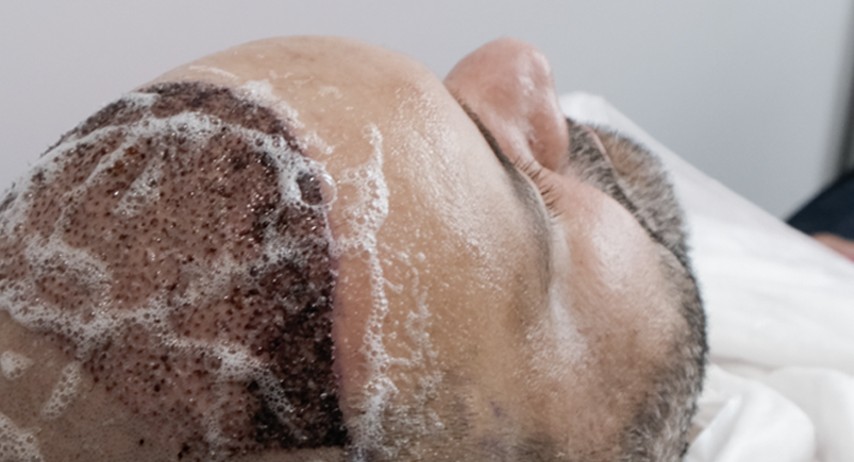
The method is patient, not aggressive. Soften first: apply the lotion or moisturiser your clinic gave you, or plain baby oil if you were not given anything, and leave it on the recipient area for thirty to forty-five minutes. The crusts need to become soft and swollen, not merely damp. Then wash with lukewarm water and a diluted baby shampoo, using only your fingertip pads in slow circular motions. No nails. No pressure. No showerhead firing directly at the grafts.
The crusts will not all come off in one session, and they should not. Over three or four days of daily washing, they release in waves. Any crust that resists is telling you it is not ready — leave it and it will come off tomorrow. Our full week-by-week washing guide walks through the technique in more detail, and it is worth re-reading in week two specifically because the washing is doing double duty now: hygiene and itch relief.
Dryness Is the Second Half of the Problem
Once the crusts are gone, some people expect instant relief and instead get a lighter but persistent itch that lasts weeks. That one is dryness.
Your scalp has just been through surgery, repeated washing with a stripped-down shampoo, days without its normal sebum distribution, and possibly a flight, a hotel, and air conditioning. The skin barrier is genuinely compromised. Dry skin itches. It is that simple, and it responds to moisture rather than to willpower.
A light, fragrance-free moisturiser or a dedicated post-transplant lotion, applied gently to the scalp once or twice daily from around day fourteen, resolves most of it. Avoid anything with alcohol high in the ingredients list, anything with heavy fragrance, and anything marketed as “cooling” via menthol in the first month — it feels good for ninety seconds and irritates for hours afterwards.
Water temperature matters more than people expect. Hot showers strip lipids from an already-stripped barrier. Lukewarm, always. If you have been reflexively turning the tap up because hot water briefly numbs the itch, you are trading a minute of relief for an hour of worse.
What Actually Helps, Ranked Honestly
Not everything works equally, and some widely repeated advice is useless. Here is our real-world ranking, based on what patients tell us afterwards:
- Correct, consistent washing — by a wide margin the most effective intervention. It removes the cause rather than muting the symptom.
- Moisturising — second place, and the most under-used. Many people stop applying lotion the moment the crusts go, exactly when dryness itch begins.
- Oral antihistamines — genuinely useful, especially at night. A non-sedating one during the day, a sedating one before bed, taken with your clinic’s approval. The sedation is a feature, not a bug: it gets you past the hours when your defences are lowest.
- Cool, not cold, saline spray — a light misting gives real short-term relief without touching anything. Keep it in the fridge.
- Tapping instead of scratching — gently patting the itchy area with flat fingertips satisfies a surprising amount of the urge without shear force. This is the technique to learn.
- Distraction and sleep hygiene — sounds soft, works hard. The itch is worst when you have nothing else to attend to.
What does not help: ice directly on grafts, antiseptic wipes, hydrogen peroxide, tea tree oil, apple cider vinegar, and any product a forum recommends that your clinic has not seen. The early scalp is not a place to experiment.
Nights Are Worse, and There Is a Reason
Almost everyone reports the same thing: tolerable by day, unbearable by night. This is not imagination.
Core body temperature and peripheral blood flow both rise in the evening, which amplifies itch signalling. Cortisol — which suppresses inflammation — is at its daily low overnight. And you have no distractions. The same sensation that registered as background noise at 3 p.m. becomes the entire foreground at 1 a.m.
Practical countermeasures: keep the bedroom cool, take your antihistamine an hour before bed rather than at bedtime, moisturise as part of your evening routine rather than your morning one, and sleep semi-upright on a travel pillow for the first ten days if you are not already — it reduces both swelling and the temptation to bury your head in a pillow. If you wake up scratching, that is what soft cotton gloves are for, and no, that is not an overreaction. Half of the graft-loss stories we hear happened while the patient was asleep. Our guide on sleeping without damaging grafts covers the positioning side of this in full.
The Donor Area Itch Is a Different Animal
Patients are often surprised that the back of the head itches more than the top. There are good reasons.
The donor zone has a higher density of extraction points packed into a smaller area, denser nerve supply, and it is the part of your head that contacts pillows and collars. It also heals faster than the recipient area, and faster healing means a more compressed, more intense itch phase. Donor itch often arrives earlier — sometimes day five — and resolves sooner.
The good news is that it is safer to address. Gentle washing with your fingertips, thorough moisturising, and a saline spray usually handle it. Because there are no grafts to lose, light tapping and even careful fingertip pressure are acceptable here in a way they are not on top. Still no nails.
If donor itch persists past week four, or comes with visible pustules, that is worth a message rather than patience. Persistent donor itch occasionally signals ingrown hairs as the shaved follicles regrow, which is treatable but not something you should be managing with guesswork.
When the Itch Is Telling You Something Is Wrong
The vast majority of post-transplant itching is benign. But it is not universally benign, and knowing the difference is the whole point of paying attention.
Get in touch with your clinic if the itch comes with any of the following: spreading redness rather than fading redness, warmth to the touch, pus or yellow crusting, a foul smell, fever, pain that increases rather than decreases after day four, or itch that is severe and localised to one specific patch rather than diffuse across the whole zone. Those patterns suggest infection or folliculitis, not healing.
Another flag: itch accompanied by a rash of small red bumps that appeared shortly after you started a new product. That is contact dermatitis — an allergic reaction to a shampoo, lotion, or spray — and the fix is stopping the product, not enduring it.
And a subtler one: itch that vanishes entirely and then returns strongly at week five or six, sometimes with small pimples. That is usually ingrown hairs as transplanted follicles push through, and while it is common and self-limiting, a clinic that knows your case can tell you whether to treat it or wait.
At Hairpol we would rather look at a photo of something harmless than hear about something serious three weeks late. If you are unsure, send us a message with a well-lit photo of the area — you can send it straight through WhatsApp — and we will tell you honestly whether it is the boring kind of itch or the kind that needs attention. It takes us two minutes and it costs you nothing but the message.
How Long This Actually Lasts
The honest timeline, based on what our patients report rather than what makes a tidy graphic:
Days 1-5: little to no itch. Tightness, soreness, swelling. If you are itching hard in this window, mention it — it is early.
Days 6-12: the peak. Crust-driven, often intense, worst at night. This is the dangerous window and also the shortest. Wash properly and it ends.
Days 13-21: sharp decline as crusts clear. What remains is dryness itch — lighter, broader, responsive to moisturiser.
Weeks 4-8: mostly quiet, with occasional flares. Some people get an ingrown-hair phase here as new shafts break through. Mild, manageable.
Months 3-6: should be gone. Persistent itching at this stage is not part of the transplant timeline and deserves a proper look — it may be seborrhoeic dermatitis or another scalp condition that was present before and is now more noticeable, and those have their own treatments through medical hair treatments.
Note what the itch timeline overlaps with: shedding. Around weeks two to six your transplanted hairs fall out, which is expected and explained in our piece on why transplanted hair falls before it grows back. Two unsettling things happening at once makes both feel worse. They are unrelated, and both are normal.
Why Technique and Aftercare Support Change the Experience
Not all post-transplant itching is created equal, and some of the variation traces back to the operating room.
Channel size and depth matter. Recipient sites cut larger than the graft require means more trauma, more crusting, more inflammation, more itch. Precision instruments — the fine blades used in Sapphire FUE or the implanter-pen approach of DHI — create sites sized to the graft, which generally means smaller crusts and a shorter, milder itch phase. This is not marketing; it is a mechanical consequence of wound size.
Hydration during the procedure matters too. Grafts kept properly and sites irrigated well produce cleaner healing than a rushed, dry field. So does bleeding control, so does how densely the sites were packed, so does whether anyone bothered to clean the scalp thoroughly before you left.
And then there is what happens after you walk out. A clinic that hands you a printed sheet and disappears has left you to interpret week two alone. This is part of why we tell people to weigh aftercare access as heavily as price when choosing where to have a hair transplant Turkey clinic perform their procedure — the surgery is one day, the healing is a year, and the itch arrives long after your flight home. Our clinic selection checklist puts follow-up support near the top for exactly this reason.
The Psychological Weight Nobody Mentions
There is a reason this article is longer than “don’t scratch.”
Week two is where the emotional floor tends to fall out. You have paid, travelled, taken time off, and endured the procedure. The initial excitement has worn off. Your head looks worse than it did before you started. Nothing is growing yet. And now you cannot stop thinking about a sensation that will not let you rest. The itch is not just a symptom; it is a constant tactile reminder that you are in the ugly middle of something you cannot rush.
What helps, genuinely, is understanding that the discomfort is finite and correlated with nothing. It will not affect your density. It says nothing about your surgeon. It is not a punishment for a decision you are quietly second-guessing at 2 a.m. It is scabs drying and nerves reconnecting, and it ends in about a week.
The people who cope best are the ones who stop treating each day as a referendum on the outcome and start treating this phase as a chore to be got through — wash, moisturise, antihistamine, sleep, repeat. Boredom is the goal. Boredom means healing.
A Simple Protocol for the Worst Week
If you want one thing to follow rather than a philosophy, follow this from day eight to day fourteen.
Morning: apply lotion to the recipient and donor areas, leave for thirty to forty-five minutes, wash with lukewarm water and diluted baby shampoo using fingertip pads only, pat dry with a clean towel, apply a light moisturiser. Non-sedating antihistamine with breakfast if your clinic approved it.
Through the day: saline spray from the fridge when the itch spikes. Tap, never scratch. Keep your hands occupied and your hat off unless you genuinely need it.
Evening: repeat the moisturiser. Sedating antihistamine an hour before bed. Cool room, semi-upright position, travel pillow. Gloves if you are a night scratcher.
Anything that deviates from that — new products, a friend’s suggestion, something you read at midnight — goes past your clinic first. Six days of this and the worst is behind you.
Getting Answers Instead of Guessing
The reason people scratch is rarely ignorance. It is uncertainty. When you do not know whether what you are feeling is normal, every hour of it feels like evidence that something is going wrong, and the pressure to do something becomes irresistible. Certainty is the actual treatment.
That is why Hairpol’s follow-up runs the full first year rather than the first week, and why we would genuinely rather field ten photos of a perfectly ordinary healing scalp than have someone quietly ride out an infection because they did not want to be a bother. You are not a bother. The message is the point.
If you are in that week right now — send us a photo on WhatsApp and we will tell you where you are on the timeline. If you are still researching and weighing whether a hair transplant Turkey trip is right for you, the questions worth asking are about exactly this: who answers when it is day nine and you are worried, and how fast. And if you are somewhere in between, our before and after gallery is full of results that all went through this same maddening, forgettable week.
The itch is temporary. The grafts are not — if you leave them alone. At Hairpol, we plan, perform, and follow through on hair transplantation with the understanding that the operation is the easy part and the year afterwards is where results are actually won. Whether you are three weeks post-op and losing your mind at 2 a.m., or still deciding whether a hair transplant Turkey plan makes sense for your case at all, message us. We will give you a straight answer, and if the honest answer is “wait,” we will say that too.
Find this helpful? Add Hairpol as a preferred source on Google.
Get a Free Consultation
Answer a few questions and the medical team will review your situation.
