
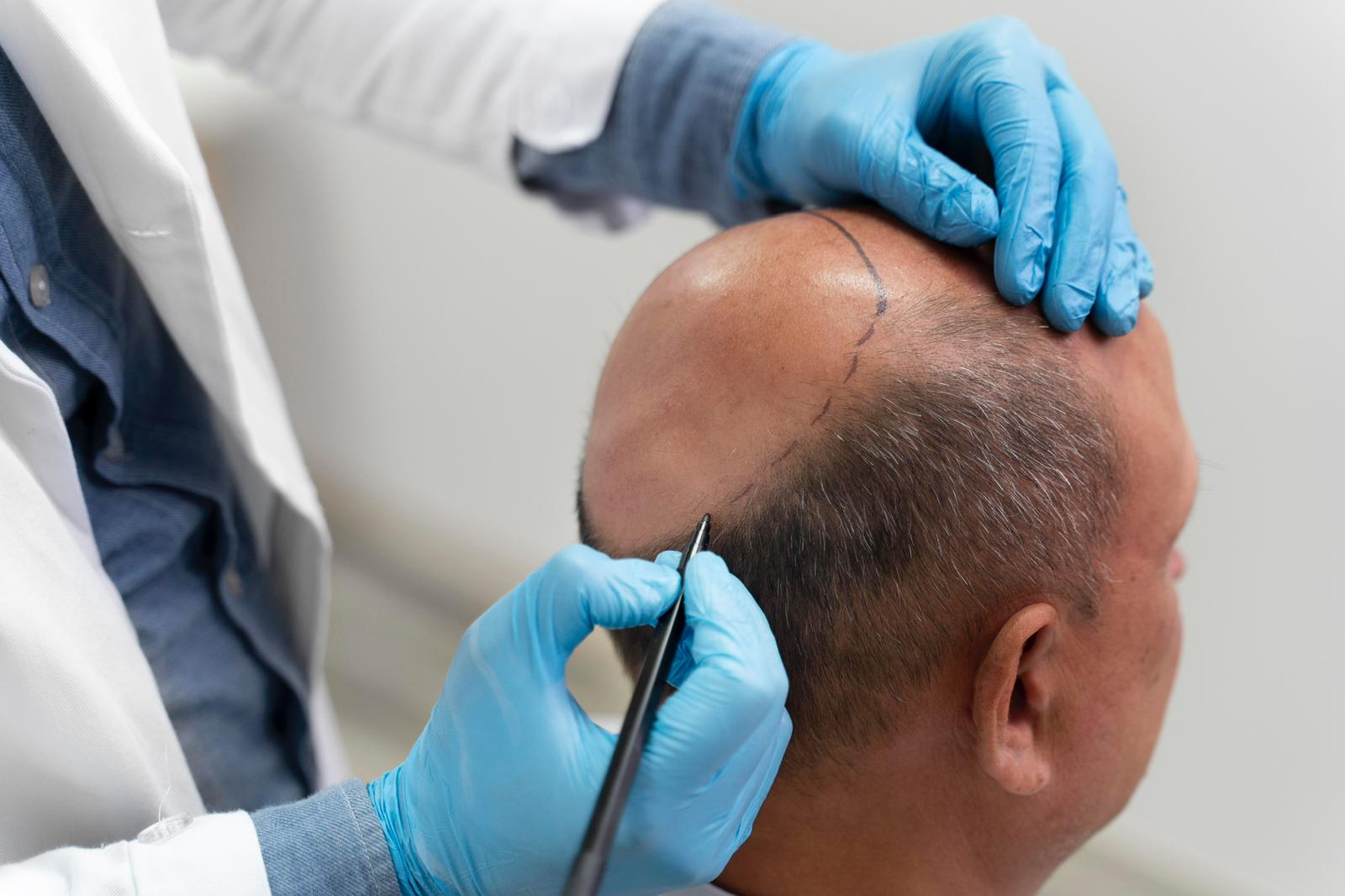
When most people picture a hair transplant, they picture the hairline — the frontal restoration that reframes the face by filling in a receding M-shape. It’s the result you see in most before-and-after galleries, the transformation that’s most visually dramatic and most immediately recognizable. Patients who research the procedure online encounter frontal results everywhere, and they tend to walk into consultations with expectations built around what they’ve seen.
The crown is a completely different story. It gets less attention in marketing materials, produces results on a longer and more frustrating timeline, and presents technical challenges that simply don’t exist in the frontal zone. Yet for many men, it’s the area they’re most self-conscious about — the part they can’t see themselves but everyone else can. The photo someone took from behind that made them realize something had changed. The comment from a friend. The slow recognition that the back of their head looks different than it used to.
If you’re considering a hair transplant to address crown thinning or loss, understanding what makes this area genuinely harder to treat will help you set realistic expectations, ask better questions in your consultation, and ultimately make a more informed decision about your care. This guide walks through everything that matters: why the crown is structurally different, what makes the procedure more demanding, what realistic results look like, and how to think about the timeline and long-term picture.
The Growth Pattern Changes Everything
The fundamental difference between the crown and the frontal zone comes down to how hair actually grows in each area — and this single biological fact is responsible for almost every challenge that follows.
Frontal hair grows in a relatively consistent direction — forward and slightly downward across the scalp. This means each hair shaft contributes to overlapping coverage as it grows, reinforcing the hairs around it and building visual density progressively. The geometry works in your favor: when you place grafts in the frontal zone, the resulting hair growth creates a unified visual surface because every strand is pointing more or less the same way.
Crown hair doesn’t behave this way at all. It grows in a spiral pattern radiating outward from a central whorl point, with hairs pointing in multiple directions simultaneously. This has two significant consequences for transplantation:
- More grafts per square centimeter are needed to achieve the same visual coverage, because hairs growing in different directions don’t create the same overlapping reinforcement that frontal hairs do. Each strand contributes less visual density per follicle than it would in the frontal zone.
- Every single graft must be placed at the correct angle for its specific position relative to the whorl — which varies continuously across the entire treatment zone. A uniform implantation angle that works fine on the front produces a result that grows visibly wrong on the crown.
This is why crown work demands a different level of surgical attention than frontal work. The planning is more complex, the execution is more demanding, and the margin for imprecision is meaningfully narrower. A surgical team that performs excellent frontal work but lacks specific experience with crown procedures can produce results that look fine on initial inspection but reveal their problems as the hair matures and grows in directions that don’t align naturally with the surrounding pattern.
The Whorl: The Detail That Defines the Result
The whorl is the natural spiral center from which all crown hair radiates. It’s the pivot point of the entire growth pattern, and how it’s handled in a hair transplant procedure is one of the clearest indicators of surgical quality you’ll find in any area of hair restoration.
In patients who have lost the central crown area to baldness, the whorl no longer exists as a physical reference point. Designing where the new whorl will sit — and how grafts will radiate from it in the correct angles and directions — is an aesthetic and technical decision that shapes the entire result. Get it right and the crown looks completely natural, with the spiral pattern emerging organically as the hair grows. Get it wrong and the result looks planted, regardless of how well the individual grafts survived. The position of the whorl, how tight or loose the spiral is, and the direction the hair flows from it all need to look believable.
In patients who still have some existing crown hair, the challenge is different but no less significant: new grafts need to integrate with the existing growth pattern without disrupting the follicles already there. This requires the surgical team to read the natural pattern and extend it rather than impose a new one. Working around existing hair without damaging it during channel creation is technically demanding work that some clinics handle better than others.
Why Graft Counts Run Higher Than Expected
One of the most common surprises patients encounter when planning a crown procedure is how many grafts are actually required. The crown looks like a discrete bald circle — how hard can it be to fill in?
Harder than it looks, for several reasons:
- The spiral growth pattern means coverage must extend all the way to the center of the whorl, not just to the visible perimeter. Underfilling the central zone produces a result that looks thin from above even when the edges appear full.
- The crown is typically a larger area than patients estimate when they’re looking at photos of their own heads. The actual square centimeter coverage required often exceeds the initial visual impression.
- Hair characteristics matter significantly — patients with fine, straight, dark hair against pale scalp need higher density to achieve the same visual coverage as patients with coarser, wavier hair.
As a general reference framework:
- Early crown thinning: 1,500–2,000 grafts
- Moderate crown deficit: 2,000–2,800 grafts
- Large fully bald crown: 3,000–4,000+ grafts
These are reference ranges, not guarantees. Your actual requirement depends on a proper assessment of the area size, your hair characteristics, your existing crown coverage, and your target density. A clinic that gives you a number without measuring the actual area being treated or assessing your individual hair characteristics is providing a guess, not a clinical recommendation.
The Timeline Is Longer Than the Front
Patients who address both their frontal zone and their crown in the same procedure often get frustrated when the crown appears to lag behind in visible progress. This isn’t a complication or a sign that something went wrong. It’s the normal biology of crown recovery, and knowing it in advance makes the experience significantly easier to manage.
The frontal hairline typically shows meaningful visible growth by months three to five. The crown follows a different schedule:
- Weeks 1–2: The acute recovery phase. Scabbing around implantation sites, some swelling (especially if frontal work was also done), and visible signs of a procedure in progress.
- Months 2–4: Shock loss phase. The transplanted hair sheds, and any existing crown hair in the treatment area may also shed temporarily. The crown can look significantly worse than before the procedure during this phase. This is fully expected and completely reversible.
- Months 5–7: New growth begins to emerge, but the overlapping coverage effect builds slowly given the multi-directional growth pattern. Patients may see strands without yet seeing density.
- Months 9–12: The result becomes genuinely assessable. Most patients have what looks like the majority of their final result by this point.
- Months 12–18: Full maturity — two to four months longer than frontal work on average. Late-emerging grafts and continuing hair shaft caliber development can still contribute to the final picture during this phase.
This extended timeline is something to build into your expectations before the procedure, not discover with anxiety afterward. Patients who understand that the crown follows its own schedule navigate the waiting period much more comfortably than those who keep comparing their crown progress to their frontal progress and assuming something is wrong.
The Ongoing Loss Problem
The crown is also the area of the scalp most prone to continued androgenetic progression. This single fact has significant implications for how a crown procedure should be planned and managed long-term.
Transplanted grafts are permanent — DHT-resistant follicles from the donor zone that retain their resistance in their new location and continue growing indefinitely. The native hair surrounding them is not permanent in the same way. It continues its androgenetic trajectory after the procedure just as it would have without one.
As native hair in and around the treated area continues thinning, the relationship between the permanent transplanted grafts and the surrounding native hair changes over time. Without medical management, a result that looks excellent at twelve months can look increasingly patchy at five years as permanent transplanted density sits within expanding areas of progressive native loss. The transplanted hair hasn’t changed — it’s still performing as it did at year one. What’s changed is the context around it.
This is why finasteride and minoxidil aren’t optional additions to a crown hair transplant — they’re part of the plan. Finasteride addresses the hormonal mechanism driving ongoing native hair loss by reducing DHT, the primary driver of androgenetic miniaturization. Minoxidil supports the active growth of native follicles and extends their anagen phase. Together, they protect the native hair that contributes to the overall crown coverage picture alongside the permanent transplanted grafts.
A crown procedure planned without accounting for medical management of ongoing loss is a plan optimized for the twelve-month photograph, not for the five-year result. Patients who proceed with crown surgery but don’t commit to ongoing medical management are accepting that the native hair contributing to their result will continue its natural trajectory regardless of what happens in the operating room.
Technique Matters More Here Than Almost Anywhere
Both Sapphire FUE and DHI are appropriate techniques for crown work. The technique choice itself matters less than the execution quality and the team’s specific experience with crown implantation.
Sapphire FUE’s precision channel creation allows very accurate control of implantation angle — particularly valuable in crown work where angle variation across the spiral pattern is significant. The sapphire blade’s cleaner incision also typically produces less tissue trauma and faster initial healing than standard steel blades. DHI minimizes out-of-body time for grafts, which has relevance in larger-count procedures, and works well when existing hair is being preserved within the treatment zone. The Choi pen’s single-step channel creation and implantation can also support precision in cases where angles need to vary frequently across a small area.
What neither technique can compensate for is inadequate planning of the whorl design, imprecise angle distribution across the treatment area, or central zone underfilling. These execution details are what separate crown results that look natural at five years from those that require revision down the line.
How to Evaluate a Clinic for Crown Work
Choosing a clinic for crown work involves the same general verification you’d do for any procedure — Ministry of Health authorization, confirmed surgeon credentials, direct procedural involvement of the named surgeon, long-term outcome documentation — but with additional emphasis on crown-specific experience.
Questions worth asking specifically about crown work:
- How much of the crown area needs treatment, in square centimeters, and what density are we targeting?
- Based on my hair characteristics, how will the proposed graft count translate to visual coverage?
- How are you planning the whorl position and the angle distribution for grafts across the crown zone?
- Who specifically performs the implantation phase, and what is their experience with crown work?
- How does this procedure relate to my remaining donor supply, and what does the picture look like at five and ten years given my likely progression pattern?
- What is the medical management plan after the procedure, and how is it integrated into the overall approach?
A clinic that answers these questions specifically and clearly is demonstrating the kind of clinical depth that crown work requires. One that responds with generalities or moves quickly to package pricing without engaging clinically with the details is showing you something important about how they approach this category of work.
At Hairpol, crown procedures are planned with explicit attention to whorl position, angle distribution across the spiral growth pattern, and the graft count required to achieve genuine central zone density — because these are the details that the mature result either rewards or exposes. The crown is the area where shortcuts in planning show up most clearly five years later, and where getting the details right from the start makes the difference between a result that holds up over time and one that requires revisiting.
Realistic Expectations for the Crown Result
Setting expectations correctly before a crown procedure is more important than for almost any other area, because the gap between what patients sometimes hope for and what a crown transplant can realistically deliver is wider than for frontal work.
What a good crown hair transplant result looks like:
- Meaningful, natural-looking coverage of the treated area that reads as hair rather than visible scalp under most viewing conditions.
- A natural whorl pattern that doesn’t look planted or geometric — one that integrates with surrounding growth.
- Density in the range of 40 to 60 follicular units per square centimeter — enough for convincing coverage under normal lighting and viewing angles, but not the density of a non-balding crown.
- Results that continue to look appropriate as the patient ages, assuming committed medical management of ongoing loss.
What a crown hair transplant cannot do:
- Restore the density of a crown that hasn’t experienced any hair loss. The transplanted zone achieves approximately half to two-thirds of native non-balding density, which is sufficient for natural appearance but isn’t identical to the original.
- Guarantee permanent coverage without attention to ongoing loss. The transplanted hair is permanent; the native hair around it is not.
- Produce equivalent results regardless of how it’s done. Quality of surgical execution — whorl design, implantation angle accuracy, graft handling — directly affects the naturalness of the mature outcome.
Patients who go into a crown procedure understanding these realities are in a much better position to be satisfied with their result than those whose expectations were built on either marketing materials or assumptions extrapolated from frontal results they’ve seen.
