
Graft count is one of the first numbers that comes up in a hair transplant conversation — and one of the most commonly misunderstood. Patients arrive at consultations having read that “2,000 grafts is a standard procedure” or that “4,000 grafts is needed for advanced loss,” and they often treat these numbers as benchmarks without understanding what they mean in their specific situation, how they’re determined, or why the same number of grafts produces dramatically different visual results in different patients.
The right graft count for any individual patient is not a number you find on a chart. It’s the output of a clinical assessment that considers the area being treated, the target density, the available donor supply, the patient’s hair characteristics, the pattern of loss, and the long-term trajectory of that loss. Understanding how these variables interact — and how to evaluate whether a proposed graft count is genuinely appropriate for your situation — is one of the most practically useful things you can do before committing to a procedure.
This guide covers the complete framework for thinking about graft count: what it measures, what determines it, what the realistic ranges are for different presentations, and how to evaluate the number a clinic is proposing rather than simply accepting it as a given.
What a Graft Actually Is
Before discussing graft counts, it’s worth being precise about what a graft is — because the term is sometimes used loosely in ways that make count comparisons misleading.
A follicular unit graft is a naturally occurring grouping of hair follicles as they exist in the scalp. These groupings — follicular units — contain one, two, three, or occasionally four hairs growing together from a shared papilla and surrounded by a shared capsule of supporting tissue. In FUE procedures, each punch extraction captures one follicular unit — which may contain one, two, three, or more individual hair follicles.
This means that 2,000 grafts is not the same as 2,000 hairs. If the average follicular unit in a patient’s donor area contains 2.2 hairs — which is typical for many patients — then 2,000 grafts yields approximately 4,400 individual hair follicles. A patient with an average of 1.8 hairs per graft gets approximately 3,600 hairs from the same 2,000 grafts. The visual density these two patients achieve from the same graft count is meaningfully different.
This is why hair-to-graft ratio — the average number of hairs per follicular unit in a patient’s donor area — is a clinically important variable that affects how much visual coverage a given graft count provides. Patients with naturally higher hair-to-graft ratios get more coverage per graft than those with lower ratios, which affects both the total count needed for a given area and how efficiently the donor supply is utilized.
The Primary Determinants of the Right Graft Count
The appropriate graft count for any patient is determined by the interaction of several variables that must all be assessed together — not any one of them in isolation.
The area of loss is the most foundational variable. A larger recipient area requires more grafts to achieve a given target density than a smaller one. This is simple arithmetic: distributing 2,000 grafts across a 20-square-centimeter frontal zone produces a different density than distributing those same grafts across a 40-square-centimeter zone. The size of the area being addressed is the denominator in the density calculation — and it must be measured rather than estimated.
The target density is the numerator. How many follicular units per square centimeter is the procedure aiming to achieve? Native scalp density — in areas without hair loss — typically runs 80 to 100 follicular units per square centimeter. Transplanted procedures typically achieve 40 to 60 follicular units per square centimeter in the recipient area — lower than native density but sufficient to look natural under normal viewing conditions when hair characteristics are favorable. Higher target density requires more grafts per unit area; lower target density requires fewer.
Hair characteristics significantly affect how much coverage a given density actually provides. Patients with coarse, wavy, or curly hair achieve more visual coverage per follicle than those with fine, straight hair — because thicker hair shafts cover more scalp surface per strand, and curl and wave create volume that provides additional coverage beyond the simple strand count. A patient with coarse, wavy hair at 40 follicular units per square centimeter may look fuller than a patient with fine, straight hair at the same density — which means the coarse-haired patient needs fewer grafts to achieve a satisfying visual result than the fine-haired patient covering the same area to the same target density.
The color contrast between hair and scalp affects how visually apparent any gaps in coverage are. Dark hair against a pale scalp creates high contrast — every gap is visible. Light hair against a pale scalp creates low contrast — the scalp blends visually with the hair. Patients with high contrast need higher density to achieve the same visual fullness as patients with low contrast. This variable affects the target density needed to achieve a satisfying result rather than simply the graft count for a given target density.
The pattern and distribution of loss determines where grafts are allocated across the recipient area. A patient with primarily frontal recession who wants to address the hairline and temples needs grafts concentrated at the leading edge with careful density distribution from hairline back. A patient with diffuse thinning across a large frontal zone needs a different distribution strategy. A patient addressing both frontal recession and crown loss needs a specific allocation between these zones based on priorities and donor supply. The pattern is not just a question of how many grafts — it’s a question of where they go and in what proportion.
The available donor supply sets the ceiling on what is achievable rather than the floor. For patients with limited donor supply — whether from naturally lower donor density, previous procedures, or conditions affecting the donor area — the graft count in a given session may be constrained by what can be safely extracted rather than by what the recipient area needs. Understanding the donor ceiling is essential for realistic planning, particularly for patients with larger areas of loss.
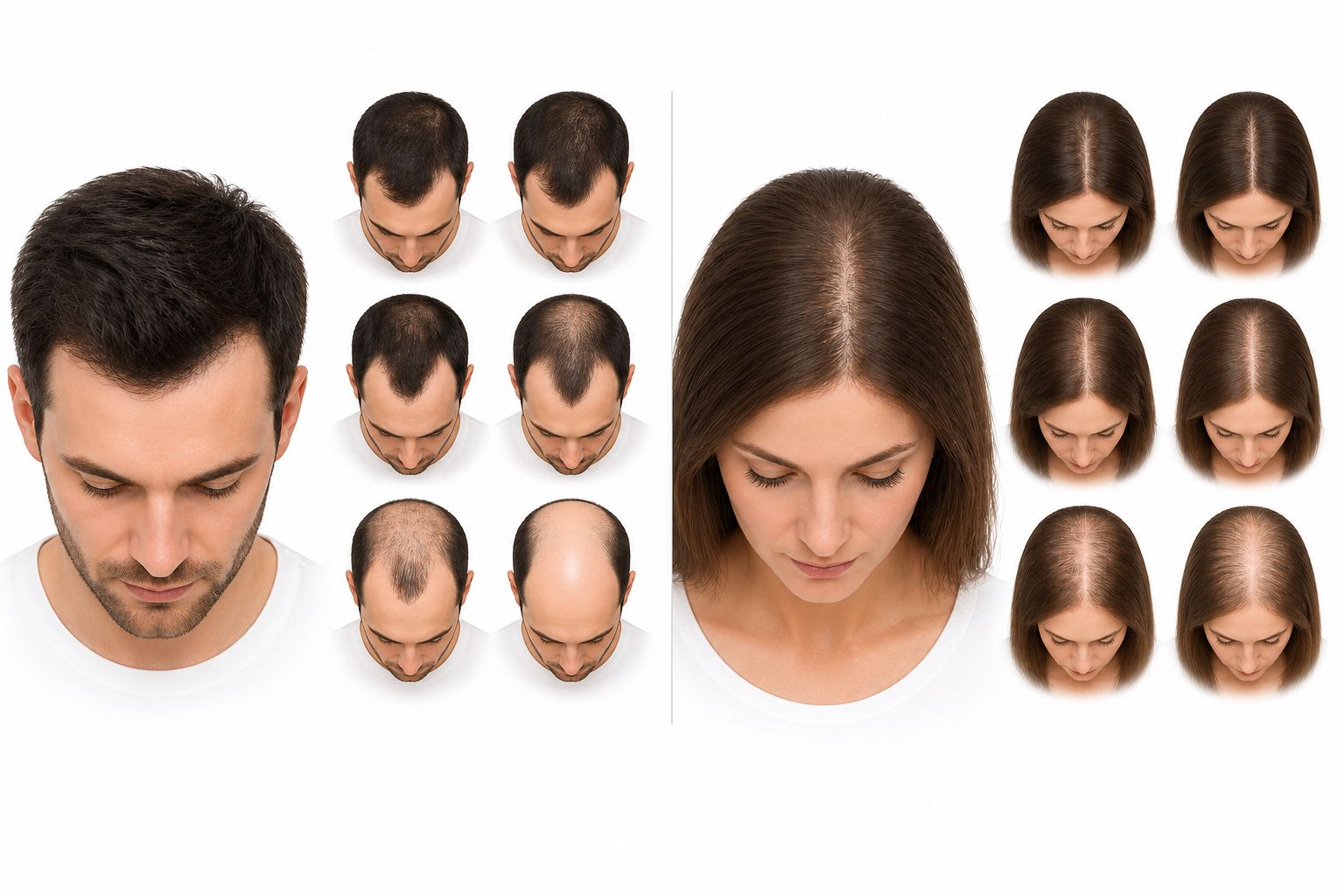
Graft Count Ranges by Norwood Type: A Reference Framework
While specific graft counts must be determined by individual assessment, reference ranges by hair loss stage provide useful context for evaluating whether a proposed count is in the appropriate ballpark.
Norwood Type 2 — slight temple recession — typically requires between 800 and 1,500 grafts to address the hairline and temple areas. The recipient area is relatively small, and a modest graft count can produce comprehensive-looking coverage. For patients at this stage with favorable hair characteristics, results from the lower end of this range can be excellent.
Norwood Type 3 — defined M-shape recession with deeper temporal recession — typically requires 1,500 to 2,500 grafts for the hairline and temple zones. The specific count within this range depends on how far recession has advanced, the size of the temple zones being addressed, and the target density. Patients who also want to address slight mid-scalp thinning that may be beginning may be at the higher end of this range or slightly above it.
Norwood Type 4 — advancing frontal and crown loss with a narrowing mid-scalp bridge — typically requires 2,500 to 3,500 grafts when addressing the full frontal zone. When the crown is also being addressed in the same session, the count may be at the higher end of this range or extend above it. Donor supply management becomes a more significant planning consideration at this stage.
Norwood Type 5 — significant frontal and crown loss with a thin mid-scalp bridge — typically requires 3,000 to 4,500 grafts for comprehensive frontal and partial crown coverage. The larger recipient area and the challenge of distributing grafts across multiple zones makes the planning more complex, and decisions about prioritization between frontal and crown coverage become more consequential.
Norwood Type 6 and 7 — extensive loss with merged frontal and crown zones — may require 4,000 to 6,000 or more grafts for comprehensive coverage, though for many patients with these patterns the donor supply cannot support this requirement in a single session. Planning at these stages almost inevitably involves explicit discussion of what can be prioritized within the available donor supply and what realistic expectations look like for multi-session approaches.
These ranges are reference frameworks rather than prescriptions. A patient with unusually coarse, wavy hair may achieve satisfying results at graft counts below the lower end of their Norwood type’s typical range. A patient with fine, straight hair with high scalp contrast may need counts at the upper end or above the typical range to achieve comparable visual coverage. The hair characteristics and contrast variables apply consistently — the Norwood stage ranges are estimates for an average patient, not predictions for any specific individual.
Why Graft Count and Density Are Different Questions
One of the most common sources of confusion in thinking about graft count is conflating it with the density of the eventual result. These are related but distinct questions, and understanding the distinction helps patients evaluate both the proposed count and the proposed plan.
Graft count tells you how many follicular units will be transplanted. Density — the number of follicular units per square centimeter in the recipient area — is determined by both the graft count and the size of the area those grafts are distributed across. The same graft count distributed across a smaller area produces higher density; distributed across a larger area, lower density.
This means that a higher graft count doesn’t automatically mean a denser result — it depends critically on where those grafts are going. A plan that places 3,000 grafts across a very large area may produce lower density than a plan that places 2,000 grafts across a smaller, well-defined zone. The density achieved in any specific zone is the clinically meaningful variable for that zone’s appearance; the total count is the resource being allocated across all zones being addressed.
Evaluating a proposed graft count therefore requires understanding not just the number but the distribution plan — which zones are being addressed, what density is being targeted in each, and whether the total count is actually sufficient to achieve that target across the proposed areas. A consultation that proposes 2,500 grafts without explaining where they’re going and what density that produces in each zone is providing incomplete information for evaluation.
The Hairline Zone: Where Every Graft Matters Most
Within any hair transplant plan, the frontal hairline zone deserves specific discussion because the density requirements here differ from the rest of the recipient area and because errors in graft allocation to the hairline have the most visible consequences.
The leading edge of the hairline — the transition zone — requires single-hair follicular units placed at specific angles to replicate the soft, natural-looking gradation from scalp to full hair. Two and three-hair grafts placed in the transition zone create an abrupt, dense-appearing edge that looks transplanted rather than grown. Using single-hair grafts in the transition zone — typically covering roughly the first half centimeter to full centimeter of the hairline — is a non-negotiable requirement for naturalness, and it consumes grafts at a rate of one follicular unit per hair rather than the more efficient two-to-three hair units used behind the transition zone.
This means the hairline zone is graft-intensive relative to the visual coverage it produces — single-hair units covering less scalp per graft than multi-hair units. A hairline design that uses 300 single-hair grafts across the leading edge produces fewer total hairs in that zone than 300 two-hair grafts would — but it looks dramatically more natural. Understanding that the hairline consumes grafts less efficiently than the body of the transplanted area helps explain why hairline work requires careful graft allocation.
Behind the leading edge, density builds progressively — from the sparse single-hair transition zone through increasing density as multi-hair grafts are placed in the body of the hairline zone. The total graft count for the hairline zone must account for both the transition zone’s single-hair requirement and the body zone’s density requirement, both of which contribute to the naturalness and coverage of the result.
The Crown: Why It Needs Its Own Allocation Thinking
The crown presents a specific graft allocation challenge that differs from the frontal zone — and understanding these differences helps patients whose procedures address both zones think about how grafts should be distributed between them.
The crown’s circular growth pattern radiating outward from the whorl means that hair grows in multiple directions from the center. Adequate coverage of the crown requires achieving density sufficient for the overlapping, shadow-creating effect of multiple directions of growth — which requires more follicular units per unit of visual coverage than the frontal zone, where hair grows in a predominantly consistent direction that allows each strand to contribute overlapping coverage more efficiently.
The crown also requires more grafts than it might appear to need at first assessment, because coverage of the circular bald area of the crown must address not just the central zone but the gradient from full density at the edges to whatever target density is achieved at the center. Underfilling the center of a crown while adequately covering the edges produces a result that looks appropriately dense from the sides but obviously thin when viewed from above — which is the most common assessment angle for crown coverage.
In procedures addressing both frontal and crown zones, the graft allocation between zones is a critical planning decision. Prioritizing frontal coverage at the expense of crown density — or vice versa — produces a result that looks imbalanced. The appropriate allocation depends on the relative sizes of the zones, the target density in each, and critically, on the total donor supply available to address both. Experienced surgeons plan this allocation explicitly rather than adding up the needs of each zone and declaring the total the required count without considering donor supply constraints.
Donor Supply: The Ceiling That Must Shape the Plan
Every discussion of graft count must eventually confront the donor supply ceiling — the maximum number of grafts that can be safely extracted from the patient’s donor area across their lifetime. This ceiling is not infinite, and planning that ignores it produces short-term results at the expense of long-term options.
The typical lifetime donor supply for most patients ranges from approximately 4,000 to 8,000 grafts, depending on donor density, scalp laxity, hair caliber, and the size of the permanent donor zone. Some patients with unusually dense donor areas exceed this upper estimate; some patients with diffuse thinning affecting the donor zone have less than the lower estimate.
The allocation of this supply across a patient’s lifetime — across the sessions they may need as their pattern develops — is the strategic planning challenge that underlies every graft count decision. A patient who uses 4,000 grafts in a comprehensive first session has 0 to 4,000 grafts remaining depending on their total supply. A patient who uses 2,000 grafts in a conservative first session has 2,000 to 6,000 grafts remaining. The residual supply available for future sessions is determined by decisions made in each current session.
For patients with stable, largely established patterns — typically older patients whose progression has plateaued — using a larger proportion of donor supply in a single comprehensive session is appropriate because future demand is more limited. For younger patients with actively progressing patterns, conservative first-session graft use that preserves supply for future sessions is the more clinically rational approach, even if it means a less comprehensive immediate result.
A proposed graft count should always be evaluated in this context: not just “is this enough for my current loss?” but “after this session, how much donor supply remains, and is that sufficient for the additional sessions I’m likely to need as my pattern develops?”
Red Flags in Graft Count Proposals
Understanding the framework for appropriate graft counts makes it possible to identify proposals that don’t add up — either because they’re too low to achieve the stated goals or because they’re inflated in ways that don’t serve the patient’s interests.
Unusually low counts for the stated coverage area should prompt specific questions. A proposal of 1,200 grafts to achieve comprehensive Norwood Type 4 coverage is mathematically insufficient to achieve the density needed across the area involved. Low-count proposals for large coverage areas either reflect a very modest target density — which the patient should understand explicitly — or they reflect planning that hasn’t been worked out rigorously. “How many grafts per square centimeter does this plan achieve, and how does that compare to what’s needed for natural-looking coverage?” is a legitimate question.
Unusually high counts without clear explanation also deserve scrutiny. A proposal of 5,000 grafts for Norwood Type 3 frontal recession may reflect one of several things: an unusually large recipient area that genuinely requires this count, a very high target density that was specifically discussed and agreed upon, or inflation that serves revenue interests rather than clinical ones. Understanding what area is being addressed, what density is being targeted, and what the mathematical basis of the proposed count is provides the information needed to evaluate whether the high count is clinically justified.
Counts that don’t account for donor supply — proposals that focus entirely on recipient area needs without discussing what will remain in the donor supply after the session and how that affects future options — are incomplete. A plan that uses 4,500 grafts on a 28-year-old with Norwood Type 4 loss and a likely eventual Norwood Type 6 pattern, without explicit discussion of what donor supply remains for the additional coverage the continuing progression will require, is not planning for the patient’s long-term interests.
Counts that are the same for every patient in a similar Norwood category — one-size-fits-all graft count recommendations that don’t account for individual hair characteristics, area size variation, and target density — reflect assembly-line planning rather than individualized assessment. The appropriate graft count varies meaningfully between patients at the same Norwood type based on variables that must be assessed individually.
How to Evaluate a Graft Count Proposal in Consultation
Going into a consultation with a framework for evaluating the proposed graft count transforms the conversation from passive reception of recommendations to active engagement with the clinical reasoning behind them.
The specific questions that turn a graft count number into a complete clinical picture include:
What is the total area being addressed in square centimeters? What density in follicular units per square centimeter is being targeted in each zone? What is the estimated average number of hairs per graft from my donor area, and what does that mean for the total hair count the procedure will provide? After this session, how many grafts remain in my estimated lifetime donor supply, and how does that compare to what I’m likely to need in future sessions as my pattern develops?
How does my hair caliber and texture affect the coverage that this graft count will provide — and how does that compare to what a patient with different hair characteristics would achieve from the same count? Is the proposed count based on what my recipient area needs or on what my donor area can provide — and if there’s a gap between those numbers, how is the plan addressing that gap?
A surgeon who can answer these questions specifically and clearly is demonstrating the individualized assessment that quality surgical planning requires. A consultation that responds to these questions with generalities — “this is the standard count for your stage” or “this is what we recommend for cases like yours” — is not providing the individualized analysis that graft count decisions genuinely require.
At Hairpol, graft count recommendations emerge from a structured assessment of each of these variables — not from a table of standard counts by Norwood type. Because the right number for any patient is the one that achieves their specific goals within their specific constraints, planned against their specific long-term trajectory, and grounded in the specific characteristics of their hair and donor area. Any other approach produces numbers that are approximately right for an average patient and potentially wrong for the individual in the consultation chair.
The Bottom Line
The right graft count for your hair transplant is not a benchmark figure you can look up — it’s the product of a genuine clinical assessment that accounts for the size of your recipient area, your target density, your hair characteristics, the distribution of your loss pattern, your available donor supply, and your long-term progression trajectory.
Understanding this framework gives you the tools to engage with the consultation process actively — to evaluate whether a proposed count is clinically justified, to ask the questions that turn a number into a plan, and to identify when a proposal doesn’t serve your long-term interests regardless of how confidently it’s presented.
The number matters. But the reasoning behind it matters more. And a consultation that can explain that reasoning specifically and clearly is the most reliable indicator that the number being proposed is actually the right one for you.
Frequently Asked Questions (FAQ)
How many grafts do I need for a hair transplant?
The number of grafts needed for a hair transplant depends on several variables specific to each patient — there is no universal answer. The primary determinants are the total area of loss being addressed, the target density in follicular units per square centimeter, the patient's hair characteristics including caliber and wave, the color contrast between hair and scalp, and the available donor supply. As general reference ranges: Norwood Type 2 typically requires 800 to 1,500 grafts; Norwood Type 3 typically 1,500 to 2,500; Norwood Type 4 typically 2,500 to 3,500; Norwood Type 5 typically 3,000 to 4,500; and Norwood Types 6 and 7 may require 4,000 to 6,000 or more, often constrained by available donor supply. Patients with coarser, wavier hair achieve more visual coverage per graft than those with fine, straight hair — which means they may need fewer grafts to achieve the same visual result despite having the same extent of loss. An accurate count for any individual requires direct clinical assessment rather than reference to stage-based averages alone.
What is the difference between grafts and hairs in a hair transplant?
A graft in a hair transplant is a follicular unit — a naturally occurring grouping of hair follicles as they exist in the scalp. These groupings contain one, two, three, or occasionally four individual hair follicles growing together from a shared papilla. This means that a graft count and a hair count are different numbers. If a patient's donor area has an average of 2.2 hairs per graft, then 2,000 grafts yields approximately 4,400 individual hair follicles. A patient with an average of 1.8 hairs per graft gets approximately 3,600 hairs from the same 2,000 grafts. This hair-to-graft ratio — the average number of hairs per follicular unit in the donor area — is an important variable that affects how much visual coverage a given graft count provides. When comparing graft counts between clinics or evaluating a proposal, understanding both the graft count and the estimated total hair count provides a more complete picture of what the procedure will deliver than the graft count alone.
How does hair thickness affect how many grafts I need?
Hair thickness — or caliber — significantly affects how many grafts are needed to achieve a satisfying visual result in a hair transplant. Thicker hair shafts cover more scalp surface per strand and create more shadow beneath them, meaning each follicle provides more visual coverage than a fine hair follicle at the same location. Patients with coarse hair achieve acceptable visual density at lower follicular unit counts per square centimeter than patients with fine hair — which means they need fewer total grafts to cover the same area to the same visual standard. Wave and curl further amplify this advantage by creating volume that provides additional coverage beyond the simple strand count. A patient with coarse, wavy hair may achieve excellent coverage from a graft count that would leave a patient with fine, straight hair looking sparse over the same area. Color contrast between hair and scalp also plays a role: patients with high contrast — dark hair over pale scalp — need higher density to achieve the same visual fullness as patients with low contrast hair and scalp color. These characteristics should be explicitly assessed in any graft count proposal rather than applying the same count to all patients at a given hair loss stage.
Is a higher graft count always better for hair transplant results?
No — a higher graft count is not automatically better for hair transplant results. The appropriate count is the one that achieves the target density across the intended recipient area within the constraints of the available donor supply — not the highest count achievable. Using more grafts than necessary in a single session depletes donor supply that may be needed for future sessions as hair loss continues progressing. For younger patients with actively progressing patterns, using too high a graft count in the first session — even if the donor area can technically supply it — leaves fewer options for addressing the additional loss that will develop over the following years. Additionally, very high graft counts in single sessions create quality management challenges: long extraction sessions mean grafts extracted early spend more time outside the body awaiting implantation, which can affect viability. The goal is the count that appropriately addresses the current treatment area, achieves the planned density, and preserves sufficient remaining donor supply for the patient's likely future needs — not the highest number achievable in a single session.
How is graft count calculated for a hair transplant?
Graft count for a hair transplant is calculated by multiplying the area being treated — measured in square centimeters — by the target density in follicular units per square centimeter, then adjusting for hair characteristics that affect how much coverage a given density provides. Native scalp density is approximately 80 to 100 follicular units per square centimeter. Transplanted procedures typically achieve 40 to 60 follicular units per square centimeter — sufficient for natural-looking coverage in most patients. So a 30-square-centimeter frontal zone at a target density of 45 follicular units per square centimeter requires approximately 1,350 grafts, before adjusting for hair characteristics. Patients with finer, straighter hair may need higher target density — and therefore more grafts — to achieve the same visual fullness as the calculation suggests for average hair. The calculation must also account for the hairline transition zone, which uses single-hair grafts at lower coverage efficiency than the multi-hair grafts used in the body of the transplanted area. A rigorous calculation incorporates all of these variables — area size, target density, hair characteristics, transition zone requirements, and donor supply constraints — rather than applying a standard number to all patients at a given hair loss stage.
What happens if I get too few grafts in my hair transplant?
Receiving too few grafts relative to what the recipient area requires produces a result with lower density than necessary for natural-looking coverage — a result that may look thin under typical viewing conditions, particularly under overhead lighting or at shorter hair lengths. The specific consequences depend on how significantly the count falls short of what the area needs. A modest deficit — say, 15 to 20 percent below optimal — may produce a result that looks acceptable in favorable conditions but thin under less forgiving ones. A significant deficit produces a result that looks sparse as a baseline. In both cases, the under-density is permanent — without an additional session using more grafts from the donor supply, the result will remain thinner than it should be. This is why accurately calculating the appropriate count before the procedure — rather than discovering after the fact that the density is insufficient — is critical. An additional corrective session is always possible if donor supply permits, but it requires another procedure, another recovery, and more donor supply than would have been used in a single well-planned session. Accurate graft count planning at the outset protects both the result quality and the efficient use of the finite hair transplant donor resource.
Should the crown and hairline have different graft densities?
Yes — the crown and frontal hairline typically require different approaches to graft density in a hair transplant, reflecting the different visual requirements of each zone. The frontal hairline requires specific density distribution: single-hair grafts at very low density in the transition zone leading edge, building progressively to multi-hair grafts at higher density in the body behind it. This distribution creates the natural gradation from scalp to full hair that makes hairlines look grown rather than transplanted. The crown's circular whorl growth pattern requires grafts distributed in multiple radiating directions from the center — achieving adequate central density while creating a natural, non-geometric whorl distribution. The crown typically needs higher follicular unit density than it might appear to need because coverage of the circular bald area requires density sufficient for the overlapping, shadow-creating effect of multiple growth directions. When both zones are addressed in the same session, the graft allocation between them — how many go to the frontal zone versus the crown — is a critical planning decision that significantly affects how the result looks in both areas. This allocation should be discussed explicitly in the consultation rather than being left implicit in a total count number.
How should I evaluate a graft count proposal from a hair transplant clinic?
Evaluating a graft count proposal from a hair transplant clinic requires going beyond the number itself to understand the clinical reasoning behind it. Key questions to ask: What is the total area being addressed in square centimeters, and what density in follicular units per square centimeter does this count achieve across that area? How do my specific hair characteristics — caliber, wave, color contrast — affect whether this density will provide natural-looking coverage? After this session, how much of my estimated lifetime donor supply remains, and is that sufficient for the additional sessions my likely progression trajectory will require? Is the count based on what my recipient area needs or on what my donor supply can provide — and if there's a gap, how is the plan addressing it? A clinic that can answer these questions specifically is demonstrating individualized assessment. A consultation that cannot explain the reasoning behind the proposed count in these specific terms — that responds with "this is standard for your stage" without engaging with individual variables — is not providing the clinical analysis that graft count decisions require. At Hairpol, every graft count recommendation is grounded in this complete assessment rather than applied from a standardized table.
Find this helpful? Add Hairpol as a preferred source on Google.
Graft Range Calculator
Answer three questions to see the typical graft range for your situation — based on our published clinical guides.
This is a preliminary estimate, not a medical assessment. The exact number can only be determined by a doctor after examining your donor area and hair characteristics.
Get a Free Consultation
Answer a few questions and the medical team will review your situation.
