
There is a particular photograph that turns up in our inbox almost weekly. A man in his late twenties, phone held at arm’s length, three weeks of growth on his face, and two bare patches along the jaw that no amount of growing out has ever filled. The message underneath is always some version of the same sentence: how much, and does it actually work?
The second half of that question takes a while to answer properly. The first half does not, so we will deal with it immediately and spend the rest of the article on everything the number does not tell you.
The short answer: the beard transplant cost at Hairpol is a flat $2,500 package, regardless of whether your case needs 1,200 grafts or 3,000. It covers the consultation and design, the extraction and placement under local anaesthesia, medication, the aftercare kit and follow-up. A typical full beard build runs 2,000 to 3,000 grafts; filling patches along the cheeks and jaw usually lands between 800 and 1,500. The final beard arrives somewhere between months eight and twelve.
What the $2,500 beard package covers
The package is built to remove the one thing patients dread most about surgical quotes, which is the moving target. It includes the pre-operative consultation, the design session where the beard line is drawn on your face and agreed before anything else happens, the local anaesthesia, the extraction of grafts from the donor area at the back and sides of the scalp, the placement itself, post-operative medication, the aftercare kit, and the follow-up over the first year.
Crucially, it does not include a graft ceiling. If your design needs 2,800 grafts to look right, you get 2,800 grafts. This is the difference that matters in practice, because a beard quoted per graft creates an awkward conversation in the middle of the procedure day, and nobody makes good decisions half-anaesthetised in a chair.
The same structure covers all of our beard transplantation work, including moustache-only cases and sideburn reconstruction, which are smaller but not cheaper — the fixed costs of a surgical day do not shrink because the treated area does.
Graft counts by zone: what the face actually needs
Beard planning is zonal, and knowing the zones makes every quote you read elsewhere easier to interpret.
The cheeks are the largest and most variable area, typically 600 to 1,200 grafts for both sides when the goal is genuine coverage rather than a light dusting. The jawline and chin together run 500 to 900. The moustache sits at 300 to 600, and it is the zone where density matters most because the hairs are short and the skin shows through easily. Sideburns and the connection points, where the beard meets the hairline, take 200 to 500.
Add those together for a full build and you land in the 2,000 to 3,000 range. Most patients do not want a full build. The commonest case by a wide margin is a man who grows a reasonable beard everywhere except two specific areas, and that is a 900 to 1,400 graft case that finishes comfortably inside one day.
Restraint applies here as much as it does in brow work. A face that receives four thousand grafts does not look like a fuller beard; it looks like a beard drawn by someone who has never seen one grow in naturally. Native beard density varies across the face, and a good plan reproduces that variation instead of flattening it.
Where beard grafts come from
Almost always the back and sides of the scalp, in the same donor zone used for a hair transplant. Scalp donor hair is plentiful, predictable, and permanent in the sense that matters — it is not sensitive to the hormonal process that thins the top of the head.
Occasionally we take grafts from under the chin or the neck, where the hair is naturally more beard-like in texture. This is a refinement rather than a default, and it is used selectively for the moustache or the area immediately around the mouth where texture mismatch would be most visible.
There is a trade-off you should understand before you commit. Grafts taken for a beard are grafts no longer available for the scalp. If you are in your twenties with a family history of pattern loss, we will say so directly during the consultation — spending 2,500 grafts on a beard at 26 can constrain what is possible on the scalp at 40. The reverse route is covered in our piece on using beard hair as a scalp donor source, and it is worth understanding both directions before you spend from either bank.
Why the beard price is flat when a scalp price is not
Scalp surgery is priced within a band — at Hairpol, $2,500 to $5,000 — because the work genuinely varies. A 1,800 graft frontal case and a 4,500 graft full-coverage case are different days with different team sizes.
Beard work does not spread that far. The range from a small patch case to a full build is roughly 800 to 3,000 grafts, and the difference in theatre time between the ends of that range is a couple of hours, not a second day. Meanwhile the design consultation, the anaesthesia, the donor session, the aftercare and the follow-up year cost the same in every case.
When the fixed component dominates the variable one, a flat package is simply the honest way to price it. It also removes the incentive problem: a clinic paid per graft has a reason to place more than your design calls for, and in beard work that is exactly how faces end up looking overbuilt.
What sits outside the price
Flights and accommodation are not bundled into the beard package. Most beard patients are in Istanbul for two or three nights and prefer to book their own hotel, and pretending otherwise inflates the headline figure without adding value.
Anything outside the beard plan is quoted separately — scalp work booked at the same time, injectable treatment courses, or unrelated procedures. What is not charged extra: follow-up appointments, the aftercare products, and the consultation itself, including when the consultation ends with us advising you to wait.
That last case happens more often than you might guess. A twenty-two year old whose beard is still filling in naturally is told to come back at twenty-five. That advice costs nothing and occasionally saves someone a procedure they did not need.
Who is a good candidate, and who should wait
The clearest candidates are men whose beard growth has been stable for at least two years and who have specific areas that never fill: patchy cheeks, a gap along the jaw, a moustache that will not connect to the beard, or scarring from acne, injury or surgery.
Men under about twenty-four sit in a grey zone. Beard density continues developing into the mid-twenties for many people, and transplanting into a face that is still changing produces a plan built on outdated information. We are conservative here and we would rather lose the booking than build a beard around a hairline of facial growth that has not settled.
Anyone with an untreated cause should also wait. Patchy growth from alopecia areata, an active skin condition, or a hormonal issue needs addressing first — our article on patchy beard causes and when a transplant helps goes through the differential in detail. Grafts do not fix an immune process, and placing them into an active one wastes donor hair.
Designing the beard line: angle is the whole game
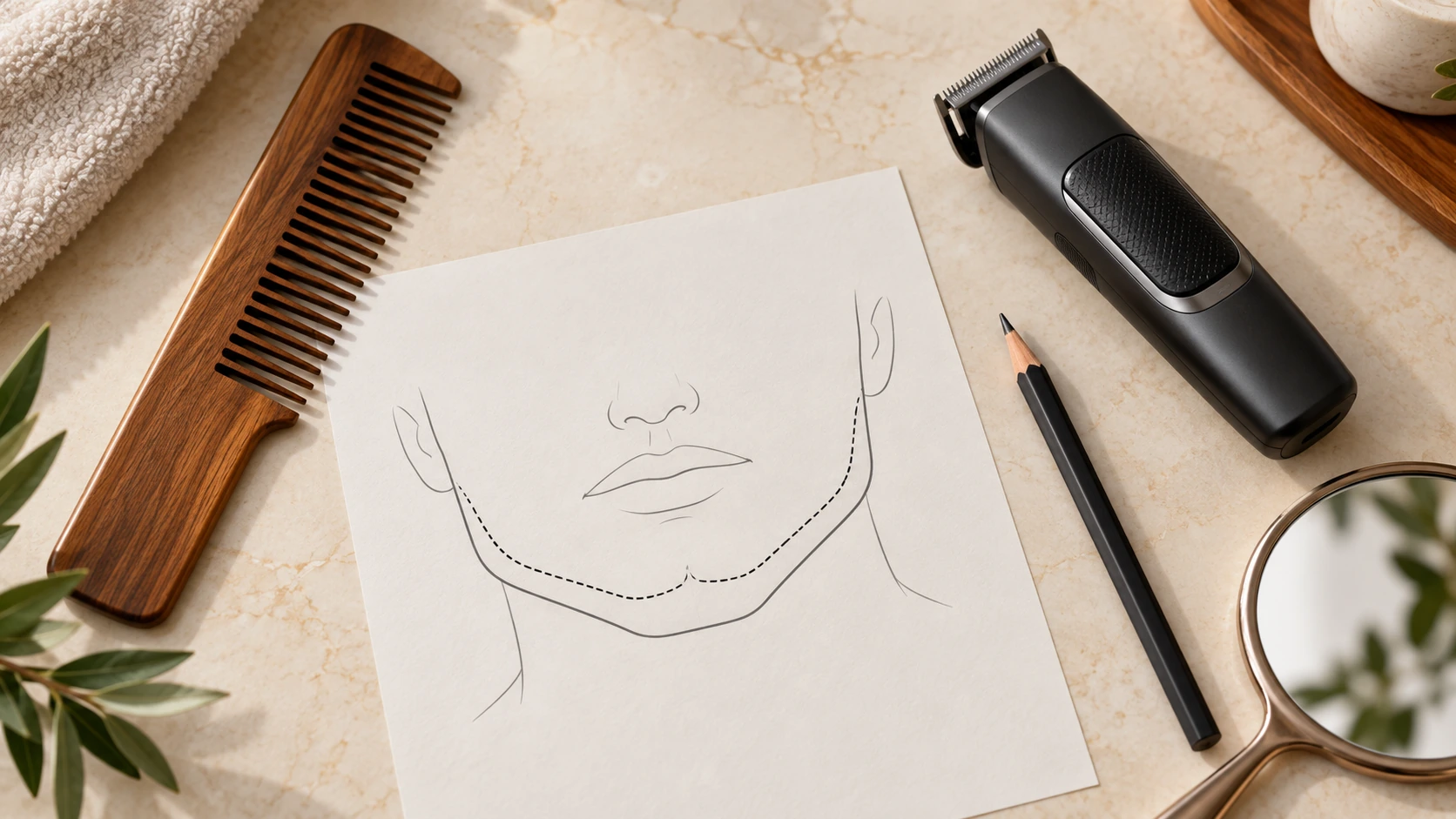
The design session happens with you sitting upright, in daylight, before any anaesthetic. The beard line along the cheek is drawn, photographed, adjusted, and drawn again. Nothing starts until you have looked at it in a mirror and agreed.
What makes beard work technically unforgiving is not density but angle. Facial hair grows almost flat against the skin, at a much sharper angle than scalp hair, and it changes direction across the face — downward on the cheeks, forward and down along the jaw, outward and slightly upward under the chin. A graft placed at scalp angle stands away from the face and is visible from across a room.
That is why the placement technique here is closely related to the DHI implanter method, which gives control over angle and depth at the moment of placement rather than requiring pre-made incisions. Grafts are almost all single hairs. A double-hair graft in the moustache reads as a tuft, and tufts are what make a beard look transplanted.
What procedure day looks like
You arrive in the morning, the design is confirmed, and the donor zone is trimmed and prepared. Extraction takes roughly two to three hours depending on graft count. There is a break, usually with lunch, and then placement runs through the afternoon.
A full beard day runs about six to eight hours; a patch case can finish in four. You are awake and under local anaesthesia throughout. Most people find the extraction phase the more tedious half and the placement phase the more uncomfortable one, though “uncomfortable” here means pressure rather than pain.
You leave the same day with a face covered in tiny red dots and a donor area that a hat covers completely. Nobody is going to mistake you for someone who has not had a procedure, which is why most patients book the trip with a few days of downtime at the other end.
Weeks one to six: crusts, shedding and the awkward stretch
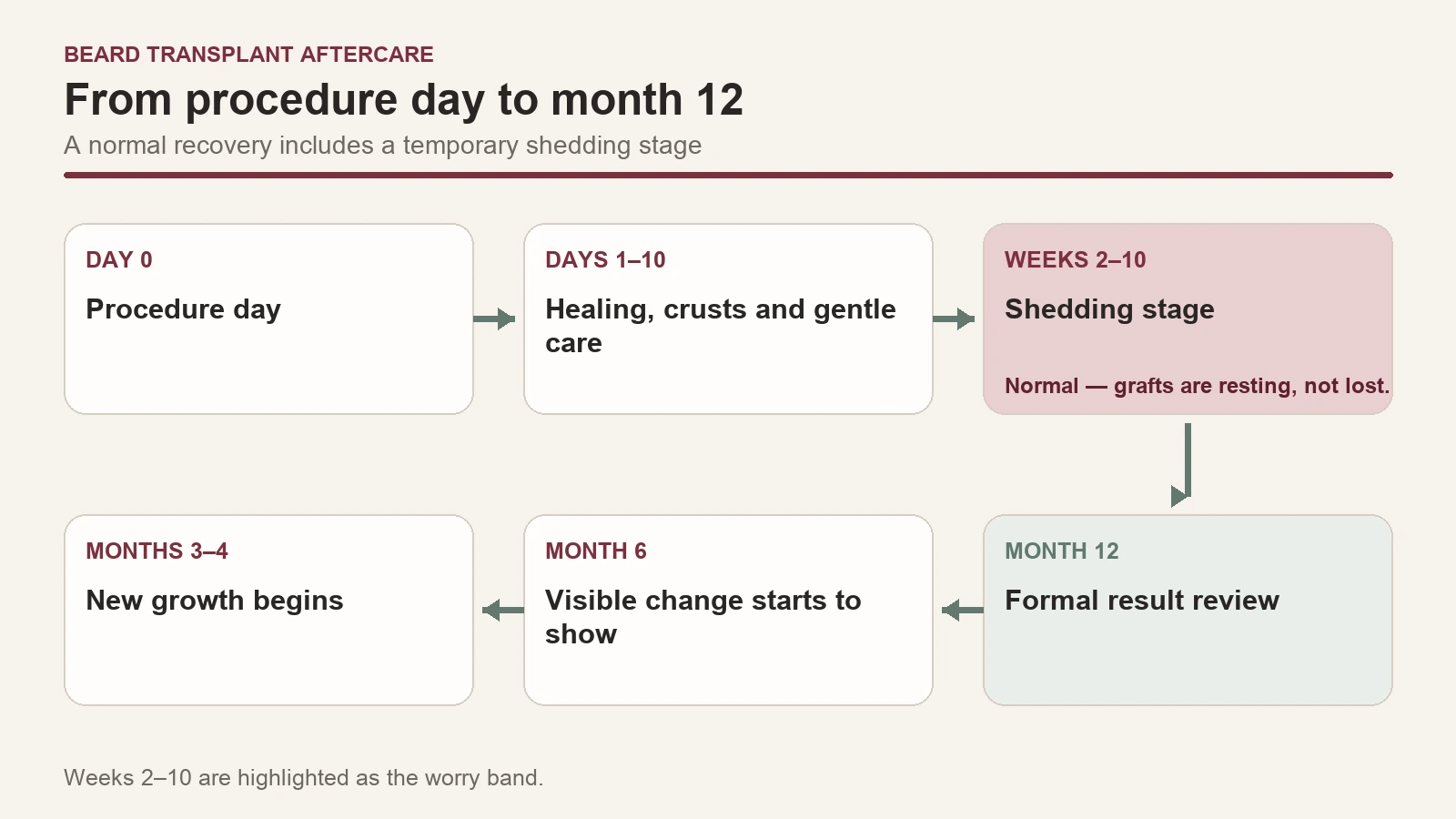
Crusting covers the transplanted area for the first week and clears between days seven and ten with the washing routine you are given. Redness fades over two to three weeks, faster in lighter skin and slower in darker.
Then the transplanted hairs fall out, typically between weeks two and six. This is the point at which patients message us convinced something has gone wrong. Nothing has. The follicle stays in place; the shaft it was carrying is shed as the follicle resets into a resting phase. Every graft-based procedure does this, on the scalp and on the face alike.
The awkward stretch is weeks four to ten, when the transplanted hairs have gone and the new ones have not arrived. Your beard during this window looks approximately like it did before surgery, which is psychologically harder than people expect. Plan the timing of your procedure with that in mind rather than three weeks before a wedding.
Months three to twelve: the real timeline
New growth starts around month three, usually unevenly, which is normal and not a sign of patchy take. By month six you have a clear indication of the shape and most of the density. Between months eight and twelve the hairs thicken, the texture settles, and the beard becomes genuinely groomable.
Final judgement belongs at month twelve, not month six. Beard hair is slower to mature than scalp hair and the calibre change in the second half of the first year is substantial. Our detailed month-by-month account is in the beard transplant recovery timeline, and the honest version of the photographs is in our before and after gallery, where the useful cases are the twelve-month ones.
Take rates in beard work are generally good but they are not one hundred per cent, and no clinic that is being straight with you will claim otherwise. A small top-up at month twelve is not a failure; in scarred or heavily patchy cases it is part of a sensible two-stage plan.
Shaving, trimming and living with it
You can trim with scissors from around month three and shave normally from around month six, once the skin has completely settled and the new hairs are established. Before that, a razor across new grafts is a genuine risk, not a caution.
Long term, transplanted beard hair behaves like scalp hair to begin with — it may grow faster and straighter than your native beard for the first year — and then adapts. It does not usually become indistinguishable, but by the second year most patients stop noticing the difference, and so does everyone else.
The one permanent change worth knowing: the transplanted hairs are yours for life, in the same way scalp grafts are. Beard fashion changes. The grafts do not go away when you decide to shave it off, and they will grow back when you stop.
Why cheap beard quotes go wrong
Beard work attracts aggressive pricing because it is perceived as a smaller procedure than scalp surgery. It is not smaller in the ways that matter — the angle control required is arguably higher — and a quote built on treating it as a quick job is a warning sign.
Four things to check in any competing quote: whether the graft range is written down, who performs the placement, whether follow-up past the first week is included, and what the policy is on a top-up at month twelve. If a clinic will not answer those four in writing, price is not your problem.
The wider logic of what a surgical price actually covers is set out in our hair transplant cost breakdown. The reasoning transfers directly: the cheap number usually represents fewer grafts, a less experienced placement team, or a package that ends when you walk out of the building.
Combining a beard case with other work
Beard and eyebrow cases are frequently booked together, and both sit at the same flat $2,500 package — so a combined facial case is quoted as two packages rather than blended into a discount. The donor zone is planned once across the visit, which is the part that genuinely benefits from combining.
If you are also considering eyebrow transplantation, that conversation belongs in the same consultation rather than six months later, because both draw on the same donor bank. Scalp work booked alongside is quoted within the $2,500 to $5,000 band, and the logistics of a multi-procedure trip are set out on our Turkey package page.
If you are unsure whether your case is a patch fill or a full build — and that distinction is what most people get wrong when estimating their own face — a photo assessment settles it in a day and costs nothing.
What to send for an accurate answer
Do not shave before photographing. Let the beard grow for at least a week, ideally two, so the actual pattern of growth is visible rather than a uniform stubble that hides the gaps.
Send five photographs in daylight: straight on, both profiles, both three-quarter angles. Add a sentence about what you want — “fill the cheeks”, “connect the moustache”, “cover an acne scar along the left jaw” — and tell us your age and whether your growth has changed in the last two years. That is the whole intake, and you can send it here to get a graft estimate and a design opinion back.
If the assessment suggests waiting, we will tell you. If it suggests your donor hair is better spent on the scalp, we will tell you that too, and the conversation continues on our hair transplantation page. The number at the top of this article is fixed. The advice is not, and it should not be.
Find this helpful? Add Hairpol as a preferred source on Google.
Graft Range Calculator
Answer three questions to see the typical graft range for your situation — based on our published clinical guides.
This is a preliminary estimate, not a medical assessment. The exact number can only be determined by a doctor after examining your donor area and hair characteristics.
Get a Free Consultation
Answer a few questions and the medical team will review your situation.
