
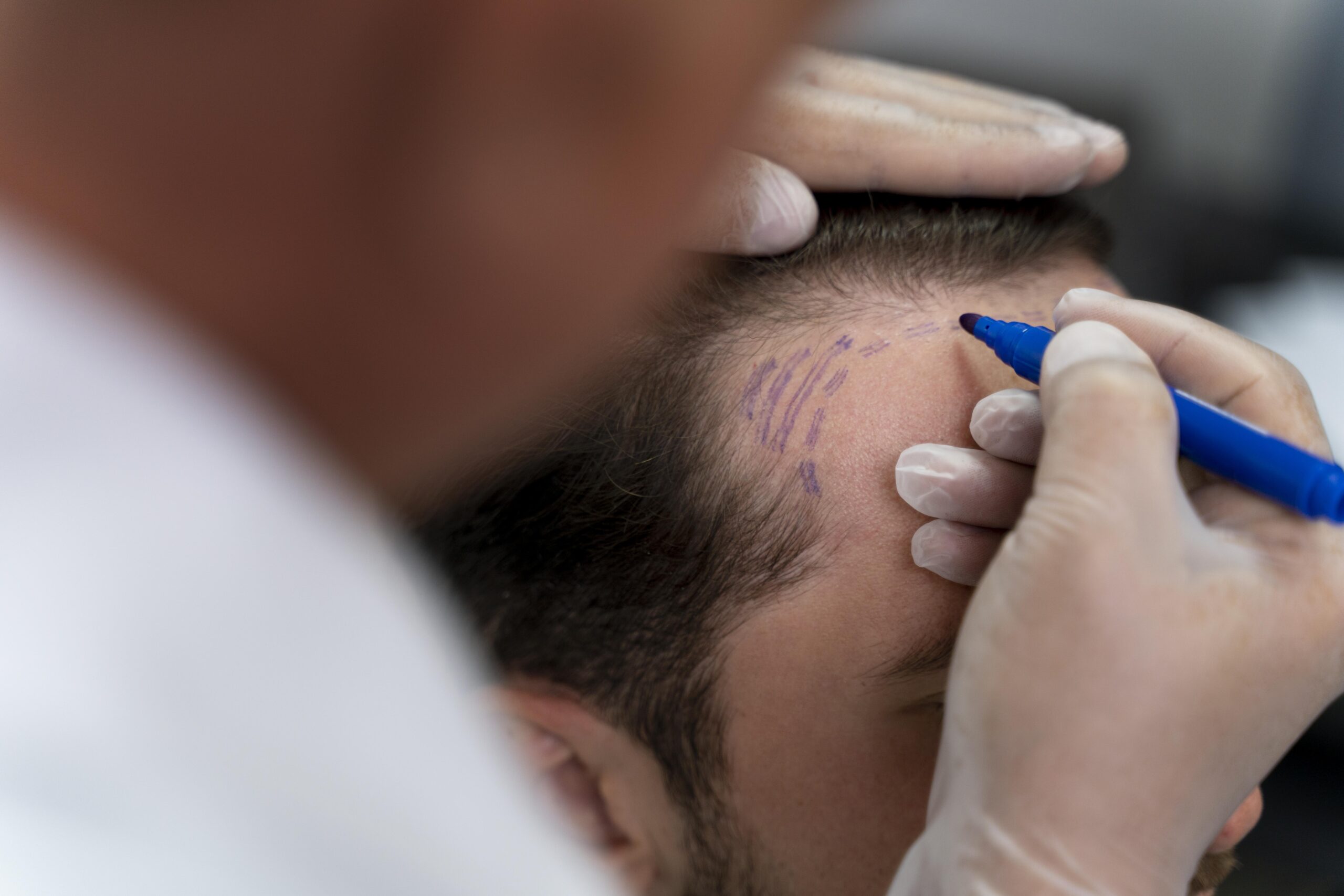
A receding hairline is one of the most common presentations that brings patients to a hair transplant consultation. It’s visible, it’s progressive, and it affects how people see themselves in mirrors, photographs, and daily interactions in ways that feel disproportionate to what anyone outside the experience fully understands. The decision to do something about it is often a long time coming — years of watching and worrying before the first consultation is scheduled.
By the time most patients sit across from a surgeon, they have a clear picture in their head of what they want the result to look like. What they often don’t have is an equally clear picture of what the procedure can and cannot realistically deliver, what the result will look like at six months versus twelve versus five years, and what factors specific to their situation will shape the outcome they actually get.
This guide addresses the realistic expectations conversation directly — not the optimistic version that clinics sometimes present to close consultations, but the honest, specific version that allows patients to make genuinely informed decisions and to evaluate their eventual results against an accurate standard rather than an inflated one.
What a Hairline Transplant Actually Restores
The first and most important clarification about hairline restoration is what it does and doesn’t fix. A hair transplant for a receding hairline moves DHT-resistant follicles from the donor area into the areas of recession, creating permanent hair growth in locations where hair has been lost. The transplanted follicles will grow in their new location for life, maintaining their genetic resistance to androgenetic loss.
What this means in practice is that the hairline that is created through transplantation is genuinely restored in the physical sense — hair grows where it previously didn’t. But there are specific and important ways in which the restored hairline is not the same as the original one, and understanding these differences is fundamental to realistic expectation-setting.
The restored hairline has lower density than a native hairline. The donor area simply doesn’t contain enough follicles to recreate the density per square centimeter that existed in the original hairline. The transplanted hairline achieves visual coverage rather than native density — typically in the range of 40 to 60 follicular units per square centimeter rather than the 80 to 100 that characterizes non-balding scalp. This is sufficient to look natural under normal viewing conditions, but it is not the same as the original.
The restored hairline is also static in a way that natural hairlines aren’t. A natural hairline matures over decades — it recedes slightly at the temples as men age, the overall line softens, the density changes gradually. A transplanted hairline, once established, doesn’t continue to mature. The surrounding native hair does continue to change — which is why hairline design for transplant patients must account for how the transplanted zone will look in relation to natural aging and ongoing hair loss, not just how it looks in the immediate result.
The Norwood Scale and What It Tells You About Realistic Results
The Norwood scale — the classification system used to describe the progression of male pattern hair loss from Type 1 (no significant loss) through Type 7 (extensive loss with only a horseshoe of hair remaining) — provides useful context for understanding what hairline restoration can realistically achieve at different stages of loss.
At Norwood Type 2, the hairline has receded slightly at the temples. This represents early loss and typically the most favorable scenario for hairline restoration. The recipient area is relatively small, the surrounding native hair provides good coverage context, and a modest graft count can produce a result that looks comprehensive. Patients at this stage who have stable loss and have been on medical management are often excellent candidates for highly natural-looking results.
At Norwood Type 3, recession has deepened at the temples and the hairline has moved back more significantly. This remains a highly treatable stage, though the recipient area is larger and requires more grafts to achieve comparable coverage. Results at this stage can be excellent, though the design conversation about how low the hairline should be placed and how the temples should be addressed becomes more significant.
At Norwood Types 4 and 5, hairline recession has advanced to the point where the frontal zone and mid-scalp are both affected. Hairline restoration at this stage involves addressing not just the leading edge but the entire frontal zone and potentially the mid-scalp, which requires substantially more grafts and more complex planning around donor supply management. Results can still be excellent, but the expectations conversation must include realistic discussion of what comprehensive coverage means for a larger area and how donor supply will be managed across likely future sessions.
At Norwood Types 6 and 7, the loss is extensive and the recipient area may be larger than what a single donor harvest can adequately address. Hairline restoration at this stage typically involves prioritizing the frontal zone for maximum visual impact per graft while accepting more conservative coverage elsewhere — a genuine trade-off that needs honest discussion rather than optimistic minimization.
The Hairline Position Conversation: Where Realistic Begins
One of the most consequential decisions in hairline restoration — and one of the most frequent sources of post-procedure dissatisfaction when it goes wrong — is hairline position. Where the restored hairline is placed on the forehead determines how natural the result looks not just immediately after the procedure, but in five, ten, and twenty years.
Most patients want their hairline as low as possible. The psychological logic is understandable — a lower hairline feels like more restoration, more youth, more recovery of what was lost. But a hairline placed too low creates problems that accumulate over time and are difficult to correct.
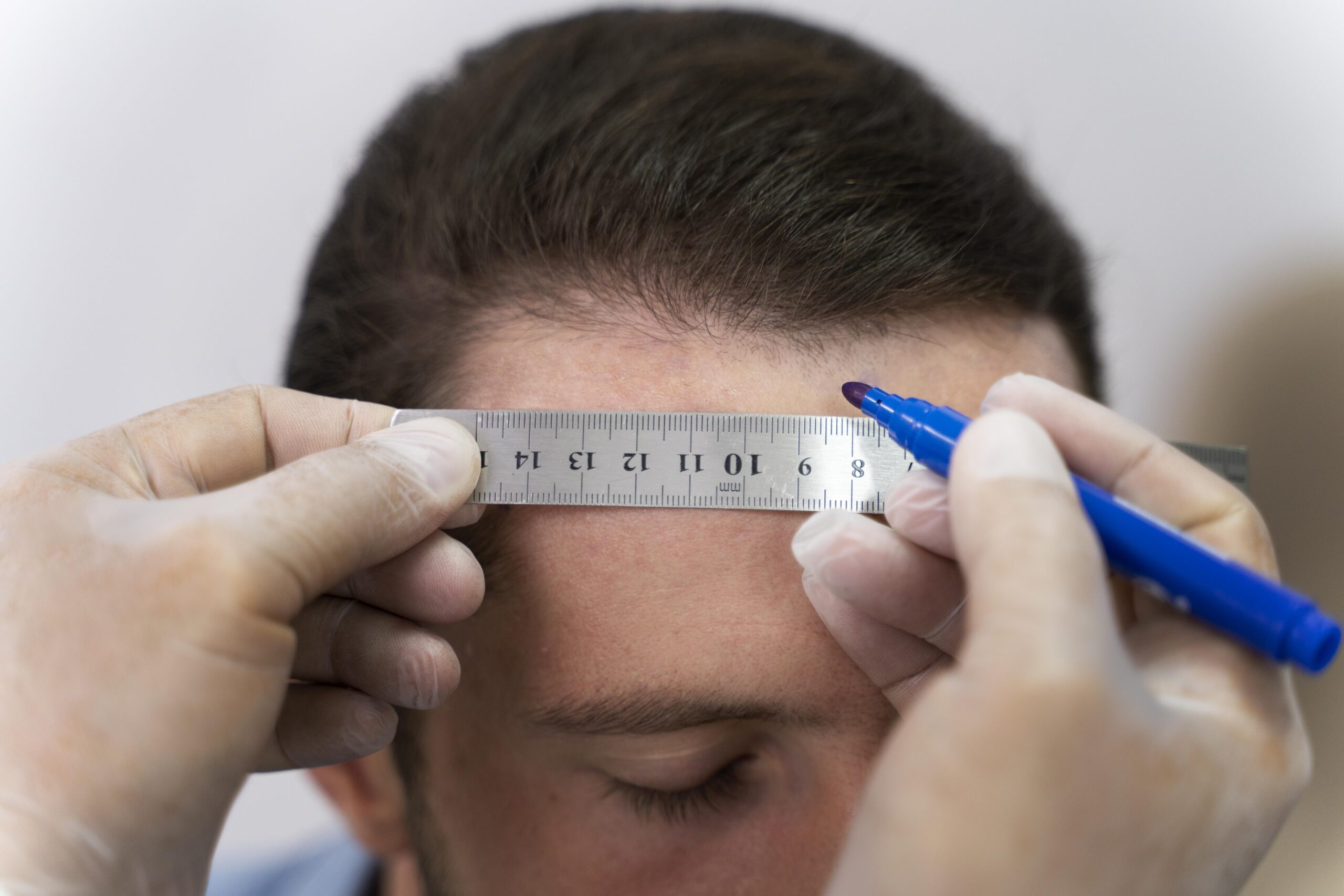
The appropriate position depends on several factors that must be assessed individually. The classic reference places the male hairline approximately 7 to 8 centimeters above the glabella — the midpoint between the eyebrows — but this is a starting framework, not a fixed rule. Facial proportions vary significantly, and a hairline that looks appropriate on one face can look too low or too high on another with different forehead dimensions.
Age is perhaps the most important consideration. A 26-year-old who receives a very low hairline looks natural at 26. At 46, with surrounding native hair that has thinned and a face that has matured, that same hairline position can look incongruous — too youthful for the face beneath it, too static in a world that has continued to change around it. Natural male hairlines mature over time. A transplanted hairline that was designed without accounting for this maturation will look increasingly designed rather than grown as the patient ages.
This is why experienced surgeons often propose a slightly more conservative hairline position than patients initially request — not because they can’t technically deliver a lower hairline, but because delivering a lower hairline without regard for how it will age is not genuinely serving the patient’s long-term interests. The realistic result is not the lowest hairline achievable; it’s the hairline that looks excellent now and continues to look natural in fifteen years.
Temple Restoration: The Detail That Makes or Breaks Naturalness
The temples are where hairline restoration most visibly succeeds or fails, and they deserve specific discussion because they are the area where design errors are both most apparent and hardest to correct.
Natural male temples don’t simply extend the frontal hairline at a fixed angle. They have their own characteristic shape — a gradual recession that frames the face in a way specific to gender, age, and individual facial structure. The angle at which the temple hairline descends, how far it extends toward the ear, and how it connects with the sideburn all contribute to whether the overall hairline looks appropriate for the person wearing it.
Temple design errors are among the most common causes of a hairline transplant result looking obviously surgical. A hairline that extends too far laterally into the temple area creates an unnaturally full, rounded appearance at the sides of the face that doesn’t match how adult male hairlines actually look. The rounded, symmetrical temples that characterize some transplant results are an immediate visual signal that the hair was placed rather than grown.
The implantation angle within the temple zone is equally critical. Temple hairs grow at extremely acute angles — almost parallel to the scalp — and in specific directions that vary across the temple area. Grafts placed in the temple zone at angles that don’t match native temple hair growth produce a result that grows visibly wrong, with hair pointing in directions that can’t be corrected through styling.
Realistic temple restoration replicates these natural characteristics: the right recession angle for the patient’s age and facial structure, the correct lateral extent without over-filling, and the precise acute implantation angles that allow temple hair to lie flat and flow naturally. When this is done well, it is the element of hairline restoration most likely to make the result look genuinely undetectable. When it’s done poorly, it is the element most likely to make the result look obviously transplanted.
The Transition Zone: What Separates Natural From Obvious
The leading edge of the hairline — the transition zone where scalp becomes hair — is where the artistry of hairline restoration is most directly expressed and where technical execution most directly determines whether the result looks natural at close range.
Natural hairlines are not solid walls of hair. They have a gradual transition zone where single-hair follicular units create a soft, slightly diffuse leading edge before density increases progressively behind it. This transition zone covers roughly half a centimeter to a full centimeter of depth, and it is what makes natural hairlines look grown rather than drawn.
In a hair transplant, recreating this transition requires specific decisions about graft allocation. Single-hair grafts must be used at the very leading edge — placing two or three-hair grafts here creates the dense, abrupt edge that looks pluggy and artificial. The progression from single-hair to multi-hair grafts must be gradual enough that no step change in density is visible, and the leading edge itself must have the slight micro-irregularity of natural hair rather than the perfectly straight or geometrically regular line that results from insufficiently artful design.
A hairline that is well-positioned, appropriately designed in terms of temple angles and lateral extent, but poorly executed in its transition zone will look transplanted at close range even when it looks acceptable from a distance. The transition zone is what allows a result to look natural in conversation, in close photographs, and in varied lighting — not just in the controlled conditions of a carefully framed before-and-after photograph.
How Many Grafts Are Realistic for Hairline Restoration
The graft count required for hairline restoration varies significantly depending on the extent of recession, the size of the frontal zone being addressed, the target density, and the individual hair characteristics of the patient. General ranges are useful as context but should not be treated as precise predictions for any individual case.
For patients addressing Norwood Type 2 to 3 recession — the most common presentation at first consultation — a procedure addressing the hairline and temple areas typically requires between 1,500 and 2,500 grafts. This range reflects the variability in how far recession has advanced and how large the temples are being addressed.
For patients at Norwood Type 3 to 4, addressing the full frontal zone including mid-scalp is often necessary to avoid a result that looks full at the hairline but sparse immediately behind it. This typically requires 2,500 to 3,500 grafts, with the higher end of this range required for patients with larger forehead dimensions or denser target density.
For more advanced loss at Norwood Type 5 or beyond, comprehensive frontal zone coverage can require 3,500 to 4,500 grafts or more, and the planning conversation must explicitly address how this allocation affects the lifetime donor supply available for future sessions. Using a large proportion of donor supply in a single comprehensive session is not inherently wrong, but it requires honest discussion of what it means for the patient’s long-term options as hair loss continues.
The relationship between graft count and result is not linear — 3,000 grafts doesn’t produce twice the coverage of 1,500 grafts, because the relationship between follicle count and visual density involves hair characteristics, area size, target density, and design quality. A patient with coarse, dark hair who receives 1,800 carefully placed grafts in a well-designed hairline may achieve better-looking coverage than a patient with fine, light hair who receives 2,500 grafts in a less thoughtfully designed procedure.
Receding Hairline Grafts by Norwood Stage
Most receding hairlines need 1,500 to 2,500 grafts for the hairline and temples. A mild Norwood 2 refinement can need 800 to 1,500, and once the zone behind the line is thinning too, the plan moves to 2,500 to 3,500. The table puts the ranges from the section above side by side, so you can find your own stage before you read anyone’s quote.
| Norwood stage | Typical graft range | Note |
|---|---|---|
| Norwood 2: mild, symmetrical temple recession | 800–1,500 | A refinement of the temples rather than a new line; if the line is still moving, waiting is often the better call |
| Norwood 2 to 3: hairline and temples | 1,500–2,500 | The most common picture at a first consultation |
| Norwood 3 to 4: the full frontal zone, including the area behind the line | 2,500–3,500 | Avoids a full edge with a sparse band right behind it |
| Norwood 5 and beyond | 3,500–4,500 or more | The front comes first; the plan has to leave donor hair for later sessions |
| Norwood 6 and 7 | Set by donor capacity, not by the size of the bald area | Frontal coverage first, more conservative coverage elsewhere |
Read each row as a starting band, not a promise. Hair calibre, curl and the contrast between your hair and skin move a case up or down within its row, and the temporal points, the small triangles in front of the ears, add a few hundred grafts whenever they are included. If you are at stage 2 and unsure whether the line is still moving, our guide to the Norwood 2 hairline covers when waiting is the better plan.
Prices are left out on purpose. A quote is built on the graft count, and our breakdown of hairline transplant cost in Turkey shows how each band turns into a package. At Hairpol, the band for your own forehead comes from your photos, in a free hair analysis.
The Density Reality: What 40 to 60 Grafts Per Square Centimeter Looks Like
Understanding what the achievable transplanted density actually looks like helps calibrate expectations accurately. Native scalp density in a person without hair loss is typically 80 to 100 follicular units per square centimeter. The density achievable through transplantation in a hairline restoration — typically 40 to 60 follicular units per square centimeter — is meaningfully lower than this.
The reason this doesn’t produce a result that looks obviously sparse is the combination of several factors. Transplanted follicles in the hairline are placed among remaining native hair, and the combination of transplanted and native hair creates more coverage than transplanted hair alone. Hair characteristics — particularly caliber and wave — significantly affect visual coverage per follicle, with coarser and wavier hair providing substantially more visual density per follicle than fine straight hair. And the transition zone design, which concentrates lower-density single-hair grafts at the leading edge and builds progressively to higher-density multi-hair placements behind it, creates the impression of gradual, natural density that doesn’t read as sparse.
What transplanted density looks like under specific conditions is also important to understand. Under overhead lighting — the most common indoor lighting in bathrooms and offices — transplanted density looks thinner than it does under side or natural lighting. This is true for everyone: people with naturally dense hair look thinner under overhead bathroom lighting than outdoors. But for transplant patients evaluating their result, this lighting sensitivity means that assessing the result primarily in bathroom mirror conditions consistently underestimates actual density.
Hair length also affects how transplanted density appears. Short hair provides less coverage per follicle than longer hair that overlaps and creates layered coverage. The same transplanted hairline looks meaningfully thinner at a buzz cut length than at three or four centimeters — which means evaluating results at very short lengths systematically underrepresents how the hairline will look when worn at any practical styling length.
The Ongoing Loss Problem: Why Hairline Results Change Over Time
This is the element of realistic expectations that most directly affects long-term satisfaction and that is most frequently underemphasized in consultations oriented toward closing a procedure booking.
A hair transplant for a receding hairline creates permanent transplanted hair in the treated zone. But it does not create permanent hair in the surrounding native zones — the mid-scalp, the crown, the areas behind and beside the hairline. These areas continue to follow their genetic pattern of loss, regardless of what was done to the hairline.
At year one, a restored hairline typically looks excellent because the transplanted hair combines with remaining native hair in the surrounding areas to create good overall density. At year five, the picture may look different as native hair behind the hairline has continued to thin. At year ten, a patient whose native mid-scalp and crown have continued progressing may have a restored hairline that looks increasingly disconnected from the thinning areas behind it — not because the hairline failed, but because the loss process that was going on before the hairline was addressed has continued after it.
This is the most important reason why medical management of ongoing hair loss is not optional for patients who have hairline restoration. Finasteride and minoxidil, started around the time of the procedure and maintained consistently, slow the progression of native hair loss in the years after the procedure. The contrast between a patient who manages their ongoing loss medically and one who doesn’t can be dramatic by the five to ten year mark — not in the transplanted hair, which is equally permanent in both cases, but in the native hair behind it that either maintained or continued to thin.
The realistic result of a hairline transplant, honestly presented, is not a static photograph at twelve months. It is a dynamic picture that evolves with ongoing native hair loss, with how well that ongoing loss is managed, and with whether the surgical planning accounted for the patient’s likely lifetime hair loss trajectory rather than only their current presentation.
When to Expect to See the Result
The hair transplant timeline for hairline restoration follows the same biological sequence as any procedure, but understanding it specifically in the hairline context matters because the hairline is the most visible and most evaluated part of the result.
In the first two weeks, the transplanted area will have scabs around each graft site and will be visibly post-procedural. Between weeks two and eight, shock loss occurs — the transplanted hairs shed their initial shafts as the follicles enter telogen. The hairline may look sparse or even worse than before the procedure during this phase, which is distressing if unexpected but entirely normal.
Between months two and four, the follicles are in telogen and producing no visible hair. This is typically the most psychologically difficult phase, when there is no visible progress and the hairline can look surprisingly bare. By months three to five, new growth begins emerging — initially fine, sparse, and light in color, but genuinely the beginning of the permanent result.
By months six to nine, the hairline is substantially visible as a hairline. The shape, the temple treatment, the density distribution — these are all becoming apparent. By months nine to twelve, most patients have a substantially complete picture of their result, though some continue to see improvement through month eighteen.
The hairline result, because it is so closely watched, requires patience in a way that feels harder than it is for other zones. Patients who understand the timeline specifically navigate the early months significantly better than those who entered the process expecting visible results within weeks.
What a Realistic Hairline Result Actually Looks Like
At its best — well-designed, well-executed, given time to mature, managed medically for ongoing loss — a hairline transplant result looks like a natural hairline. Not the hairline of a twenty-two year old with no hair loss. A natural hairline for the patient’s age and face — with appropriate recession at the temples, a soft leading edge that reads as grown rather than drawn, density that provides genuine coverage under normal viewing conditions, and a position that looks congruent with the face beneath it.
It holds up at close range, in photographs taken from the front and the side, in varied lighting conditions, and when the hair is wet or styled differently from the controlled conditions of a post-procedure photograph. It doesn’t require specific styling to conceal the procedure — the transplanted hair grows normally and behaves like any other hair.
What it is not is invisible to a trained eye under all conditions. Very close inspection under harsh lighting, or deliberate examination of the scalp between hairs, can reveal the transplanted nature of the hairline in ways that aren’t apparent under normal viewing conditions. The standard a realistic result achieves is not “undetectable under a magnifying glass in a clinical setting” — it is “undetectable to someone who doesn’t know the patient has had a procedure in normal social interaction.”
This standard is genuinely achievable with good surgical planning and execution. It is achieved regularly by patients who went into the process with accurate expectations, chose their clinic on clinical merit rather than price or marketing quality, managed their ongoing hair loss medically, and gave the result the time it needs to mature fully.
At Hairpol, the hairline design and expectation conversation happens at every consultation because the realistic result for each patient depends on their specific hair characteristics, loss pattern, donor supply, and long-term trajectory — not on a generic template. Getting those specifics right is what produces results that patients are satisfied with not just at twelve months, but at five and ten years after the procedure.
Find this helpful? Add Hairpol as a preferred source on Google.
Get a Free Consultation
Answer a few questions and the medical team will review your situation.
