

 Türkçe
 Deutsch
 Français
Stembio Exosome:
Cellular-Level Support for Your Hair Follicles
The language cells use to communicate with each other, now working for your hair.
Derived from Wharton’s jelly in the umbilical cord · 5 billion exosomes per vial · Produced under cGMP conditions
Exosome technology is one of the most talked-about areas of regenerative medicine, and at HAIRPOL we offer it as Stembio Exosome. It is a new-generation, single-session option to support your hair transplant or to strengthen weak hair that does not need a transplant.
The Messenger Molecules of Cells
Exosomes are important structures that play a role in communication between cells and support the body’s healing process. These tiny sacs (vesicles), 30–150 nanometres in diameter, form inside the cell, are released outside it and carry information to other cells. They are roughly one thousandth the size of a cell.
Exosomes contain proteins, fats (lipids), DNA and RNA as well as growth factors. Through the messages they carry, they support cellular repair and renewal and contribute to the healing of damaged tissue.
An important note: exosomes are not cells. They are cell-free structures secreted by cells.

What Does One Vial Contain?
The ExoStem we use at HAIRPOL is an exosome product made in Turkey by Stembio under an operating licence from the Turkish Medicines and Medical Devices Agency (TİTCK) of the Ministry of Health, under cGMP (current Good Manufacturing Practice) conditions.
Its Source: Wharton’s Jelly
The source of ExoStem is Wharton’s jelly, found inside the umbilical cord. Wharton’s jelly is a special, gel-like tissue from the newborn: it has not aged, has not been exposed to external factors and is very rich in mesenchymal cells.
This tissue is obtained from the umbilical cord, which is normally discarded after birth; no intervention on the mother or the baby is needed. The umbilical cord is accepted by the laboratory only after donor serology tests. The exosomes that mesenchymal cells from Wharton’s jelly secrete in culture are isolated and purified by ultracentrifugation. The result is a pure, cell-free exosome product rich in growth factors.
- Product: 5 billion exosome particles in 0.9% isotonic sodium chloride, in a 5 ml sterile vial.
- Purity: the exosome-specific markers CD63 and CD9 are tested by flow cytometry. The proportion of exosome markers in the product is above 90%.
- Particle analysis: particle size and count are measured with a NanoSight NS300 device, confirming particles in the 30–150 nm range.
- Safety tests: every batch is tested for sterility, endotoxins and mycoplasma. The product is delivered with a final product certificate that includes the test results.
- Tissue compatibility: exosomes derived from mesenchymal cells do not carry HLA antigens, so tissue rejection is not expected.
- Single-patient use: each vial is used for one patient and one treatment area only.
How Does ExoStem Work in the Hair Follicles?
The aim: to wake up resting follicles and support growing ones.
Hair follicles work in a cycle made up of a growth phase (anagen), a transition phase and a resting phase (telogen). With hair loss, this cycle becomes shorter and more follicles stay in the resting phase. ExoStem aims to support this cycle through the signals it carries.
Effect on the Hair Follicle
- Support for the growth phase: it is intended to help increase the number of follicles in the growth phase (anagen).
- Activating resting follicles: by supporting the move of resting (telogen) follicles into the growth phase, it may help lengthen the hair cycle.
- Dermal papilla support: it aims to contribute to the renewal of dermal papilla cells, the “engine” of the hair follicle.
Effect on the Scalp
- Tissue renewal: it supports the activity of cells involved in tissue repair, such as fibroblasts and keratinocytes.
- Nourishment and circulation: by contributing to the formation of new capillaries (angiogenesis), it aims to support the nourishment of the follicles.
- A calmer scalp: through its anti-inflammatory effect, it may help create a more favourable environment for follicle development.
Treatment
A single injection session
First Changes
The first changes may start to become noticeable
Visible Progress
The period when the most visible changes are expected
Results may vary from person to person. If your doctor considers it necessary, a second session can be planned at month 12.
Prepare for Your Transplant, Then Support It Afterwards
At HAIRPOL, Stembio Exosome can be applied 1 month before or 1 month after your hair transplant. Your doctor decides the timing based on your hair structure and your healing process.
Before the Transplant
The scalp and existing hair follicles are prepared for the procedure.
Hair Transplant
On the day of the procedure, the transplant is carried out following the HAIRPOL protocol.
After the Transplant
The development of the newly transplanted and existing follicles is supported.
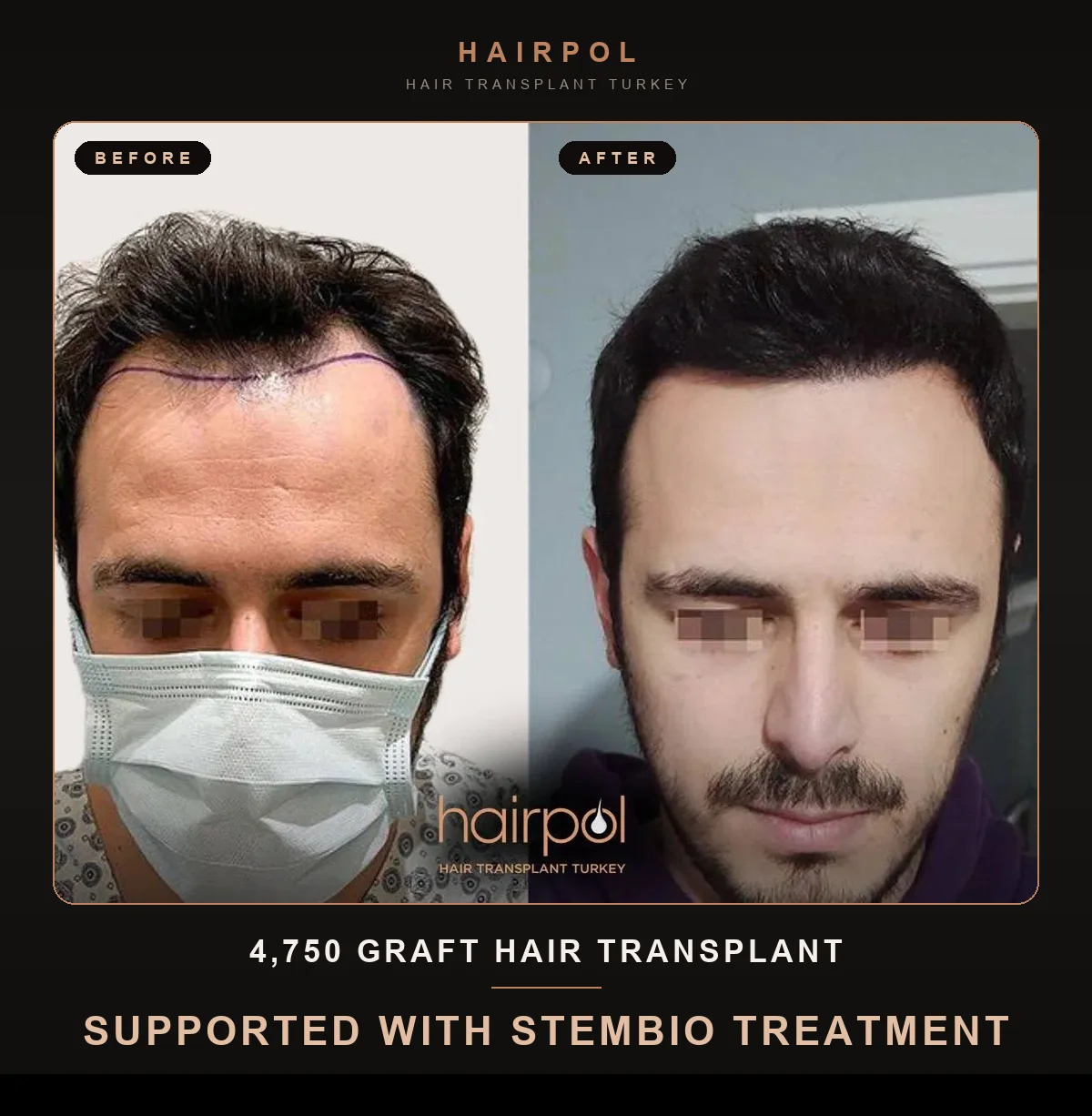
Individual results may vary. Published with the patient's written consent.
New Support for Weak, Thinning and Damaged Hair
Not every hair problem needs a transplant. Sometimes what your follicles need is the right signal.
Stembio Exosome is not only for patients having a hair transplant. It is also used to strengthen the hair of women and men whose hair is thinning, becoming sparse, falling out, or has been damaged over time by chemical treatments and stress.
- Women and men whose hair is starting to thin and become sparse
- Hair damaged by colouring, keratin treatments or frequent blow-drying
- People experiencing postpartum, stress-related or seasonal hair loss
- People who do not need a hair transplant but want to strengthen their hair
How Is Stembio Exosome Applied?
A single session, by injection.
Examination
Your doctor assesses your hair and scalp and looks into the cause of your hair loss.
Planning
If it is planned alongside a hair transplant, the timing (1 month before or after the transplant) is set.
Treatment
Stembio Exosome is injected into the scalp with very fine needles in a single session.
Daily Life
You can return to your daily routine shortly after the treatment.
Let’s Choose the Right Method for You Together
At HAIRPOL, we offer three different, complementary methods of hair treatment.
| Feature | PRP | GCell | Stembio Exosome |
|---|---|---|---|
| Source | Your own blood | Your own scalp tissue | Exosomes produced under cGMP conditions |
| How it works | Growth factors in platelets | Cell suspension prepared from tissue | Cell-to-cell signalling molecules |
| With a hair transplant | Sessions on the day of the transplant and afterwards | Supporting treatment | 1 month before or 1 month after the transplant |
| Without a transplant | Yes | Yes | Yes |
| Session plan | 4 sessions, 15 days apart | Single session, every 6–12 months | Single injection session, a 2nd session at month 12 if needed |
These methods are not alternatives to one another but complementary treatments that work in different ways. Your doctor decides which one, or which combination, suits you after your examination.
Frequently Asked Questions
Is exosome treatment a stem cell treatment?
No. Exosomes are not cells. ExoStem consists of cell-free exosomes secreted by mesenchymal cells. No cells are introduced into your body during the treatment.
Is Stembio Exosome safe?
ExoStem is produced under cGMP conditions with an operating licence from TİTCK, part of the Turkish Ministry of Health. Every batch is tested for sterility, endotoxins and mycoplasma, and the product is delivered with a final product certificate. The treatment is carried out under medical supervision in sterile conditions.
How long before or after a hair transplant is it applied?
At HAIRPOL, Stembio Exosome can be applied 1 month before or 1 month after a hair transplant. Your doctor decides the timing that suits you.
Can it be applied without a hair transplant?
Yes. It can also be applied independently of a transplant, to strengthen weak, thinning, sparse or damaged hair.
How many sessions are needed?
Stembio Exosome is applied in a single session. Depending on your doctor’s assessment, a second session may be carried out at month 12.
When will I start to see results?
The first changes may start to become noticeable 1–2 months after the treatment. The most visible changes are usually expected between months 6 and 12. This varies from person to person.
Is the treatment painful? Are there any side effects?
Because the treatment is done with very fine needles, there is usually no noticeable discomfort apart from a slight stinging sensation. A local anaesthetic cream can be used beforehand if you wish. Temporary redness, mild swelling or tenderness may occur in the treated area. These effects usually settle on their own within a short time.
Can it be combined with PRP or GCell?
Yes, if your doctor considers it appropriate, different methods can be planned together. The combination and timing are decided after your examination.
Where do the exosomes come from?
The exosomes in ExoStem are isolated by ultracentrifugation from the culture medium of mesenchymal cells obtained from Wharton’s jelly inside the umbilical cord. The umbilical cord is tissue that is normally discarded after birth, and it is used only after the required serology tests. No intervention is made on the mother or the baby.
Who is it not suitable for?
The treatment may not be recommended during pregnancy and breastfeeding, with active scalp infections, during active cancer treatment or with certain immune system disorders. Your doctor assesses whether it is suitable for you during your examination.
New-Generation Support for Your Hair
Arrange a consultation with our specialist team to find out whether Stembio Exosome is suitable for you.
Contact Us Now for a Free Initial ConsultationEvery patient’s hair structure and treatment process is different. The most suitable treatment for you is determined after a medical examination.
