
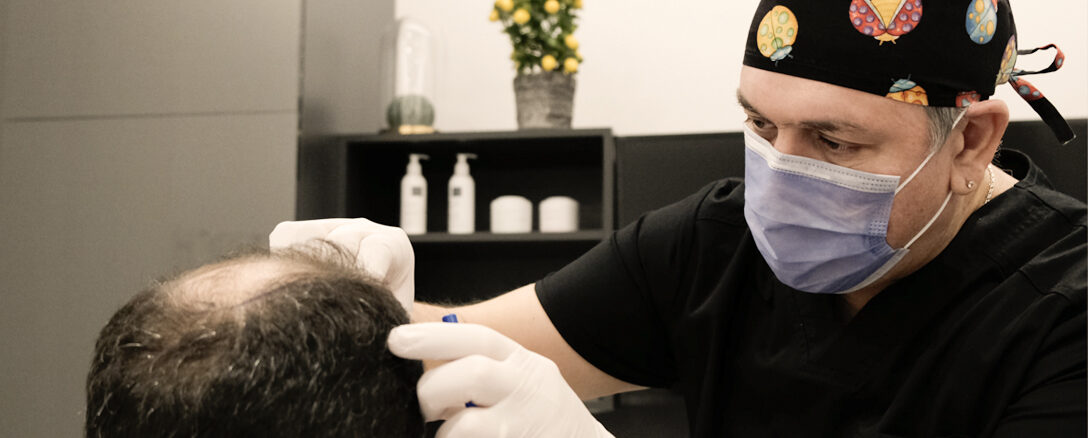
Walk into almost any hair transplant consultation and the conversation will eventually center on numbers. How many grafts. What the density will be. What the coverage will look like across different zones. These are quantifiable things, and quantifiable things feel safe — they can be compared, negotiated, and written into a treatment plan.
The hairline design conversation is different. It’s harder to quantify, harder to compare across clinics, and easier to gloss over in a consultation that’s moving toward a procedure date. Most patients don’t push on it because they don’t know what questions to ask. Most clinics don’t dwell on it because it requires a more nuanced conversation than a graft count does.
This is a significant problem. Because if you ask any experienced hair transplant surgeon which single factor most determines whether a result looks natural or obviously surgical, the answer is almost never graft count. It’s almost always the hairline.
A poorly designed hairline with 3,500 grafts looks worse than a well-designed hairline with 2,000. A hairline placed at the wrong position ages badly regardless of how many follicles were used to create it. A hairline with the wrong angle, the wrong transition, or the wrong relationship to the face beneath it announces itself as transplanted to anyone who looks closely — not because the surgery failed technically, but because the design was wrong before a single graft was placed.
This is what needs to be understood before any hair transplant consultation moves toward a treatment plan.
What a Hairline Actually Is
The hairline is not a line. This is the first and most important thing to understand, and it’s where a lot of transplant designs go wrong from the beginning.
A natural hairline is a zone — a gradual transition from scalp to hair that has depth, irregularity, and variation in density. At the very leading edge, individual single-hair follicles create a soft, slightly diffuse boundary. Behind that boundary, density increases progressively as two-hair and three-hair follicular units take over. The overall effect is a transition that reads as natural because it replicates how hair actually grows from skin.
When people describe a transplant as looking “pluggy” or obviously surgical, what they’re almost always responding to is a hairline that was designed as an actual line — a dense, uniform edge that begins abruptly and lacks the gradual transition of natural hair growth. This can happen even with excellent graft survival and technically competent surgery. The grafts took. The hair grew. But the design was wrong, and no amount of growth corrects a design error.
The zone of transition at a natural hairline includes what surgeons call the micro-irregular zone — a slightly uneven, asymmetric leading edge that mimics the natural randomness of hair growth. No natural hairline is perfectly symmetrical or precisely defined. Transplanted hairlines that are too symmetrical, too defined, or too uniform in density immediately read as designed rather than grown.
Position: Where the Hairline Sits on the Face
Hairline position is one of the most consequential decisions in hair transplant planning, and it’s one of the decisions most susceptible to being driven by patient emotion rather than clinical judgment.
Most patients want their hairline as low as possible. The psychological logic is understandable — a lower hairline feels like more restoration, more youth, more of what was lost. But a hairline placed too low creates problems that compound over time and are difficult to correct.
The appropriate hairline position for any individual is determined by several measurements and proportions that relate the hairline to the specific features of the face beneath it. The classic guideline places the hairline approximately 7 to 8 centimeters above the glabella — the point between the eyebrows — but this is a starting reference, not a fixed rule. Facial proportions vary significantly, and a hairline that looks appropriate on one face can look too low or too high on another with different forehead dimensions.
The position also needs to account for aging. A 26-year-old who receives a very low hairline looks natural at 26. At 46, with a face that has matured and potentially with surrounding hair that has thinned further, that same hairline position can look incongruous — too youthful for the face beneath it, too static in a face that has changed. Natural hairlines mature with age. They don’t remain frozen at the position they occupied when someone was in their twenties.
This is why experienced surgeons often propose a slightly more conservative hairline position than the patient initially requests, particularly for younger patients. The proposal isn’t a failure to deliver what the patient wants — it’s a recognition that the hairline being designed today needs to look natural in twenty years, not just in the first set of post-procedure photographs.
The hairline position conversation should include an explicit discussion of aging. If it doesn’t, ask for it.
Symmetry and the Illusion of Naturalness
Natural hairlines are not symmetrical. This surprises many patients who assume that symmetry equals naturalness — but human faces are not symmetrical, hair growth is not symmetrical, and a perfectly mirrored hairline looks as artificial as a wig edge precisely because it lacks the minor variations that characterize real hair.
In practice, this means that a well-designed hair transplant hairline will have subtle differences between the left and right sides. The temples may sit at slightly different heights. The micro-irregular leading edge will not be a perfect reflection of itself. Individual hair directions will vary. These apparent imperfections are deliberate — they are what makes the result read as grown rather than placed.
The paradox is that patients sometimes look at a well-designed hairline with appropriate asymmetry and feel uncertain, while looking at an overly symmetrical design and feeling more confident. The symmetrical design looks cleaner, more controlled, more obviously crafted — which is exactly the problem. Clean and controlled is not what a natural hairline looks like.
A surgeon who explains this asymmetry principle and designs it deliberately into the hairline is demonstrating more sophisticated aesthetic judgment than one who produces a mirror-image design because it photographs well in the immediate post-procedure period.
Temple Angles: The Detail That Changes Everything
The temples are where hairline design most visibly determines whether a result looks natural or surgical, and they’re also where design errors are hardest to correct.
Natural temples don’t simply extend the frontal hairline at a fixed angle. They have their own characteristic shape — a gradual recession that frames the face in a way that’s specific to gender, age, and individual facial structure. The angle at which the temple hairline descends, how far it extends toward the ear, and how it connects with the sideburn all contribute to whether the overall hairline looks appropriate for the person wearing it.
Temple design errors are among the most common causes of a hair transplant looking obviously surgical. A hairline that extends too far laterally into the temple area creates an unnaturally full, rounded appearance at the sides of the face that doesn’t match how adult men’s hairlines actually look. A temple angle that is too steep or too shallow changes the apparent shape of the forehead in ways that don’t suit the face.
The implantation angle within the temple zone is also critical. Temple hairs grow at extremely acute angles — almost parallel to the scalp — and in very specific directions that vary across the temple area. Placing grafts in the temple zone at angles that don’t match native hair growth produces a result that grows visibly wrong, with hair pointing in directions that look unnatural and are difficult or impossible to style correctly.
DHI and Sapphire FUE both allow precise angle control in temple implantation, but the precision of the instrument matters far less than the judgment of the surgeon using it. The technical ability to place a graft at any angle is not the same as knowing which angle is correct for a specific position on a specific patient’s scalp.
The Transition Zone: Where Natural Hairlines Actually Live
If the position of the hairline is one critical design decision and the temple angle is another, the transition zone is where those decisions are expressed and where technical execution most directly affects the naturalness of the result.
The transition zone is the area between the very leading edge of the hairline and the higher-density zone behind it. In natural hair, this transition covers roughly half a centimeter to a centimeter of depth — a space where single-hair follicles create decreasing density as you move toward the scalp, producing a feathered, soft boundary rather than an abrupt edge.
Replicating this transition requires specific decisions about graft allocation. Single-hair grafts must be used at the leading edge — using two or three-hair grafts here creates the dense, abrupt edge that looks pluggy. The transition from single-hair to multi-hair grafts must be gradual enough to avoid any visible step change in density.
The micro-irregularity of the leading edge — the slight forward and backward variation in position across the width of the hairline — must be deliberately created. A leading edge that is too regular, too even in its forward position across the width of the forehead, looks drawn rather than grown regardless of how good the individual grafts look.
This level of detail in transition zone design is what separates hairlines that look natural from a normal conversational distance from hairlines that only look good in a photograph taken from a specific angle under specific lighting. Real life involves people standing close, looking from different angles, seeing hair in different lighting conditions. A well-designed transition zone holds up across all of these conditions. A poorly designed one doesn’t.
How Hairline Design Interacts With Graft Count
The relationship between hairline design and graft count is more nuanced than the common framing suggests, and understanding it reframes the consultation conversation significantly.
A well-designed hairline is efficient with grafts. By using single-hair follicles correctly at the transition zone, placing multi-hair grafts only where density is appropriate, and distributing grafts according to a logical density gradient rather than concentrating them at the visible front, a skilled surgeon can achieve a natural-looking result with fewer total grafts than a poorly planned design would require.
Conversely, an aggressively large graft count placed without thoughtful design doesn’t guarantee a better result. Packing grafts densely into a hairline that is positioned too low, designed without a proper transition zone, or built with the wrong graft types at the leading edge produces a result that looks over-dense and artificial — not because too many grafts were used in absolute terms, but because they were used without the design judgment that makes density look natural.
The practical implication is that the hairline design quality is more important than the number of grafts allocated to it. The best use of any graft count is a well-designed distribution. The worst use of a large graft count is an undisciplined design that treats density as a substitute for planning.
The Crown and Mid-Scalp: Design Beyond the Hairline
Hairline design in the strict sense refers to the leading edge and temple zones. But design thinking extends throughout the entire transplanted area, and the principles that apply at the hairline apply — in different forms — to the crown and mid-scalp as well.
The crown presents its own specific design challenge. Hair in the crown grows in a spiral or whorl pattern, radiating outward from a central point. Transplanting into the crown without respecting this pattern produces hair that grows in directions that conflict with each other and with surrounding native hair, creating a result that looks normal when hair is very short but increasingly unnatural as it grows longer.
Identifying and designing around the crown’s natural spiral direction — even when the original hair is gone and the pattern must be reconstructed — is a significant technical and observational challenge. Surgeons who spend time mapping the crown’s likely growth pattern before implantation produce results that behave naturally as hair grows. Those who implant without this mapping produce results that improve less with length rather than more.
The mid-scalp requires density gradient planning — ensuring that the transition from the frontal zone’s higher density to the crown’s typically lower density follows a natural taper rather than an abrupt change. Patients who have received high-density hairline restoration without corresponding attention to mid-scalp and crown planning can end up with a result that looks full at the front and noticeably sparse behind it, which draws attention to the procedure rather than concealing it.
Why Hairline Design Is a Test of the Surgeon
The graft count is a number that a clinic can deliver with technical consistency. Either the grafts were extracted and placed, or they weren’t. Quality control systems can verify survival rates and count grafts.
Hairline design cannot be reduced to a checklist. It requires aesthetic judgment, an understanding of facial anatomy and proportion, knowledge of how hair grows and ages, and the ability to translate abstract principles into specific placement decisions thousands of times across a single procedure. It is, in the most literal sense, an expression of the surgeon’s skill and taste.
This is why the hairline design conversation is one of the most revealing things a patient can have with a potential surgeon. How a surgeon approaches the design discussion tells you more about their capabilities and priorities than any claim about technique, technology, or success rates.
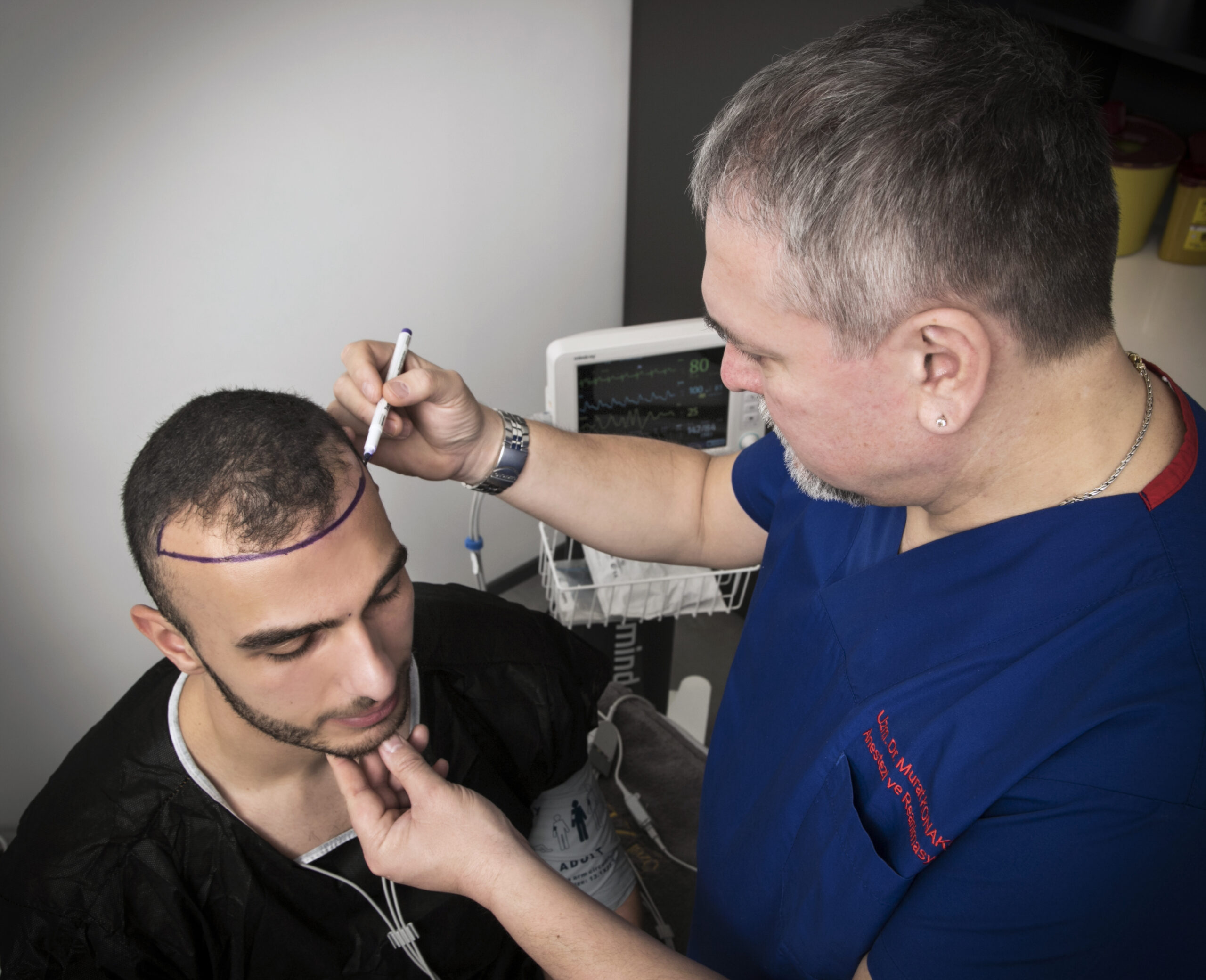
A surgeon who proposes a specific hairline position and explains why — referencing your facial proportions, your age, your likely hair loss trajectory, and how the design will age — is demonstrating clinical thinking that goes beyond selling a procedure. A surgeon who draws a line on your forehead based primarily on where you pointed and moves quickly to discussing graft count is telling you something different about what drives their planning.
Questions worth asking in any consultation include: Why this hairline position and not lower? How will this design look in fifteen years if my hair loss continues? What graft types are you planning to use at the leading edge and why? How will you handle the temple angles given my facial structure? What happens to this design if I need a second procedure later?
The answers to these questions — not the graft count, not the technique name, not the price per graft — are what tell you whether the person across the table is planning a result you’ll be satisfied with long-term.
When Design Goes Wrong and What It Costs
Poorly designed hairlines are among the most difficult hair transplant problems to address. A procedure where grafts didn’t survive can sometimes be corrected with a second transplant. A hairline that was placed too low, designed without a proper transition zone, or built with incorrect angles creates a structural problem that is far harder to fix.
Lowering a hairline that has been placed correctly is straightforward. Raising a hairline that has been placed too low requires either removing grafts — a technically demanding and imperfect process — or accepting a compromise between the original design and what would be ideal. Neither option is as satisfying as getting the design right the first time.
This asymmetry of risk — where good design decisions are largely invisible and bad design decisions are very difficult to undo — is precisely why the design conversation deserves more time and weight than it typically receives in consultations that are oriented toward closing a procedure booking.
The cost of a poorly designed hairline is not measured in the weeks of recovery or the months of the hair transplant timeline. It’s measured in years of living with a result that announces its origins to anyone who looks, and in the difficulty and expense of attempting correction that may never fully resolve the original design error.
The Standard the Design Should Meet
A well-designed hairline meets a specific standard: it should be undetectable as transplanted by someone who doesn’t know the patient has had a procedure. Not undetectable under a magnifying glass in a clinical setting. Undetectable in real life — in conversation, in photographs, in different lighting conditions, at different hair lengths, as the patient ages.
This standard is achievable. It is achieved regularly by surgeons who prioritize design with the same seriousness they apply to technique. It is not achieved by prioritizing graft count at the expense of design thinking, by placing hairlines where patients point rather than where clinical judgment indicates, or by treating the hairline as a line rather than a zone.
The grafts are the material. The design is what determines what the material builds.
When you evaluate a hair transplant clinic, spend as much time on the design conversation as you spend on the number conversation. Look at results not just for density but for how the hairline transitions, how the temples are handled, how natural the leading edge looks at close range. Ask questions that require the surgeon to articulate design reasoning rather than just describe a technical process.
The hairline you end up with will be on your face for the rest of your life. It deserves the most careful thinking in the room.
