
For many people, the first hair transplant feels like a turning point. Hair returns, confidence improves, and the constant focus on hair loss finally fades into the background. But for some, another question slowly appears months or years later.
Do I need a second hair transplant?
This question can come from different places. Sometimes it is driven by ongoing hair loss. Sometimes expectations were too high the first time. Sometimes the first procedure simply did not deliver what was promised. And sometimes, a second transplant is not only reasonable, but actually part of a smart long-term plan.
At Hairpol, second hair transplants are approached with caution, honesty, and perspective. Because while a second procedure can be the right decision, it can also be a serious mistake if done for the wrong reasons.
Why people consider a second hair transplant
The idea of a second hair transplant does not always mean the first one failed. In many cases, the first procedure did exactly what it was meant to do.
Hair loss is progressive. A transplant replaces hair where follicles are already gone, but it does not stop future loss in untreated areas. Over time, new thinning can appear, creating imbalance between transplanted and native hair.
In other cases, the first transplant was intentionally conservative. A natural hairline was created, but density was limited to preserve donor hair. Later, once results are visible and hair loss stabilizes, additional density may be desired.
These situations are very different from dissatisfaction caused by poor planning or unrealistic expectations.
When a second hair transplant makes sense
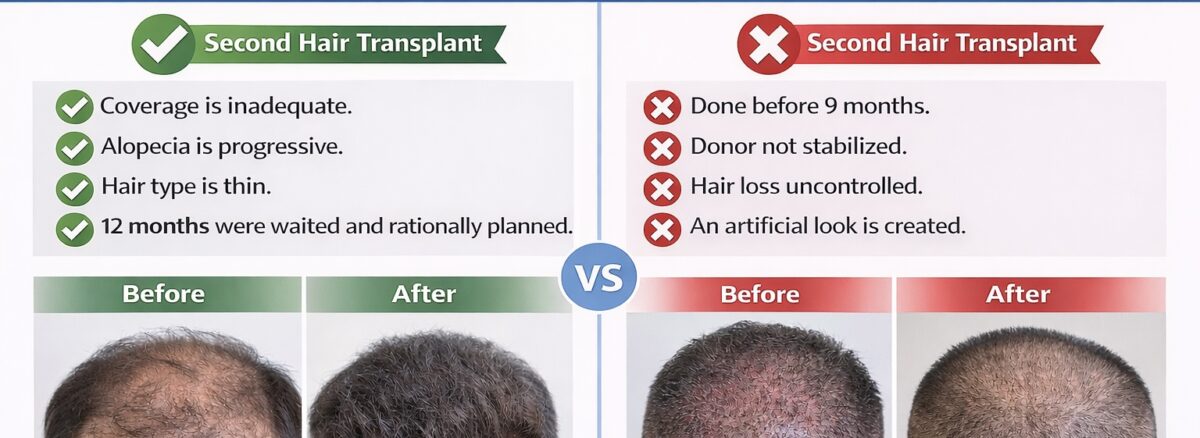
A second hair transplant is usually reasonable when it fits into a clear, long-term plan.
One common reason is continued hair loss. Even with medication or PRP support, some patients experience further thinning years after their first procedure. In these cases, a second transplant can restore balance and maintain a natural look.
Another valid reason is density refinement. Some patients are happy with their hairline but want more fullness in the mid-scalp or crown once they see how transplanted hair grows and behaves.
A second procedure can also be appropriate when the first transplant was done early, and donor hair was intentionally preserved for future use.
At Hairpol, second transplants are recommended only when donor capacity, scalp condition, and expectations align realistically.
The timing matters more than the decision itself
One of the most common mistakes is rushing into a second transplant too soon.
Hair transplant results take time. Final density, texture, and coverage are not fully visible until 12 months or more after surgery. Judging results at six or eight months often leads to unnecessary anxiety.
At Hairpol, patients are encouraged to wait until results fully mature before considering another procedure. What feels like insufficient density early on often improves naturally over time.
A second transplant should never be a reaction to impatience.
When a second hair transplant becomes a mistake
Not every desire for a second transplant is a good idea.
One of the biggest red flags is chasing perfection. Hair transplantation restores hair, not youth or genetic density. Wanting more and more density can quickly lead to overharvesting the donor area.
The donor area is limited. Once grafts are used, they cannot be replaced. Using too many grafts to chase unrealistic density can create visible thinning in the donor zone and limit future options.
Another mistake is trying to fix design errors with more grafts. If the first hairline is unnatural or poorly planned, adding more hair rarely solves the problem. In such cases, revision or corrective planning may be needed, not simply another transplant.
At Hairpol, patients are advised honestly when a second procedure will not improve the situation and may even worsen it.
The donor area is the real limiting factor
Every decision about a second hair transplant revolves around the donor area.
Some patients assume that if the first transplant went well, another one is automatically possible. This is not always true. Donor density, scalp elasticity, and previous extraction patterns determine what is still available.
A responsible clinic evaluates donor health carefully before even discussing a second procedure. Without sufficient donor reserves, a second transplant becomes risky.
At Hairpol, donor preservation is considered just as important as recipient area coverage.
Expectations change after the first transplant
Interestingly, many patients approach a second hair transplant with a different mindset than the first.
The fear is gone. The process is familiar. Confidence is higher. But expectations can also become sharper and less forgiving.
This is where honest discussion matters. A second transplant should improve balance and harmony, not aim for dramatic transformation.
Patients who understand this tend to be far more satisfied with their second procedure than those chasing a “perfect” result.
Repair cases are a different category
Some second hair transplants are not enhancements, but repairs.
Poor hairline design, incorrect graft direction, unnatural density, or visible pluggy results may require corrective work. These cases demand advanced experience and careful planning.
Repairing a bad transplant often requires removing or redistributing grafts, softening hairlines, or correcting angles. It is not simply about adding more hair.
At Hairpol, repair cases are handled cautiously, with a focus on minimizing further damage and achieving the most natural outcome possible.
How techniques affect second hair transplants
Techniques like Sapphire FUE and DHI can both be used in second procedures, but the choice depends on what the scalp needs.
Areas with scar tissue may require different handling. Density refinement may benefit from precise placement. Donor extraction must be even more controlled than the first time.
Technique supports the plan. It does not define it.
The emotional side of going back for more
A second hair transplant is often driven by emotion as much as logic.
Sometimes it comes from renewed confidence and desire to improve further. Sometimes it comes from lingering dissatisfaction or comparison with others.
At Hairpol, these emotional factors are discussed openly. A second procedure should feel like a thoughtful decision, not a reaction.
Patients who proceed calmly and with realistic goals tend to be the most satisfied in the long run.
When waiting is the smartest choice
In some cases, the best decision is not to act at all.
If donor reserves are limited, if hair loss is still progressing unpredictably, or if expectations are drifting toward perfection rather than balance, waiting protects future options.
A good clinic does not push for a second surgery simply because it is possible.
The real question to ask yourself
The question is not “Can I have a second hair transplant?”
The real question is “Will a second hair transplant improve my long-term result without creating new problems?”
At Hairpol, second hair transplants are recommended only when the answer to that question is clearly yes.
When planned carefully, a second procedure can enhance balance, confidence, and satisfaction. When done impulsively, it can compromise everything the first transplant achieved.
Knowing the difference is what separates a smart continuation from a costly mistake.
Frequently Asked Questions (FAQ)
Is it normal to need a second hair transplant?
Yes, in many cases it is completely normal. Hair loss is progressive, and a hair transplant does not stop future thinning in untreated areas. A second procedure is often part of long-term planning rather than a sign of failure.
How long should I wait before considering a second hair transplant?
You should wait at least 12 months after your first procedure. Hair transplant results take time to fully mature, and judging density too early can lead to unnecessary or premature decisions.
Does needing a second transplant mean the first one failed?
No. In most cases, the first transplant worked exactly as intended. A second transplant is often considered due to ongoing hair loss, conservative initial planning, or the desire for additional density once results are visible.
Can everyone have a second hair transplant?
No. The deciding factor is the donor area. Donor density, scalp elasticity, and how grafts were previously extracted determine whether a second procedure is safe and beneficial.
Is a second hair transplant riskier than the first?
In many cases, yes, but not always completely. Repair procedures depend on remaining donor hair and the type of mistake made. This is why preventing mistakes through proper planning is far more effective than fixing them later.
Can a second transplant fix an unnatural or failed first result?
In many cases, yes, but not always completely. Repairing poor hairline design or unnatural density often requires advanced techniques and may involve graft redistribution rather than simply adding more hair.
Can too many hair transplants damage the donor area?
Age alone does not determine success. Hair loss stability, donor area quality, and realistic expectations are far more important than how old a patient is.
When is it better to wait instead of having a second hair transplant?
If hair loss is still progressing rapidly, donor reserves are limited, or expectations are drifting toward perfection rather than balance, waiting is often the smartest decision to protect future options.
