
Most people don’t think about sleep until the night of the procedure. They’ve researched the technique, compared clinics, asked about graft counts and hairline design — and then they get back to the hotel room, lie down out of habit, and immediately realize they have no idea what they’re supposed to do with their head.
Sleep after a hair transplant is one of those topics that sounds simple until you’re actually trying to do it. And in the first week, how you sleep matters more than most patients expect — not because the rules are complicated, but because the consequences of getting it wrong are real and entirely avoidable.
This guide covers everything: the position, the pillow setup, the timing, the common mistakes, and why the first few nights are the most important ones in your entire hair transplant recovery.
Why Sleep Position Matters After a Hair Transplant
In the first 72 hours after a hair transplant, the grafts are not yet anchored by tissue. They’re held in place by the body’s initial healing response — a thin fibrin seal that forms around each follicle during the first days. It’s functional, but it’s not robust. Direct pressure on the recipient area during this window can physically dislodge a graft, and a dislodged graft is a lost graft.
Beyond graft safety, sleeping position in the first week also affects swelling. The tumescent fluid used during the procedure distributes through the scalp and, if the head is kept too low, migrates downward toward the forehead and eyes. Most patients who sleep flat on day one wake up on day two with significant facial puffiness — not dangerous, but uncomfortable and avoidable.
The goal of the first week of sleep is simple: keep the head elevated, keep the recipient area off every surface, and make that position sustainable enough that you can actually sleep in it.
The Right Sleeping Position
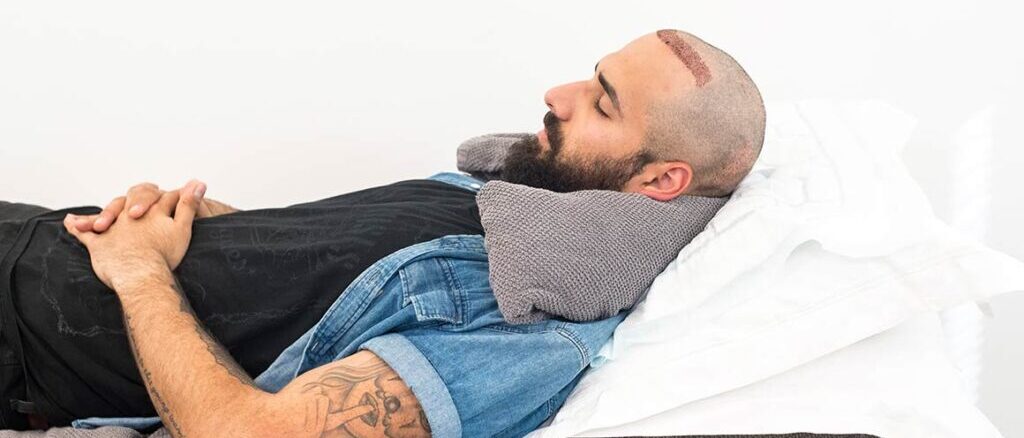
The correct position for the first seven to ten days is on your back, with your head and upper body elevated at roughly 45 degrees. Not slightly propped up. Not one thin pillow under your neck. A genuine incline that keeps the scalp clearly above the level of the heart.
This elevation serves two purposes simultaneously. It protects the grafts from surface contact, and it reduces the gravitational pull that draws swelling fluid toward the face.
The most practical way to achieve this at home is to stack two or three firm pillows — not soft ones that compress under weight — and position them so that your entire upper back and head rest on the incline rather than just your neck. If only your neck is elevated and your head falls backward, you’ve created tension without protection.
A travel neck pillow used around the neck can help prevent the head from rolling to the side during sleep. This is especially useful for people who naturally sleep on their sides and tend to shift position without realizing it. The neck pillow creates a physical reminder and mild barrier against lateral rolling.
Some patients find it more comfortable to sleep in a recliner chair for the first few nights. If you have access to one that holds a stable angle, this is actually an excellent option — the incline is maintained automatically, there’s no risk of pillows shifting during the night, and the arms of the chair prevent sideways rolling. It’s not glamorous, but it works.
The Donor Area and What People Forget
Most of the conversation about sleep after a hair transplant focuses on the recipient area — the transplanted zone on top or front of the scalp. This is understandable because that’s where the grafts are. But the donor area, typically the back and sides of the head, also needs consideration.
The donor area has been through extraction. The skin there is sensitive, slightly raw, and healing simultaneously with the recipient zone. Sleeping in a position where the back of the head presses hard against a firm surface adds unnecessary pressure to already-healing tissue and can cause discomfort significant enough to wake you during the night.
The elevated back-sleeping position that protects the recipient area naturally takes some pressure off the back of the head as well, since the incline shifts weight to the upper back and shoulders. But it doesn’t eliminate contact entirely. A soft, clean pillowcase — or placing a clean cotton cloth over your pillow — reduces friction and feels more comfortable against the donor area without introducing any infection risk.
The First Night Is the Hardest
It’s worth being honest about this: the first night after a hair transplant is not comfortable for most people. The combination of physical tension in the scalp, the unfamiliar sleeping position, the mild residual soreness from the procedure, and the psychological awareness of every small sensation makes genuine restful sleep difficult.
Most patients manage a few hours of light sleep and spend portions of the night awake and aware of their scalp. This is not dangerous. One night of poor sleep does not compromise healing. The body’s repair processes continue regardless of sleep quality, and the grafts are not at risk simply because you were awake.
What matters is that you maintained the position even while awake, didn’t touch the recipient area, and resisted the temptation to get up and look in the mirror every hour.
By the second and third nights, most patients report that the position becomes more familiar and sleep quality improves. The acute soreness typically reduces significantly by day three, making it easier to relax into the elevated position without the physical tension of the first night.
Managing the Urge to Roll Over
Side sleeping is the most common natural position for adults. If you’ve slept on your side for decades, your body will attempt to return to that position during sleep — often without waking you.
This is the practical risk of the first week. Not intentional contact with the grafts, but unconscious position changes during deep sleep that bring the recipient area into contact with the pillow.
Several approaches help manage this. The neck pillow method mentioned earlier creates a mild physical barrier. Some patients place rolled towels or a firm bolster pillow on either side of their body to make rolling physically more difficult. Others find that sleeping slightly diagonally across the bed, with the elevated pillows positioned at an angle, makes side-rolling feel more unnatural and less likely.
If you wake up and discover you’ve rolled onto your side, don’t panic. Carefully return to the elevated back position and go back to sleep. One brief contact event in an otherwise careful week is not the same as sustained pressure throughout a night. The concern is habitual or prolonged contact, not a single accidental roll.
Swelling and How Sleep Affects It
The swelling that appears between days two and four after a hair transplant is one of the most frequently misunderstood parts of the recovery. Patients often assume it indicates something wrong, when it is actually a predictable consequence of the tumescent fluid used to expand the scalp during the procedure.
Sleep position directly affects how severe this swelling becomes and how quickly it resolves. Patients who sleep elevated consistently in the first three nights typically experience less pronounced swelling and faster resolution compared to those who sleep flat or at a low angle.
The swelling usually moves downward with gravity. It appears first at the forehead, then sometimes progresses to the area around the eyes and nose by days three and four. Keeping the head elevated slows this migration and reduces the peak volume of visible swelling.
Cold compresses applied to the forehead — never to the transplanted area — can help alongside proper sleep positioning. The combination of elevation during sleep and careful cold application during waking hours gives the body its best conditions for managing and resolving swelling without intervention.
Pillow Hygiene During Recovery
Something that doesn’t get discussed enough is the cleanliness of the sleeping surface during hair transplant recovery. The recipient area is healing skin with small scabs and follicles in the early stages of integration. Contact with an unwashed pillowcase carries a low but real risk of introducing bacteria to a surface that is more vulnerable than normal intact skin.
Change your pillowcase daily for the first week. If that’s not practical, place a fresh clean towel over the pillow each night and replace it each morning. The goal is simply to ensure that whatever the back of your head contacts is clean.
Avoid thick or textured pillowcase materials that create more friction against the donor area. A smooth cotton surface is the most comfortable and least likely to catch on healing skin.
What Happens If You Sleep Wrong
This is the question patients ask most often, usually after they’ve already done something they’re worried about.
If you woke up on your side after falling asleep on your back, or if you realized you’d been sleeping at too low an angle for part of the night, the realistic outcome depends on what happened and for how long.
Brief accidental contact — rolling to the side for a short period before waking and correcting — is unlikely to cause meaningful graft loss in a patient who is otherwise following proper aftercare. The risk comes from sustained, direct pressure on the recipient area over an extended period, particularly in the first 72 hours when the fibrin seal is at its most fragile.
If you notice that a scab has been displaced or that a small amount of bleeding has occurred from the recipient area during the night, contact your clinic. Don’t attempt to manage it yourself. A small amount of dried blood in the morning without any other symptoms is often not significant, but your clinic should make that assessment, not a forum post.
The honest reality is that most patients make at least one small sleep-related mistake during the first week and their results are not meaningfully affected. The body has more resilience than the anxiety of the first week suggests. What matters is pattern, not a single incident.
How Long the Special Sleep Position Is Actually Necessary
The elevated back-sleeping requirement is most critical for the first three nights, when the grafts are at their most vulnerable. Most clinics recommend maintaining it for seven to ten nights to account for the full initial healing window.
After day ten, the grafts are integrated into the tissue and no longer at risk of physical dislodgement from normal sleeping. You can return to your preferred sleep position gradually — most patients find that transitioning back to side sleeping after the ten-day mark is comfortable and causes no issues.
The donor area typically no longer requires any special consideration by the end of week two. The extraction sites have healed, the sensitivity has reduced, and normal pillow contact is fine.
The Bigger Picture
One week of uncomfortable sleep is a small price relative to the result a properly healing hair transplant produces over the following year. Patients who understand this trade-off in advance find the first week significantly more manageable than those who encounter it unprepared.
The position feels unnatural. The first night is disrupted. You’ll probably be tired by day three. None of that is permanent, and none of it is harming the result — it’s protecting it.
Every night that you maintain the elevation, avoid the side-rolling, keep the pillowcase clean, and resist touching the recipient area is a night where the grafts are doing exactly what they need to do: integrating, stabilizing, and preparing to produce the hair growth that the entire procedure was designed to deliver.
The result you’re working toward is built in these quiet, unglamorous nights during the first week. Treat them accordingly.
Frequently Asked Questions (FAQ)
How should I sleep after a hair transplant?
The recommended sleeping position after a hair transplant is on your back with your head and upper body elevated at approximately 45 degrees for the first seven to ten days. This position protects the grafts from surface contact and reduces the gravitational migration of tumescent fluid that causes swelling in the forehead and around the eyes. Stacking two or three firm pillows beneath the upper back — not just under the neck — creates the necessary incline. A travel neck pillow worn around the neck helps prevent unconscious rolling to the side during deep sleep, which is the most common sleep-related risk during the first week of recovery.
How long do I need to sleep in a special position after a hair transplant?
The elevated back-sleeping position is most critical during the first three nights after a hair transplant, when the grafts are anchored only by a thin fibrin seal and are at their most vulnerable to physical dislodgement. Most clinics recommend maintaining the position for seven to ten nights to cover the full initial healing window. After day ten, the grafts are integrated into the surrounding tissue and no longer at risk from normal sleep positions. Most patients can return comfortably to side sleeping from the ten-day mark onward without any concern for graft safety.
What happens if I accidentally roll onto my side during sleep after a hair transplant?
A single accidental roll onto your side is unlikely to cause meaningful graft loss in a patient who is otherwise following proper aftercare. The risk comes from sustained, direct pressure on the recipient area over an extended period — particularly in the first 72 hours when the fibrin anchoring is at its most fragile. If you wake up on your side, simply return carefully to the elevated back position and go back to sleep. If you notice a displaced scab or any bleeding from the recipient area following a sleep incident, contact your clinic rather than attempting to assess or manage it yourself. What matters across the first week is consistent pattern, not a single accidental incident.
Can sleeping position affect swelling after a hair transplant?
Yes, sleep position directly influences how severe swelling becomes and how quickly it resolves after a hair transplant. The swelling that typically appears between days two and four is caused by tumescent fluid redistributing downward from the scalp by gravity. Patients who maintain consistent head elevation during the first three nights experience less pronounced swelling and faster resolution than those who sleep flat. Keeping the head elevated slows the downward migration of fluid toward the forehead and eyes, and combining elevated sleep with careful cold compresses applied to the forehead during waking hours gives the body its best conditions for managing the swelling without intervention.
Should I worry about pillow cleanliness after a hair transplant?
Yes, pillow hygiene is a genuinely important part of hair transplant recovery that is frequently overlooked. The recipient area in the first week has small healing wounds around each graft that are more susceptible to bacterial exposure than intact skin. Sleeping on an unwashed pillowcase introduces a low but real infection risk to a surface that is actively healing. The practical solution is to change pillowcases daily for the first week, or to place a fresh clean towel over the pillow each night and replace it each morning. Smooth cotton pillowcase materials are preferable — thick or textured fabrics create more friction against the donor area and can cause unnecessary discomfort against healing skin.
Can I sleep in a recliner chair after a hair transplant?
Yes, sleeping in a recliner chair is actually an excellent option for the first few nights after a hair transplant. A recliner that holds a stable angle maintains the recommended 45-degree elevation automatically without the risk of pillows shifting during the night. The arms of the chair also prevent sideways rolling, which is one of the primary sleep-related risks during the first week when the grafts are in their most vulnerable phase. For patients who are habitual side sleepers and find it difficult to maintain the back position in a bed, a recliner can make the first few nights significantly more manageable and reduce the anxiety around accidental position changes during sleep.
Does the donor area need any special consideration during sleep after a hair transplant?
Yes, the donor area — typically the back and sides of the scalp where follicles were extracted — also requires consideration during sleep after a hair transplant, though it receives less attention than the recipient area. The extraction sites are healing simultaneously, and sustained pressure of the back of the head against a firm pillow surface can cause discomfort significant enough to disrupt sleep. The elevated back-sleeping position naturally reduces some of this pressure by shifting weight to the upper back and shoulders. Placing a smooth, clean pillowcase or a soft cotton cloth over the pillow reduces friction against the donor area and makes contact more comfortable during the healing period. By the end of week two, the donor area has typically healed sufficiently that normal pillow contact is no longer a concern.
Why is the first night after a hair transplant so difficult to sleep through?
The first night after a hair transplant is genuinely uncomfortable for most patients due to a combination of factors that occur simultaneously. Physical tension and mild soreness in both the recipient and donor areas make relaxation difficult. The unfamiliar 45-degree elevation position feels unnatural for most people. And the psychological awareness of the grafts — the constant low-level monitoring of every scalp sensation — makes truly restful sleep hard to achieve. Most patients manage a few hours of light sleep rather than a full night's rest. This is not dangerous. One disrupted night does not compromise healing or graft survival. Sleep quality typically improves significantly by the second and third nights as the position becomes more familiar and the acute post-procedure soreness begins to reduce.
