
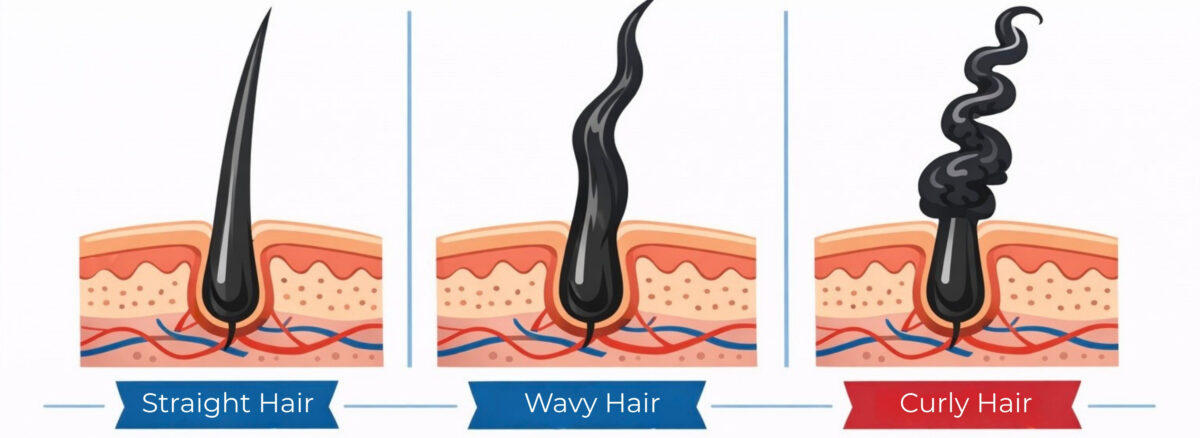
When people look at hair transplant results online, they often compare graft numbers, techniques, or clinics. What they rarely consider is something far more personal and influential: hair type.
Straight hair, wavy hair, and curly hair behave very differently. They grow differently, cover the scalp differently, and age differently. Two people can receive the same number of grafts using the same technique and end up with results that look completely different in real life.
At Hairpol, hair type is one of the first things evaluated during consultation, because it directly affects planning, density decisions, and how natural the final result will look over time.
Understanding how your hair type influences hair transplant results helps set realistic expectations and prevents unnecessary disappointment.
Why hair type matters more than people think
Hair transplantation is not about filling space. It is about creating the illusion of fullness. That illusion is heavily influenced by how hair bends, overlaps, reflects light, and moves.
Straight hair lies flat.
Wavy hair creates volume naturally.
Curly hair coils and overlaps itself.
These behaviors change how dense hair appears, even when the actual number of hairs is the same. This is why a successful transplant for one hair type cannot be copied directly to another.
Straight hair and hair transplant results
Straight hair is often the most challenging hair type when it comes to achieving visual density.
Because straight hair grows flat and parallel, it allows more light to pass through to the scalp. This means gaps are easier to see, especially under strong lighting or when hair is wet or styled backward.
What this means for planning
Patients with straight hair often require more thoughtful graft distribution. Density must be built gradually and strategically, especially in visible areas like the hairline and mid-scalp.
Overpacking grafts in straight hair can backfire. Hair may look stiff, unnatural, or overly uniform. The key is balance, not aggression.
At Hairpol, straight hair transplants are planned with subtle layering and careful angle control to avoid a “see-through” effect while keeping movement natural.
Hairline considerations for straight hair
Hairlines in straight hair must be softer and less defined. Sharp lines are more visible in straight hair than in wavy or curly hair.
Single-hair grafts, irregular spacing, and conservative density are essential for a natural look.
Wavy hair and why it creates better coverage
Wavy hair is often considered the most forgiving hair type in hair transplantation.
Because it bends and changes direction naturally, wavy hair overlaps and creates shadow. This makes the scalp less visible and enhances the appearance of fullness, even with fewer grafts.
Advantages of wavy hair in transplantation
Wavy hair allows for more flexibility in density planning. Moderate graft numbers can achieve strong visual coverage. Minor spacing errors are less noticeable. Movement looks natural more easily.
This does not mean wavy hair requires less skill. Poor direction or inconsistent angles can still look unnatural. But when done correctly, results tend to look fuller faster.
At Hairpol, patients with wavy hair often achieve satisfying density with conservative graft use, preserving donor hair for the future.
Styling benefits
Wavy hair also offers more styling freedom. Results look good both short and long, and transitions between transplanted and native hair blend more easily.
Curly hair and the illusion of maximum density
Curly hair provides the strongest illusion of density, but it comes with its own challenges.
Curly hair coils and overlaps itself, creating volume and coverage even when graft density is relatively low. This makes curly-haired patients excellent candidates for achieving full-looking results without excessive graft use.
However, curly hair requires precise handling.
The hidden challenges of curly hair
Curly follicles curve beneath the skin. Extracting them without damage requires experience and proper technique. Incorrect extraction can reduce graft survival.
Implantation also requires careful angle control. Curly hair grows in complex directions, and mistakes become obvious as hair length increases.
At Hairpol, curly hair transplants are approached with extra attention during both extraction and placement to protect follicle integrity and ensure natural growth patterns.
Hairline design for curly hair
Curly hairlines should never be too dense or too sharp. Natural curl creates softness on its own. Overdesigning the front can result in an exaggerated or heavy appearance.
When done well, curly hair transplants often deliver some of the most natural-looking long-term results.
How hair thickness interacts with hair type
Hair type is not just about straight or curly. Thickness matters just as much.
Thick hair shafts provide more coverage than fine hair, regardless of curl pattern. Fine straight hair is the most challenging combination for visual density. Thick wavy or curly hair offers the easiest coverage.
At Hairpol, hair shaft thickness is measured and factored into graft planning. This prevents unrealistic density expectations and improves long-term satisfaction.
Technique choice depends on hair type
Techniques like Sapphire FUE and DHI are selected differently depending on hair type.
Straight hair often benefits from precise channel creation and controlled spacing, making Sapphire FUE a common choice.
Wavy hair works well with both techniques, depending on area size and existing hair.
Curly hair may require customized extraction and implantation strategies to protect follicle shape.
Technique supports planning. It does not replace it.
Why copying someone else’s results rarely works
One of the most common mistakes patients make is bringing photos of someone else’s transplant as a reference.
If hair type differs, expectations should differ too. A result that looks dense on curly hair may look thin on straight hair with the same graft count.
At Hairpol, consultations focus on explaining what your hair can realistically achieve, not recreating someone else’s outcome.
Hair type and long-term appearance
Hair type also affects how results age.
Straight hair may reveal thinning more quickly if future hair loss continues. Wavy and curly hair tend to maintain the illusion of density longer.
This is why long-term planning is especially important for straight-haired patients. Conservative hairline design and donor preservation matter even more.
Managing expectations honestly
Understanding your hair type helps avoid frustration.
A natural result is not about matching someone else’s density. It is about achieving balance and harmony with what your hair can naturally provide.
At Hairpol, honest expectation management is considered part of the medical responsibility.
When hair type is respected, results feel natural
The most successful hair transplants are the ones that work with hair type, not against it.
When straight hair flows naturally, when wavy hair adds volume without effort, when curly hair frames the face organically, the result feels authentic.
At Hairpol, hair type is not a detail. It is a foundation.
Because when hair behaves naturally, the result does not just look good in photos.
It feels right in real life.
Frequently Asked Questions (FAQ)
Does hair type really affect hair transplant results?
Yes, hair type plays a major role in how hair transplant results look in real life.
Straight, wavy, and curly hair reflect light differently, overlap differently, and create different
levels of visual density.
Even when the same number of grafts is used, results can appear much fuller or thinner depending on
hair type. This is why planning must always be personalized.
Which hair type gives the most natural-looking results after a hair transplant?
All hair types can achieve natural results when planned correctly. However, wavy and curly hair
tend to create the illusion of higher density more easily because they overlap and create volume.
Straight hair can also look natural, but it requires more careful density distribution and softer
hairline design.
Is straight hair harder to transplant successfully?
Straight hair is not harder to transplant, but it is less forgiving visually. Because it lies flat, the scalp is more visible, especially under bright light or when hair is styled back.
For this reason, straight hair transplants require precise planning, gradual density, and conservative hairline design to avoid a see-through appearance.
Why do curly hair transplants often look denser with fewer grafts?
Curly hair coils and overlaps itself, creating natural volume and shadow. This allows better scalp coverage even with lower graft density.
However, curly hair follicles require experienced handling during extraction and implantation, as their curved structure makes them more sensitive.
Does hair thickness matter as much as hair type?
Yes, hair shaft thickness is just as important as hair type. Thick hair provides more coverage than fine hair, regardless of whether it is straight or curly.
Fine straight hair is usually the most challenging combination for visual density, while thick wavy or curly hair offers the easiest coverage.
Can the same hair transplant technique be used for all hair types?
No single technique works best for everyone. Sapphire FUE and DHI are chosen based on hair type, area size, existing hair, and donor characteristics.
Technique supports the plan, but it cannot compensate for poor design or unrealistic expectations.
Why can’t I copy someone else’s hair transplant result if we use the same graft count?
Because hair type changes everything. A result that looks dense on curly hair may look thin on straight hair using the same number of grafts.
Natural results come from working with your own hair characteristics, not replicating someone else’s outcome.
Does hair type affect how long hair transplant results last?
Hair type does not affect graft survival, but it does affect how density is perceived over time. Straight hair may reveal future thinning more quickly, while wavy and curly hair tend to maintain the illusion of fullness longer.
This is why long-term planning is especially important for straight-haired patients.
