
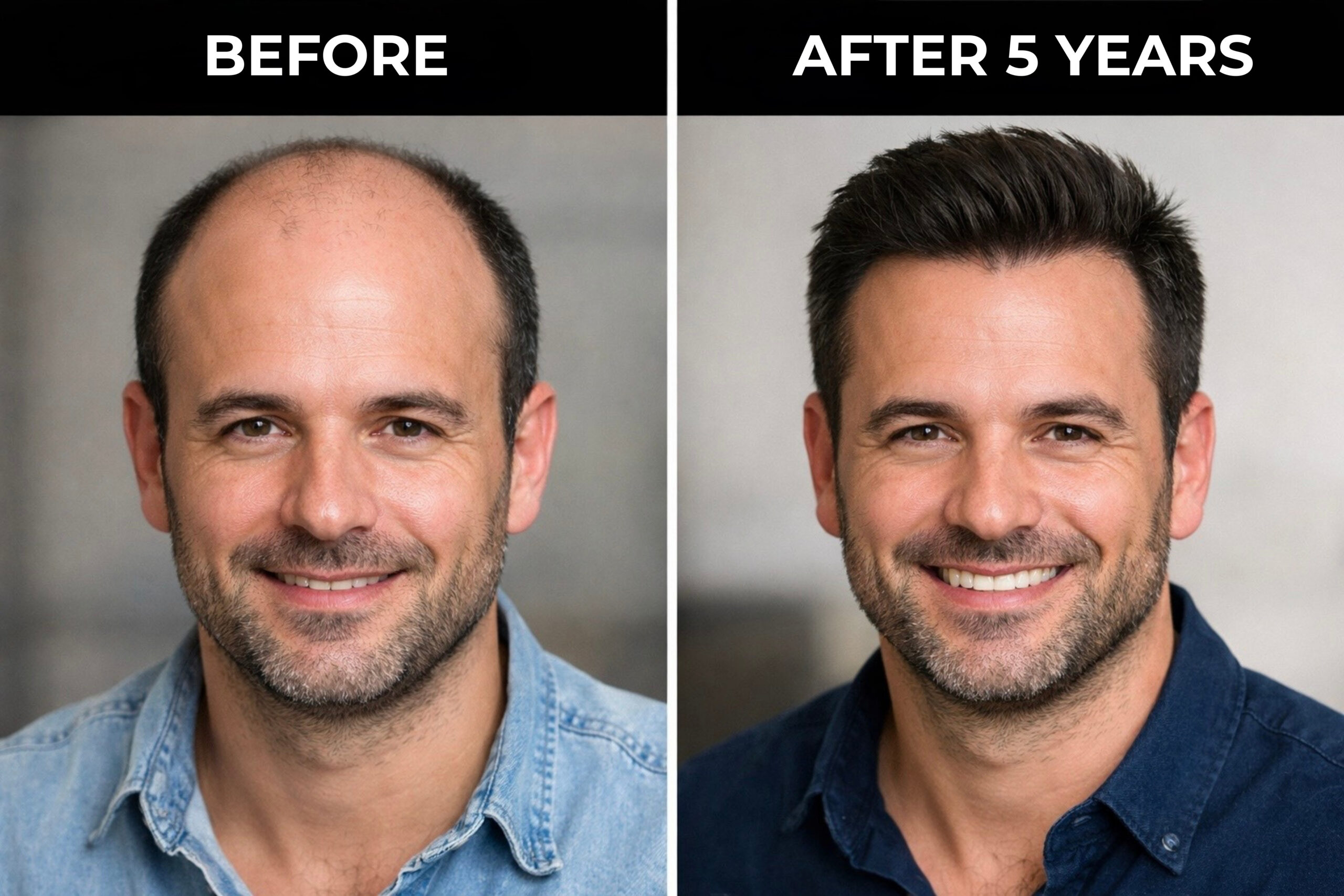
Hair Transplant Results After 5 Years: What Does the Result Look Like Long-Term?

The before-and-after photographs that clinics publish are almost always taken at twelve months. This makes practical sense — the result is substantially mature, the transformation is visible, and the patient is at a stage where documentation is meaningful. What these galleries rarely show is what the same patient looks like at year five, year eight, or year ten — and what they look like in those later years is a question that many patients aren’t asking at the consultation stage but will eventually need an answer to.

The long-term picture of a hair transplant result is not a single outcome. It is a dynamic picture that evolves with biological processes that don’t stop when the procedure is complete. Understanding how and why results change — or don’t change — across five to ten years is essential for patients who are making a significant investment in their appearance and want to understand what they’re actually buying for the long term.

This guide covers the genuine long-term picture of hair transplant outcomes: what remains stable, what changes and why, what the result looks like at five years for patients who managed their hair well versus those who didn’t, and what planning decisions made at the outset most strongly determine the long-term picture.

The Permanent Element: What Doesn’t Change at Five Years

The starting point for understanding long-term results is the biological principle that makes hair transplantation work at all: donor dominance. Follicles extracted from the permanent donor zone at the back and sides of the scalp retain their genetic resistance to dihydrotestosterone — the hormone responsible for androgenetic hair loss — in their new location. DHT-resistant follicles transplanted into areas of loss continue growing in their new location indefinitely, unaffected by the same hormonal signals that caused the original loss.

At five years, ten years, and beyond, this permanence is real. Patients who had procedures five to ten or more years ago with sound technique and appropriate donor zone selection consistently report that their transplanted hair continues to perform exactly as it did at twelve months. It grows, it cycles through anagen and telogen normally, it can be cut, colored, and styled like any other hair. It does not disappear.

This is the foundation of the long-term result picture. The transplanted hair is genuinely permanent in a way that is biologically well-established and clinically documented across decades of patient outcomes. Any honest discussion of long-term results starts from this foundation — and then adds the nuance that surrounds it.

The Changing Element: What Does Change at Five Years

What changes in the years after a hair transplant is not the transplanted hair but everything around it. And this is the part of the long-term picture that is most consequential for patient satisfaction and most frequently underemphasized in the initial consultation.

At the time of a hair transplant procedure, the recipient area typically contains three distinct populations of hair. First, the transplanted follicles — newly placed, DHT-resistant, and permanent. Second, native hair that remains in the recipient zone — follicles that haven’t yet been lost to androgenetic progression and that contribute meaningfully to the overall density and coverage of the result at year one. Third, native hair in adjacent zones — the mid-scalp, crown, and temples — that provides the surrounding density context that makes the transplanted zone look naturally integrated rather than isolated.

Both the second and third populations — all native hair — will continue to follow their genetic trajectory. They are DHT-sensitive. They will continue to miniaturize and eventually be lost over the years following the procedure, just as they would have without any surgical intervention. The rate at which this happens depends on the individual patient’s genetics, their hair loss progression speed, and whether they manage ongoing loss medically.

At year one, the combination of transplanted and native hair produces an excellent result in most patients — the native hair that remains is still there, still contributing. At year five, the picture may be different. Native hair that was providing density context at year one has, in some patients, continued thinning. In patients without medical management, the gap between what the result looked like at year one and what it looks like at year five reflects not the failure of the transplanted hair but the natural continuation of the loss process that was already underway before the procedure was performed.

Understanding this distinction — between the stable transplanted hair and the evolving native hair around it — is the most important conceptual tool for interpreting long-term results accurately.

The Five-Year Picture With Medical Management

The most significant variable determining what a hair transplant result looks like at five years is not the procedure itself — it’s whether the patient managed their ongoing native hair loss medically in the years following the procedure.

Patients who started finasteride at or around the time of their procedure and maintained it consistently have, in most cases, preserved the majority of their native hair through the five-year mark. The DHT suppression that finasteride provides slows the miniaturization of native follicles — the same follicles that are providing density context around the transplanted zone. When this process is effectively slowed, the year-five result looks meaningfully closer to the year-one result than in patients without medical management.

In practical terms, this means a patient with good medical management at five years typically has transplanted hair performing as designed, native hair in the recipient zone substantially preserved, and adjacent native hair in surrounding zones maintained at something approaching year-one density. The overall scalp picture at five years, for this patient, looks excellent — close to the twelve-month result that the clinic’s before-and-after gallery showed.

Minoxidil, used consistently alongside finasteride, further supports native hair retention through its mechanisms of improved scalp blood flow and direct follicle activity stimulation. Patients using both medications give their native hair the best available medical support against the ongoing androgenetic process. The combination approach consistently produces better five-year native hair retention than either medication alone.

This is not a theoretical benefit — the contrast between patients who managed their native hair medically and those who didn’t is one of the most consistently observed phenomena in long-term hair restoration outcomes. The transplanted hair is identically permanent in both groups. The overall coverage picture at five years is dramatically different.

The Five-Year Picture Without Medical Management

For patients who chose not to pursue medical management — or who started it and discontinued — the five-year picture tells a different story. The transplanted hair remains, performing exactly as designed. But the native hair that provided density context and surrounding coverage at year one has continued its progression without intervention.

The specific presentation varies with the extent of ongoing loss. For patients with slower genetic progression, the five-year picture may look only modestly different from year one — the native hair is thinner but still present, the overall coverage is reduced but not dramatically so. For patients with more aggressive progression who declined medical management, the five-year picture can look substantially different: transplanted hair that is stable and performing well, surrounded by native hair that has thinned significantly, creating a visual impression of increasingly isolated transplanted zones.

This is not a failure of the procedure. The transplanted hair is doing exactly what it was designed to do. The change in overall appearance reflects the biological reality of a progressive condition — androgenetic hair loss — that the surgery addressed at one point in time without stopping the underlying process. What looks like a deteriorating result is, more precisely, an evolving hair loss pattern in which the transplanted zone is stable but the surrounding native hair has continued its natural trajectory.

The specific appearance at five years without medical management depends strongly on which Norwood stage the patient has reached in their natural progression. A patient who was Norwood Type 3 at the time of the procedure but whose natural trajectory would take them to Type 5 or 6 by their mid-thirties will have a dramatically different five-year picture without finasteride than the twelve-month result suggested. The transplanted frontal hairline is still there. The mid-scalp and crown behind it are continuing to thin. The overall impression at year five is that the transplant “worked” in the front but hasn’t addressed everything — which reflects exactly what happened: the procedure addressed the front, and the back continued progressing.

Hair Transplant Results After 5 Years: What Does the Result Look Like Long-Term?

How Age at the Time of the Procedure Shapes the Five-Year Picture

The patient’s age at the time of the procedure is one of the most powerful determinants of what the five-year picture looks like — and it’s one of the primary reasons that experienced surgeons treat age as a major planning variable rather than an incidental detail.

A patient who had their procedure at 45 with stable Norwood Type 3 hair loss that hadn’t progressed meaningfully in several years is at five years likely 50, with a hair loss pattern that has continued to be largely stable. The transplanted hair is performing well, the surrounding native hair hasn’t changed dramatically, and the result at year five looks close to the year-one result with or without aggressive medical management.

A patient who had their procedure at 26 with Norwood Type 3 loss that was actively progressing is at five years only 31 — still in the active progression phase of androgenetic loss for most patients. Without medical management, the five-year picture for this patient may show significantly more native hair progression than the 45-year-old’s, because five years of active progression at 26 to 31 produces more loss than five years at 45 to 50 in most patients with the same genetic trajectory.

This is why procedures for younger patients require specific planning around the long-term picture — not because the transplanted hair is any less permanent, but because the surrounding native hair is operating on a longer progression timeline that significantly affects the evolution of the overall result. Young patients who receive comprehensive-looking first sessions without accounting for this long-term picture may find that the five-year result shows significant divergence from the twelve-month result in ways that a more conservative initial approach and consistent medical management would have prevented.

The Role of Hairline Design in Long-Term Results

One of the planning decisions that most significantly affects how a hair transplant result looks at five years — and at ten and twenty years — is the hairline design made at the outset. This is an area where short-term and long-term considerations sometimes point in different directions, and where the decisions made at consultation have permanent consequences.

A hairline designed too low for a younger patient — placed at the position the patient had at eighteen or twenty, rather than at a position appropriate for a face that will age over the following decades — looks excellent at year one. The transplanted hairline is where the patient wanted it, and the result is satisfying. At year five, the same hairline may begin to look different: the face has aged somewhat, the native hair behind the hairline has thinned, and the transplanted hairline — fixed in position and unchanging — may look increasingly incongruous relative to the age of the face beneath it and the thinning of the hair behind it.

At year ten, the incongruity can be more pronounced. The transplanted hairline is still exactly where it was placed — permanently, as designed. The face is now ten years older. The native hair behind the hairline has continued its progression. The result at year ten can look as if a young person’s hairline has been grafted onto an older person’s face — not because anything went wrong surgically, but because the design didn’t account for how the face and surrounding hair would evolve.

Experienced surgeons who prioritize long-term outcomes deliberately design hairlines at positions that will look appropriate as the patient ages — slightly more conservative than the patient’s instinct in many cases — precisely because the five and ten-year pictures are part of what they’re designing for, not just the twelve-month result. This conservative approach sometimes requires managing patient expectations at consultation, but it consistently produces better long-term satisfaction than designs optimized only for the immediate post-procedure result.

The transition zone — where single-hair grafts create the soft leading edge of the hairline — also matters for the long-term result. A transition zone that looks natural at year one, because it accurately replicates the gradual density variation of a natural hairline, continues to look natural at year five because the biological characteristics of the zone are permanently established. A hairline with an abrupt leading edge — even if adequate immediately after — looks increasingly designed rather than grown as time passes and the result loses the visual camouflage of new procedure freshness.

Donor Area at Five Years: What It Looks Like

The donor area at five years looks, for most patients with well-planned procedures, essentially the same as it looked at twelve months. FUE extraction sites — the small circular dots in the donor zone — continue to be covered by surrounding hair at normal lengths, and the donor area retains its natural appearance without ongoing degradation.

For patients who had FUT procedures, the linear scar at the donor area has by five years matured fully. The maturation process for surgical scars involves progressive lightening and softening — the scar is typically at its most visible at three to six months and gradually becomes less prominent as it matures. By five years, an FUT scar is fully matured, and its final appearance reflects both the quality of the closure technique and the patient’s individual healing characteristics.

What can change in the donor area at five years — in either FUE or FUT patients — is the density of hair covering the donor zone if the donor area itself has experienced ongoing loss. The permanent zone at the back and sides of the scalp is called “permanent” because it’s the area that is most genetically resistant to androgenetic loss. But in patients with more aggressive genetic trajectories, the safe zone can narrow over time — the boundary of DHT-resistant hair gradually retreating as the androgenetic process affects follicles at the outer edge of what appeared to be the safe zone at the time of the procedure.

This donor zone narrowing — most relevant in patients with the most aggressive genetic trajectories toward Norwood Type 6 or 7 — means that follicles extracted from the periphery of the safe zone at the time of the procedure may not retain their DHT resistance indefinitely. In a small minority of patients, some of the transplanted hair — specifically that which came from the peripheral rather than central donor zone — may show some thinning over years as the genetic safe zone boundary advances. This is one of the clinical reasons why experienced surgeons harvest conservatively from the central, most stable portion of the donor zone rather than pushing to the periphery for additional yield.

The Crown at Five Years: The Zone Most Likely to Show Change

If there is a zone where the five-year picture most commonly shows meaningful change from the twelve-month result, it is the crown — and understanding why helps patients with crown involvement in their procedures calibrate their long-term expectations appropriately.

The crown is the last zone to show growth after a hair transplant — typically not reaching full maturity until twelve to eighteen months — and it is the zone where ongoing native hair loss is most visually significant in the years that follow. The spiral growth pattern of the crown means that both the transplanted hair and the native hair covering the crown contribute to coverage in a way that requires both populations to be functional — the crown doesn’t look naturally covered by transplanted hair alone if the native hair around it has thinned significantly, because the whorl pattern requires a certain density distribution to look complete.

Patients who had crown transplants at earlier stages of crown involvement — where native hair was still substantially present at the time of the procedure — may find at five years that the combination of transplanted and native hair in the crown looks different from year one as native hair has continued to thin. In patients without medical management and with more aggressive progression, the crown at five years can look noticeably thinner than at twelve months, even though the transplanted hair is performing normally, because the native crown hair that was present at year one is less present at year five.

This is one of the primary reasons that crown procedures are approached more conservatively than frontal procedures in patients with active progression — the crown’s long-term native hair context is particularly vulnerable to ongoing loss, and procedures that depend heavily on the continuation of native crown density to look complete are more susceptible to five-year change than frontal hairline procedures, where the transplanted zone is more self-contained.

What Genuinely Good Five-Year Results Look Like

With all the variables that affect the long-term picture, it’s worth being specific about what the five-year result actually looks like for patients whose procedures were well-planned and well-managed.

For a patient who had a well-designed frontal hairline procedure at age 38 with stable Norwood Type 3 loss, has maintained finasteride and minoxidil consistently since the procedure, has native hair that has responded well to medical management, and has a family history suggesting a moderate rather than aggressive final pattern — this patient at year five typically has a result that looks excellent. The transplanted hairline is where it was placed, performing identically to year one. The native hair behind it has been substantially preserved by medical management. The overall coverage picture looks close to the twelve-month result. This patient is satisfied and looking at a result that, barring dramatic changes in their medical management or an unexpected acceleration of their pattern, will continue to look good for many more years.

For a patient who had a comprehensive first session at age 24 covering a moderately advanced Norwood Type 4 pattern, whose family history suggests significant eventual progression, who did not pursue medical management, and whose natural hair loss has continued progressing — this patient at year five may have a more complex picture. The transplanted hair is still performing. But the mid-scalp and crown behind the frontal work have continued thinning. The overall picture shows the frontal zone looking good and the posterior zones showing increasing thinning that was beginning to be apparent at year three and is more visible at year five. This patient likely needs a second session to address the continuing progression — which requires donor supply that was partially consumed by the comprehensive first session rather than being conserved for exactly this situation.

These two pictures illustrate the range of realistic five-year outcomes — not because one procedure was technically better than the other, but because the planning decisions and medical management decisions that surrounded the procedures were different.

Planning for the Five-Year Picture at the Consultation Stage

The most effective way to ensure a good five-year result is to plan for it explicitly at the consultation stage — treating the five-year picture as part of the goal rather than something to worry about later.

This means having an honest conversation about hair loss progression trajectory, family history, and what the final pattern is likely to be. It means understanding how much donor supply is being used in the first session and how much is being preserved for future needs as the pattern develops. It means establishing medical management with finasteride — for eligible patients — before or at the time of the procedure, with the understanding that this is a long-term commitment rather than a temporary intervention. It means designing the hairline for the face the patient will have in fifteen years, not just the face they have today.

Patients who engage with these conversations at the consultation stage — who accept the slightly more conservative first-session approach in exchange for better long-term management, who commit to medical management before the procedure begins, and who understand the long-term picture honestly — consistently report better satisfaction at five years than those who optimized only for the twelve-month result.

At Hairpol, the five-year picture is explicitly part of every consultation. The question being answered is not only “what will this look like at twelve months?” but “what will this look like at year five, and what plan gives you the best long-term result across the decades ahead?” Because a result that looks excellent only at year one and deteriorates significantly by year five is not a successful hair restoration outcome — regardless of how impressive the twelve-month photographs are.

The Honest Summary

A hair transplant result at five years is an excellent and stable outcome for patients who had sound surgical planning, conservative donor management, age-appropriate hairline design, and consistent medical management of ongoing native hair loss. The transplanted hair performs as it did at twelve months — growing, cycling, and providing permanent coverage in the treated zone. The native hair has been substantially preserved by medical management. The overall result reflects the combination of good surgery and good long-term stewardship.

For patients without medical management, or with procedures planned without adequate accounting for long-term progression, the five-year picture reflects the reality that hair transplantation addresses hair loss at one point in time without stopping the underlying process. The transplanted hair is still there — permanent, unchanged. But the surrounding native hair has continued its natural progression, and the overall coverage picture at five years may look meaningfully different from the twelve-month result.

The five-year picture is the product of decisions made across the full five-year period — at consultation, in the operating room, in the months of aftercare, and in the years of medical management that follow. Understanding this full picture before committing to the procedure is what allows patients to make decisions that produce lasting satisfaction rather than excellent twelve-month photographs followed by years of wondering why things look different than they expected.

Frequently Asked Questions (FAQ)

Does a hair transplant still look good after 5 years?

Yes — a well-planned and well-managed hair transplant looks good at five years, with transplanted hair performing identically to how it looked at twelve months. The permanence of transplanted hair is rooted in donor dominance — follicles from the permanent donor zone retain their genetic DHT resistance in their new location and continue growing indefinitely. At five years, patients with sound procedures consistently report that transplanted hair remains fully functional, growing normally and looking as it did at the year-one result. What determines whether the overall result looks as good at five years as at twelve months is primarily whether ongoing native hair loss was managed medically in the years following the procedure. Patients who maintained finasteride and minoxidil consistently have substantially preserved the native hair that provides density context around the transplanted zone, producing a five-year picture that closely resembles year one. Patients without medical management may find that native hair has continued progressing around the permanently stable transplanted zone.

Why might a hair transplant look different at 5 years compared to 12 months?

A hair transplant result looks different at five years compared to twelve months primarily because of ongoing native hair loss — not because the transplanted hair has changed. At the time of the procedure, the overall result reflects both transplanted hair and the native hair that remained in the recipient zone and adjacent areas. Transplanted hair is permanent and DHT-resistant — it doesn't change. Native hair continues to follow its genetic trajectory, miniaturizing and eventually being lost over time regardless of the procedure. At year one, native hair is still substantially present and contributes significantly to overall density and coverage. At year five, native hair that was present at year one has continued thinning in proportion to how aggressive the patient's natural progression is and whether they managed it medically. The difference between the year-one and year-five pictures reflects this native hair progression — not a deterioration in the transplanted zone. Patients who managed ongoing loss with finasteride see far less change between year one and year five than those who didn't.

How does finasteride affect hair transplant results at 5 years?

Finasteride is the single most impactful variable determining what a hair transplant result looks like at five years — more impactful than any aspect of the surgical technique, because it operates on the native hair that provides density context around the permanent transplanted zone. Finasteride's DHT-suppressing mechanism slows the miniaturization of native follicles in and around the recipient area, preserving their contribution to density for longer than would occur without treatment. At five years, patients who maintained finasteride consistently have substantially more native hair than those who didn't — producing a year-five picture that looks significantly closer to the year-one result. The contrast between these two groups is one of the most consistently observed phenomena in long-term hair restoration outcomes. Both groups have identical transplanted hair — permanent and unchanged in both cases. The difference is the native hair surrounding it: preserved in the finasteride group, progressively thinned in the unmanaged group. Patients who invest in a hair transplant without committing to medical management are leaving the long-term protection of their result to chance in a way that is avoidable.

Can the transplanted hair thin or fall out after 5 years?

Transplanted hair from the permanent donor zone does not thin or fall out after five years due to androgenetic processes — its genetic DHT resistance, retained in its new location through the principle of donor dominance, protects it from the hormonal signals that cause native hair miniaturization. Patients with procedures performed five to ten or more years ago consistently report that their transplanted hair continues to perform as it did at twelve months. There are specific circumstances in which some transplanted hair may be less permanent than expected: follicles extracted from the peripheral rather than central donor zone may carry less robust DHT resistance, and in patients with very aggressive loss trajectories the safe zone boundary can narrow over years, potentially affecting follicles that appeared stable at the time of extraction. This risk is minimized by harvesting conservatively from the central safe zone rather than the periphery. Medical conditions unrelated to androgenetic hair loss — significant nutritional deficiencies, hormonal changes, or autoimmune conditions — can also temporarily affect transplanted hair as they would any hair, though recovery typically follows resolution of the underlying cause. A well-executed hair transplant from appropriate donor zones is reliably permanent at five years and beyond.

What does a hair transplant look like at 5 years without medical management?

At five years without medical management, the transplanted hair from a hair transplant is performing identically to how it looked at twelve months — permanent, unchanged, growing normally. What looks different is the overall scalp picture, because native hair in the recipient zone and adjacent areas has continued its natural androgenetic progression without the protection of finasteride or minoxidil. The specific extent of this difference depends on how aggressive the patient's natural progression is. Patients with slower genetic trajectories may see only modest change at five years — native hair is thinner but still present, overall coverage is slightly reduced. Patients with more aggressive progression may see a more significant difference — the transplanted frontal zone remains stable, but the mid-scalp and crown have continued thinning, creating an increasingly visible contrast between the transplanted zone and the progressively sparse native hair surrounding it. This is not a failure of the procedure — it is the biological reality of treating a progressive condition at one point in time without addressing the underlying process. Medical management that was declined or discontinued cannot retroactively protect native hair that has already been lost in the five years since the procedure.

How does age at the time of hair transplant affect the 5-year result?

Age at the time of a hair transplant significantly affects what the five-year result looks like, because it determines where the patient is in their natural hair loss progression across those five years. A patient who had their procedure at 45 with stable, largely established loss is at 50 at the five-year mark — typically with a pattern that has continued to be relatively stable and a year-five picture that closely resembles year one. A patient who had their procedure at 26 with actively progressing loss is at 31 at the five-year mark — still in the active progression phase for most patients, with potentially significant additional native hair loss having occurred across those five years. Without medical management, the 26-year-old's five-year picture may look substantially different from their twelve-month result, while the 45-year-old's may look nearly identical. This is why younger patients require more conservative first-session planning — preserving donor supply for future sessions as the pattern develops — and why medical management is especially important for younger patients whose natural progression will continue for decades. A well-planned procedure for a younger patient accounts for the five-year picture explicitly, rather than optimizing only for the twelve-month result.

Does the donor area look different at 5 years after a hair transplant?

For most patients with well-planned procedures, the donor area at five years looks essentially the same as it did at twelve months. FUE extraction sites — the small circular dots in the donor zone — continue to be covered by surrounding hair at normal lengths, and the donor area retains its natural appearance without ongoing degradation. FUT linear scars continue the maturation process through the first year and are fully matured by five years, typically lighter and less prominent than they appeared at three to six months. What can change in the donor area at five years is the density of hair covering the donor zone if the patient has experienced ongoing androgenetic progression that affects the outer boundary of the permanent zone. In patients with more aggressive genetic trajectories — particularly those heading toward Norwood Type 6 or 7 — the safe zone boundary can narrow over time, potentially reducing the apparent density of the donor area as follicles at the outer edge of what appeared to be the safe zone at the time of extraction experience some androgenetic effect. This risk is minimized by harvesting from the central, most stable portion of the donor zone and by managing ongoing loss with finasteride to slow the advancement of the androgenetic process into the peripheral donor area.

What should I do to ensure my hair transplant looks good at 5 years?

Ensuring that a hair transplant looks good at five years requires decisions made across the full period — starting before the procedure and continuing throughout. The most impactful single step is starting and consistently maintaining finasteride — for eligible patients — at or before the procedure, treating it as a long-term commitment rather than a temporary intervention. Finasteride's DHT-suppressing protection of native hair is the primary determinant of how the overall result evolves in the years after the procedure. Adding minoxidil provides complementary support for native hair retention. At the surgical planning level, the five-year picture is best protected by choosing a clinic that plans explicitly for long-term outcomes — conservative hairline design that accounts for natural facial aging, donor supply management that preserves grafts for future sessions as the pattern develops, and honest discussion of progression trajectory and what additional sessions may eventually be needed. After the procedure, maintaining appropriate nutritional status — particularly adequate ferritin, vitamin D, and protein — supports the optimal function of both transplanted and native follicles. And engaging with the clinic's follow-up protocol at key milestones — including the three and six-month marks on the hair transplant timeline — ensures that any concerns are addressed before they become larger problems.

whatsapp button