
For a lot of people, the question about exercise after a hair transplant isn’t casual. It’s one of the first things they want to know — not because they’re impatient, but because their training routine is a genuine part of their daily life. Missing the gym for a day feels like a disruption. Missing it for weeks feels like a different kind of loss on top of everything else the recovery period involves.
The short answer is that exercise needs to wait, and the timeline is longer than most patients initially want to hear. But the reasoning behind the restrictions is specific and worth understanding properly — because when you know exactly why certain activities are off limits at certain stages, the timeline stops feeling arbitrary and starts making sense.
This guide covers what you can and can’t do at each stage of recovery, why the restrictions exist, what happens if you push too early, and how to return to full training in a way that protects the result you’ve invested in.
Why Exercise Is Restricted After a Hair Transplant
The restrictions on physical activity after a hair transplant come from three distinct physiological concerns, each of which operates over a slightly different timeframe. Understanding all three explains why the return-to-exercise timeline is staged rather than a single clearance date.
The first concern is graft stability. In the first several days after a procedure, the transplanted follicles are anchored by a thin fibrin seal — the body’s initial healing response — rather than by established tissue integration. During this window, elevated blood pressure from physical exertion can increase blood flow to the scalp in ways that physically disturb grafts that haven’t yet integrated. The risk isn’t from the exercise itself in the abstract — it’s from what exercise does to circulation in the recipient area before the grafts are secure.
The second concern is sweat. Sweat on the scalp during the healing phase introduces bacteria to a surface that is more vulnerable than intact skin. The recipient area has small healing wounds around each graft, and the donor area has extraction sites that are still closing. Sweat doesn’t guarantee infection, but it creates conditions that increase risk — and infection in the early healing phase is one of the few things that can genuinely compromise graft survival.
The third concern is impact and contact. Certain types of exercise — contact sports, activities with fall risk, anything involving direct impact to the head — carry physical risks to grafts and healing tissue that exist independently of blood pressure and sweat. These activities remain restricted for longer than general exercise because the risk mechanism is different.
Each of these concerns diminishes at different rates as healing progresses, which is why the return to exercise is staged across several weeks rather than cleared all at once.
The First Two Weeks: Complete Rest From Exercise
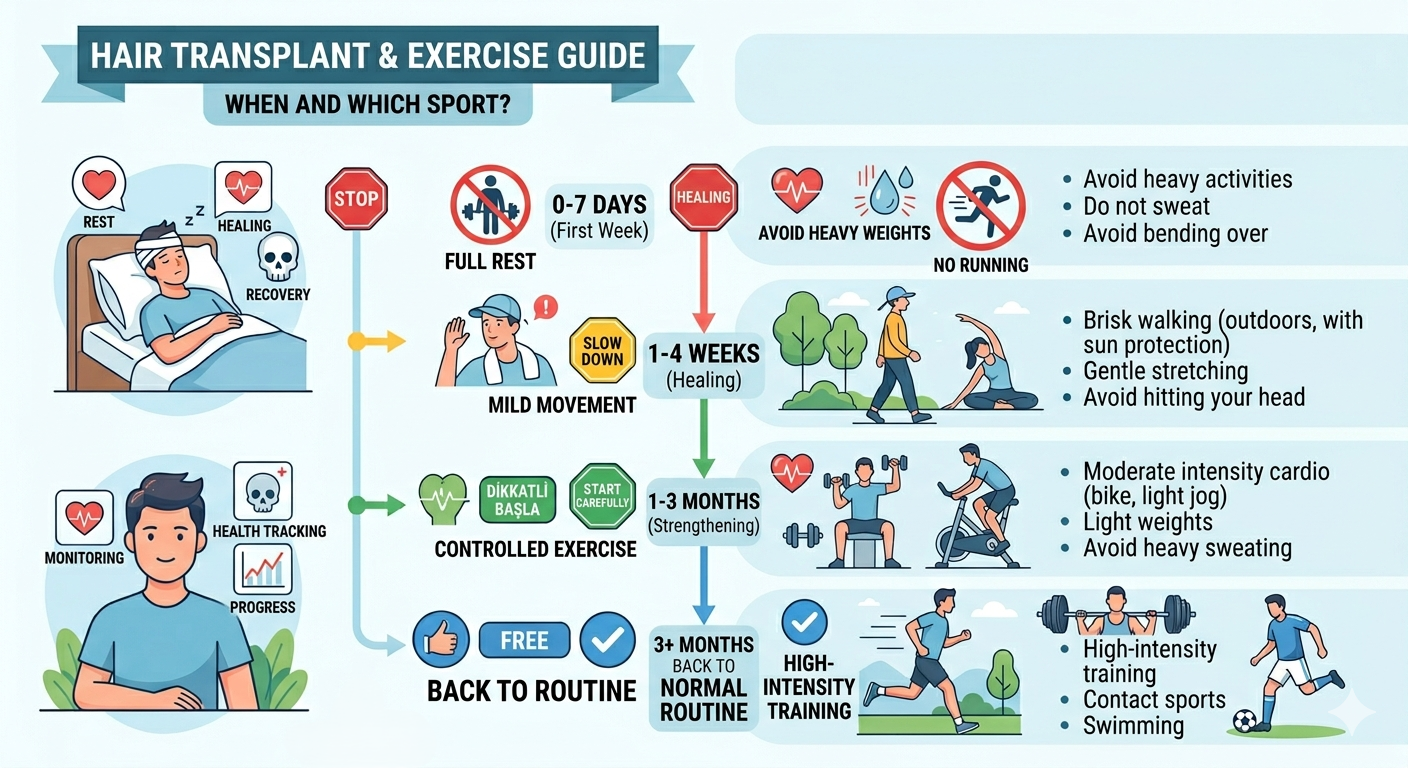
The first fourteen days after a hair transplant represent the most critical phase of physical restriction. During this period, the grafts are establishing their blood supply, the scalp is healing from thousands of small wounds, and the body is devoting significant resources to the initial recovery process.
During weeks one and two, the following categories of physical activity should be avoided entirely.
Any cardiovascular exercise that raises the heart rate significantly — running, cycling, rowing, swimming, HIIT training — is off limits. The elevated heart rate drives increased blood pressure, which increases blood flow to the scalp, which is exactly what the healing grafts don’t need in this window.
Weight training and resistance exercise carry similar concerns. Heavy lifting, in particular, creates significant intra-abdominal pressure through the Valsalva effect — the breath-holding that naturally occurs during maximal efforts — which directly elevates blood pressure and intracranial pressure. A patient doing a heavy deadlift or squat in week one is creating a physiological environment that is not compatible with graft stability.
Yoga and stretching that involves significant inversion — downward-facing dog, forward folds, anything that brings the head below the level of the heart — also raises blood pressure to the scalp and should be avoided in the first two weeks.
Swimming carries multiple risks in this phase: chlorine in pool water irritates healing scalp tissue, the activity raises heart rate, and the mechanical contact of water at any significant pressure can disturb scabs. Open water swimming involves bacterial exposure that is a genuine infection risk for a healing scalp.
What is permitted in the first two weeks is genuine rest movement — slow walking at a pace that doesn’t raise the heart rate meaningfully, gentle daily movement around the house, and the kind of light activity that keeps circulation normal without stressing the healing scalp. The threshold to hold in mind is whether you’re breathing heavily or feeling your pulse significantly. If yes, it’s too much.
Weeks Two to Four: Careful, Graduated Return
After the two-week mark, the grafts have integrated into the surrounding tissue. They are no longer at risk of physical dislodgement from normal elevation in blood pressure, and the healing wounds in the recipient and donor areas have closed substantially. The restriction framework shifts from complete avoidance to careful, graduated reintroduction.
Light cardiovascular activity can typically begin around days fourteen to sixteen for most patients, subject to how healing has progressed. This means genuinely light activity — a brisk walk, a slow steady-state cycle at low resistance, gentle movement that elevates the heart rate moderately without pushing into intense effort.
The test for whether an activity is appropriate in this window is not the category of exercise but the physical response. If you can maintain a conversation while doing it, you’re likely within a safe intensity range. If you’re breathing hard, sweating significantly, or feeling your heart rate at a level you’d associate with actual training, you’ve exceeded what this phase supports.
Resistance training can begin to return in weeks three and four, but with significant modifications. Light weights, machines rather than free weights, movements that don’t involve the Valsalva effect, and a general rule of staying well below the weights you’d normally train with. The goal in this phase is movement and muscle maintenance, not training stimulus. Anything that requires genuine effort or breath-holding is too early.
The scalp should be checked after any exercise session in this window. Minor sweating during light activity is manageable with gentle cleaning per your clinic’s instructions, but if you’re sweating enough to drip from the hairline onto your face, the intensity is too high.
Contact sports, water sports, and anything with fall risk remain off limits through this entire phase. The healing is progressing, but these activities carry risk mechanisms — impact, contact, potential falls — that don’t resolve with the same timeline as general cardiovascular restriction.
The Sweat Management Question
A practical concern for patients returning to exercise in weeks two through four is managing sweat on the healing scalp. This is worth addressing specifically because it affects how patients approach the return to training.
Light sweating during genuinely light activity in weeks two to four is generally manageable. Cleaning the scalp gently after exercise, using the washing protocol your clinic has recommended, reduces the bacterial concern that sweat introduces. The key word is gently — aggressive post-exercise washing that involves rubbing, scrubbing, or significant friction is still not appropriate in this phase.
The concern about sweat is not binary. A slight sheen of perspiration during a slow walk is different from the heavy sweating of a high-intensity training session. The former is manageable with proper hygiene. The latter creates conditions on the healing scalp that are genuinely risky in the weeks when the donor and recipient areas are still completing their surface healing.
Patients who train in hot environments — outdoor running in warm weather, non-air-conditioned gyms — will sweat more at the same intensity than those training in climate-controlled environments. This is worth factoring into the return-to-exercise decisions during weeks two to four. An activity that’s appropriate in a cool gym might be too sweaty in an outdoor summer setting.
Month One to Two: Return to Normal Training
For most patients, the return to normal training intensity becomes appropriate somewhere between four and six weeks after the procedure. By this point the grafts are fully integrated, the scalp surface has healed, and the physiological risks of the early recovery phase have resolved.
This doesn’t mean walking back into the gym at week four and immediately returning to pre-procedure training loads. The body has had a period of reduced activity, and reconnecting with training should follow the same gradual return that would apply after any period of deconditioning.
Standard cardiovascular exercise — running, cycling, rowing — can return to normal intensity around week four to five for most patients. The heart rate and blood pressure concerns that restricted intensity in the earlier phases no longer apply in the same way.
Resistance training can return to normal programming — including compound movements, heavier loads, and efforts that involve the Valsalva effect — around weeks four to six. The specific timeline depends on individual healing and the advice of your clinic, but by six weeks the physiological basis for the heavy lifting restriction has resolved for the vast majority of patients.
Swimming in treated pools can typically return around week four, when the scalp surface has healed completely and chlorine exposure no longer poses an irritation risk to healing tissue. Open water swimming can return on a similar timeline, though this depends on the specific environment.
Contact Sports and High-Risk Activities
Contact sports occupy a different restriction category than general exercise because the risk mechanism — physical impact to the head — doesn’t resolve with the same timeline as the cardiovascular and sweat-related concerns.
Boxing, martial arts, wrestling, rugby, football, basketball, and any activity where direct contact to the head is possible require a longer restriction period. Most clinics recommend waiting a minimum of four weeks before returning to non-contact versions of these sports, and a minimum of six to eight weeks before returning to full contact training.
The specific concern is that impact to the transplanted area — from a punch, a ball, a fall, another player — during the period when the scalp is still healing can disrupt both the superficial healing process and, in the early weeks, potentially dislodge grafts. By weeks six to eight, the grafts are fully integrated and the risk from impact is no different from the risk to any normal area of scalp. Before that point, unnecessary exposure to contact sport risk is hard to justify.
Activities with significant fall risk — skiing, mountain biking, climbing, skateboarding — carry similar logic. A fall that contacts the head in week three carries risks it wouldn’t carry in week eight. If these activities are part of your regular life, the appropriate timeline for returning to them is in the six to eight week range, not the four week range.
Swimming: The Special Case
Swimming deserves its own discussion because it involves multiple simultaneous concerns that apply at different timescales.
Pool water contains chlorine, which is an irritant to healing scalp tissue. In the first two weeks, pool swimming is completely off limits. In weeks two to four, even as light activity becomes possible, pool swimming remains restricted because the scalp surface is still completing its healing process and chlorine exposure can cause irritation and discomfort that interferes with recovery.
By week four to five for most patients, the scalp has healed sufficiently that pool swimming no longer poses a meaningful irritation risk. Thorough rinsing after swimming — to remove chlorine from the scalp — remains advisable through the first couple of months, but the risk has substantially resolved.
Open water swimming carries additional concerns beyond chlorine — bacteria in lakes, rivers, and the sea can be more diverse and potentially more concerning than in treated pool water. For this reason, some clinics extend the open water swimming restriction slightly beyond the pool swimming timeline, particularly for ocean swimming which also involves salt water that can be irritating to recently healed scalp tissue.
Competitive swimmers who train daily face a particularly challenging return-to-sport timeline relative to most athletes. The combination of sustained cardiovascular intensity, significant scalp sweating beneath a swim cap, and repeated chlorine exposure means that returning to full swim training is typically appropriate around week four to five at the earliest, and should begin with reduced volume and intensity rather than returning immediately to pre-procedure training loads.
The Gym Environment and Infection Risk
Beyond the physiological concerns related to heart rate and sweat, gym environments carry a specific infection risk concern in the early healing phase that’s worth understanding.
Gym equipment — weights, benches, machines — carries bacterial load. Gyms are high-traffic environments with shared surfaces that, even in well-maintained facilities, represent a different bacterial exposure than a home environment. For a patient with a healing scalp in the first two weeks, spending time in a gym environment adds unnecessary exposure risk even if they’re not exercising intensely.
This is one reason why the first two weeks of recovery are better spent at home rather than at the gym, even for activities light enough that they might otherwise be permissible. A slow walk on a home treadmill is lower risk than a slow walk on a gym treadmill in terms of environmental bacterial exposure to a healing scalp.
From week two onward, the scalp’s surface healing has progressed enough that gym environments no longer represent meaningfully elevated risk beyond general hygiene considerations. The infection concern that makes gym avoidance appropriate in week one does not extend through the full restriction period — it’s specific to the earliest healing phase.
Monitoring Your Scalp During the Return to Exercise
As you begin reintroducing exercise in weeks two through four, paying attention to how your scalp responds to each session gives useful information about whether the progression is appropriate.
Signs that an exercise session was within appropriate limits include normal post-exercise scalp appearance with no unusual redness beyond what was present before the session, no bleeding or discharge from the recipient or donor area, and no significant increase in discomfort or tenderness compared to the pre-exercise baseline.
Signs that an activity was too intense or too early include unusual redness or warmth in the recipient area following exercise, any bleeding — even minor — from the scalp during or after exercise, increased swelling, or discomfort that is meaningfully worse than baseline after the session.
If any of these occur, step back in intensity and give the healing more time before attempting the same activity again. A conservative return to exercise that takes an extra week or two beyond the minimum timeline costs very little relative to the risk of pushing the healing process faster than it can support.
The Mental Side of the Exercise Restriction
For patients who train regularly, the exercise restriction period has a psychological dimension that deserves acknowledgment. Exercise is not just physical for most committed athletes and gym-goers — it’s a stress management tool, a routine that anchors the day, a significant source of wellbeing.
Removing that routine for several weeks at a time when the patient is also managing the anxiety and uncertainty of the early hair transplant recovery period compounds the psychological challenge of the process. Some patients find the exercise restriction harder to deal with than the physical discomfort of recovery itself.
The most useful reframe is to treat the restriction period as a legitimate and purposeful phase of the process rather than a passive waiting period. The weeks of reduced activity are not empty time — they are the period during which the grafts are establishing themselves, the scalp is healing, and the foundation of the result is being built. Using that time for sleep, nutrition, hydration, and the mental rest that recovery requires is genuinely supportive of the outcome rather than simply a concession to medical caution.
Most athletes find that returning to training at week four or five feels more normal than expected. The fitness loss from four to six weeks of reduced activity is real but not dramatic for most people, and it recovers quickly once training resumes. The result that the restriction period protected, on the other hand, is permanent.
A Practical Timeline Summary
The return to exercise after a hair transplant follows a staged progression that reflects how the healing process actually works rather than an arbitrary set of rules.
In the first two weeks, genuine rest is the appropriate approach. Slow walks and light daily movement are fine. Anything that raises the heart rate significantly, causes sweating, or involves the gym environment is not appropriate during this phase.
In weeks two to four, light cardiovascular activity at conversation pace can return. Light resistance training with significant load reduction is appropriate from around week three. Sweating should be managed with gentle post-exercise cleaning. Contact sports and swimming remain restricted.
From week four onward, normal cardiovascular training can progressively return to full intensity. Resistance training can return to normal programming including heavy compound movements. Swimming in treated pools becomes appropriate around weeks four to five. Contact sports and high-risk activities clear around weeks six to eight.
The specific timeline for any individual patient should be confirmed with the clinic that performed the procedure, as variation in technique, graft count, individual healing rate, and other factors can shift these windows in either direction.
What doesn’t vary is the underlying logic: the restrictions exist because the healing process has specific requirements at specific stages, and exercise that’s appropriate at week six was genuinely risky at week one. Respecting that distinction is what allows the hair transplant timeline to produce the result it’s designed to produce — and what allows you to return to full training with a result worth training around.
Find this helpful? Add Hairpol as a preferred source on Google.
Get a Free Consultation
Answer a few questions and the medical team will review your situation.
