
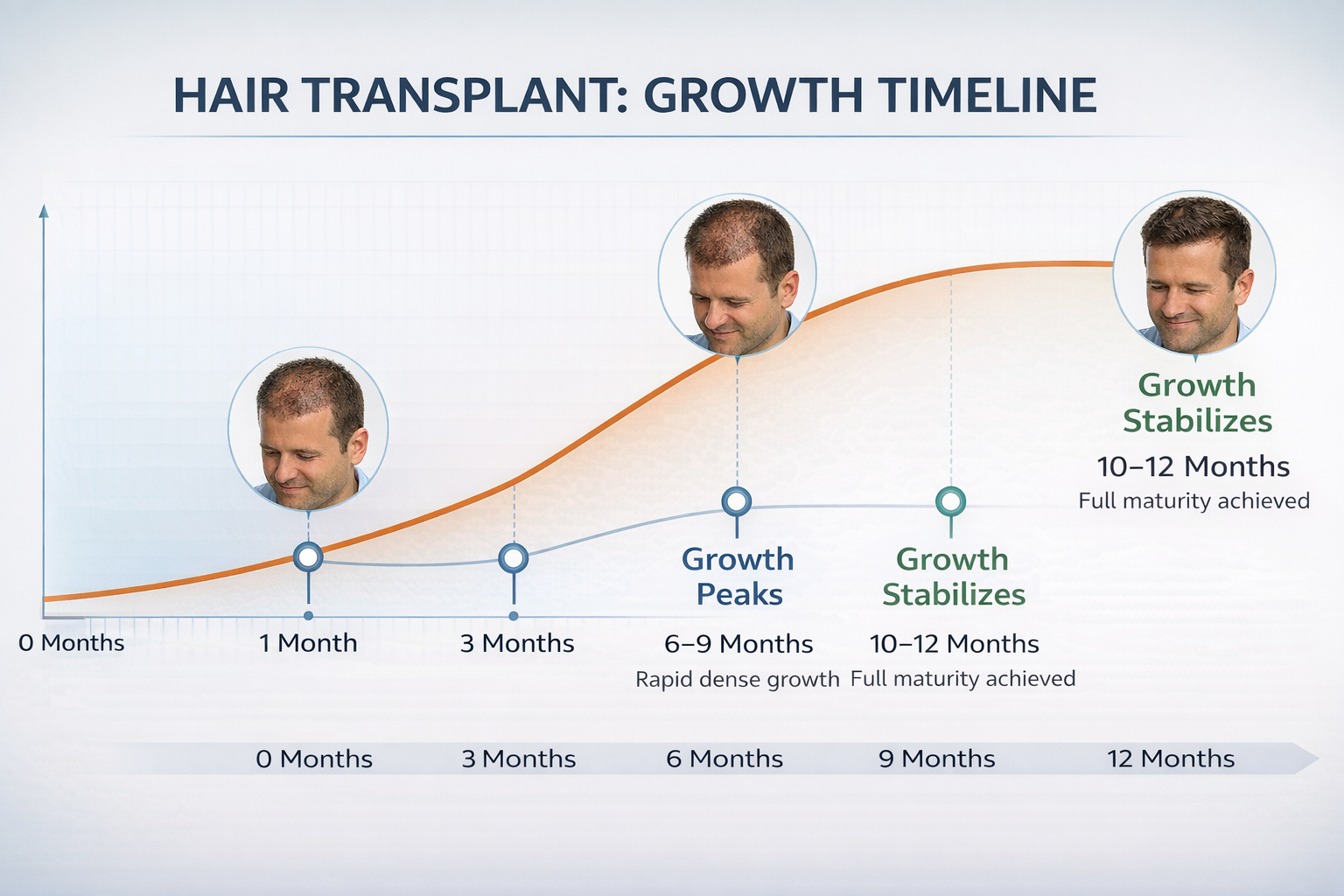
If you’re considering a hair transplant or you’ve already had one, the most useful thing you can understand is the hair transplant timeline. Not the hype version. The real version.
Because most anxiety, regret, and confusion after a transplant comes from one mistake: expecting the timeline to be faster, smoother, or more linear than it actually is.
Hair growth after a hair transplant is slow for a reason. Follicles need to heal, reset, shed the hair shaft, and then re-enter the growth cycle. That process takes months, not weeks. And even when growth starts, it doesn’t grow evenly or at the same speed for everyone.
This guide explains the full hair transplant timeline, what’s happening under the skin at each stage, when growth usually starts, when it tends to peak, and when it stabilizes in a way that feels “final.”
Why the Hair Transplant Timeline Works This Way
A hair transplant relocates follicles from the donor area to thinning or bald areas. Those follicles survive, heal, and then continue their normal hair cycle. The key is that the hair cycle includes phases where hair naturally sheds and rests.
After surgery, follicles can enter a resting phase (telogen) before they produce new hair. This is why you can see shedding early and then “nothing” for a while.
So the timeline isn’t designed to torture you. It’s designed by biology.
Days 1–10: Healing, Scabbing, and Early Recovery
This stage is mostly about protecting grafts and letting the scalp heal.
What You Typically See
- Redness and tenderness
- Scabs forming in the recipient area
- Swelling (often around the forehead in the first days)
- Donor tightness or soreness
What’s Actually Happening
- The grafts are settling into place
- The scalp is closing micro-incisions
- Early inflammation is part of normal healing
This is not “growth time.” It’s “stabilize the environment” time.
Weeks 2–4: Scabs Fall Off and the Scalp Looks Cleaner
This is the period where many people feel relieved because the scalp looks less dramatic.
What You Typically See
- Scabs softening and falling off
- Redness gradually reducing (varies by skin type)
- Some itchiness
- The donor area looking more normal
What’s Actually Happening
- The skin continues healing
- The follicles remain under the surface
- Early recovery settles, but the hair cycle is still resetting
Some people think the hardest part is over here. Visually, maybe. But emotionally, the next phase is often tougher.
Weeks 3–8: Shedding Starts (This Is Normal)
This is where many patients panic. Transplanted hair begins to shed, and sometimes native hair sheds too (shock loss).
What You Typically See
- Transplanted hairs falling out during washing
- Hairline looking thinner than expected
- Patchy appearance in some areas
- Temporary shedding of native hair around the zone
What’s Actually Happening
- The hair shafts shed, but follicles remain alive
- Many follicles enter resting phase before regrowth
- The scalp is transitioning from healing to growth readiness
This is one of the most misunderstood parts of the hair transplant timeline. Shedding is often not failure. It’s part of the reset.
Months 2–3: The “Quiet Phase” (Nothing Seems to Happen)
This phase frustrates people because it feels like the transplant is stuck.
What You Typically See
- Little visible growth
- Continued thin appearance in some zones
- Scalp may look normal but not “full”
What’s Actually Happening
- Follicles are in resting phase
- The body is re-establishing normal cycling
- Early regrowth may begin under the surface
This is where patience matters most. Many people judge the result too early here, even though the real work is just beginning.
Months 3–4: Growth Starts (But It’s Not Impressive Yet)
If you want the clearest answer to “When does growth start?” it’s usually around this window for many patients.
What You Typically See
- Small new hairs emerging
- Uneven growth between sides
- Thin, soft, sometimes wiry hair texture
- A slightly improved look, but still not “done”
What’s Actually Happening
- Follicles re-enter active growth (anagen)
- Hair shafts begin pushing through the scalp
- Early hairs may be finer and less mature
This is growth starting, but it’s early growth. It’s like seedlings, not a finished garden.
Months 4–6: Visible Improvement Becomes Noticeable
This is when many patients start feeling relief. The “nothing is happening” stage fades, and you can finally see progress.
What You Typically See
- More consistent growth across the transplant zone
- Better hairline softness as hairs lengthen
- Less scalp visibility in normal lighting
- Still thinner under harsh overhead light
What’s Actually Happening
- More follicles enter active growth
- Hair begins to gain length and some thickness
- Direction starts blending better as hairs lay down
Many people describe months 4–6 as the “it’s working” period.
Months 6–9: Growth Peaks for Many People
This is where the term “peak” becomes relevant. Peak doesn’t mean “final.” It means the period of fastest and most noticeable improvement.
What You Typically See
- Strong increase in density appearance
- Hair thicker and easier to style
- Better coverage in photos and daily life
- Hairline looks more natural and blended
What’s Actually Happening
- A high portion of transplanted follicles are actively growing
- Hair shafts mature in diameter
- The scalp environment is more stable
For many patients, the biggest change happens here. If you’re waiting for that “wow” moment, it often lives in this window.
Months 9–12: Stabilization Begins (The Result Looks More Consistent)
By this stage, the result often starts feeling more stable and predictable. You still may see improvements, but they’re slower and more subtle.
What You Typically See
- Density looks more even month to month
- Hair texture feels more like your natural hair
- Less day-to-day fluctuation in appearance
- More confidence with haircuts and styling
What’s Actually Happening
- Hair continues maturing
- Growth rate becomes less dramatic
- More follicles settle into a stable cycle
This is where a lot of patients start saying “It feels like mine now.”
Months 12–18: Final Maturation (Especially for Crown Work)
Some people think month 12 is the end. For many it’s close, especially for frontal work. But for certain zones, especially the crown, maturation can continue longer.
What You Typically See
- Slight continued thickening
- Better blending and texture
- Crown density sometimes improves later than front
What’s Actually Happening
- Slow maturation of hair shafts
- Continued cycling and thickening
- Late bloomers catching up
This is why some clinics describe final results as closer to 12–18 months depending on the case.
When Does Growth Start, Peak, and Stabilize?
Here’s the simple summary within the hair transplant timeline:
When Growth Starts
- Often becomes noticeable around months 3–4
- Can vary depending on individual cycling and healing
When Growth Peaks
- Often feels most dramatic around months 6–9
- This is when visual density improvements accelerate
When Growth Stabilizes
- Many people feel more stable around months 9–12
- Final maturation can continue up to 12–18 months, especially in the crown
These are typical ranges, not guarantees. But they match how follicles usually behave after transplantation.
What Can Shift the Hair Transplant Timeline?
Not everyone follows the same schedule. Growth can be faster or slower based on:
- hair caliber (thicker hair often looks better earlier)
- scalp sensitivity and redness duration
- shock loss occurrence
- diffuse thinning vs localized recession
- smoking and lifestyle factors
- aftercare consistency
- the zone transplanted (crown often appears slower)
The important thing is not comparing your timeline to someone else’s. Compare your progress to your own monthly photos.
How to Track Progress Without Misreading the Timeline
If you want to judge your result accurately:
- Take photos once a month, not daily
- Use the same lighting and angles
- Use similar hair length and styling
- Compare month-to-month trend, not week-to-week panic
- Don’t judge density under the harshest lighting of your day
This reduces false disappointment and helps you see real progress.
The Most Honest Way to Think About It
The hair transplant timeline is not a straight upward line. It’s more like:
- healing
- shedding
- waiting
- slow growth
- faster growth
- gradual stabilization
If you expect that shape, you’ll feel calmer through the whole journey.
For Hairpol patients, this is also why follow-up support matters. When you know what stage you’re in and what’s normal, you don’t waste months worrying about a phase that was always part of the plan.
A hair transplant is a long game, but when you understand the timeline, it stops feeling like uncertainty and starts feeling like a predictable process.
Frequently Asked Questions (FAQ)
When does hair growth start after a hair transplant?
For many patients, noticeable growth often starts around months 3–4. Early hairs can appear thin, soft, and uneven at first, because follicles are re-entering the active growth phase after a resting period.
Is shedding normal in the hair transplant timeline?
Yes. Shedding commonly begins between weeks 3–8. Transplanted hair shafts can fall out while follicles remain alive under the skin, and some people may also experience temporary shedding of nearby native hair.
What is the “quiet phase” after a hair transplant?
The quiet phase usually happens around months 2–3, when visible growth seems minimal and the scalp can look unchanged. During this period, follicles are often in a resting phase while the body re-establishes normal cycling before regrowth becomes visible.
When does hair transplant growth peak?
Growth often feels most dramatic around months 6–9. This is when density appearance improves faster, hair becomes easier to style, and many patients notice the biggest visual change.
When do hair transplant results stabilize?
Many people feel results become more consistent around months 9–12, with slower but ongoing improvements. Final maturation can continue up to 12–18 months, especially for crown work.
Why does the hair transplant timeline look worse before it looks better?
Early healing, scabbing, and the shedding phase can temporarily make the area look thinner. This doesn’t usually mean failure—it’s part of follicle resetting and the normal transition from healing to growth readiness.
Why does crown growth often take longer than the front?
The crown area can mature more slowly, so thickening may continue beyond month 12. Many patients see later improvements in crown density compared to frontal zones.
How should you track progress without misreading the timeline?
Take photos once a month in the same lighting and angles, and compare month-to-month instead of day-to-day. Consistent photo tracking helps you see real trends and avoid panic based on normal short-term fluctuations.
Find this helpful? Add Hairpol as a preferred source on Google.
Get a Free Consultation
Answer a few questions and the medical team will review your situation.
