
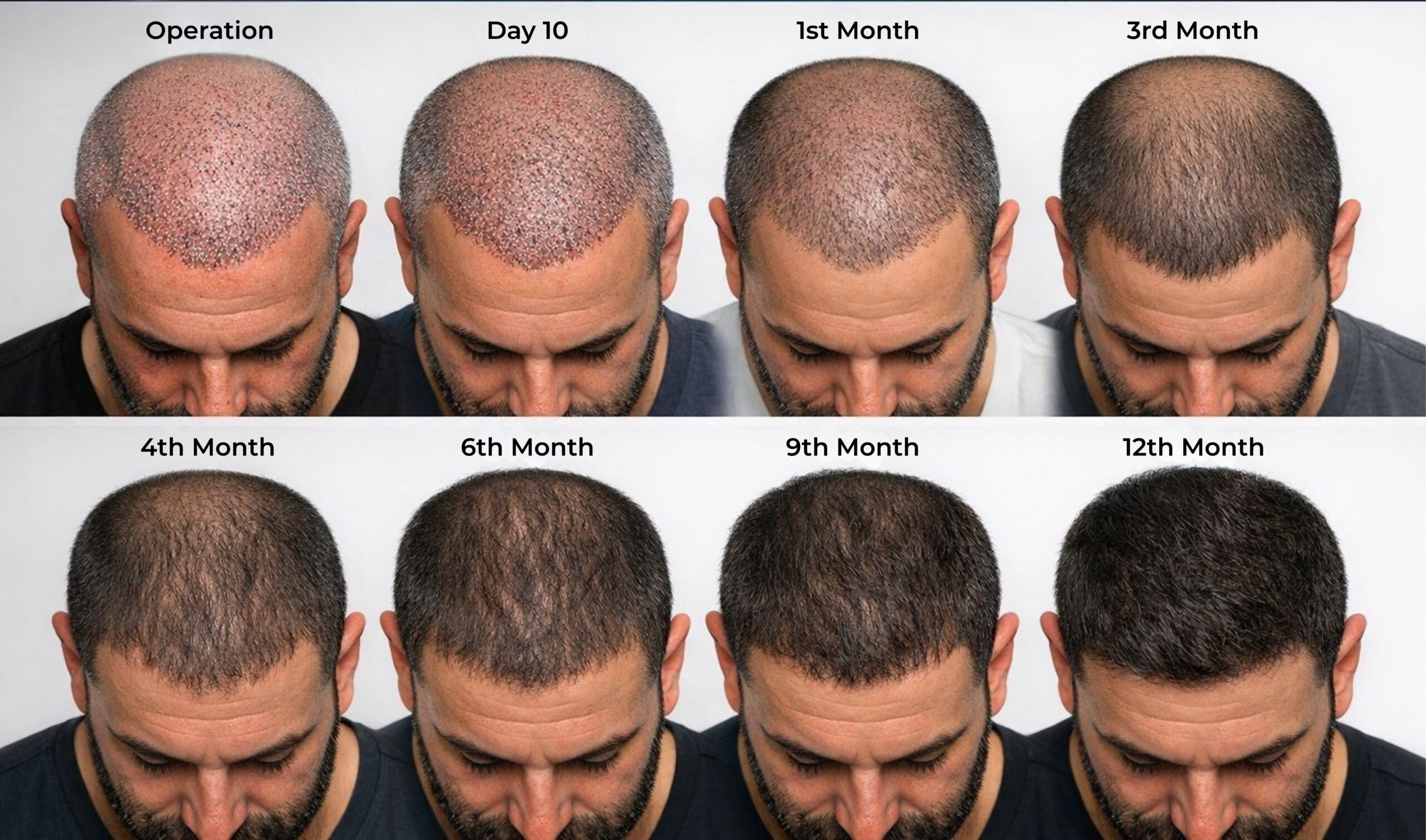
If you’ve had a hair transplant (or you’re planning one), the most important thing you can understand is what actually happens after surgery, step by step. Not the clean, simplified marketing version. The real version, including the parts that feel confusing, slow, or emotionally annoying.
The hair transplant timeline is not a straight line. Many patients look better, then worse, then better again. Hair sheds before it grows. Growth starts quietly. Density shows up late. Texture changes. Lighting changes everything. And if you don’t expect those phases, you might assume something is wrong when, in reality, your body is doing exactly what it’s supposed to do.
This guide walks you through the full hair transplant timeline from Day 1 to Month 12, including what you’ll see, what you’ll feel, what’s happening under the skin, and when most people stop stressing about it.
Day 1: The “This Is Real Now” Day
The first day after a hair transplant is usually a mix of relief and uncertainty. You’re hyper-aware of your scalp and you’re trying to move carefully.
What You’ll See
- Fresh graft sites in the recipient area
- Early redness
- Small blood dots or crusting starting
- Donor area looking irritated or tender
What You’ll Feel
- Tightness or soreness in the donor area
- Mild burning or sensitivity
- Some swelling beginning (often mild at first)
What’s Happening
- The grafts are settling into newly created sites
- The scalp begins closing micro-incisions
- Early healing starts immediately
This is not the day to judge “density.” Everything looks intense because it’s fresh.
Days 2–3: Swelling, Tenderness, and High Awareness
These days are often the most physically noticeable.
What You’ll See
- Increased redness in the recipient area
- Swelling that may move toward the forehead
- Scabs beginning to form more clearly
What You’ll Feel
- Tightness, especially in donor
- Itching starting for some patients
- A “helmet” feeling on the scalp
What’s Happening
- Inflammation and fluid response peak early
- Your scalp is protecting and stabilizing the grafts
If you’re worried about how “obvious” it looks, yes, it can be obvious at this stage. That’s normal in the early hair transplant timeline.
Days 4–7: Scabs Set In and the Routine Begins
By now, you’re usually adjusting to aftercare routines. This is where consistency matters most.
What You’ll See
- Scabs becoming darker and more defined
- Redness still present
- Donor area starting to calm down slightly
What You’ll Feel
- Itching can increase
- Donor soreness starts fading for many
- Sleep might still feel awkward
What’s Happening
- Scabs protect healing sites
- Grafts anchor more firmly with time
- Skin continues repairing
This is when many patients make mistakes by scratching or “helping” scabs off. Don’t. Let them soften naturally.
Days 8–10: Scabs Begin to Loosen
This phase can feel like the end of the most visible stage.
What You’ll See
- Scabs starting to soften and detach with washing
- Redness gradually lightening (varies by skin type)
- Recipient area looking cleaner each day
What You’ll Feel
- Itching often peaks around this window
- Less tightness overall
- Still some sensitivity in both zones
What’s Happening
- The outer healing layer is transitioning
- The scalp is moving from “protect” to “normalize” mode
Many people feel relief here, but remember: the next major phase is shedding.
Week 2: “I Look Normal-ish Again” (But It’s Not the Finish)
Around week 2, many patients look much more socially presentable.
What You’ll See
- Most scabs gone or nearly gone
- A more even scalp surface
- Mild redness that can still show under harsh light
What You’ll Feel
- Less discomfort
- Slight numbness or tingling in some areas
- Continued mild itching or dryness
What’s Happening
- Skin healing continues deeper
- Follicles are stable under the surface
- The hair cycle begins to reset
This is a calm-looking stage, but it’s not a “result” stage yet.
Weeks 3–4: Shedding Starts (And People Panic)
This is where confusion begins for many patients. You might see transplanted hairs falling out and think something failed.
What You’ll See
- Transplanted hairs shedding
- The hairline looking thinner
- Sometimes patchy appearance in the transplant zone
- Possibly shock loss in native hair nearby
What You’ll Feel
- Less physical discomfort
- More emotional stress than physical stress
- “Why am I losing hair?” thoughts
What’s Happening
- Hair shafts shed, follicles remain
- Many follicles enter resting phase (telogen)
- The scalp prepares for regrowth later
This shedding phase is one of the most normal parts of the hair transplant timeline. It’s not the grafts “falling out.” It’s the visible hair shedding before new growth.
Weeks 5–8: The Quiet Stretch
By the second month the drama is mostly over, and that is exactly what makes this stretch hard. Nothing hurts, nothing is crusted, and nothing is growing that you can see. Most of the shedding that started around weeks two and three has finished by week eight, so the recipient area often looks close to how it did before surgery, and sometimes a little worse if shock loss has thinned the native hair around it.
What You’ll See
- A recipient area that looks short, sparse, or almost untouched
- Pinkness fading, though on very fair skin it can linger for a few more weeks
- The donor area blending back in as the surrounding hair grows
What You’ll Feel
- Patches of numbness or tingling, which usually ease over the following months
- An occasional itch as the skin finishes remodelling
- Impatience, and the urge to check the mirror every morning
What’s Happening
- Follicles are resting in telogen, alive and anchored under the skin
- The small blood vessels around each graft are maturing
- Native hairs pushed into shedding by surgery are preparing to cycle back
If you want the day-level detail of how you got here, our guide to the first 30 days day by day covers every band up to the end of month one. And if the thinning around the transplant worries you more than the grafts themselves, read how long shock loss lasts before you draw conclusions. In most patients it is temporary.
Months 2–3: Before Anything Shows
This is the window most patients describe as the longest. The calendar says two months have passed, the mirror says nothing has happened, and the photos from surgery day look more impressive than your scalp does now. Clinicians sometimes call it the ugly duckling phase. It is completely ordinary.
What You’ll See
- Little visible change from one week to the next
- A few early hairs near the hairline in some patients, none at all in others
- Occasional small spots or ingrown hairs as new shafts push toward the surface
What You’ll Feel
- Physically, close to normal
- Emotionally, the most doubt of the whole year
What’s Happening
- Follicles begin moving from rest into the growth phase (anagen)
- New shafts are forming below the surface, weeks before they break through
What you see at months two and three predicts almost nothing about month nine. Two patients with very different graft survival look nearly identical at this point, because both are waiting on the same biology. The most useful thing you can do is take one photo a month in the same light, then put the phone down.
Months 3–4: First New Growth
Somewhere between the third and fourth month, new hair growth after a hair transplant becomes visible. It rarely arrives the way people imagine. The first hairs are fine, light and sometimes slightly wavy, and they come through in scattered patches rather than as an even lawn.
What You’ll See
- Thin, short hairs emerging, often first at the hairline
- Uneven coverage, with some zones ahead of others
- Hair that looks lighter in colour and finer than your native hair
What You’ll Feel
- Relief that something is finally happening
- Disappointment, if you expected density by now
What’s Happening
- More follicles enter anagen every week
- Each new shaft starts at its thinnest and thickens over the coming months
Month four is where a lot of unnecessary worry starts. Short, fine hair lets light through, so the scalp shows more than it will later, even when the graft count is exactly where it should be. We go through the optics in detail in why density looks thin at first. If you are at month four and genuinely unsure whether your progress is on track, a few clear photos usually settle it: you can send them to our medical team and get an honest read instead of a forum guess.
Months 5–6: The Visible Change
For most people, months five and six are the turning point. Hair transplant results at 6 months are not final, but they are real. Friends start noticing, the hairline holds a shape, and you can style your hair rather than arrange it to hide the scalp.
What You’ll See
- Clear coverage across the frontal zone
- Hair long enough to cut and style
- The crown, if it was treated, often still behind the front
What You’ll Feel
- Confidence coming back, often quite suddenly
- A new kind of impatience, this time about density
What’s Happening
- Most transplanted follicles are now actively growing
- Shafts are lengthening and slowly gaining thickness
Many patients see a clear, visible part of their eventual result by month six, although this varies from person to person, and it explains why the six-month photo feels so different from the four-month one. What happens between here and the end of the first year is less about new hairs and more about thicker ones, a shift we break down in FUE results at 6 months vs 12 months.
Months 7–9: Density and Texture
This is usually the most satisfying part of the hair transplant timeline month by month. The number of hairs changes less now. What changes is each hair: shafts thicken, darken and settle into their natural direction, and that alone makes the same graft count look noticeably fuller.
What You’ll See
- Visibly better density at normal viewing distance
- Texture that may stay a little wiry or wavy before it softens
- The hairline blending into the native hair around it
What You’ll Feel
- Sensation almost back to normal across most of the scalp
- Less need to check, more time simply living with your hair
What’s Happening
- Hair calibre increases as the follicles mature
- Later-starting follicles keep emerging, especially in the crown
It is also the right moment to think about the hair that was never transplanted. Grafts taken from the donor zone tend to keep growing, but the native hair around them can keep thinning, and that is the most common reason a good result looks weaker a few years on. Whether you need a medical hair treatment to protect it, and which one, is a decision for your doctor. Minoxidil, finasteride and their doses should only be started or changed with your physician’s approval.
Months 10–12: The Result Takes Shape
By the end of the first year, your hair transplant results after 12 months can finally be judged. For most patients the frontal zone looks close to finished, and the photo taken at month twelve is the one worth comparing against your starting point.
What You’ll See
- Stable density and a natural-looking hairline
- Hair that behaves like the rest of your hair when you cut, wash and style it
- A slight see-through effect under harsh overhead light, which is normal
What You’ll Feel
- Normal sensation in nearly all patients
- Usually, the sense that you can stop counting months
What’s Happening
- Most of the final result is typically in place
- Hair keeps thickening slowly, particularly in later-starting areas
Twelve months is the honest point to judge a hairline. Not month six, not month nine. If you want to calibrate your expectations against real patients at similar stages, our before and after results show what the same timeline looks like on different hair types. At Hairpol, the twelve-month review is where we decide together whether anything else is worth doing, and most of the time the answer is nothing at all.
Beyond 12 Months: Crown and Final Maturation
The hairline is usually the first area to finish and the crown the last. Hair at the crown grows outward in a swirl, so each hair covers less of the visible scalp, and the area tends to start later and mature more slowly. Many patients see the crown keep improving until around month 15 to 18, and some subtle thickening continues into the second year everywhere.
So a crown that looks thinner than the front at month twelve is not, on its own, a sign that something failed. A fair assessment of the crown waits for month eighteen. If the crown was part of your plan, our guide to crown recovery month by month follows that area on its own, slower calendar.
One practical habit is worth keeping: the monthly photo. Change between months twelve and eighteen is real but slow, and it only becomes obvious when you line the pictures up side by side.
Hair Transplant Timeline at a Glance
The short answer: crusts clear by about day 10, transplanted hairs shed somewhere in weeks 2 to 8, new growth starts around months 3 to 4, the visible change arrives at months 5 to 6, density and texture build through month 9, and the result can be judged at month 12, with the crown maturing until about month 18. Every range varies by patient.
| Period | What’s happening | What it looks like |
|---|---|---|
| Days 1–3 | Grafts settle; swelling peaks around days 2 to 4 | Redness, small crusts, possible swelling toward the forehead |
| Days 4–10 | Crusts protect the sites; first gentle washes | Dark crusts that soften and wash off by about day 10 |
| Weeks 2–4 | Skin surface healed; shedding begins | Close to normal, then transplanted hairs start to fall |
| Weeks 5–8 | Follicles rest under the skin; shedding finishes | Short and sparse, sometimes thinner than before surgery |
| Months 2–3 | Follicles move into the growth phase | Little visible change; occasional small spots |
| Months 3–4 | First new hairs break through | Fine, light, patchy growth |
| Months 5–6 | Most follicles actively growing | Clear coverage at the front; hair can be styled |
| Months 7–9 | Hairs thicken and darken | Noticeably fuller; texture settling |
| Months 10–12 | Result largely in place | Natural, stable density at the front |
| Months 12–18 | Late follicles and the crown mature | Crown keeps filling; subtle thickening overall |
Read the table as a map, not a deadline. Two people operated on the same day can sit a month apart on any row and both be perfectly on track.
How Long Is Hair Transplant Recovery? Work, Gym, Travel
There are two answers to how long hair transplant recovery takes. The visible recovery, the part other people notice, is usually 10 to 14 days. The growth recovery, the part you notice, is twelve months or longer. Most everyday questions sit inside the first one.
| Activity | Typical return | Note |
|---|---|---|
| Flying home | 2–3 days after surgery | After your first post-operative check; keep bags and headrests off the grafts |
| Desk work | About 7–14 days | Possible from around day 7; most people wait until the crusts clear at days 10 to 14 |
| Physical work, helmets, hard hats | About 4 weeks | Heat, dust, heavy lifting and pressure on the grafts all wait |
| Walking | First week | Gentle pace, no straining |
| Light cardio | About 2 weeks | Low impact, no head-down positions |
| Gym at moderate intensity | About 4 weeks | Build up gradually; stop if the scalp throbs |
| Heavy lifting, full-intensity training | 6–8 weeks | Contact sports and helmets that press on the grafts can take up to 3 months |
| Pool, sea, sauna | About 4 weeks | Saunas and steam rooms often later; rinse after swimming |
| Direct sun | Avoid completely for 2 weeks | Then a loose hat; sunscreen once your clinic confirms the skin has healed; protect the scalp through the first year |
| Hats | From about day 10 | Loose and breathable, once your clinic confirms the grafts are secure |
For the exercise rows in more depth, our phase-by-phase guide to exercise after a hair transplant explains why each step waits as long as it does. If you are travelling for surgery, the question of how many days to stay in Istanbul comes down to three fixed points: arrival, the procedure, and at least one check before you fly. Most international patients head home two to three days after the operation.
All of these are typical ranges, and your own surgeon’s instructions come first. If you are still at the planning stage and want to see how this timeline would look on your own hair, start with how we approach hair transplantation.
Frequently Asked Questions (FAQ)
How long does a hair transplant take to show results?
A hair transplant does not produce immediate visible results. Most patients begin seeing new growth around months 3–4, with noticeable density improvements between months 6–9. Final results usually appear around month 12, although crown areas may continue improving beyond this stage.
Is it normal for transplanted hair to fall out after surgery?
Yes, shedding is a normal part of the hair transplant timeline. Transplanted hairs often fall out during weeks 3–4, but the follicles remain alive under the skin. This shedding phase is temporary and prepares the scalp for new growth.
When does hair start growing after a hair transplant?
New hair growth typically begins around the third month after a hair transplant. Early growth may appear thin or uneven at first, but density gradually improves over the following months as follicles enter the active growth phase.
When does a hair transplant look natural?
Unnatural results often appear later due to poor initial planning, overly aggressive hairlines, or continued hair loss around transplanted areas. Hair transplantation must be designed to age naturally, not just look good early on.
Why does the hair transplant timeline feel slow?
The hair transplant timeline follows the natural hair growth cycle. Follicles need time to heal, reset, and re-enter the growth phase. Because hair grows gradually, visible improvements happen month by month rather than immediately.
Do all transplanted hairs grow at the same time?
No. Hair follicles grow in cycles, which means transplanted hairs may emerge at different times. This uneven growth is completely normal during the hair transplant recovery process and gradually evens out as hair matures.
Does the crown area take longer to grow after a hair transplant?
Yes, the crown often matures slower than the hairline. While frontal areas may show strong improvement by month 9, the crown may continue developing up to 15–18 months after a hair transplant.
What is the most important thing during the hair transplant timeline?
The most important factor is patience. Following aftercare instructions, avoiding trauma to the grafts, and understanding that growth is gradual helps ensure the best long-term hair transplant results.
Find this helpful? Add Hairpol as a preferred source on Google.
Get a Free Consultation
Answer a few questions and the medical team will review your situation.
