
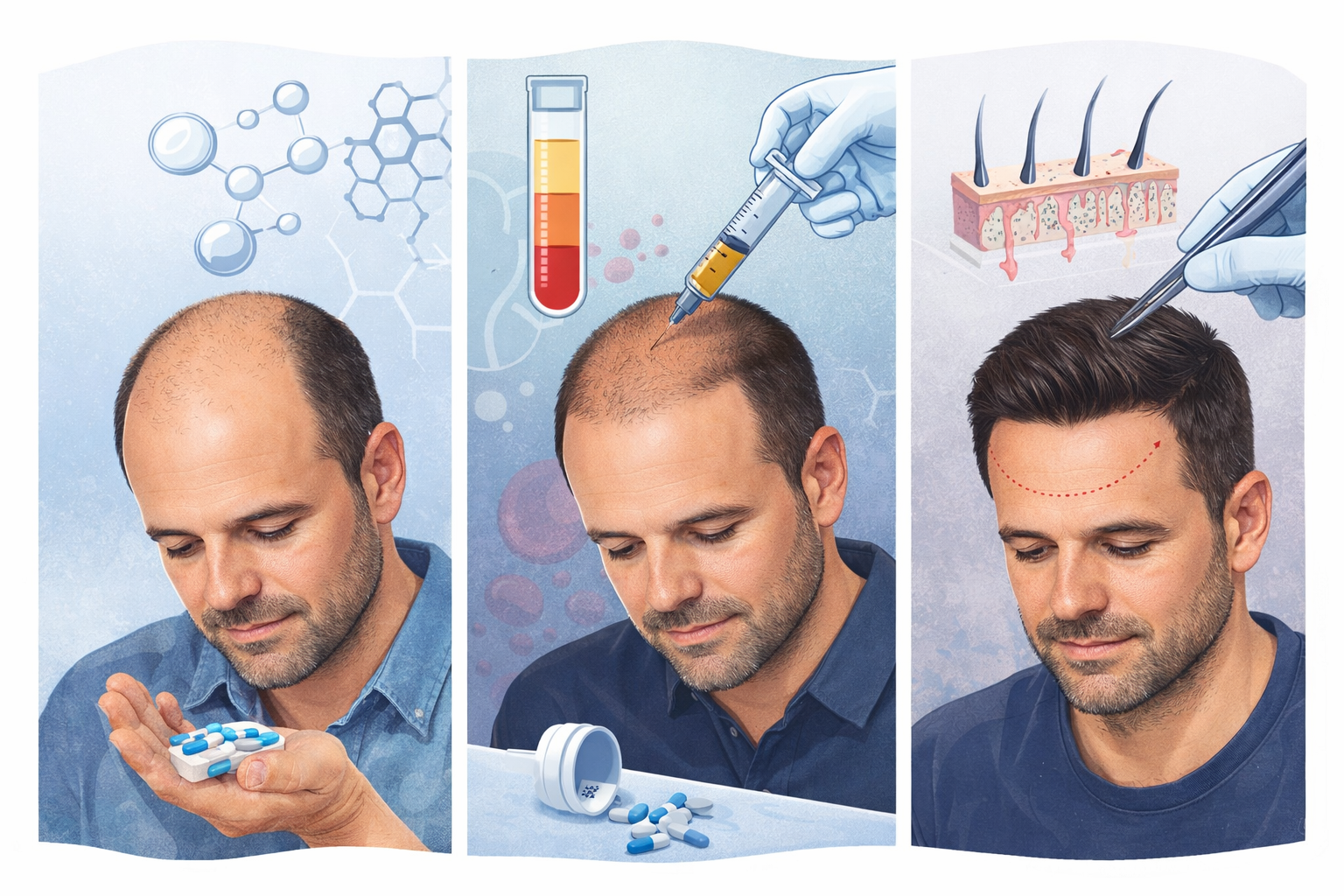
When hair loss begins, most people hope for a solution that does not involve surgery. That hope is understandable. Surgery feels final, serious, and intimidating. PRP sounds modern and regenerative. Medication sounds simple and reversible. A pill, a serum, a few injections. Surely one of these should work.
This is why many people spend years moving between PRP treatments, hair loss medications, supplements, shampoos, and topical solutions before ever considering a hair transplant. Some benefit. Some stabilize their hair. Others quietly lose ground while waiting for something to reverse what is already gone.
The real challenge is not choosing between these options. It is understanding when each one actually makes sense, and when surgery stops being an aggressive choice and becomes the logical one.
At Hairpol, this conversation happens daily. Not as a comparison of treatments, but as a timeline. Hair loss is progressive, and each option fits a different stage of that progression.
Hair loss is not one condition with one solution
One of the biggest misunderstandings around hair loss is treating it as a single problem. In reality, hair loss behaves differently depending on genetics, hormones, age, health, and even lifestyle.
Some people experience slow thinning over decades. Others lose density rapidly in a few years. Some lose hair only at the hairline. Others thin diffusely across the scalp.
Because of this, no single treatment works for everyone. PRP, medication, and hair transplantation are not competitors. They are tools used at different points in the journey.
Understanding what stage you are in matters more than the treatment itself.
What medication can realistically do
Hair loss medications, especially those targeting hormonal causes, are often the first line of defense. Their main role is slowing or stabilizing hair loss, not restoring lost hair.
Medication works best when follicles are still alive but weakened. In these cases, it can help hair grow thicker, reduce shedding, and delay further loss.
However, medication cannot revive follicles that have already stopped producing hair. Once a follicle is inactive for too long, it does not come back. This is where expectations often break down.
At Hairpol, patients are told this clearly. Medication can protect what you have. It cannot replace what is gone.
Another important factor is commitment. Medication only works while you use it. Stopping often leads to resumed hair loss. For some patients, this long-term dependency is acceptable. For others, it becomes frustrating.
Where PRP fits into the picture
PRP (Platelet-Rich Plasma) therapy is often misunderstood as a regrowth treatment. In reality, PRP is best seen as a supportive therapy, not a standalone cure.
PRP can improve scalp health, increase blood circulation, and strengthen existing hair follicles. It can reduce shedding and improve hair quality in early or moderate hair loss.
But like medication, PRP does not create new follicles. It cannot fill bald areas. It cannot rebuild a receded hairline.
PRP works best in two situations. As an early intervention to support thinning hair, or as a complementary treatment after a hair transplant to support healing and growth.
At Hairpol, PRP is never sold as an alternative to surgery when surgery is clearly needed. That distinction matters.
Why many people delay surgery for too long
Surgery feels like a last resort. People worry it means they failed to act earlier, or that hair loss has become severe. In reality, delaying a hair transplant too long can make results harder to achieve.
Hair loss does not pause while treatments are tested. While PRP sessions continue and medications are adjusted, donor hair remains limited and recipient areas may expand.
At Hairpol, many patients say the same thing. They wish they had understood sooner when non-surgical options were no longer enough.
Surgery becomes necessary not because other treatments failed, but because hair loss reached a point where replacement, not stimulation, is required.
The moment surgery becomes the logical option
A hair transplant becomes necessary when hair follicles are no longer producing hair in visible areas. At this stage, no injection or pill can restore density.
Common signs include a clearly receded hairline, visible scalp in the crown, or long-standing bald patches. These areas lack active follicles. They need new ones.
This is not a failure of PRP or medication. It is simply biology.
At Hairpol, surgery is recommended only when analysis shows that non-surgical options cannot realistically achieve the patient’s goals.
Why surgery is not a shortcut, but a reset
Some people view hair transplantation as the fastest solution. In reality, it is the most permanent one.
A hair transplant does not stop future hair loss. It replaces what is already lost using donor hair that is resistant to shedding. That is why planning matters so much.
Surgery resets the landscape. After that, medication or PRP may still be used to protect existing hair and maintain balance.
This combined approach often produces the most natural, long-term results.
Comparing outcomes, not promises
Medication and PRP are ongoing processes. Their results are gradual and often subtle. Surgery is a one-time procedure with delayed but visible outcomes.
Medication requires discipline. PRP requires repetition. Surgery requires patience.
The key difference is permanence. Transplanted hair, when done correctly, is permanent. Medication-dependent hair is not.
This distinction helps patients decide what level of commitment they are comfortable with.
Why some patients need all three
The most effective hair loss strategies often involve a combination of treatments.
- Medication to slow loss
- PRP to support scalp health
- Surgery to restore missing hair
At Hairpol, this integrated approach is common. The goal is not to choose one option, but to use each where it makes sense.
What matters is sequencing. Using the right tool at the right time prevents disappointment.
Cost is rarely the real deciding factor
While cost is part of the discussion, it is rarely the true reason patients choose or avoid surgery.
Most people decide based on emotional readiness. The moment when living with hair loss feels heavier than acting.
At that point, surgery no longer feels extreme. It feels appropriate.
Why honest guidance matters
The hair loss industry often promotes endless treatments without acknowledging their limits. This creates confusion and false hope.
At Hairpol, the responsibility is not to sell procedures, but to guide patients honestly through options. Sometimes that means recommending medication. Sometimes PRP. Sometimes surgery. Sometimes waiting.
The right answer is not always the most profitable one.
When surgery is actually necessary
A hair transplant is necessary when hair loss has passed the point of stimulation and entered the stage of absence.
When follicles are gone, they must be replaced. No alternative can change that.
Recognizing this moment early allows for better planning, better use of donor hair, and more natural results.
And when surgery is chosen at the right time, it does not feel like surrender.
It feels like clarity.
At Hairpol, that clarity is the goal.
Frequently Asked Questions (FAQ)
Is PRP better than a hair transplant?
PRP is not “better” or “worse” than a hair transplant. They do different jobs. PRP can support scalp health and strengthen existing follicles, but it cannot create new follicles in bald areas. A hair transplant is designed to restore missing hair where follicles are no longer producing.
Can medication regrow hair in completely bald areas?
In most cases, no. Medication is mainly used to slow down hair loss and improve thickness where follicles are still alive but weakened. Once a follicle has stopped producing hair for a long time, medication usually cannot bring it back.
When does a hair transplant become necessary?
A hair transplant becomes necessary when visible areas have progressed from thinning to true absence—meaning follicles are no longer producing hair. Signs often include a clearly receded hairline, long-standing bald patches, or visible scalp in the crown that does not improve with supportive treatments.
Can PRP replace surgery if I do it regularly?
PRP can support existing hair and may reduce shedding, but it typically cannot replace surgery if your goal is to fill areas where hair is already gone. PRP is best viewed as a supportive option, not a replacement for restoration when follicles are inactive.
Should I try PRP and medication before considering a hair transplant?
It depends on your stage of hair loss. If you are in early thinning and follicles are still active, medication and PRP may help stabilize. If you already have areas with long-term thinning or baldness, delaying may not add regrowth and can reduce flexibility in planning later.
Can I combine a hair transplant with PRP or medication?
Yes. Many patients use a combined approach: medication to slow further loss, PRP to support scalp health, and a hair transplant to restore missing hair. The key is using each option at the right time and for the right purpose.
Does a hair transplant stop future hair loss?
No. A hair transplant restores hair in areas where follicles are no longer producing, but it does not stop the natural progression of hair loss in non-transplanted hair. This is why long-term planning matters and why some patients choose supportive treatments afterward.
How do I know which option is right for me?
The most accurate answer comes from a professional assessment that looks at hair loss pattern, donor quality, follicle activity, and your expectations. In general: if follicles are still active, stimulation may help; if follicles are absent, restoration becomes the logical step.
