
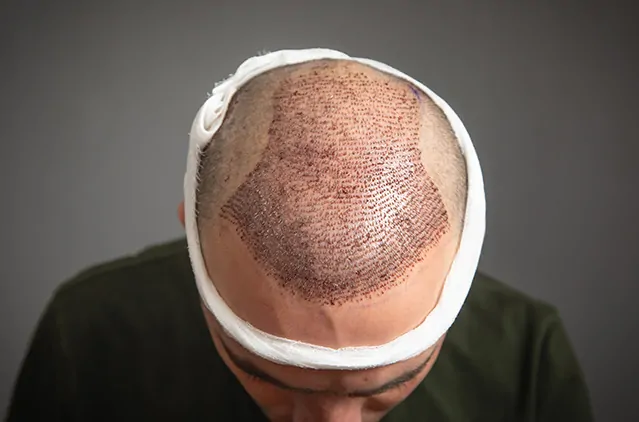
When people talk about a hair transplant, the conversation usually revolves around success stories. Before-and-after photos, dramatic transformations, confident smiles. Failure is rarely discussed openly, and when it is, it is often brushed aside as something that only happens at “bad clinics” or to “unlucky patients.”
The reality is more complex.
Yes, a hair transplant can fail. Not often, not randomly, and not without reason. When unsuccessful results happen, they are almost always the outcome of a chain of decisions made before, during, or after the procedure.
At Hairpol, this topic is addressed honestly, because understanding why failure happens is one of the most effective ways to avoid it. A hair transplant does not fail overnight, and it does not fail without warning signs.
What failure actually means in hair transplantation
The word “failure” can be misleading. It does not always mean that no hair grows at all.
In many cases, failure looks like low density, unnatural hairlines, uneven growth, visible scarring, or results that simply do not match expectations. Sometimes hair grows, but it does not blend. Sometimes it grows in the wrong direction. Sometimes it looks fine at first and disappointing later.
Understanding failure starts with defining it correctly. A hair transplant fails when the outcome does not meet medical, aesthetic, or long-term expectations.
Poor planning is the most common cause
The most frequent reason behind unsuccessful hair transplant results is poor planning.
Planning is not just about deciding how many grafts to use. It involves evaluating hair loss pattern, donor area quality, hair characteristics, future hair loss progression, age, lifestyle, and expectations.
When planning is rushed or superficial, problems appear later.
An aggressive hairline may look impressive early on, but age poorly. Overuse of grafts can weaken future options. Ignoring ongoing hair loss can lead to isolated islands of transplanted hair surrounded by thinning areas.
At Hairpol, planning is treated as the foundation. Without it, even the best technique cannot deliver lasting results.
Donor area misuse leads to irreversible problems
The donor area is a limited resource. Once grafts are extracted, they cannot be replaced.
One of the most serious forms of failure happens when the donor area is overharvested or poorly managed. This can lead to visible thinning, patchiness, or scarring at the back or sides of the scalp.
In some cases, patients end up with thin donor areas and insufficient grafts to correct the original transplant.
This type of failure is often permanent.
Responsible clinics respect donor limits and think long-term. At Hairpol, donor preservation is prioritized over short-term density goals.
Technique alone does not guarantee success
Many patients assume that choosing the “right” technique will prevent failure. Sapphire FUE, DHI, robotic systems. While technique matters, it does not replace judgment.
The same technique can produce excellent results in one case and poor results in another, depending on how it is used.
Failure occurs when techniques are applied without adaptation. Using the same approach for every patient, regardless of hair type or loss pattern, increases risk.
At Hairpol, technique follows the plan, not marketing trends.
Inexperienced teams increase graft loss
Hair transplantation is a team effort. While the surgeon plays a central role, graft survival depends heavily on how follicles are handled, stored, and implanted.
Poor graft handling can lead to dehydration, trauma, or prolonged exposure outside the body. These factors significantly reduce survival rates.
In clinics with rotating or undertrained staff, inconsistency becomes a risk factor.
Unsuccessful growth is often not visible immediately. Patients may only realize something went wrong months later when density remains weak.
Unnatural hairline design is a form of failure
Not all failures involve hair loss.
An unnatural hairline is one of the most emotionally difficult outcomes for patients. Hair that grows too straight, too dense, or too low can draw constant attention, even if growth itself is successful.
This kind of failure is aesthetic, not medical, but its impact is long-lasting.
Correcting an unnatural hairline is complex and often requires graft removal or redistribution, which further reduces donor reserves.
At Hairpol, hairline design is approached with restraint. Natural irregularity matters more than symmetry.
Unrealistic expectations create perceived failure
Sometimes the procedure succeeds medically, but the patient still feels disappointed.
This often comes from expectations that were never realistic.
A hair transplant cannot restore teenage density. It cannot stop all future hair loss. It cannot change hair texture or guarantee perfection from every angle.
When these limitations are not clearly explained, patients may interpret normal outcomes as failure.
Education before surgery is one of the strongest protections against disappointment.
Poor aftercare can compromise results
What happens after surgery matters as much as what happens during it.
Ignoring aftercare instructions, smoking excessively, scratching grafts, or returning to intense physical activity too early can all reduce graft survival.
In some cases, patients blame the procedure for weak results when the real issue occurred during recovery.
At Hairpol, aftercare is treated as an extension of the procedure, not an optional extra.
Why some transplants look good early and fail later
Another form of failure appears over time.
Early results may look promising, but years later the transplant begins to look isolated or unbalanced due to ongoing hair loss.
This does not mean the transplant stopped working. It means future loss was not adequately planned for.
Long-term failure is often a planning issue, not a technical one.
This is why Hairpol emphasizes long-term strategy rather than one-time solutions.
Can a failed hair transplant be fixed?
In many cases, yes, but not always completely.
Repair procedures can improve density, adjust hairlines, or soften unnatural results. However, repairs require available donor hair and careful planning.
Some damage, especially to the donor area, cannot be fully reversed.
This is why prevention is far more valuable than correction.
How to reduce the risk of failure
While no medical procedure is entirely risk-free, the risk of hair transplant failure can be dramatically reduced.
Key factors include choosing an experienced surgeon, prioritizing planning over promises, respecting donor limits, following aftercare instructions, and maintaining realistic expectations.
At Hairpol, success is defined not by early photos, but by how patients feel years later.
When failure is not the patient’s fault
It is important to say this clearly. Not all failures are caused by patient choices.
Some patients trust clinics that prioritize volume over care. Others are misled by guarantees or manipulated by urgency.
Blame does not fix results. Understanding does.
Patients deserve honest information before making permanent decisions.
Why honest clinics talk about failure
Clinics that never discuss failure should raise questions.
Hair transplantation involves biology, healing, and long-term change. Pretending failure does not exist is not confidence. It is avoidance.
At Hairpol, discussing risks openly is part of ethical care. Patients who understand what can go wrong are better equipped to make the right decision.
Failure is rare, but avoidable
A hair transplant can fail, but failure is not random.
It usually follows shortcuts, pressure, poor planning, or unrealistic expectations.
When the process is handled carefully, with long-term thinking and respect for biology, successful outcomes are the norm rather than the exception.
A good hair transplant does not draw attention. It does not need explanation. It simply becomes part of the person.
And when done right, failure becomes a story you read about, not one you experience.
Frequently Asked Questions (FAQ)
Can a hair transplant really fail?
Yes, a hair transplant can fail, but it is not random. Failure usually happens due to poor planning, donor area misuse, inexperienced teams, unrealistic expectations, or inadequate aftercare. When the process is handled correctly, failure is rare.
What does hair transplant failure actually mean?
Failure does not always mean that no hair grows. In many cases, it appears as low density, unnatural hairlines, uneven growth, or results that do not match expectations. Sometimes the hair grows, but it does not blend naturally.
Is poor planning the main reason hair transplants fail?
Yes. Poor planning is the most common cause of unsuccessful results. Proper planning includes evaluating hair loss pattern, donor area quality, future hair loss progression, and long-term expectations, not just graft numbers.
Can the donor area be permanently damaged?
Yes. The donor area is a limited resource. Overharvesting or poor extraction techniques can cause visible thinning or scarring, and in some cases, this damage cannot be fully reversed.
Does choosing the right technique prevent failure?
No. While techniques like Sapphire FUE or DHI matter, they do not guarantee success on their own. The surgeon’s experience, planning, and adaptation to the patient’s hair characteristics are far more important.
Can unrealistic expectations make a transplant feel like a failure?
Yes. A hair transplant cannot restore teenage density, stop all future hair loss, or guarantee perfection from every angle. When these limitations are not understood, patients may perceive normal outcomes as failure.
Can a failed hair transplant be corrected?
In many cases, partial correction is possible through repair procedures. However, repair depends on remaining donor hair, and some damage, especially to the donor area, may be permanent.
How can the risk of hair transplant failure be reduced?
The risk can be significantly reduced by choosing an experienced surgeon, prioritizing long-term planning, respecting donor limits, following aftercare instructions carefully, and maintaining realistic expectations from the start.
