
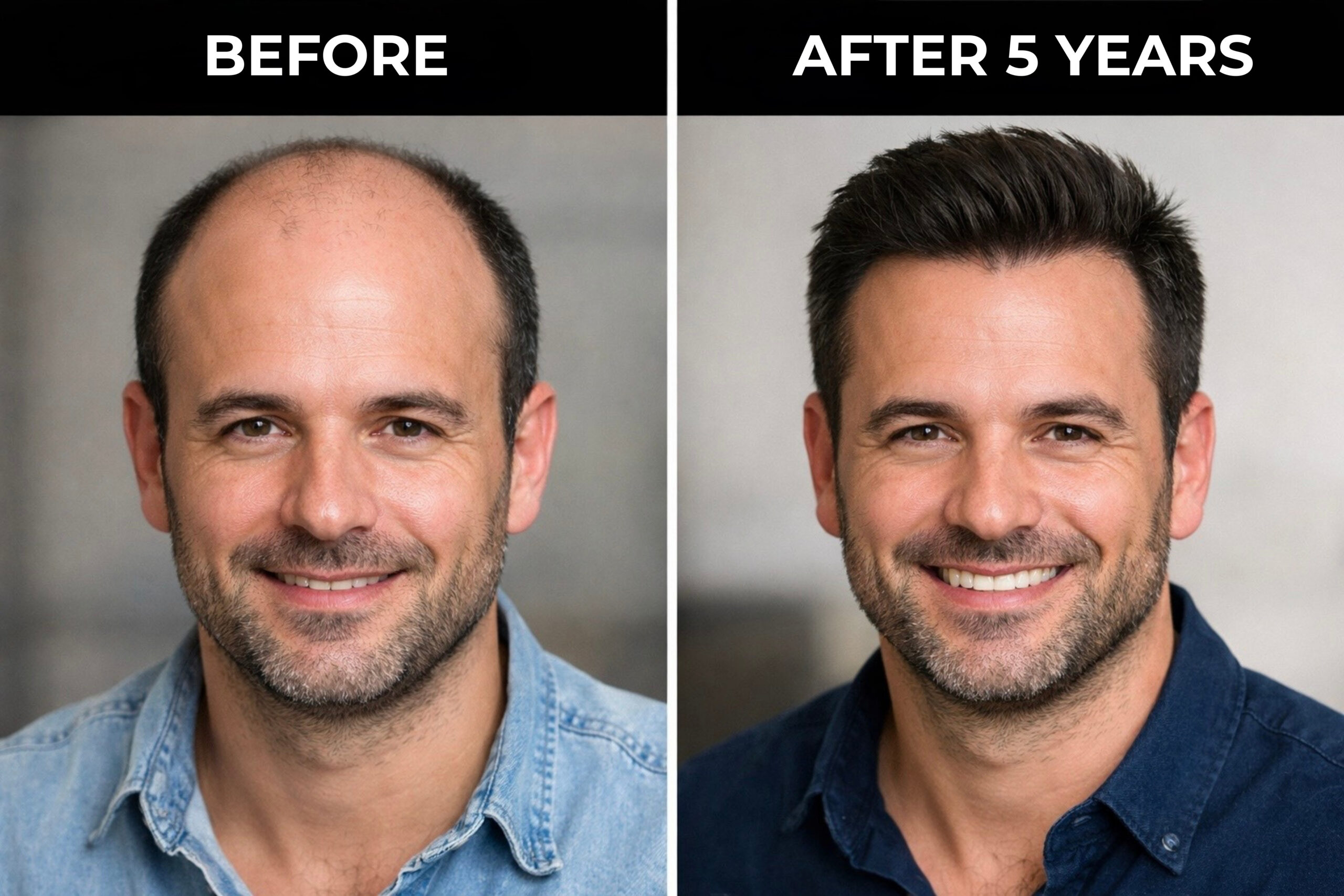
When people consider a hair transplant, most of the attention goes to short-term results. Before and after photos at six months. Transformation videos at one year. Social media posts showing dramatic change in a short time.
But hair transplantation is not a short-term decision.
The real question many patients ask later is much quieter and far more important. What happens five years after a hair transplant? Does the hair still look natural? Does it thin again? Does it age well, or does it start to look artificial?
At Hairpol, this question comes up often, especially from patients who are thinking long-term rather than chasing quick results. Understanding what truly lasts and what naturally changes over time helps set realistic expectations and prevents disappointment years down the line.
This is not a promise-filled story. It is an honest look at hair transplant results after 5 years, based on biology, planning, and how hair behaves as people age.
The transplanted hair itself is permanent
The most important fact to understand is this. Hair that is transplanted correctly is permanent.
Hair follicles used in a hair transplant are taken from the donor area, usually the back or sides of the scalp. These follicles are genetically resistant to hair loss. Once they are implanted and successfully grow, they retain this resistance.
Five years later, transplanted hair does not suddenly fall out just because time has passed. If grafts were placed properly and survived the initial healing phase, they remain active for life.
This is why people often say hair transplants are permanent. The statement is true, but incomplete.
What changes is not the transplanted hair, but the rest of the hair
While transplanted hair remains stable, the surrounding native hair may continue to thin.
This is where many misunderstandings begin.
A hair transplant does not stop natural hair loss. It restores hair where follicles were no longer producing healthy strands, but it does not protect existing hair from genetic or hormonal influence.
Five years after surgery, some patients notice thinning behind the transplanted area or in the crown. This does not mean the transplant failed. It means hair loss followed its natural course.
At Hairpol, this reality is discussed from the beginning, because long-term satisfaction depends on understanding this distinction.
A well-planned transplant ages naturally
One of the biggest fears patients have is that their hair will look unnatural as they get older.
This fear is justified when planning is aggressive or unrealistic.
A hairline designed too low or too dense for a young patient may look impressive early on. Five years later, as the face matures and surrounding hair changes, it can look out of place.
A conservative, age-appropriate hairline usually ages much better. After five years, it blends naturally with facial features and changing hair patterns.
At Hairpol, long-term aging is considered during hairline design. The goal is not to freeze time, but to move with it.
Density perception changes over time
Another aspect that evolves is how density is perceived.
In the first year after a hair transplant, patients often focus on thickness. Every new hair feels significant. Styling feels exciting again.
Over time, hair becomes part of daily life. Expectations normalize.
Five years later, density may feel slightly different than at year one, not because hair is lost, but because hair length, styling habits, and surrounding hair change. This is normal.
Importantly, transplanted hair does not suddenly thin at year five. What changes is how it interacts visually with the rest of the scalp.
Texture and hair behavior remain stable
Transplanted hair keeps the characteristics it had in the donor area. Texture, curl pattern, and thickness remain the same over time.
This means that after five years, transplanted hair behaves like your natural hair always did. It grows, needs cutting, reacts to humidity, and ages gradually.
There is no sudden texture shift or structural weakening caused by the transplant itself.
Patients who experience unexpected texture changes years later are usually seeing changes in non-transplanted hair, not the grafts.
Styling becomes less conscious over time
In the early years after a hair transplant, people are highly aware of their hair. They check mirrors often. They compare photos. They worry about angles and lighting.
Five years later, most patients no longer think about it much at all.
This is often the clearest sign of success. Hair becomes something you live with, not something you manage constantly.
At Hairpol, patients who return years later often say they forgot how much hair loss once occupied their thoughts.
The role of ongoing hair loss management
Some patients choose to support long-term results with non-surgical treatments such as medication or PRP.
These treatments do not affect transplanted hair, but they can help protect remaining native hair.
Five years after a hair transplant, patients who followed a long-term plan often maintain a more balanced overall appearance, even if hair loss continued elsewhere.
This does not mean additional treatments are mandatory. It means they are options, depending on individual goals.
Secondary procedures are sometimes part of long-term planning
Another reality to understand is that some patients may choose a second procedure years later.
This is not a failure. It is often a planned step.
Hair loss patterns evolve. Areas that were not a priority initially may become more noticeable later. With proper donor management, additional grafts can be used strategically.
At Hairpol, this possibility is discussed openly so patients do not feel surprised or discouraged if they consider future reinforcement.
What does not change after five years
Several things remain consistent when a transplant is done correctly.
The transplanted hair remains. The hairline shape stays the same. The direction and angle of growth do not change. Scarring remains minimal and usually invisible.
Most importantly, the result continues to look like hair that belongs to that person.
There is no moment where a successful transplant suddenly reveals itself as artificial years later.
Why some people feel disappointed after years
When disappointment happens years after a hair transplant, it is usually not because the procedure stopped working.
It is often due to unrealistic expectations set at the beginning.
Patients who expected hair loss to stop completely may feel frustrated when native hair thins. Those who expected teenage density forever may feel results are weaker than anticipated.
Education prevents this. When expectations match biology, satisfaction lasts much longer.
The importance of choosing a clinic that thinks long-term
Hair transplantation is easy to sell short-term. It is much harder to plan long-term.
A clinic focused only on early results may push high graft counts, aggressive hairlines, or dramatic density.
A clinic focused on five-year outcomes plans differently.
At Hairpol, success is measured by how results look years later, not just months later. This mindset influences every decision, from hairline placement to graft distribution.
Five years later, hair becomes part of identity again
Perhaps the most meaningful change after five years is psychological.
Hair stops being a problem to solve. It becomes background again.
Patients often say they no longer think about hair loss, photos, or comparisons. They simply live.
That quiet return to normality is something no before-and-after photo can capture.
What truly lasts after five years
The hair lasts. The confidence often lasts. The relief lasts.
What changes is how much attention you give it.
A successful hair transplant does not freeze time. It integrates naturally into it.
And when planning respects biology, aging, and individuality, the result five years later does not feel like something that was added.
It feels like something that stayed.
Frequently Asked Questions (FAQ)
Does transplanted hair fall out after 5 years?
No. Transplanted hair is permanent because it is taken from genetically resistant donor areas. If the grafts survive the first healing phase, they continue growing even after 5 years and beyond.
Why does hair look thinner years after a hair transplant?
In most cases, thinning occurs in non-transplanted native hair. A hair transplant restores lost hair but does not stop natural hair loss from continuing in surrounding areas.
Will my hair transplant still look natural as I age?
Yes, if the transplant was planned conservatively and age-appropriately. Hairlines and density designed with long-term aging in mind tend to blend naturally even 5 years later.
Does transplanted hair change texture over time?
No. Transplanted hair keeps the same texture, thickness, and growth pattern it had in the donor area. Any texture changes usually come from non-transplanted hair.
Is a second hair transplant necessary after 5 years?
Not always. Some patients choose a second procedure if hair loss progresses in new areas, but this is usually part of long-term planning rather than a sign of failure.
Can a hair transplant fail years later?
A properly performed hair transplant does not fail years later. Disappointment usually comes from unrealistic expectations, not from transplanted hair stopping its growth.
Do I need medication after a hair transplant to maintain results?
Medication is not required for transplanted hair, but it can help preserve existing native hair. This decision depends on individual hair loss patterns and goals.
What is the biggest difference between year 1 and year 5 results?
At year one, patients focus on density and appearance. By year five, hair becomes a natural part of daily life, and most patients no longer think about hair loss at all.
