
Anyone researching hair transplantation eventually reaches the same crossroads. Two techniques appear again and again, often presented as opposites, competitors, or even rivals. Sapphire FUE and DHI.
One is described as advanced and precise, the other as direct and controlled. Clinics promote one or the other with confidence, patients compare photos, forums argue endlessly, and yet the question remains surprisingly difficult to answer.
Which technique actually gives more natural density?
The honest answer is not as simple as most people expect. Natural density is not something a technique delivers on its own. It is the result of planning, restraint, experience, and understanding how hair behaves once it grows, not just how it looks on the day of the procedure.
At Hairpol, this question is addressed almost daily, and the conversation rarely starts with the technique itself.
It usually starts with expectations.
Density is not just about numbers
When patients talk about density, they often imagine numbers. Grafts per square centimeter, total graft count, coverage percentages. While these figures matter, they are not what the human eye responds to first.
Natural density is visual. It is about how light passes through hair, how strands overlap, how the hairline blends into the scalp, and how the hair moves when styled or touched.
Two patients can receive the same number of grafts and end up with very different results depending on how those grafts were placed.
This is where the difference between Sapphire FUE and DHI begins to matter, but not in the way most people think.
Understanding Sapphire FUE beyond the name
Sapphire FUE is often described as an upgraded version of traditional FUE. The main difference lies in the blades used to open channels in the scalp.
Instead of steel, sapphire blades are used, allowing for finer, cleaner incisions.
What this really means in practice is control.
With Sapphire FUE, channels are created before implantation, and their angle, depth, and direction are carefully planned in advance.
This step defines how the hair will eventually grow.
Once these channels are created, grafts are placed into them one by one.
This separation between channel opening and implantation gives the surgical team time to focus on design.
Hair direction can be adjusted gradually. Density can be distributed evenly rather than concentrated aggressively.
For many patients, especially those seeking soft transitions and natural coverage, this matters more than raw graft numbers.
At Hairpol, Sapphire FUE is often chosen for patients who want balanced density across larger areas, where the goal is not dramatic thickness in one spot, but a consistent, natural look from different angles.
What DHI actually changes in the process
DHI, or Direct Hair Implantation, approaches the same goal from a different direction.
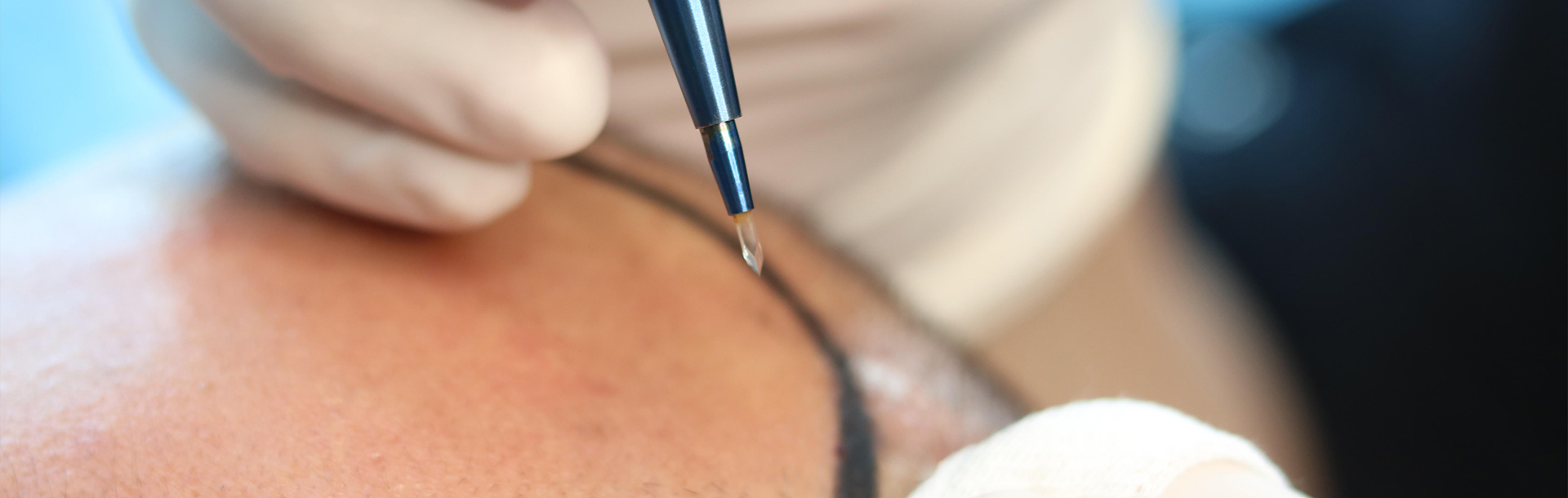
Instead of opening channels first, grafts are implanted directly using a specialized pen.
The channel is created and filled in a single motion.
This gives the surgeon immediate control over angle and direction at the moment of implantation.
It is a highly precise method, especially useful in areas where existing hair is present and needs to be preserved.
Because there is no need to shave large areas or open channels in advance, DHI is often associated with minimal disruption to surrounding hair.
However, this precision comes with responsibility.
When density is pushed too far too quickly with DHI, the result can appear crowded or unnatural.
The technique allows for high-density placement, but high density does not automatically translate into natural density.
At Hairpol, DHI is often used in smaller or more delicate areas where control matters more than speed or coverage, such as the frontal hairline or areas requiring subtle reinforcement.
Why density feels different after growth
One of the most overlooked aspects of this comparison is time.
Density on the day of surgery means very little.
The scalp is swollen, hair is short, and the visual effect is misleading.
Real density reveals itself months later, when hair grows, thickens, and begins to behave naturally.
This is where technique selection shows its long-term impact.
With Sapphire FUE, the pre-planned channel structure often allows hair to emerge in a more uniform pattern.
The result may not look extremely dense early on, but it matures gradually and blends well with existing hair.
With DHI, early results can appear impressive due to tight placement.
Over time, however, the final appearance depends heavily on how conservatively the implantation was done.
When restraint is applied, results can be exceptionally natural.
When it is not, density can look forced.
This is why at Hairpol, neither technique is marketed as “better” for density.
The question is always how density will look a year later, not a week later.
Hair characteristics matter more than the technique
Another factor that often gets ignored in online comparisons is hair type.
Thick, coarse hair creates the illusion of density more easily than fine hair.
Wavy hair covers the scalp differently than straight hair.
Dark hair on light skin behaves differently than light hair on light skin.
A patient with thick donor hair may achieve excellent visual density with fewer grafts, regardless of technique.
Another patient with fine hair may need careful distribution and conservative planning to avoid disappointment.
Sapphire FUE and DHI respond differently to these variables.
At Hairpol, technique selection is influenced heavily by hair thickness, curl pattern, and donor quality, not just by the area being transplanted.
The role of the hairline in perceived density
Density is often judged at the hairline, even though most grafts are placed behind it.
A hairline that is too dense, too straight, or too sharp draws attention immediately.
A softer hairline, even with fewer grafts, can make the entire result look fuller.
Sapphire FUE allows for gradual transitions at the hairline by varying channel angles and spacing.
DHI allows for extremely fine control when placing single-hair grafts at the very front.
Both can produce natural density, but only when the hairline is treated as a visual boundary rather than a density target.
At Hairpol, the hairline is always designed first, before deciding which technique will serve it best.
Why over-comparison often leads patients astray
Many patients arrive convinced that one technique must be superior.
They have read testimonials, seen marketing claims, and watched videos promising maximum density.
What they often underestimate is the role of judgment.
A skilled team using either technique can achieve natural density.
An inexperienced team using the most advanced tools cannot.
This is why at Hairpol, discussions around Sapphire FUE vs DHI are framed differently.
Instead of asking which technique is better, patients are encouraged to ask which approach suits their hair, their expectations, and their long-term goals.
Density that looks natural is density that belongs on that head.
It respects proportions, age, facial structure, and lifestyle.
No technique can guarantee that on its own.
Where the decision usually settles
In practice, many procedures combine elements of both techniques.
A hairline reinforced with DHI may transition into areas covered with Sapphire FUE.
Density can be layered rather than concentrated.
The scalp is not a flat surface, and one method rarely serves every area equally well.
This flexible approach is one of the reasons Hairpol avoids rigid technique labels.
The focus remains on outcome rather than method.
Patients who return a year later rarely ask which technique was used.
They talk about how their hair feels, how easy it is to style, how natural it looks in photos, and how little they think about hair loss now.
That is the real measure of natural density.
So which technique gives more natural density?
The most honest answer is this.
Natural density comes from understanding when not to push density too far.
Sapphire FUE offers structure, balance, and consistency.
DHI offers precision, control, and subtlety.
Both can produce excellent results.
Both can fail when misused.
At Hairpol, the technique follows the plan, not the other way around.
Density is designed, not promised.
And when density is done right, it does not announce itself.
It simply looks like hair that was always meant to be there.
